Get in touch with Yun-Sculpture company
Venus de Milo: History, Meaning & Why It Still Captivates the World

She has no arms. She has no name attached to a known sculptor. She was discovered in pieces, buried in a wall on a small Greek island, and arrived in Paris already broken. Two centuries later, she stands in the Louvre drawing more visitors than almost any other object in the building — and her image appears on everything from perfume bottles to subway advertisements across the world.
The Venus de Milo is not famous because she is pretty. She is famous because she is unresolved — a figure caught mid-turn, mid-thought, mid-gesture, permanently incomplete and permanently compelling. Understanding why requires looking at what Hellenistic sculpture was actually trying to do, and why this particular figure did it better than almost anything else that survived.
Table of Contents
Table of Contents
Who Sculpted the Venus de Milo?
The sculptor is unknown. The base that accompanied the statue when it was discovered bore an inscription — Alexandros of Antioch — but the French officials who acquired the piece removed and subsequently lost that base before the statue was formally presented to the king. The attribution disappeared with it.
What remains is the object itself. Stylistic analysis places the carving somewhere between 150 and 100 BC, in the late Hellenistic period. The technique — the handling of the drapery, the resolution of the torso’s planes, the particular quality of the surface finish — suggests a sculptor of considerable accomplishment working within the tradition of Praxiteles, the fourth-century master whose treatment of the female nude established the standard that Hellenistic carvers spent two centuries refining.
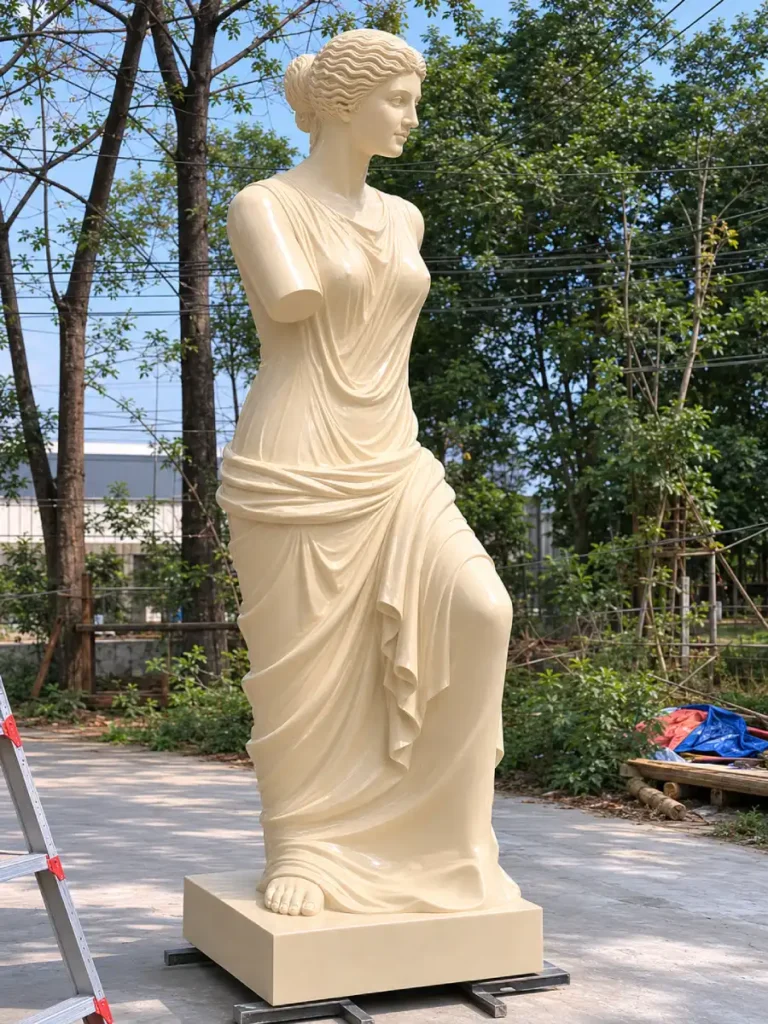
The marble is Parian — from the island of Paros in the Cyclades, the finest-grained white marble available in the ancient world and the preferred material of the greatest Greek sculptors. The figure was carved in two separate blocks joined at the hips, a construction technique common in Cycladic workshops of the period. The join is nearly invisible on the finished piece.
The Discovery: A Farmer, a Wall, and a French Ambassador
In April 1820, a Greek farmer named Yorgos Kentrotas was working on his land near an ancient ruined theater on the island of Melos — Milos in modern Greek — when he found marble fragments buried in a niche in an ancient wall. He uncovered the torso and the lower section, along with fragments of arms, a hand holding an apple, a plinth with the partially surviving inscription, and several Hermes figures.
Word reached the French ambassador’s secretary, who arranged the purchase and transport of the major fragments to France. The statue was presented to Louis XVIII in 1821 and donated to the Louvre, where it has remained ever since — removed briefly during the Second World War for safekeeping, then returned to Salle 346 in the Denon Wing, where it stands today.
The arm fragments and the inscribed base did not make the journey intact. They were lost in the transfer — and with them, any certainty about what the hands once held and who made the figure.
What Does the Venus de Milo Represent?
The figure is almost certainly Aphrodite — the Greek goddess of love and beauty, known as Venus in Roman tradition. The identification rests on several details: the partial nudity, consistent with Aphrodite’s established iconography since Praxiteles’ Aphrodite of Knidos in the fourth century BC; the physical idealization of the body; and the context of the discovery on Melos, where Aphrodite was actively venerated.
What she held in the missing hands has never been established. The apple fragment found with her suggests the Judgment of Paris — the mythological moment when Paris of Troy awarded Aphrodite the golden apple, triggering the chain of events that led to the Trojan War. Other reconstructions propose a mirror, a shield reflecting Ares, or simply drapery. None has been accepted as definitive, and the question remains formally open.
As a symbol, the Venus de Milo has accumulated meaning far beyond her original religious function. By the nineteenth century she had become the Western ideal of feminine beauty — the standard against which all other representations were measured. In the twentieth century she became something more complicated: an image of beauty defined by what is missing, a figure whose power depends partly on incompleteness. Artists from Salvador Dalí to Yayoi Kusama have engaged with her precisely because the missing arms make her permanently open to interpretation.
She represents, in the end, what the best figurative sculpture always represents: a body that means more than a body.
Why Is the Venus de Milo So Famous?
Three things produced her fame, and they are not the things most people assume.
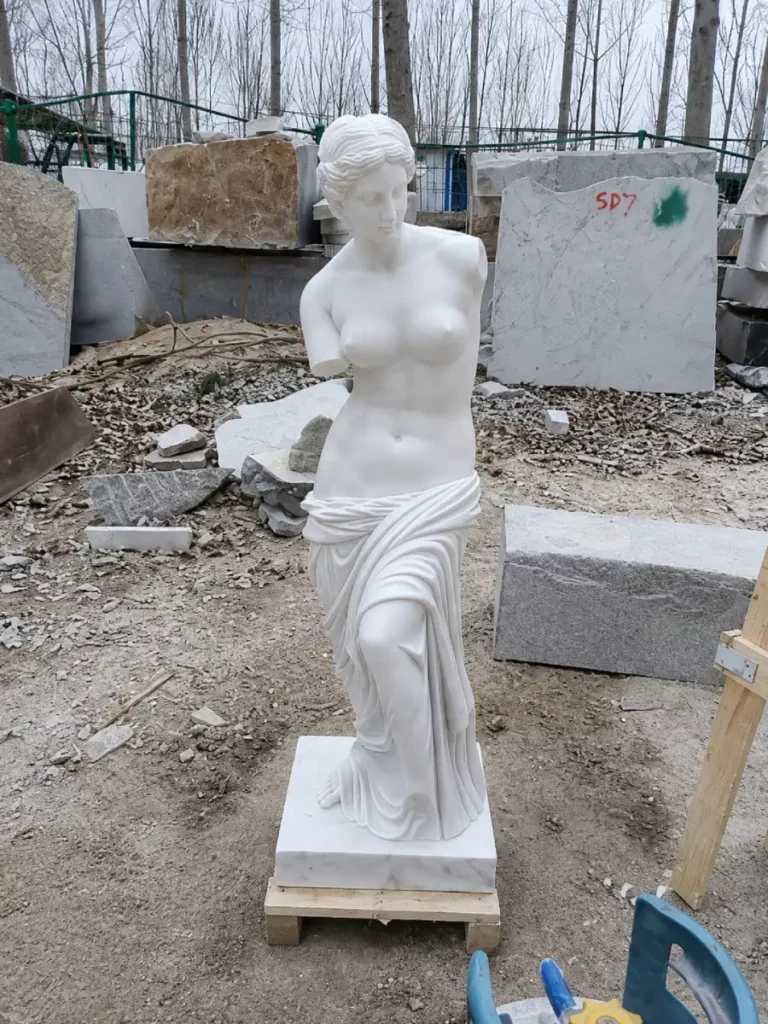
The quality of the carving. The Venus de Milo is a technically extraordinary object. The spiral of the composition — hips facing one direction, torso turning, shoulders turning further, head turning further still — is the central achievement of Hellenistic sculpture: a figure that inhabits three-dimensional space rather than presenting a single frontal view. Walk around her and she is always becoming a different statue. That quality is rare in surviving ancient sculpture and immediately apparent to anyone who encounters the original.
The timing of her arrival. She reached Paris in 1821, at the precise moment when European culture was most intensely focused on the classical ideal as the standard of beauty and civilization. The Elgin Marbles had arrived in London just years earlier. The appetite for recovered antiquity was at its height. A figure of this quality, this scale, and this degree of preservation arriving in the French capital at that moment was guaranteed cultural prominence.
The missing arms. This is the thing that makes her unforgettable rather than merely admired. The open composition created by the absent arms — the sense of a gesture forever unresolved, a narrative forever incomplete — engages the viewer’s imagination in a way that a fully intact figure does not. She is famous not despite the damage but partly because of it. The question of what the hands held is one of the most persistently asked questions in art history, and it has kept her in active cultural conversation for two centuries.
Where Is the Venus de Milo Today?
The original has been in the Louvre in Paris continuously since 1821, displayed in Salle 346 in the Denon Wing on the ground floor. It is not on loan and has never been exhibited elsewhere. The Louvre is the only place in the world where the original can be seen.
She shares the Denon Wing with two other objects that anchor the Louvre’s collection: the Winged Victory of Samothrace and Leonardo da Vinci’s Mona Lisa. Together these three are sometimes called the Big Three of the Louvre — the pieces that draw the largest concentrations of visitors and that most people, consciously or not, come to Paris partly to see.
The Venus de Milo and the Collector
For collectors and institutions, the Venus de Milo presents a specific challenge: the figure is so thoroughly absorbed into visual culture that a replica risks reading as decoration rather than as sculpture. The way to avoid this is scale and material.
At or near life-size — the original stands 2.02 meters — the spiral composition fully resolves. The twist from hip to shoulder to head covers enough vertical distance to read as movement rather than as a slight lean. The drapery has room to fall. A life-size marble statue of this figure, hand-carved in natural stone, operates differently from any reduced or molded version — not as a souvenir of the original but as an object that does what the original does, in the same material, at the same scale.
For everything you need to know about acquiring a replica — material grades, scale decisions, indoor versus garden placement, and pricing — see our complete Venus de Milo replica guide.
Frequently Asked Questions
What does the Venus de Milo statue represent?
The Venus de Milo almost certainly represents Aphrodite, the Greek goddess of love and beauty. Her partial nudity, physical idealization, and the context of her discovery on Melos — where Aphrodite was venerated — all support this identification. As a cultural symbol she has come to represent the Western classical ideal of feminine beauty, and more broadly a figure whose power is inseparable from what is missing: the absent arms keep her composition open and her meaning permanently unresolved.Why does the Venus de Milo have no arms?
The arms were already missing when the statue was discovered in 1820 on the island of Melos — they were not worn away gradually. Arm fragments found at the site were lost during transport to France. What the hands originally held has never been established: scholarly proposals include an apple (suggesting the Judgment of Paris), a mirror, a shield, or drapery. No reconstruction has been accepted as definitive. Most replicas omit the arms entirely, which preserves the open, unresolved quality of the composition.Why is the Venus de Milo so famous?
Three factors produced her fame: the exceptional quality of the carving, which achieves the Hellenistic goal of a figure fully alive in three-dimensional space; the timing of her arrival in Paris in 1821, when European appetite for classical antiquity was at its height; and the missing arms, which create an open composition and an unresolvable question that has kept her in active cultural conversation for two centuries. She is memorable not despite the damage but partly because of it.Where is the original Venus de Milo located today?
The original Venus de Milo is in the Louvre in Paris, displayed in Salle 346 in the Denon Wing on the ground floor. It has been there continuously since 1821 and is not on loan. The Louvre is the only place in the world where the original can be seen.Who sculpted the Venus de Milo?
The sculptor is unknown. A base found with the statue bore an inscription attributing the work to Alexandros of Antioch, but that base was lost before the statue was formally presented to the French king. Stylistic analysis places the carving between 150 and 100 BC, in the late Hellenistic period, by a sculptor working within the tradition of Praxiteles.What is the most famous Venus sculpture?
The Venus de Milo is the most famous Venus sculpture in the world, followed by the Venus of Willendorf (a prehistoric figurine approximately 30,000 years old), Botticelli’s Birth of Venus (a painting rather than a sculpture), and the Capitoline Venus (a Roman marble in Rome’s Capitoline Museums). Among three-dimensional works, the Venus de Milo has no serious rival in terms of global recognition.What are some replicas of the Venus de Milo?
Venus de Milo replicas range from small resin figurines costing under $50 to hand-carved natural marble commissions at life-size and above. The material difference is significant: natural marble — the same material as the original — transmits light in a way that resin, bonded marble, and composite stone cannot replicate. For a replica intended for permanent display, hand-carved natural marble in the 80cm to 300cm range is the appropriate choice. Production typically runs 30 to 60 days depending on scale.What are some interesting facts about the Venus de Milo?
The Venus de Milo was carved from two separate blocks of Parian marble joined at the hips. She stands 2.02 meters tall. She was discovered in 1820 by a Greek farmer named Yorgos Kentrotas. The sculptor’s identity was lost when the inscribed base was misplaced during transport to France. She was removed from the Louvre during World War II for safekeeping. The question of what her hands originally held — apple, mirror, shield, or drapery — has never been resolved.Commission a Venus de Milo in Natural Marble
Hand-carved from quarried white marble, 80 cm to 300 cm. The same material as the original, resolved at every scale. Indoor and garden specifications available — factory direct from Quyang.