Get in touch with Yun-Sculpture company
Greek Mythology Statues: The 12 Olympians — A Buyer’s Guide to Gods in Bronze & Marble

From the thunder of Zeus to the wisdom of Athena — a guide to the mythology, iconography, and sculptural tradition behind the 12 Olympian gods, with practical guidance for collectors and buyers.
Table of Contents
Table of Contents
The Olympians: Who They Are and Why They Still Matter
The twelve Olympians are the principal deities of ancient Greek religion — the gods who ruled from Mount Olympus over every domain of human and natural life, from the movement of the sea to the outcome of war to the growth of grain. They are not simply mythological characters. For nearly a millennium, they were the active religious framework of one of history’s most consequential civilizations, and the statues built to honor them were among the most technically ambitious objects their culture produced.
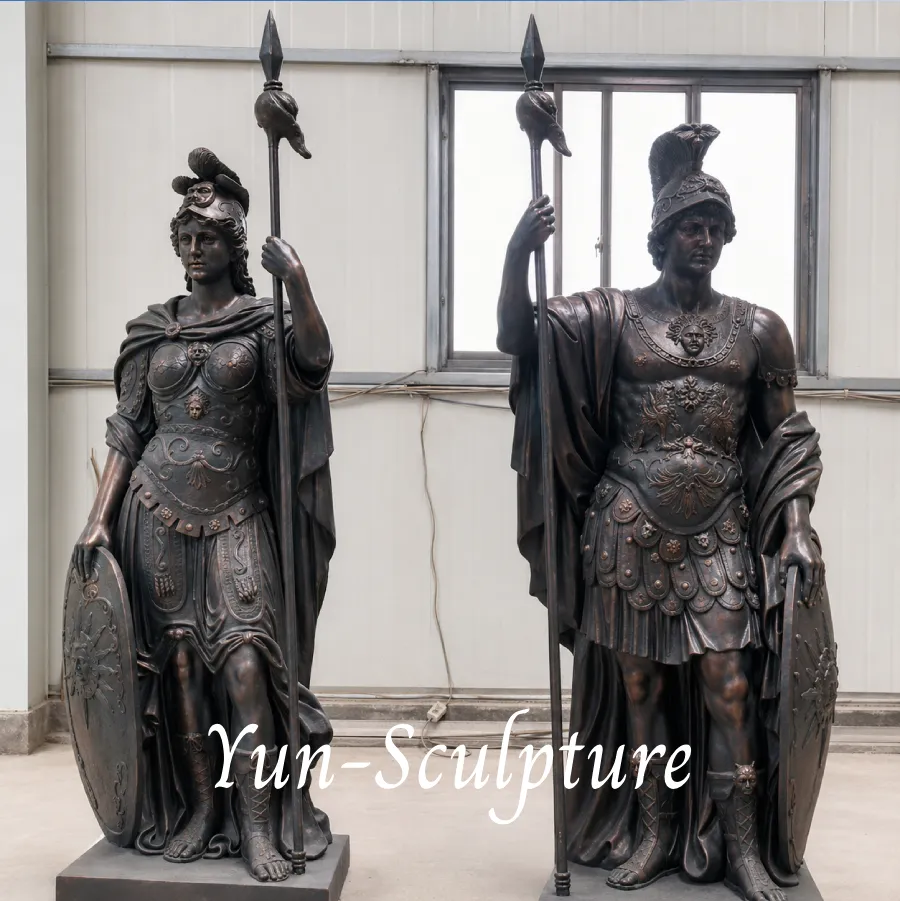
The Parthenon’s forty-foot ivory and gold statue of Athena, the chryselephantine Zeus at Olympia counted among the Seven Wonders of the Ancient World, the bronze Poseidon of Artemision recovered from the sea — these were not decorative objects. They were the physical presence of the divine in the world, objects before which people prayed, made offerings, and organized their civic and personal lives.
What brings the Olympians forward into the present is not nostalgia but visual power. The iconographic language developed over centuries of Greek sculpture — Zeus with his thunderbolt, Athena with her owl and aegis, Poseidon with his trident — is immediately legible across cultures and millennia. A bronze Zeus in a corporate lobby or a marble Athena in a university library carries layered meaning that no contemporary abstract form can replicate. This is why Greek mythology statues remain among the most consistently requested commissions in the Western market, two and a half thousand years after the Parthenon was built.
The question for a contemporary buyer is not whether to engage this tradition but how — which god, which material, which scale, which placement. The sections below address each of the twelve Olympians and then provide practical guidance for making these decisions well.
The Ruling Triad: Zeus, Poseidon, and Hera
Zeus — King of the Gods, Lord of Thunder
Zeus is the eldest son of the Titans Cronus and Rhea, the god who overthrew his father’s order, divided the cosmos among his brothers, and established the authority of the Olympians over gods and mortals alike. His domain is the sky, lightning, and thunder — but his deeper function in Greek religion is the personification of cosmic law, justice, and the binding force that holds the ordered world together.
In sculpture, Zeus is almost always depicted as a mature, bearded figure of commanding physical presence — the most authoritative body in the pantheon made visible. His primary attributes are the thunderbolt (wielded as weapon and symbol of divine power), the eagle (his sacred animal), and the scepter (marking his kingship). The Zeus of Olympia, lost but reconstructed from ancient descriptions and coin images, showed the god enthroned, on a scale so large that ancient visitors reported it would have broken through the temple roof had it stood.
A Zeus statue in bronze or marble brings the full weight of that authority into any space. For institutional settings — entrance halls, boardrooms, civic buildings — Zeus carries an unambiguous message about power, order, and permanence.
Poseidon — God of the Sea, Earthquakes, and Horses
Poseidon received dominion over the sea when the cosmos was divided among the three brothers after the defeat of the Titans. He is the most temperamental of the ruling triad — his anger produces storms and earthquakes, his favor grants safe passage and abundance from the sea. Coastal cities, sailors, and fishermen held him in particular reverence; his worship was inseparable from the rhythms of maritime life.
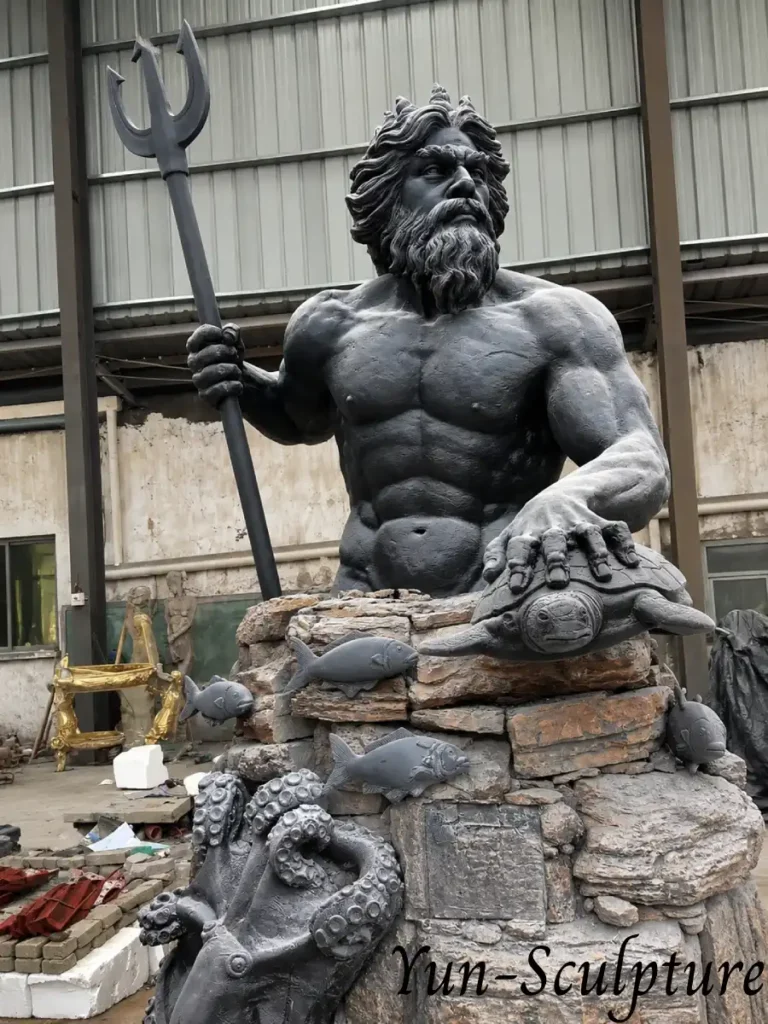
In sculpture, Poseidon is physically almost indistinguishable from Zeus — the same mature, powerful male body, the same commanding stance — differentiated primarily by his attribute: the trident, the three-pronged spear that simultaneously commands the sea, causes earthquakes by striking the earth, and creates springs of water. The famous bronze Poseidon statue recovered from the sea near Cape Artemision (c. 460 BCE) shows the god with both arms extended, right arm poised to hurl the trident, in a moment of divine authority captured at its apex.
For garden installations near water features, pool surroundings, or coastal properties, a Poseidon statue carries immediate environmental logic. For interior spaces, his drama and physical force work well in large volumes.
Hera — Queen of the Gods, Protector of Marriage
Hera is the wife and sister of Zeus — a relationship that ancient Greeks understood as the necessary counterpart to his authority rather than as the troubling pairing it appears to modern eyes. She is the goddess of marriage, women, childbirth, and the ordering of domestic and civic life. Where Zeus represents cosmic law, Hera represents the social institutions — above all, marriage — through which that law is enacted in human experience.
In sculpture, Hera is depicted as a mature, regal woman of formal dignity — always clothed, never the partially draped or nude figure common in depictions of Aphrodite or Artemis. Her attributes include the peacock (whose iridescent tail feathers represent the eyes of Argus, her servant), the pomegranate (symbolizing fertility and the cycle of life), and the diadem or crown marking her queenship. For formal residential interiors, reception halls, and domestic spaces where the theme of household order and female authority is appropriate, a Hera statue carries meaning that more commonly commissioned goddesses do not.
The War and Wisdom Gods: Athena, Ares, and Hercules
Athena — Goddess of Wisdom, War Strategy, and Craft
Athena is among the most complex figures in the Greek pantheon — and the most consistently beloved in Western cultural memory. She is the goddess of strategic intelligence in war (as opposed to Ares’s brute force), of craft and technical skill, of wisdom in civic and personal life. She was the patron deity of Athens, the city that named itself after her and built the Parthenon in her honor.
Her birth is among the most vivid in Greek mythology: she emerges fully formed and armored from the head of Zeus, born from pure divine intelligence rather than from a mother’s body. This origin reinforces her primary characteristic — she is the embodiment of mind over instinct, strategy over impulse, ordered thought over chaos.
In sculpture, Athena is identified by her helmet (almost always present, whether worn or held), her aegis (a breastplate or cloak bearing the Gorgon’s head), her owl (the animal of wisdom and night vision), and her spear. She is depicted as a figure of controlled power — athletic but not aggressive, authoritative but not domineering. Our dedicated Athena statue guide covers her iconographic variations in detail.
For libraries, universities, law firms, and spaces where intellectual authority and strategic capability are the intended resonances, Athena is the single most appropriate choice in the Greek pantheon.
Ares — God of War, Courage, and Conflict
Ares is the god of war in its rawest form — not the strategic, disciplined warfare of Athena but the violence, chaos, and physical courage of battle itself. He is one of the least loved gods in the Olympian pantheon; even Zeus, his father, expresses contempt for him in the Iliad. Yet he was widely worshipped, particularly by soldiers, warriors, and the cities that depended on military strength for survival.
In sculpture, Ares appears as a young, powerfully built male figure in full military equipment — helmet, breastplate, greaves, and shield. Unlike Athena, who is frequently depicted in repose or in a pose of calm authority, Ares is often shown in dynamic, aggressive postures that emphasize physical force and martial readiness. For collectors drawn to dramatic sculptural energy rather than classical restraint, an Ares figure in bronze is among the most visually commanding choices in the pantheon.
Hercules — Hero and Demigod, Symbol of Strength and Perseverance
Hercules (Heracles in Greek) occupies a unique position in the mythological tradition — he is not one of the twelve Olympians by birth but is elevated to divine status after death as a reward for his labors and suffering. As the son of Zeus and the mortal Alcmene, he embodies the possibility of human transcendence through extraordinary effort — which is why his image has proven so durable across every subsequent period of Western culture.
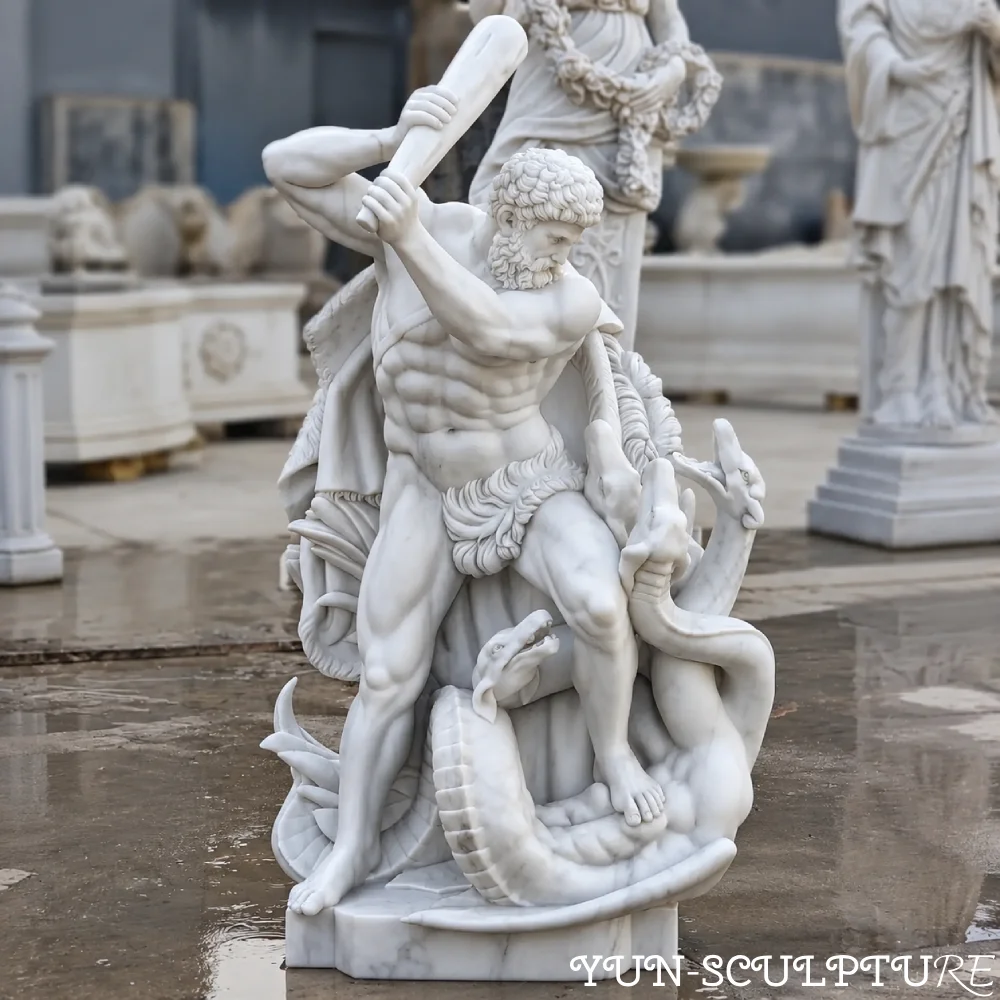
His iconographic signature is immediately recognizable: the lion skin (from the Nemean Lion, the first of his twelve labors) worn over his shoulders, and the club (his primary weapon). He is always depicted as a figure of overwhelming physical power — the most muscular body in the sculptural tradition, developed to a degree that strains credibility while remaining unmistakably human. A Hercules statue reads universally as a symbol of strength, perseverance through adversity, and the ultimate triumph of human capability.
The Arts and Nature Gods: Apollo, Artemis, and Aphrodite
Apollo — God of Light, Music, Prophecy, and Healing
Apollo is the most multifaceted deity in the Greek pantheon — god simultaneously of the sun, light, music, poetry, prophecy, truth, healing, and plague. He is the embodiment of the Greek ideal of ordered beauty: rationality, harmony, and the disciplined pursuit of excellence in every domain he governs. His oracle at Delphi was the most authoritative voice in the ancient Mediterranean world for nearly a thousand years.
In sculpture, Apollo is the prototype of the kouros — the idealized young male figure whose perfection of proportion and physical beauty serves as a visual argument that divinity and the human form are not as different as we might think. His attributes include the lyre (music), the laurel wreath (victory and poetic achievement), the bow and arrows (which he shares with his twin sister Artemis, though his arrows bring healing or plague rather than prey), and the sun disk. Our Apollo statue guide examines his key iconographic forms across the three periods of Greek sculpture.
For music rooms, studios, creative workspaces, and spaces where intellectual achievement and cultural refinement are the intended atmosphere, Apollo is the most appropriate deity in the entire pantheon.
Artemis — Goddess of the Hunt, the Moon, and the Wild
Artemis is Apollo’s twin sister and his temperamental opposite — where he represents ordered civilization and rational light, she belongs to the wilderness, the hunt, the untamed spaces beyond the city’s edge, and the cold light of the moon. She is a virgin goddess, perpetually independent, fiercely protective of her autonomy and that of the young women in her care.
In sculpture, Artemis is depicted in motion — typically in a hunting pose, striding forward with bow drawn or arrow nocked, accompanied by a deer or hound. Her body is athletic and unencumbered by heavy drapery, built for speed and physical capability rather than the formal dignity of Hera or the regal calm of Athena. The Artemis of Versailles (a Roman copy of a Greek original) captures her characteristic energy: purposeful movement caught at the moment of absolute readiness.
For garden installations, hunting lodges, sports facilities, and spaces where the values of independence, physical capability, and connection to the natural world are appropriate, Artemis is the most resonant choice among the female Olympians.
Aphrodite — Goddess of Love, Beauty, and Desire
Aphrodite is the goddess of love, beauty, pleasure, and procreation — the force that draws living beings together and makes continuation possible. She is among the oldest of the Olympians, born (in Hesiod’s account) from the sea-foam that formed around the severed genitals of Uranus — an origin that places her before the ordered world of Zeus’s Olympus, connected to something more primal and elemental.
In sculpture, Aphrodite is the figure most associated with the female nude in the Western tradition. The Aphrodite of Knidos by Praxiteles (c. 350 BCE) is credited as the first monumental female nude in Greek sculpture and became one of the most copied works in antiquity. Her attributes include the dove, the rose, the myrtle, and the apple — all symbols of love, beauty, and the pleasure of the senses. For residential interiors, garden settings, and spaces where beauty and sensory richness are the intended atmosphere, an Aphrodite figure in white marble or warm bronze brings a tradition of more than two millennia of continuous sculptural engagement with her image.
The Artisan and Messenger Gods: Hephaestus, Hermes, and Dionysus
Hephaestus — God of Fire, the Forge, and Craft
Hephaestus is the only Olympian born physically imperfect — lame from birth (or thrown from Olympus by Hera in some accounts) — which makes him the most paradoxical of the gods: the divine craftsman whose hands produce the most beautiful objects in existence, housed in a body the other Olympians consider beneath them. He forges the armor of Achilles, the palace of the gods, the chains that bind Prometheus, and the thunderbolts of Zeus himself.
In the sculptural tradition, Hephaestus is depicted as a mature, bearded figure — physically powerful in the upper body from the work of the forge, with a lame leg that is sometimes indicated and sometimes elided. He carries his attributes of craft: the hammer and tongs of the metalworker, the anvil. For studios, workshops, manufacturing facilities, and spaces where the dignity of skilled labor and technical mastery is the intended message, Hephaestus is the single most appropriate Olympian.
Hermes — Messenger of the Gods, Patron of Trade and Travelers
Hermes is the most mobile figure in the Greek pantheon — the messenger who moves between the world of the gods and the world of mortals, and between the world of the living and the world of the dead. He is the patron of travelers, merchants, orators, thieves, and athletes; the god of crossroads, boundaries, and transitions of every kind. His speed and versatility make him the divine embodiment of commerce, communication, and the flow of information.
In sculpture, Hermes is always depicted young and athletic, built for speed rather than power. His defining attributes are his winged sandals (talaria), his winged helmet (petasos), and his caduceus — the staff with two serpents entwined around it, which has become the symbol of medicine and commerce in the modern world. The Hermes of Praxiteles (c. 330 BCE), showing the god in a relaxed contrapposto with the infant Dionysus on his arm, is among the finest surviving original Greek bronzes. For commercial buildings, airports, trade centers, and spaces dedicated to communication and movement, Hermes carries immediate symbolic resonance.
Demeter — Goddess of the Harvest and the Cycle of Life
Demeter is the goddess of agriculture, grain, the harvest, and the fertile earth — the deity most directly responsible for human survival. Her myth of loss and return — the abduction of her daughter Persephone by Hades, and the resulting winter during which Demeter withdraws her gifts from the earth in grief — is one of the most elemental narratives in Greek religion, explaining the cycle of seasons through divine emotion.
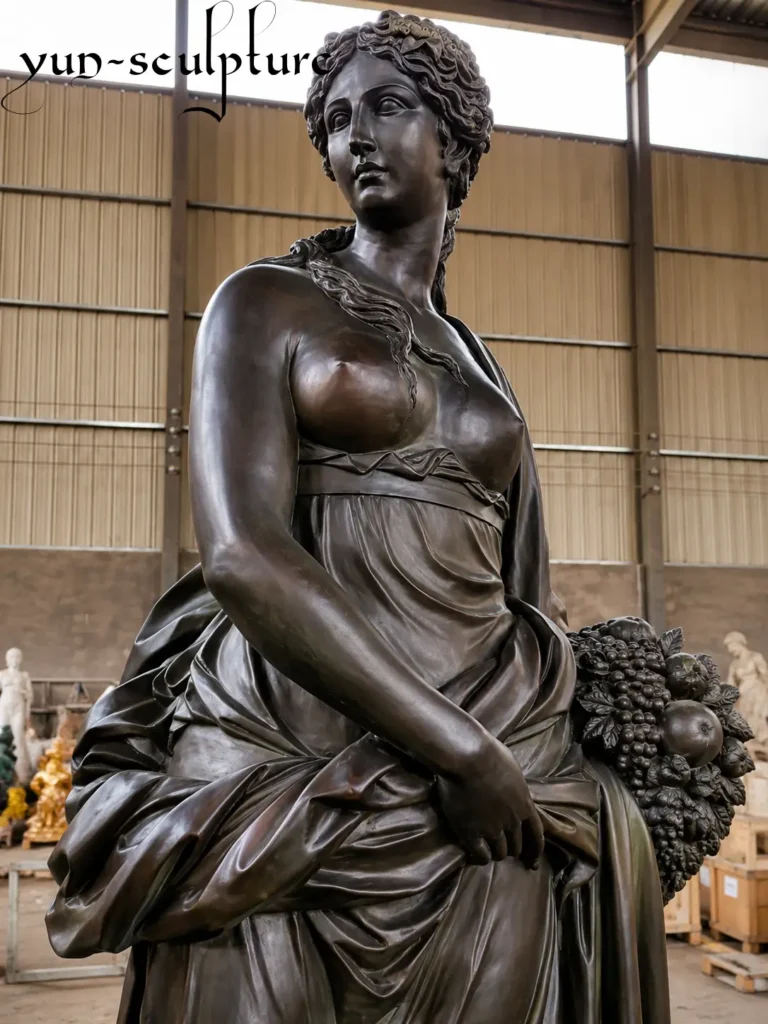
In sculpture, Demeter is depicted as a mature, dignified woman, often holding sheaves of wheat or a cornucopia — the symbols of agricultural abundance. She is a figure of quiet authority rather than martial power or divine drama, appropriate for spaces where nurturing, abundance, and the cycles of natural life are the intended themes: gardens, agricultural institutions, schools, and family estates.
Choosing a Greek Mythology Statue: Space and Meaning
The twelve Olympians are not interchangeable. Each carries specific mythological associations that make certain gods more appropriate for certain spaces and intentions than others. The table below provides a practical framework for matching deity to environment.
| God / Goddess | Domain | Best For | Typical Pose |
|---|---|---|---|
| Zeus | Authority, law, cosmic order | Corporate lobbies, civic buildings, entrance halls | Enthroned or standing, thunderbolt raised |
| Poseidon | Sea, water, power | Gardens with water features, coastal properties, pools | Striding, trident extended |
| Hera | Marriage, dignity, queenship | Formal residential interiors, reception halls | Standing, regal, crowned |
| Athena | Wisdom, strategy, craft | Libraries, universities, law firms, offices | Standing with helmet and spear |
| Ares | War, courage, physical strength | Military institutions, gyms, sports facilities | Armored, dynamic pose |
| Hercules | Strength, perseverance, triumph | Corporate awards, public parks, sports venues | Standing with lion skin and club |
| Apollo | Music, light, healing, beauty | Music rooms, studios, creative spaces, spas | Relaxed contrapposto, lyre or bow |
| Artemis | Hunt, nature, independence | Gardens, hunting lodges, outdoor spaces | Striding with bow |
| Aphrodite | Love, beauty, pleasure | Residential gardens, bedrooms, spas, hospitality | Standing or semi-draped nude |
| Hephaestus | Craft, fire, technical mastery | Studios, workshops, manufacturing spaces | With hammer and tongs |
| Hermes | Commerce, communication, travel | Commercial buildings, airports, trade centers | Athletic, winged sandals |
| Demeter | Harvest, abundance, cycles of life | Gardens, schools, family estates | Standing with wheat sheaves |
Materials for Greek God Statues: Bronze vs. Marble
Ancient Greek sculptors worked primarily in two materials — marble and bronze — and the choice between them was not arbitrary. Marble was the material of temples and civic buildings, its white surface under Mediterranean light carrying associations of purity, permanence, and divine presence. Bronze was the material of honorific portraits and athletic victors — more precious by weight than marble, capable of finer detail, and the preferred medium for freestanding figures in exposed outdoor settings.
The original Athena Parthenos was neither marble nor bronze in its surface but chryselephantine — ivory and gold over a wooden armature — a material so precious it has left no survivors. The bronze originals that inspired the marble copies we know today have almost entirely been lost to the melting pot of later centuries; what survives of ancient Greek bronze is largely what fell into the sea and was preserved by anaerobic conditions.
For contemporary commissions, the choice between bronze and marble follows similar logic to the ancient one:
- Choose bronze for outdoor installations, portrait commissions, and settings where the warm, aged tonal range of patinated metal is appropriate. Lost-wax silicon bronze with a brown or antique green patina reads as directly continuous with the ancient tradition — which it is, technically and aesthetically.
- Choose marble for interior architectural settings, formal residential spaces, and installations where the cool, luminous quality of white stone is preferred. White Sichuan marble is the practical choice for most commissions; Carrara marble for premium applications where the specific historical associations of Italian stone matter.
- Consider a combined commission — a marble-carved figure on a bronze or granite pedestal — for formal institutional settings where both material traditions are appropriate and the contrast between warm and cool adds visual richness.
Our full collection of Greek god statues covers all twelve Olympians in both bronze and marble, at scales from desktop display to life-size installation. Custom commissions for specific deities, poses, or scales are available with standard lead times of 35–50 working days for bronze and 45–65 working days for marble.
Frequently Asked Questions
What are the most famous Greek god statues? +
The most famous Greek god statues include the Athena Parthenos (a forty-foot chryselephantine statue of Athena inside the Parthenon, now lost), the Zeus of Olympia (one of the Seven Wonders of the Ancient World, also lost), the Bronze Poseidon of Artemision (recovered from the sea, now in the National Archaeological Museum in Athens), the Aphrodite of Knidos by Praxiteles (the first monumental female nude in Greek sculpture), and the Hermes of Praxiteles (one of the finest surviving original Greek marble works). Most original bronze statues were melted down in later centuries; the majority of surviving ancient Greek sculpture are marble originals or Roman marble copies of lost bronze originals.
What are the 12 major Greek gods? +
The 12 major Greek gods — the Olympians — are Zeus (king of the gods, sky and thunder), Hera (marriage and queenship), Poseidon (the sea and earthquakes), Demeter (harvest and agriculture), Athena (wisdom and strategic warfare), Apollo (light, music, prophecy, and healing), Artemis (the hunt, the moon, and the wilderness), Ares (war and courage), Aphrodite (love and beauty), Hephaestus (fire and craft), Hermes (commerce, travel, and communication), and either Dionysus (wine and theater) or Hestia (the hearth and home), depending on the source. Hercules, though not originally an Olympian by birth, was elevated to divine status after death and is closely associated with the pantheon.
What is considered the best sculpture ever? +
There is no single consensus, but several works appear consistently in discussions of the greatest sculptures ever made. Michelangelo’s David (1501–1504, Galleria dell’Accademia, Florence) is most frequently cited — a technical and expressive achievement that has defined the human figure in stone for five centuries. Among ancient works, the Laocoön Group (c. 200–100 BCE), the Venus de Milo (c. 150–125 BCE), and the Winged Victory of Samothrace (c. 200–190 BCE) are consistently ranked among the greatest surviving works of figurative sculpture. Rodin’s The Thinker (1880) and his Gates of Hell are most frequently cited for the modern period.
What is the prettiest statue in the world? +
Beauty in sculpture is subjective, but certain works command near-universal admiration for their combination of technical mastery and emotional resonance. The Venus de Milo (Louvre, Paris) is perhaps the most globally recognized as beautiful in the classical sense — its idealized female form and enigmatic incompleteness have made it an enduring standard of sculptural beauty for two centuries. Among marble works, Antonio Canova’s Psyche Revived by Cupid’s Kiss (1787–1793, Louvre) is widely considered the most technically perfect rendering of human skin and emotion in stone ever achieved. The Winged Victory of Samothrace is frequently cited for its combination of dramatic movement and sublime scale.
Which Greek god statue is best for home or garden? +
The best Greek god statue for a home or garden depends on the space and the intended meaning. For gardens, Poseidon works beautifully near water features; Artemis suits natural, wooded settings; Aphrodite is appropriate for intimate garden spaces and residential courtyards. For home interiors, Apollo suits music rooms and creative spaces; Athena is ideal for libraries and home offices; Hermes works well in entryways and home offices oriented toward business. Zeus is the most commanding choice for formal entrance halls. In terms of material, bronze is preferable for outdoor garden installations due to its weather resistance; white marble is the traditional choice for interior formal spaces.
What materials were ancient Greek statues made from? +
Ancient Greek sculptors worked primarily in marble and bronze, with both materials evolving in use across different periods. Marble (particularly from the islands of Paros and Naxos, and later Pentelic marble from Attica) was the dominant material for temple sculpture, architectural friezes, and commemorative figures from the Archaic period onward. Bronze was preferred for freestanding honorific statues — athletic victors, portraits, and deity figures — because it could achieve finer detail and withstand the stresses of unsupported outstretched limbs better than stone. The most prestigious statues of gods were chryselephantine — gold and ivory over wooden armatures — of which none survive intact. Terracotta was widely used for smaller votive figures and household shrines.
Commission a Greek Mythology Statue from Quyang
Every Olympian, every scale, every material — bronze or marble, desktop to life-size. Our foundry produces Greek mythology statues for private collectors, corporate clients, and institutional commissions with factory-direct pricing and a structured approval process.
Commission a Greek Mythology Statue from Quyang
Every Olympian, every scale, every material — bronze or marble, desktop to life-size. Our foundry produces Greek mythology statues for private collectors, corporate clients, and institutional commissions with factory-direct pricing and a structured approval process.