Get in touch with Yun-Sculpture company
Outdoor Horse Statue Materials: Bronze, Steel, Stone & Fiberglass Compared

An outdoor horse statue commission has four realistic material options: bronze, stainless steel, stone, and fiberglass or resin composite. Each performs differently outdoors — not in ideal conditions, but in the actual conditions where these sculptures live: freeze-thaw cycling in Minnesota winters, salt air on coastal properties, UV exposure in Arizona summers, and the slow accumulation of decades. The most common mistake I see buyers make is not choosing the wrong material, but choosing a material without understanding what that choice commits them to. This guide covers what each material actually does outdoors, where each is the right choice, and where each creates problems that will surface years later.
Table of Contents
Table of Contents
Why Material Determines Whether a Horse Statue Lasts or Fails
A horse statue outdoors faces stresses that indoor sculpture does not: thermal cycling (the expansion and contraction of material through seasonal temperature ranges), UV radiation, precipitation, wind load, and the specific chemistry of its local environment — coastal salt, urban pollution, acid rain in industrial areas, mineral-rich groundwater splashing up from irrigation. Different materials respond to these stresses in fundamentally different ways. What looks identical on day one can look completely different after ten years, and the material that appears more expensive at the point of purchase is frequently less expensive over a twenty-year ownership period when maintenance and replacement costs are included.
The other factor that drives material selection is structural: a life-size horse statue at natural scale weighs 600 to 1,200 kilograms in bronze and requires engineering for wind load, anchor bolt specifications, and base construction. These structural requirements vary by material and by pose — a rearing horse has different structural demands than a standing horse — and the material decision affects the structural solution available.
| Material | Outdoor Lifespan | Freeze-Thaw | Salt Air | Pose Flexibility | Best Setting |
|---|---|---|---|---|---|
| Silicon Bronze (5–8mm) | 100+ years | Excellent | Excellent | All poses | Traditional estate, formal garden, any climate |
| Stainless Steel (304/316) | 50–80+ years | Excellent | 316 grade: excellent | All poses | Contemporary architecture, coastal (316), modern landscape |
| Granite (hard stone) | 100+ years | Very good | Good | Standing poses only | Protected garden, sheltered courtyard, standing pose only |
| Marble | 15–40 years (climate-dependent) | Vulnerable | Moderate | Standing poses only | Sheltered interior or protected garden in mild climate only |
| Fiberglass / Resin | 5–8 years | Poor | Poor | Limited | Indoor display, temporary events, short-term installations |
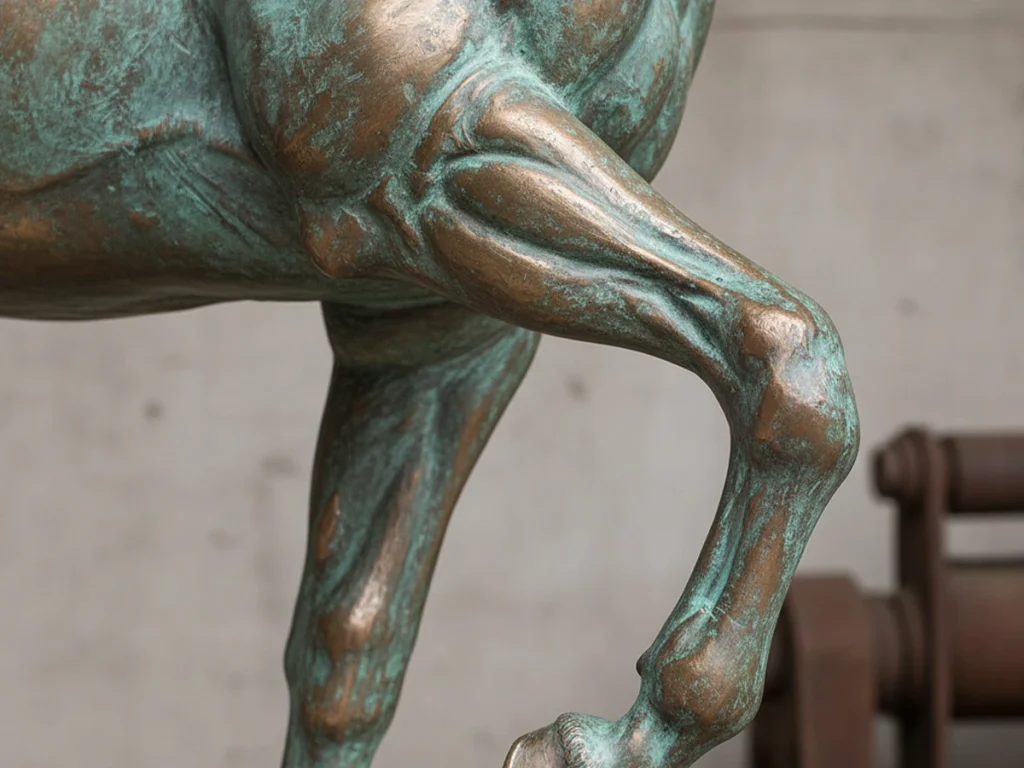
Caption: 5–8mm solid silicon bronze wall thickness prevents deformation and cracking
Bronze — The Default Standard, and Why It Earned That Position
Bronze has been the primary material for outdoor figurative sculpture for 4,000 years. This is not tradition for its own sake. It is the accumulated result of every civilization that tried other materials outdoors and found bronze more durable. The bronze alloy used for serious outdoor horse commissions is silicon bronze — approximately 95% copper with silicon additions that improve casting flow and corrosion resistance. This is not brass. Brass is a copper-zinc alloy with fundamentally different corrosion behavior. The distinction matters outdoors.
The key property of bronze outdoors is the patina. Bronze exposed to air forms a stable oxide layer — the patina — that bonds to the metal surface and prevents further oxidation. This is not deterioration. It is the opposite: a self-protective layer that forms once and then stabilizes, darkening and deepening over years without weakening the metal beneath it. A bronze statue that has developed full patina outdoors requires less active protection than a freshly cast piece, because the patina is doing the protection work.
Two production variables determine whether bronze performs correctly outdoors: wall thickness and patina application method.
Wall thickness is the most important structural variable and the one most frequently compressed by cost-cutting foundries. The minimum wall thickness for a bronze horse statue intended for permanent outdoor installation is 5 millimeters. At this thickness, the bronze has the mass to resist vibration fatigue, the structural depth to hold detail through decades of thermal cycling, and the ability to absorb minor impacts without deforming. Most of what is sold as “outdoor bronze” in lower price ranges is cast at 2 to 3 millimeters — which looks identical on day one and fails progressively from year five or six onward, beginning with deformation at thin sections (legs, ears, tail) and progressing to stress cracking at high-load points.
Patina application method is the second critical variable. A heat-applied chemical patina — applied with acids at temperature so that the chemical reaction occurs within the surface of the bronze — is permanent. It cannot peel, because it is part of the metal surface rather than a coating on top of it. A cold-applied or spray-painted patina finish sits on the surface and begins deteriorating within two to three years of outdoor exposure, starting at exposed high points that receive the most UV and weathering, and progressing to an uneven, degraded appearance that no amount of cleaning will correct.
Foundry Note: The Minnesota Concrete Replacement In 2019, a property developer contacted us to replace two life-size concrete horses he had installed in Minnesota four years earlier. The statues had developed vertical cracks wide enough to insert a finger — the freeze-thaw cycling had infiltrated the concrete, expanded the internal steel reinforcement, and split the figures from the inside. We replaced them with 8-millimeter silicon bronze. The concrete pieces went to a landfill. The bronze replacements, now six years old, have developed a stable dark-green patina and show no structural stress. That is the practical difference between the two materials in a freeze-thaw climate.
Bronze’s limitations are few but real. In fully contemporary architectural settings — glass and steel minimalist buildings, modern landscape design with geometric water features and polished stone hardscaping — traditional bronze with its dark patina can feel mismatched. These settings often call for the clean visual character of stainless steel instead.
Stainless Steel — The Contemporary Alternative
Stainless steel outdoor horse statues are produced from 304 or 316 grade stainless steel sheet and plate, internally reinforced with welded structural frames. The surface is finished to a mirror polish, a satin brushed finish, or an intermediate matte. Unlike bronze, stainless steel does not develop a patina — it maintains its surface character indefinitely, with the reflective quality making it visually integrate with glass, water features, and contemporary hardscaping in a way that dark patinated bronze does not.
The structural approach differs from bronze casting. Stainless steel horse statues are fabricated from formed panels rather than cast, which allows larger surface areas but requires more careful attention to the internal reinforcement structure — a large mirror-polished horse with insufficient internal framing will show oil-canning (visible distortion of flat areas under thermal expansion) and weld read-through (visible marks from internal welds showing through the polished exterior surface) within a few summers. The minimum acceptable panel thickness for a life-size outdoor stainless steel horse is 3 millimeters, with internal structural framing at all major load paths.
316 stainless steel is the correct specification for coastal environments with salt air exposure. The molybdenum content in 316 grade improves chloride corrosion resistance in a way that 304 does not provide. For inland or urban installations, 304 is adequate.
Stainless steel is the right material choice when the architectural context is contemporary and the setting benefits from reflective surface interaction with light and surroundings. It is not the right choice for traditional estate settings, formal garden designs in the classical tradition, or any setting where the organic warmth of bronze patina is aesthetically appropriate.
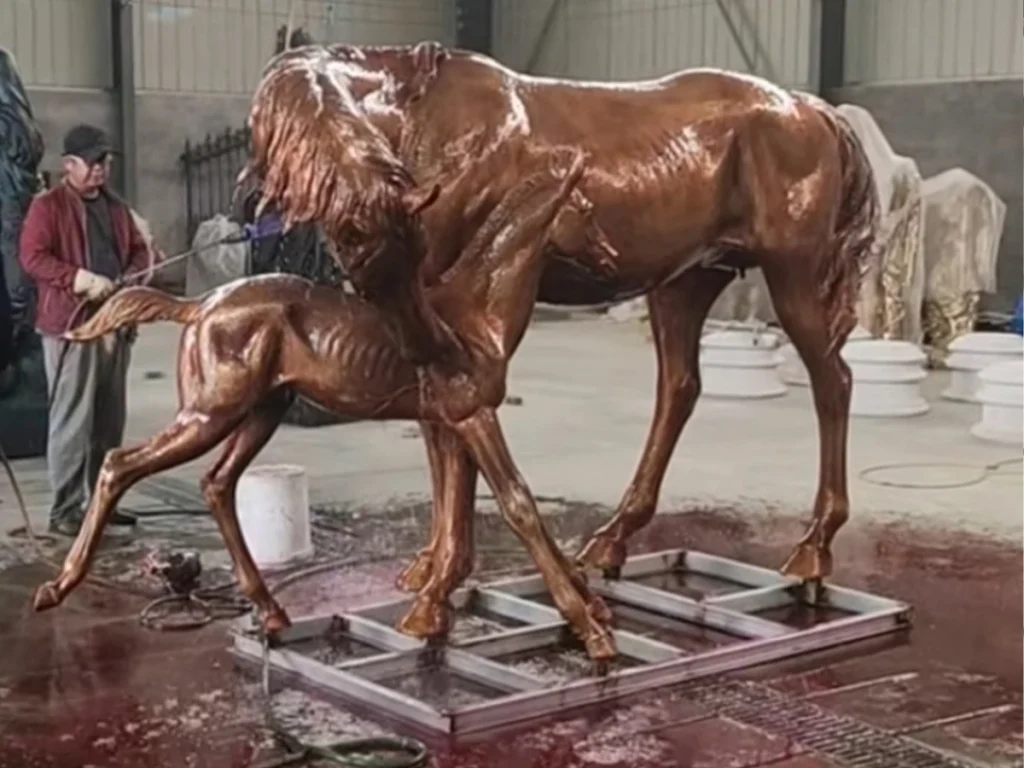
Caption: Chemical patina penetrates bronze surface—paint peels, patina ages beautifully.
Stone and Granite — A Real but Limited Outdoor Choice
Granite and hard limestone have been used for outdoor sculpture for thousands of years and remain valid choices for specific horse poses in appropriate settings. The key qualifications are the word “specific” and the word “appropriate.”
Stone is not appropriate for dynamic horse poses — galloping, rearing, cantering figures with unsupported legs or projecting forms. The structural physics of stone do not allow the same load paths that bronze and stainless steel handle through their tensile strength. A rearing horse in granite, with 600 kilograms of stone concentrated on two rear contact points, is not a structural solution that holds reliably outdoors. Stone horse commissions belong in standing poses with all four legs on the ground, creating multiple stable load paths through the stone to the base.
In the correct pose, granite is an excellent outdoor material. It is immune to the patina development that bronze undergoes (which some buyers prefer), highly resistant to UV, and in most climates more durable surface-wise than bronze. Granite does not have bronze’s freeze-thaw vulnerability, because its crystal structure is denser and less permeable than calcium carbonate stone like marble or limestone. For a standing horse in a protected garden setting in a cold climate, a granite commission is a legitimate alternative to bronze.
The weight of a granite horse at life-size — 1,800 to 3,000 kilograms depending on pose and density — requires more substantial foundation engineering than bronze, and the limited available poses reduce its range of aesthetic expression.
White Carrara marble, which is the standard material for classical figurative sculpture in interior and sheltered settings, is not recommended for horse statue outdoor commissions. Its calcium carbonate structure is vulnerable to the specific weathering stresses that horse sculptures face: freeze-thaw cycling, acid rain, and the physical stress of projecting forms in dynamic poses. Marble is the correct material for sheltered garden settings and interior installations, not for fully exposed outdoor horse statues.
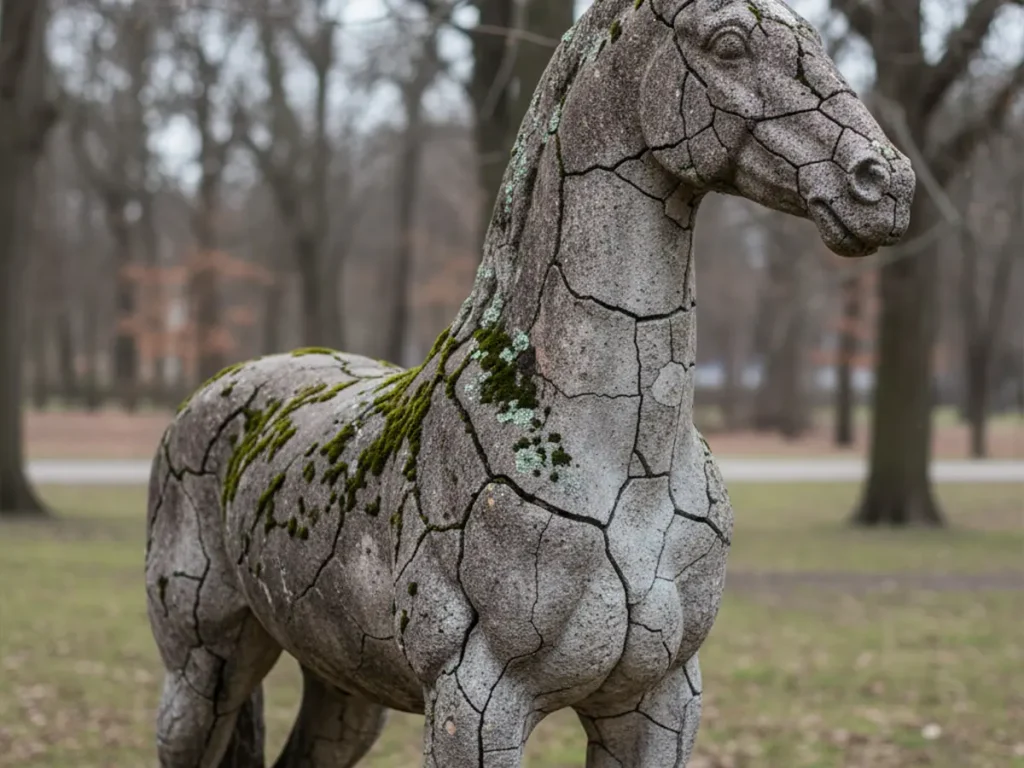
Caption: Freeze–thaw cycles cause micro-cracks that expand yearly.
Fiberglass and Resin — An Honest Assessment
Fiberglass-reinforced plastic and resin composite horse statues are the entry-level option in the market. They are produced by mold duplication — a resin matrix is layered into a mold taken from an existing sculpture, producing a lightweight replica at significantly lower cost than any casting process. The surface is typically painted, sometimes with a metallic coating intended to resemble bronze or stone.
The honest assessment of fiberglass and resin outdoors is that they are short-term materials in permanent outdoor applications. UV radiation degrades the polymer matrix of fiberglass from the surface inward, causing surface chalking, color fading, and brittleness within two to three years in direct sun exposure. The painted surface begins peeling as the substrate degrades. By year five to eight in most climates, a fiberglass horse statue shows visible surface deterioration that cannot be corrected by cleaning or repainting without stripping the piece entirely.
Where fiberglass is appropriate: indoor display, temporary exhibitions, short-term decorative installations, and applications where replacement every five to eight years is an accepted part of the budget model. For any permanent outdoor installation intended to last more than a decade, fiberglass is not the right material regardless of its initial purchase price.
Resin composite — often sold as “cold cast bronze” or “bonded bronze” with a small percentage of bronze powder mixed into a resin matrix — has no meaningful structural or durability advantage over standard fiberglass. The bronze content is cosmetic rather than functional, providing some surface color and weight but not the corrosion resistance or structural integrity of genuine bronze casting.
Traditional estate or formal garden, any climate
→ Silicon Bronze (5–8mm)
The permanent standard. All poses, all climates, develops character with age. Heat-applied patina required.
Contemporary or minimalist architecture
→ Stainless Steel (304)
Clean reflective surface integrates with glass and polished stone. Bronze patina visually mismatches modern settings.
Coastal property with salt air exposure
→ Silicon Bronze or 316 Stainless Steel
316 stainless for contemporary settings; silicon bronze for traditional. Both handle chloride environments. 304 stainless not recommended in direct salt air.
Cold climate (genuine freeze-thaw cycling)
→ Silicon Bronze or Stainless Steel only
Both metals are immune to freeze-thaw damage. Marble, limestone, and low-quality concrete all carry freeze-thaw vulnerability. Granite is acceptable for protected standing-pose commissions.
Standing-pose horse in sheltered garden, mild climate
→ Granite or Silicon Bronze
Granite is a legitimate alternative for standing poses in mild climates with good drainage. Provides a different aesthetic — no patina development, permanent stone color.
Indoor display or temporary event
→ Fiberglass / Resin
The only context where fiberglass is the right choice. Lightweight, lower cost, acceptable for interior or short-term use. Not for permanent outdoor installation.
Frequently Asked Questions
What is the best material for an outdoor horse statue?
Silicon bronze at 5–8mm wall thickness is the best material for most permanent outdoor horse installations. It handles all climates, all poses, and all exposure conditions, developing a self-protective patina that stabilizes over time. For contemporary architectural settings where bronze’s dark patina visually mismatches the design context, stainless steel is the correct alternative. Fiberglass and resin are not appropriate for permanent outdoor installations in any climate.
How long does a bronze horse statue last outdoors?
A bronze horse cast at 5–8mm wall thickness with heat-applied chemical patina will last indefinitely outdoors. The alloy forms a stable oxide layer — the patina — that bonds to the metal surface and prevents further corrosion. Bronze sculptures from 2,500 years ago survive intact today. Conditions that cause premature failure: wall thickness below 4mm, cold-applied or painted patina finishes, and inadequate anchoring that allows movement and stress fractures.
Will a bronze horse statue rust outdoors?
No. Silicon bronze oxidizes — forming the green and brown patina visible on aged bronze — but this oxidation is self-limiting and self-protective rather than progressive. Once the patina forms and stabilizes, it prevents further oxidation of the metal beneath. The green patina on bronze is not damage; it is the material’s long-term stable state. Internal structural frames use 304 stainless steel, which also does not rust in outdoor conditions.
Can fiberglass horse statues be used outdoors permanently?
No. Fiberglass and resin deteriorate under UV exposure — surface chalking and color fading typically appear within 2–3 years in direct outdoor exposure, with obvious deterioration within 5–8 years. They are appropriate for indoor display, temporary exhibitions, and short-term applications. For any permanent outdoor installation intended to last more than a decade, bronze or stainless steel is the correct choice regardless of the initial cost difference.
What is the difference between bronze and stainless steel for outdoor horse statues?
Both are permanent materials. Bronze develops a dark patina — green, brown, or black — that deepens over years, suited to traditional estate and formal garden settings. Stainless steel maintains its clean reflective surface indefinitely, correct for contemporary architecture and minimalist landscape. For coastal environments, 316 stainless steel is recommended over 304 for superior chloride corrosion resistance.
Factory Direct · Quyang, China
Get a Quote for Your Outdoor Horse Statue
Silicon bronze or stainless steel. 5–8mm wall thickness standard. Heat-applied patina. Installation drawings included with every outdoor commission.