Get in touch with Yun-Sculpture company
Buying a Wall Street Bull Statue Replica? 5 Details That Separate High-Quality Art from “Cheap Fakes”

If you are considering buying a wall street bull statue replica, let me be brutally honest with you.
Most of them are terrible.
Not “slightly off.”
Not “acceptable for the price.”
I mean embarrassing, reputation-damaging, investor-questioning terrible.
I say this as the Chief Foundry Director of Yun Sculpture — and as someone who has spent decades dissecting bronze casting quality across Asia, Europe, and the United States. I’ve personally inspected dozens of Charging Bull copies sold to corporate lobbies, luxury developers, and financial institutions.
And I’ve watched clients spend six figures… only to receive what can only be described as a bloated bronze cow with horns.
The original Charging Bull by Arturo Di Modica is not just a sculpture. It is a kinetic symbol of power, financial aggression, and forward momentum. A poor replica doesn’t just look bad — it silently tells your investors that your company cuts corners.
So today, I’m going to give you the brutal, no-fluff guide you deserve.
This is your Buyer’s Protection Guide to identifying a true high quality bronze bull — and avoiding the cheap fakes flooding the global market.
Table of Contents
The Spot-the-Difference Game: Why 90% of Replicas Fail
Before we dive into the anatomy checkpoints, here is the uncomfortable truth:
Cheap factories optimize for ease of casting, not artistic truth.
A masterpiece charging bull is difficult to produce because:
- Complex muscle anatomy requires master sculptors
- Dynamic poses require internal engineering
- Authentic patina requires chemical fire techniques
- Thick bronze requires higher material cost
- Multi-stage finishing requires thousands of manual hours
Cheap manufacturers eliminate these steps. And every shortcut shows.
Your job is not to be an art historian.
Your job is to know where to look.
Let’s begin.
Anatomy Lesson 1: Muscle Definition — Explosive vs. Bloated
The shoulders, flanks, and hindquarters reveal everything about a bronze bull’s authenticity.
The Cheap Standard: The “Fat Cow” or “Sausage Effect”
Zoom in on the neck and shoulders.
You’ll usually see:
- Smooth rounded surfaces
- No separation between muscle groups
- No visible tendon tension
- Inflated balloon-like curves
These bulls look like they ate too much grain and forgot leg day.
Cheap foundries simplify anatomy because crisp muscle definition is extremely difficult to cast and finish. Smooth surfaces hide casting flaws and reduce labor time.
The result? A bull that looks sleepy instead of explosive.
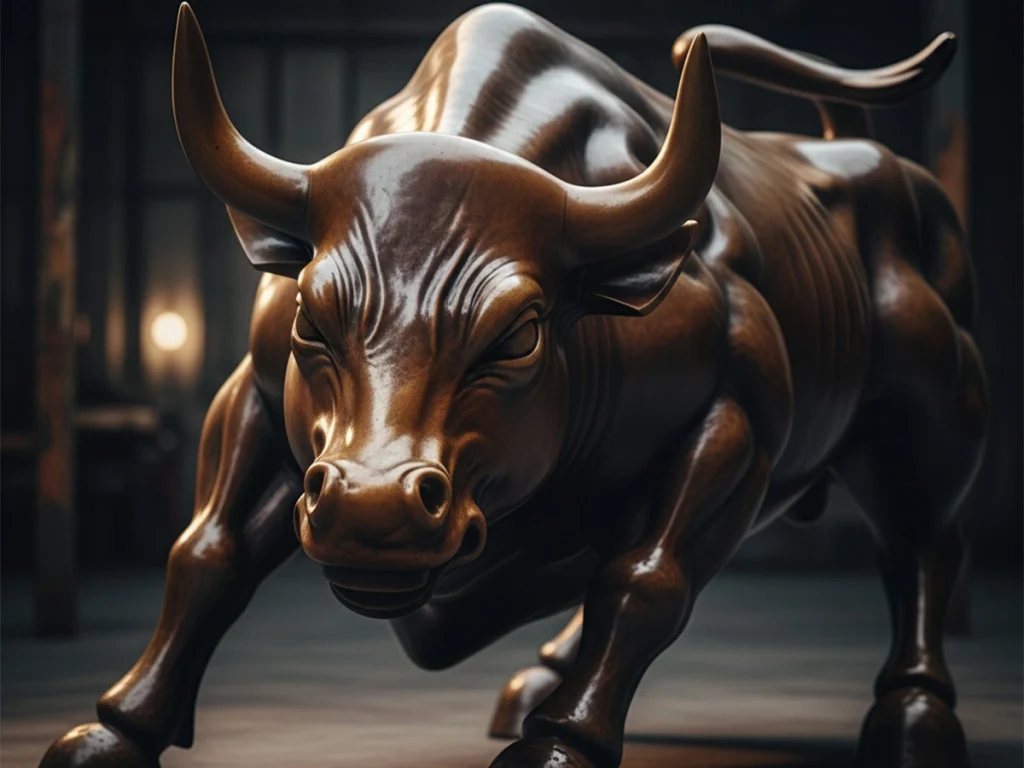
The Yun Standard: Striation & Pre-Charge Tension
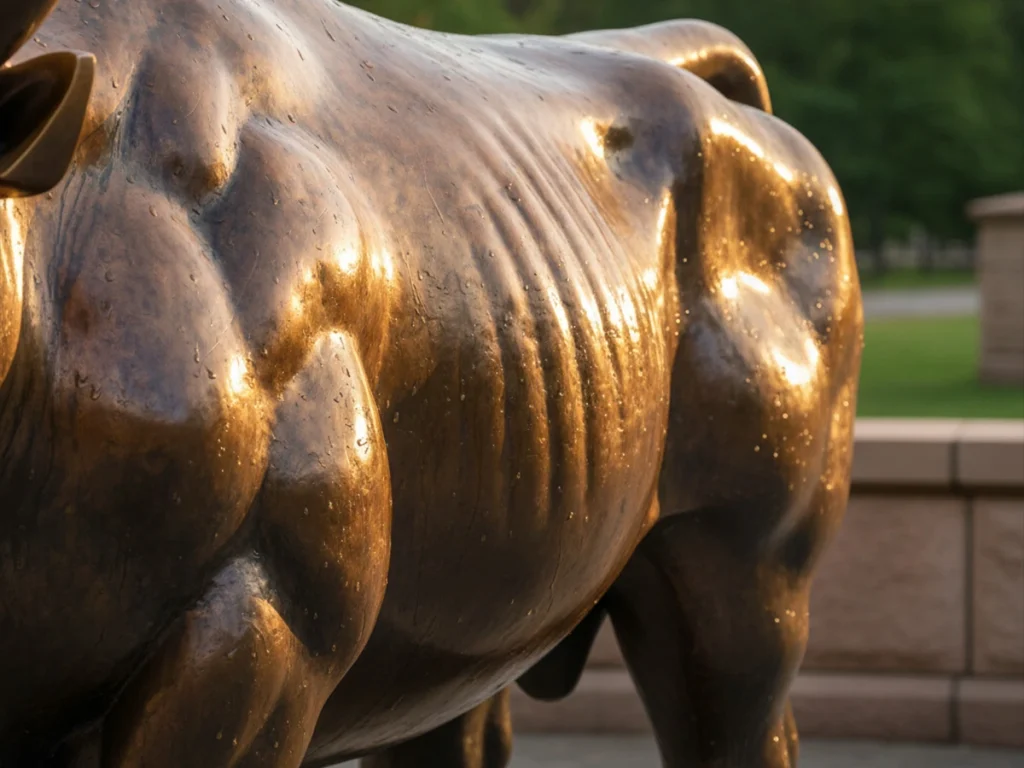
A museum-grade bronze bull anatomy must show striated muscle fibers and stretched tendons.
Our sculptors intentionally capture:
- Muscle compression near joints
- Tendon tension at the shoulder and knee
- Skin folding over flexed muscle
- Directional muscle fibers showing motion
This recreates the split second before impact.
The viewer should feel like the bull might launch forward at any moment.
Anatomy Lesson 2: The Predator Gaze — The Eyes Tell the Truth
If you only check one feature, check the eyes.
Humans are neurologically wired to detect emotional authenticity through gaze.
The Cheap Standard: The “Pet Cow Eyes”
Look closely at cheap replicas.
You will usually notice:
- Symmetrical round eyes
- Wide open, relaxed eyelids
- No brow tension
- Passive expression
These eyes belong on a dairy farm, not Wall Street.
Why does this happen?
Because detailed eye sculpting requires elite sculptors who understand animal anatomy and predator psychology. Cheap manufacturers treat eyes like decorative buttons.
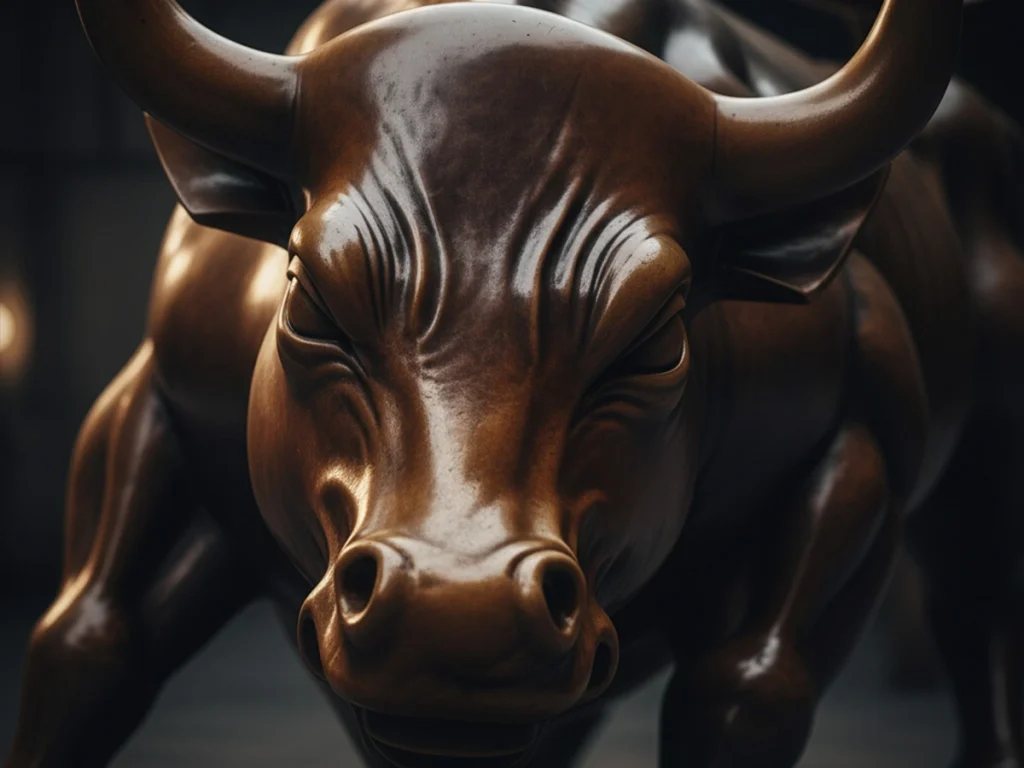
The Yun Standard: Orbital Bone Shadow & Target Lock
The original Di Modica inspiration conveys aggression and focus.
We sculpt:
- Lowered brow ridge creating shadow
- Asymmetrical eyelid compression
- Deep orbital bone structure
- Directional gaze locking onto the symbolic Bear
This creates danger.
A real charging bull should look like it has chosen a target — and nothing will stop it.
Anatomy Lesson 3: The Kinetic Tail — Gravity vs. Motion
This is the easiest shortcut to spot — and the most common cost-cutting trick in the global market.
The Cheap Standard: The Limp Tail Support
Most low-cost factories attach the tail directly to the rear leg.
Why?
Because it simplifies casting and removes the need for internal engineering.
But visually, it destroys motion.
The tail looks:
- Heavy
- Lifeless
- Structurally dependent
- Emotionally weak
It’s the bronze equivalent of a deflated flag.
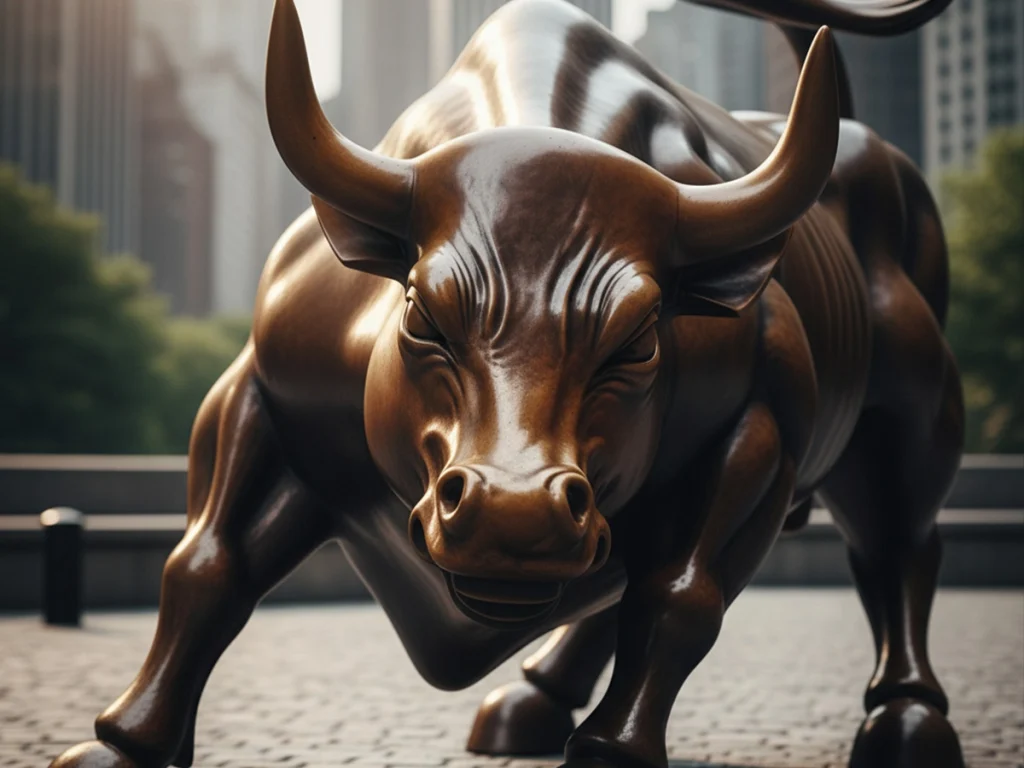
The Yun Standard: The Whipping Motion Line
A true charging bull statue for sale must show continuous kinetic energy from horn to tail tip.
Our foundry builds:
- Internal stainless steel armature
- Balanced bronze weight distribution
- Suspended tail positioning
- Dynamic arc representing whip motion
The tail must visually extend the forward thrust of the body.
If the tail touches the leg, the sculpture has already failed.
Anatomy Lesson 4: The Neck Twist — Understanding Torque
This is where amateurs collapse completely.
A charging bull is not running straight. It is rotating, twisting, and generating torque through the neck and shoulders.
The Cheap Standard: The Straight Pipe Neck
Cheap bulls typically show:
- Cylindrical neck shape
- Uniform surface tension
- No skin compression
- Minimal directional movement
The sculpture looks rigid — like it was assembled from tubes.
This removes the sensation of violent turning motion.
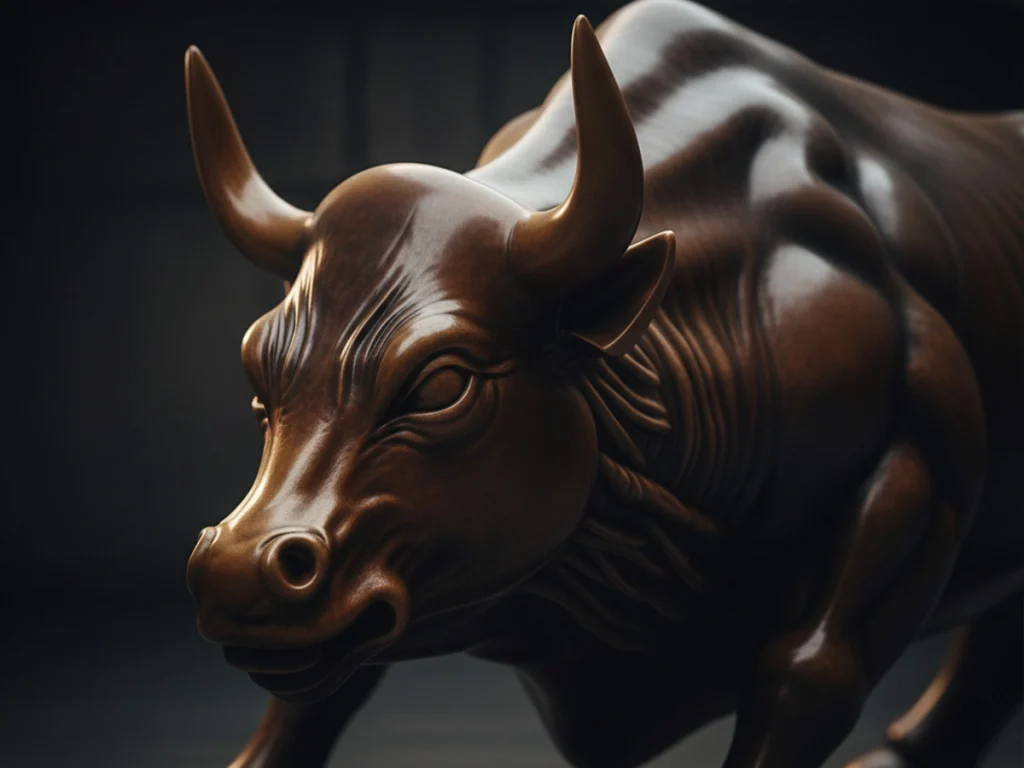
The Yun Standard: Rotational Torque & Skin Folding
We obsess over neck torsion because this is where the bull’s power originates.
Our sculptors capture:
- Massive skin folds forming under rotational pressure
- Asymmetrical muscle bulging
- Tendon tension wrapping around vertebrae
- Directional energy transferring to horn alignment
You should feel the bull violently whipping its head mid-charge.
Anatomy Lesson 5: The Patina — Fire vs. Spray Paint
This is the most misunderstood — and most abused — quality indicator.
The Cheap Standard: Flat Spray Paint Bronze
Many factories apply:
- Acrylic spray coating
- Artificial brown pigment
- Single-tone surface
It looks acceptable during delivery.
Then:
- Paint begins fading in 18–24 months
- UV exposure causes peeling
- Surface loses depth and character
These replicas age like cheap outdoor furniture.
The Yun Standard: Thermal Chemical Patina
Authentic Arturo Di Modica replica style demands fire patination.
Our method involves:
- Layered chemical applications
- Controlled torch heating
- Surface oxidation manipulation
- Multi-tone translucent bronze coloring
The result is a living surface that:
- Changes subtly under sunlight
- Displays gold-brown depth
- Ages gracefully for decades
Real bronze patina is not paint.
It is controlled chemistry fused into the metal itself.
The Psychology of Sculpture: Why Cheap Bulls Damage Brand Authority
Let me speak directly to executives, developers, and institutional buyers.
Your lobby sculpture is the first handshake with investors.
Do you want a limp handshake?
The Uncanny Valley Effect
Humans instinctively recognize flawed anatomy — even if they cannot explain why.
A poorly sculpted bull creates subconscious reactions:
- Something feels “off”
- Movement appears unnatural
- The sculpture looks decorative instead of symbolic
This triggers subtle distrust.
Your visitors may never verbalize it.
But perception shapes confidence.
The Status Signal of Museum-Grade Craftsmanship
A high-quality bull replica communicates:
- Precision-driven leadership
- Long-term thinking
- Respect for legacy symbolism
- Commitment to excellence
Luxury hospitality brands, financial headquarters, and elite residential developments understand this instinctively.
A masterpiece sculpture becomes a silent brand ambassador.
The Financial Reality: Cheap Replicas Are Expensive Mistakes
Clients often assume they are saving money by purchasing low-cost replicas.
But here’s the pattern we repeatedly see:
- Cheap replica lifespan: 3–7 years
- Repair and repaint cycles
- Structural failures due to thin bronze
- Full replacement within a decade
Meanwhile, a properly cast monumental bull lasts generations.
If you are evaluating long-term symbolism and brand prestige, you should also evaluate lifecycle cost.
Curious about the financial and symbolic return of investing in a premium bull sculpture?
Read our [Investment & Feng Shui Guide].
Where to View Authentic Monumental Bull Options
If you want to explore museum-grade designs, engineering options, and scale variations, you can view our curated [Collection of Monumental Bulls].
Each piece is engineered with structural integrity, anatomical accuracy, and outdoor longevity in mind.
The Final Challenge: Test Before You Invest
Here is my personal offer — and a challenge.
Do not trust marketing photos.
Do not trust price comparisons.
Do not trust catalog promises.
Instead, test the sculpture with an expert anatomy audit.
Send us:
- A supplier photo
- A product listing
- Or a design proposal
Our master sculptors will analyze:
- Muscle accuracy
- Structural engineering shortcuts
- Patina authenticity
- Bronze thickness indicators
We will tell you — brutally honestly — whether the sculpture meets museum-grade standards.
Final Thoughts from the Foundry Floor
The Charging Bull is not decoration.
It is a symbol of confidence, aggression, prosperity, and momentum. When executed correctly, it becomes a generational landmark.
When executed poorly… it becomes a corporate joke.
And trust me — investors notice.