Get in touch with Yun-Sculpture company
The Guardian of the Estate’s Soul: The Ultimate Guide to Custom Jesus the Good Shepherd Statues

Imagine a September morning. A thin veil of mist still clings to the boxwood hedges as you step onto the stone path that bisects your garden. At its far end, half-consumed by the soft grey light and the reaching arms of climbing roses, a figure slowly resolves into clarity. He holds a lamb. His gaze is downward—patient, present, unhurried by the world.
This is the quiet power of a jesus the good shepherd statue placed with intention. It does not announce itself. It waits.

For the estate owner, the landscape architect, or the curator of a private Healing Garden, this moment of discovery is precisely the point. A jesus garden statue of this kind is not mere ornamentation—it is a narrative anchor, a fixed soul within a living, seasonal composition. It transforms a garden from a collection of beautiful plants into a place that means something.
Interest in outdoor jesus statue installations for private properties has risen steadily over the past decade. Searches for garden religious statuary have climbed year-on-year, reflecting a broader cultural shift: high-value buyers are moving away from mass-produced public icons toward bespoke, story-driven sculpture. They are not replicating a church forecourt. They are commissioning a personal sanctuary.
This guide is written for those buyers—and for the landscape professionals who serve them. In the sections that follow, we will trace the two-thousand-year iconographic history of the Good Shepherd image, examine the material science behind bronze, stone, and steel for outdoor installation, walk through the engineering standards for safe placement at any scale, and detail the full custom fabrication and global delivery process that Yun Sculpture provides. By the end, you will have everything you need to make a decision that will endure for generations.
Table of Contents
Table of Contents
Understanding the Good Shepherd: A Visual Symbol Spanning 2,000 Years
Iconographic Origins and Theological Roots
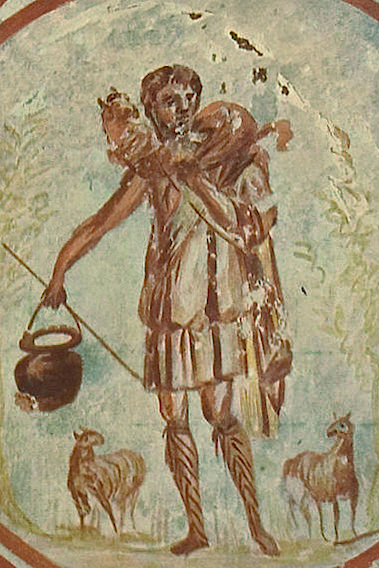
The image did not begin in a cathedral. The ancient statue of jesus christ is the good shepherd has its roots in the shadows of underground Rome—specifically, in the Catacomb of Callixtus, the third-century burial complex beneath the Appian Way where early Christians buried their dead and, on the surrounding vault surfaces, painted their faith in secret.
Here, among the oldest surviving examples of Christian figurative art, a young shepherd carries a lamb across his shoulders. The figure is calm, even domestic. In an era when openly Christian imagery invited persecution, this image spoke volumes in whispers.
Its formal antecedent was the Greco-Roman Criophoros—literally, the “ram-bearer”—a devotional figure from pagan antiquity in which a young man carries a sacrificial animal. Early Christian artists absorbed this visual vocabulary and transformed its meaning entirely. The shepherd was no longer offering the lamb to a god. He was the God, and the lamb was the soul under his protection.
The theological text that crystallized this shift remains John 10:11: “I am the good shepherd. The good shepherd lays down his life for the sheep.” These words give the image its permanent weight. Every subsequent sculpture in this tradition—from Byzantine mosaic to Renaissance marble to contemporary bronze casting—carries this verse in its posture, whether or not it is inscribed anywhere on the stone.
From Public Cathedrals to Private Estates: The Shift in Context
Stand before a monumental religious sculpture in a public square and you feel your own smallness. That is intentional. Scale communicates theology: the divine as vast, the human as finite. Public sacred art speaks to crowds, from a distance, in declarations.
A private garden operates on entirely different terms.
The concept of the Therapeutic Landscape—developed within environmental psychology and now widely applied in estate design and Healing Garden planning—holds that the symbolic and aesthetic qualities of a space directly affect the body’s stress response. Carefully placed sculpture with personal or spiritual meaning has been shown to reduce cortisol levels, slow respiration, and extend the duration of restorative attention. The garden becomes a site of physiological as well as spiritual recovery.
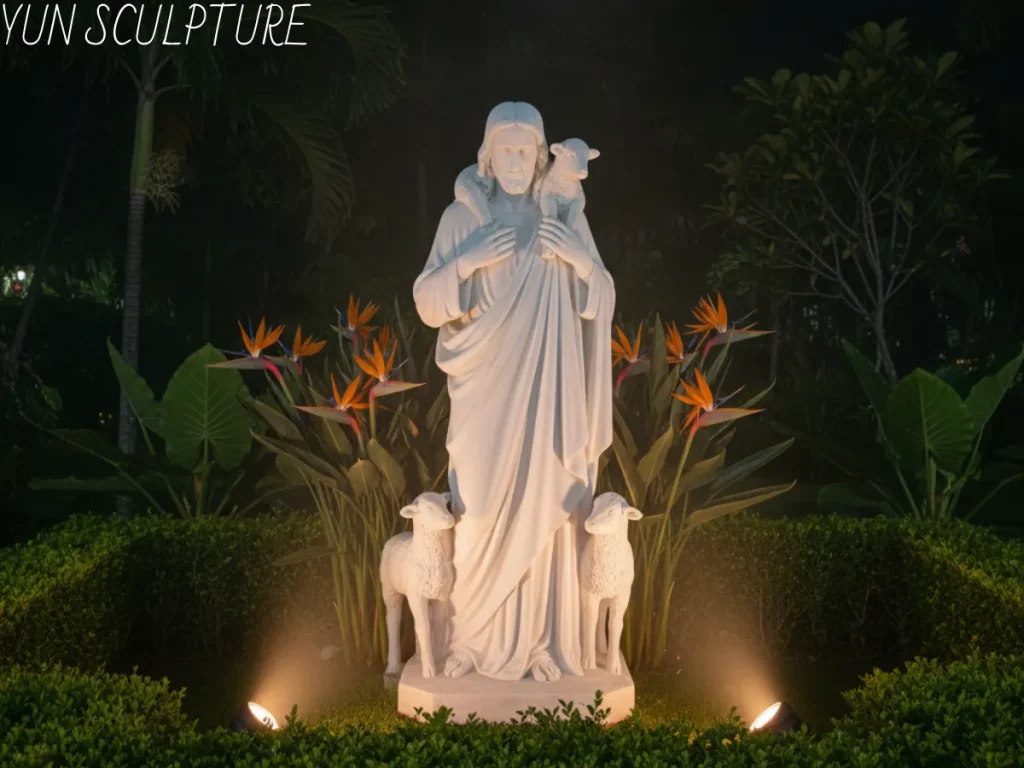
Consider the contrast in intent. The jesus the redeemer statue above Rio de Janeiro extends its arms across an entire city skyline. Its message is shelter on a civilizational scale—grand, declarative, unforgettable. It belongs to the world.
The Good Shepherd belongs to you.
Where the Redeemer gestures outward toward millions, the Good Shepherd looks downward toward one. His aesthetics are those of Intimacy and Invitation—a figure that seems, regardless of its size, to have been placed in your garden specifically to meet your gaze, at the end of your path, on your particular misty morning.
This is why the image has migrated, with such quiet inevitability, from the cathedral to the private estate.
Visual Theology and Artistic Composition: The Sculptor’s Language
Decoding the Symbolic Elements
Every element of the Good Shepherd composition carries meaning that predates the Christian era by centuries. When we at Yun Sculpture begin a new commission, we do not simply cast a figure—we resolve a series of competing symbolic and structural demands simultaneously. Understanding these tensions helps a client appreciate why the process takes the time it does.
The table below maps each iconographic element to its theological significance and the specific engineering challenge it presents in fabrication.
Symbolic Elements & Engineering Challenges
| Element | Symbolic Meaning | Fabrication Challenge | Engineering Consideration |
|---|---|---|---|
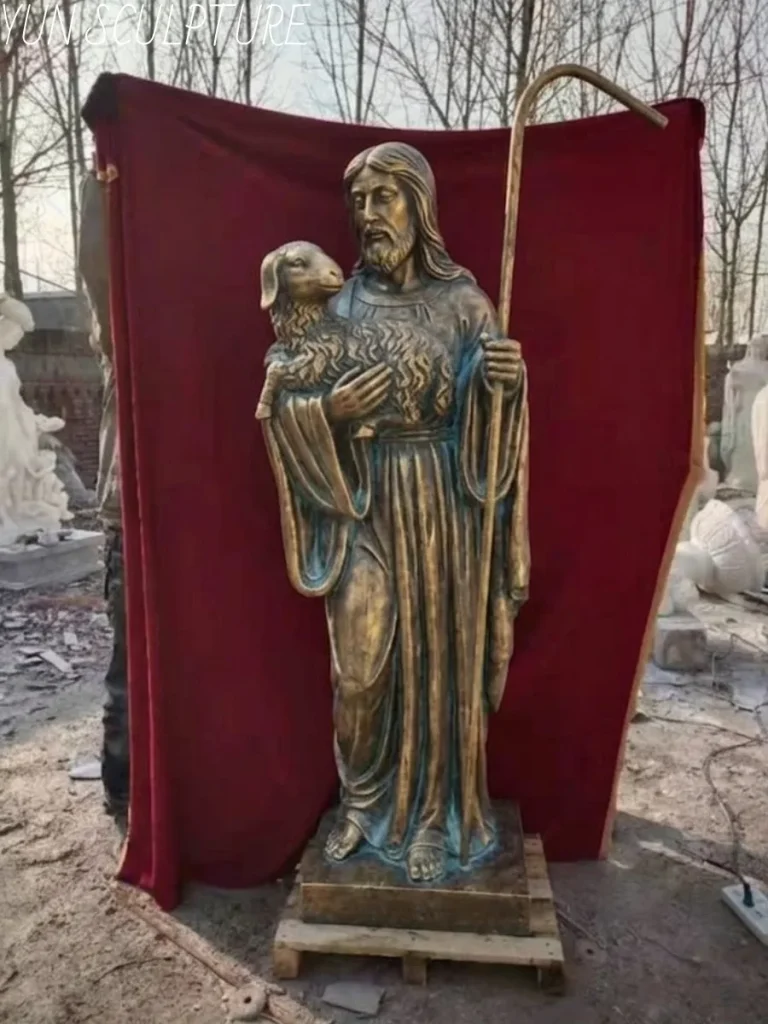
| Lamb | Purity; the individual soul under protection | Wool texture detail requires multi-layer wax mold work in bronze casting | Small-section limb joints must carry dynamic load without stress fracture |
| Shepherd’s Staff | Divine authority; the act of guidance | Slender vertical form is the most wind-vulnerable element in the composition | Hollow-cast vs. solid-cast weight trade-off; internal steel armature for tall versions |
| Looking-Down Posture | Downward care; intimate, daily attention | Forward center of gravity places asymmetric load on base contact points | Precise base counterweight calculation to prevent forward lean over decades |
| Flowing Robes | Human warmth; embodied presence | Deep-relief carving in marble requires controlled undercutting without fracture risk | Robe folds must be designed with a minimum 3° drainage slope to prevent water pooling and freeze-crack cycles |
Aesthetic Distinctions from Other Jesus Sculptures
The broader vocabulary of Christian monumental sculpture offers three dominant gestures, and they are not interchangeable.
The resurrected jesus statue moves upward. Arms rise, the body elongates, the gaze ascends. It speaks of transcendence—of the human form straining toward the divine. It is the grammar of Easter morning, of rupture and triumph. Placed in a garden, it draws the eye skyward and diminishes the ground beneath it.
The jesus the redeemer statue—most iconically rendered above Rio de Janeiro—opens its arms horizontally, addressing a horizon. It is an act of public embrace at civilizational scale. Its emotional register is protection extended over multitudes. It is magnificent, and it is impersonal.
The Good Shepherd does neither. He looks down. He holds one lamb. His posture is closed, gathered, specific. The emotional register is not triumph or grandeur—it is recognition. The figure seems, at any scale, to have noticed you in particular.
This distinction is why contemporary sculptors working in the Minimalist Interpretation tradition have found the Good Shepherd uniquely adaptable. Stripped of robes and rendered in clean geometric planes, the essential gesture—a figure bowed in attentive care over something small and vulnerable—remains immediately legible. For the modern estate owner who wants spiritual resonance without ecclesiastical vocabulary, this interpretive flexibility is significant.
Material Science: Choosing the Right Medium for Your Climate and Aesthetics
Foundry Bronze: The Witness of Time
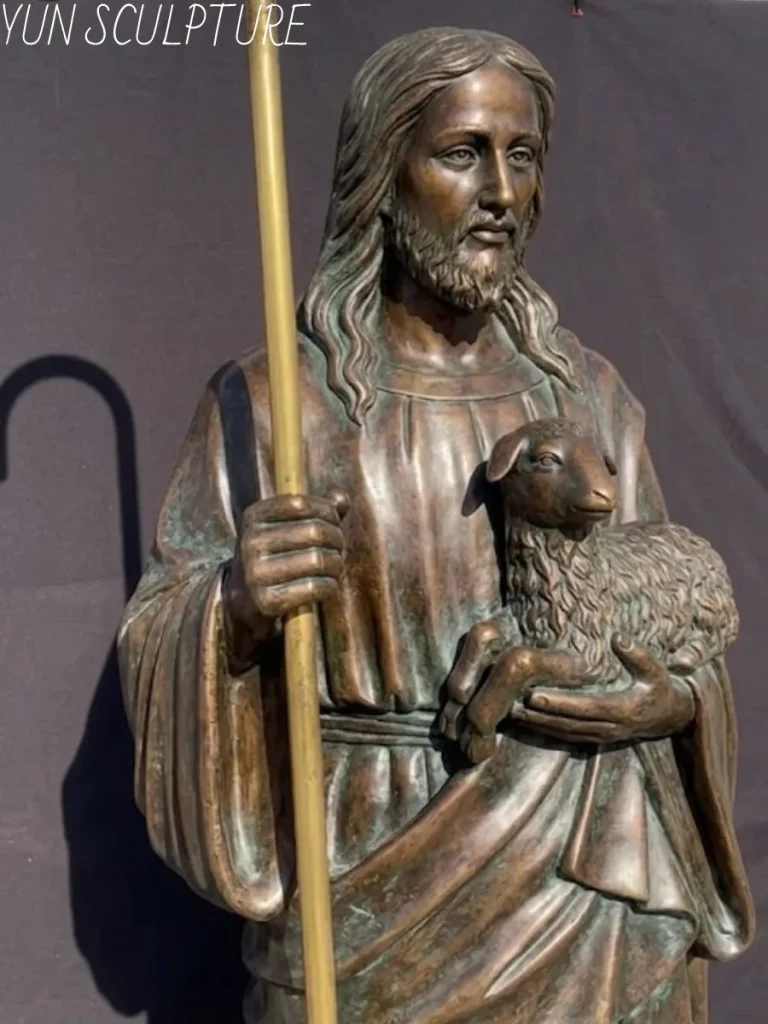
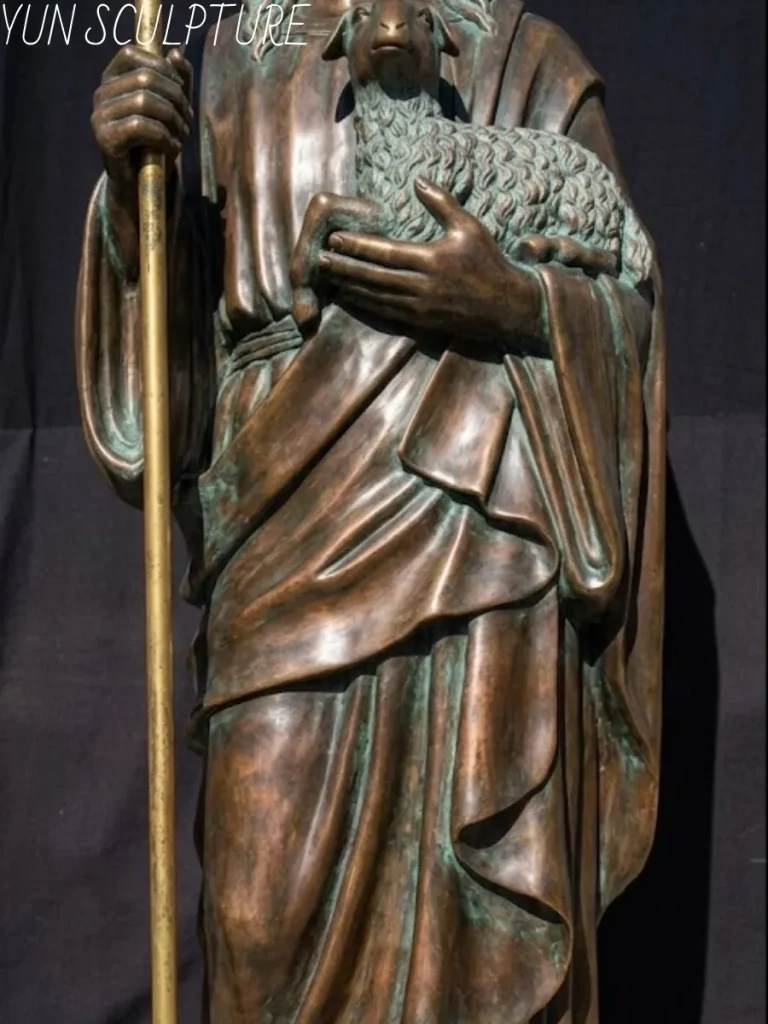
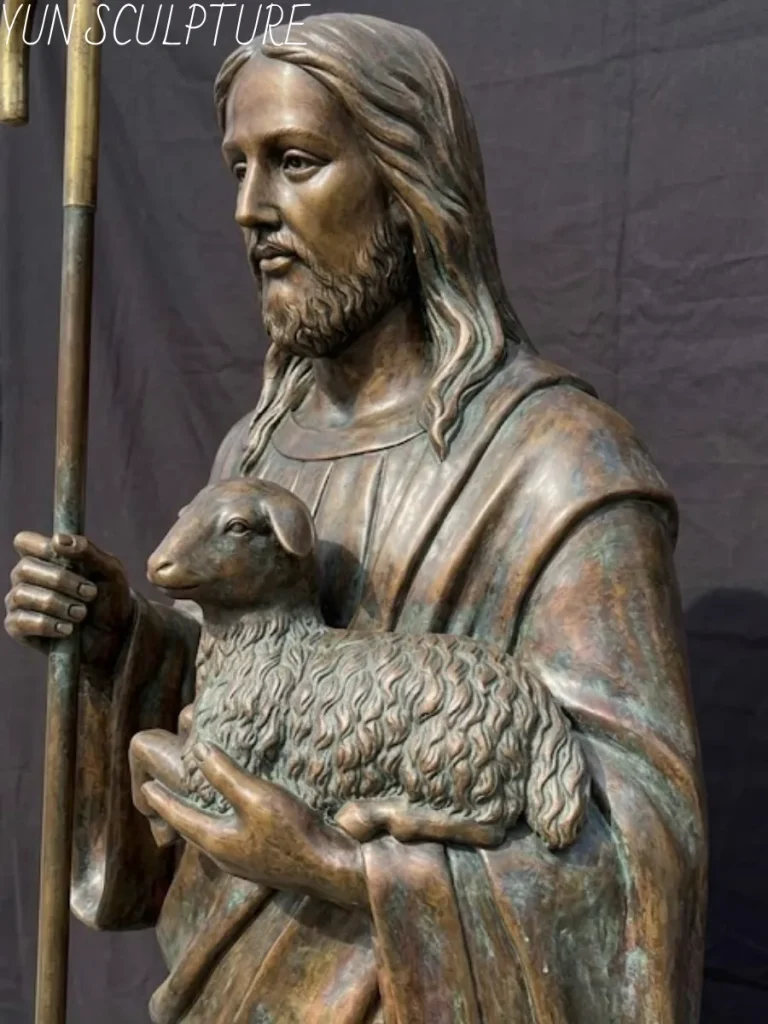
The standard alloy specification for fine art bronze casting is 85% copper, 5% tin, 5% zinc, and 5% lead. This is not an arbitrary formula. The tin hardens the copper matrix and improves casting flow; the zinc increases corrosion resistance; the lead reduces porosity in the finished pour. The result is a material with a density of approximately 8.7 g/cm³—heavy enough to resist impact, stable enough to be welded and repaired centuries after casting.
Patina is not corrosion. It is chemistry in service of beauty.
In coastal environments with salt-laden air, a bronze jesus statue will develop the iconic verdigris—a blue-green copper carbonate layer—within three to five years. In dry continental interiors, oxidation trends toward warm chestnut and tobacco brown. Both are protective. Both are permanent records of where the sculpture has lived.
Maintenance is straightforward: an annual application of paste beeswax, buffed to a light sheen, seals the patina against acid rain and biological deposit. Never use acidic cleaners or pressure washing. In regions with sustained sub-zero winters, a breathable canvas cover prevents the thermal shock cycling that can stress patina layers.
A well-maintained bronze carries a realistic functional lifespan in excess of one hundred years. The lifecycle cost per decade is lower than any alternative material at comparable quality.
Natural Stone: The Eternity of Classics
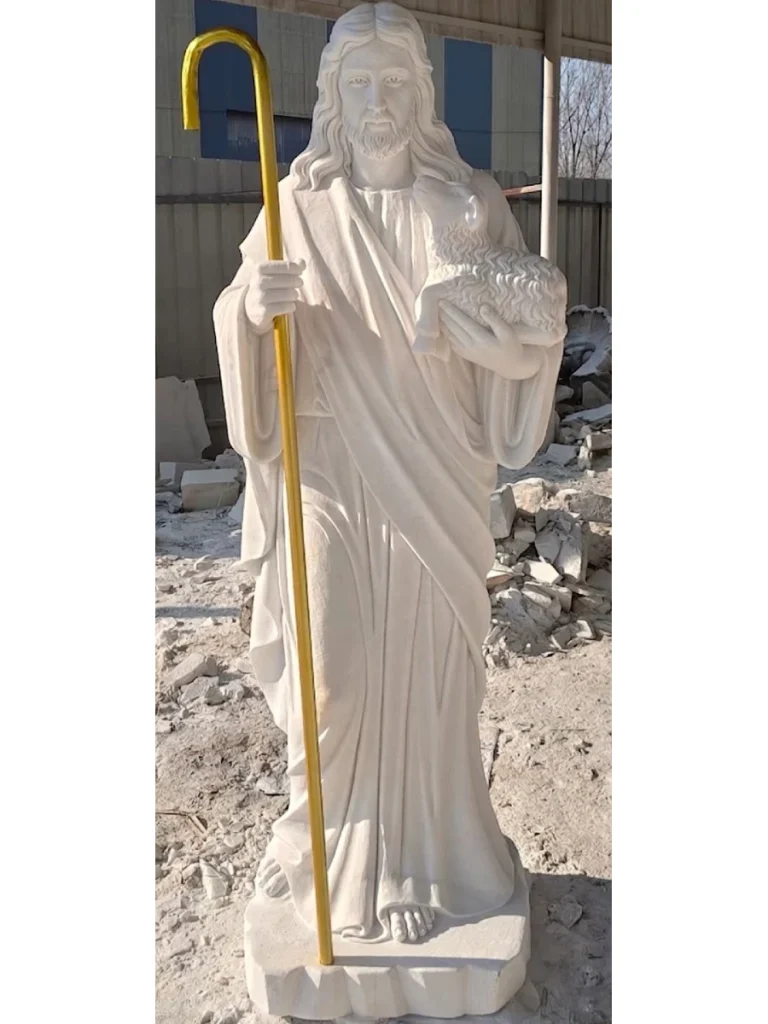
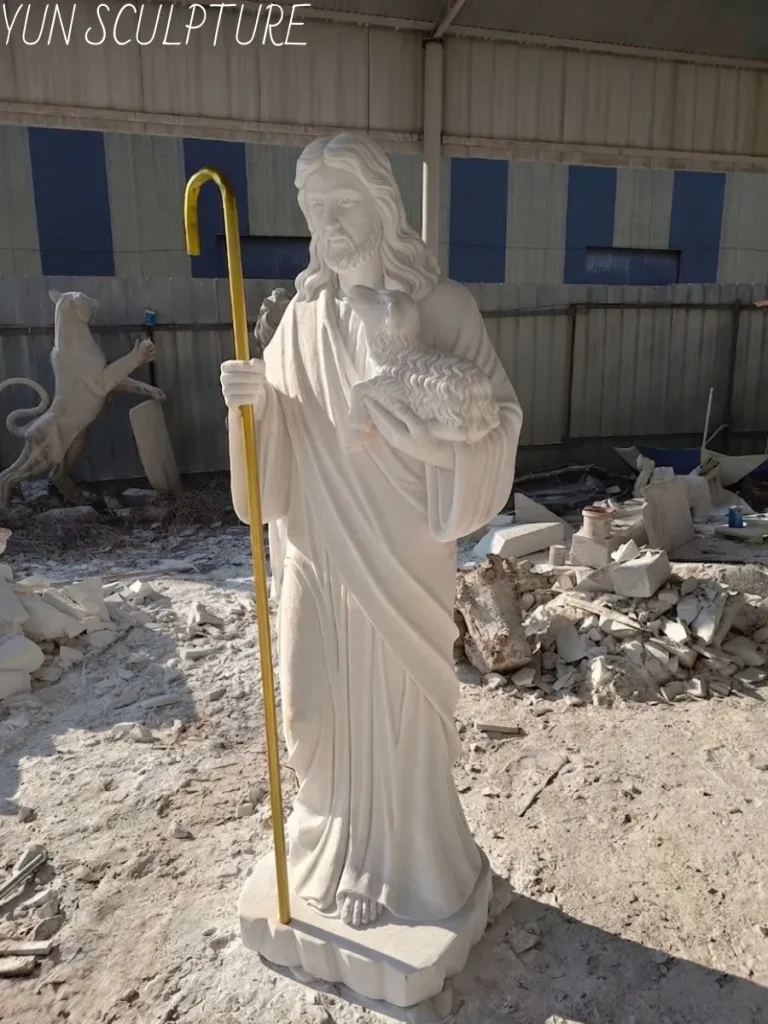
Stone selection is a climate decision before it is an aesthetic one.
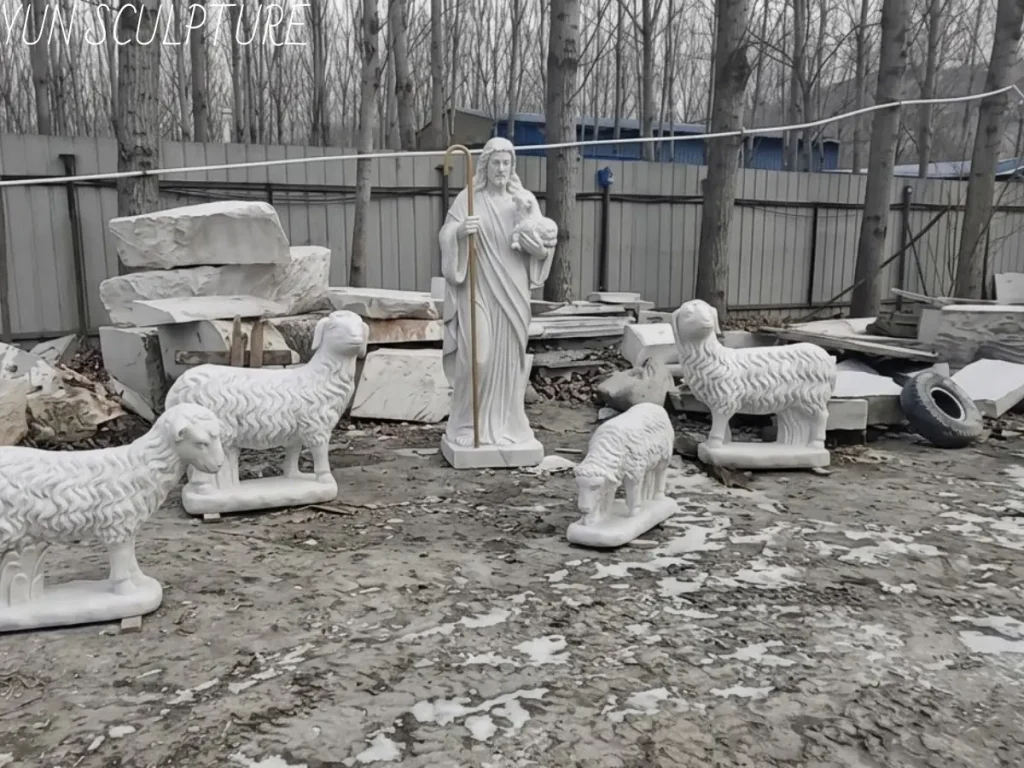
Carrara Marble—quarried from the Apuan Alps of Tuscany and used by Michelangelo—is the correct choice for Mediterranean-climate estates. Its crystalline structure transmits light rather than reflecting it, creating a translucency that no synthetic material replicates. In the angled morning light of a California or Spanish garden, a marble jesus statue appears to glow from within.
Travertine carries a warmer, honey-toned palette and a naturally textured surface. It is sympathetic to Tuscan and Spanish Colonial landscape styles where the material palette already includes aged plaster and terracotta.
Granite is the specification for extreme cold climates. With a water absorption rate below 0.4% and a compressive strength exceeding 200 MPa, it resists freeze-thaw cycling that will eventually fracture less dense stones.
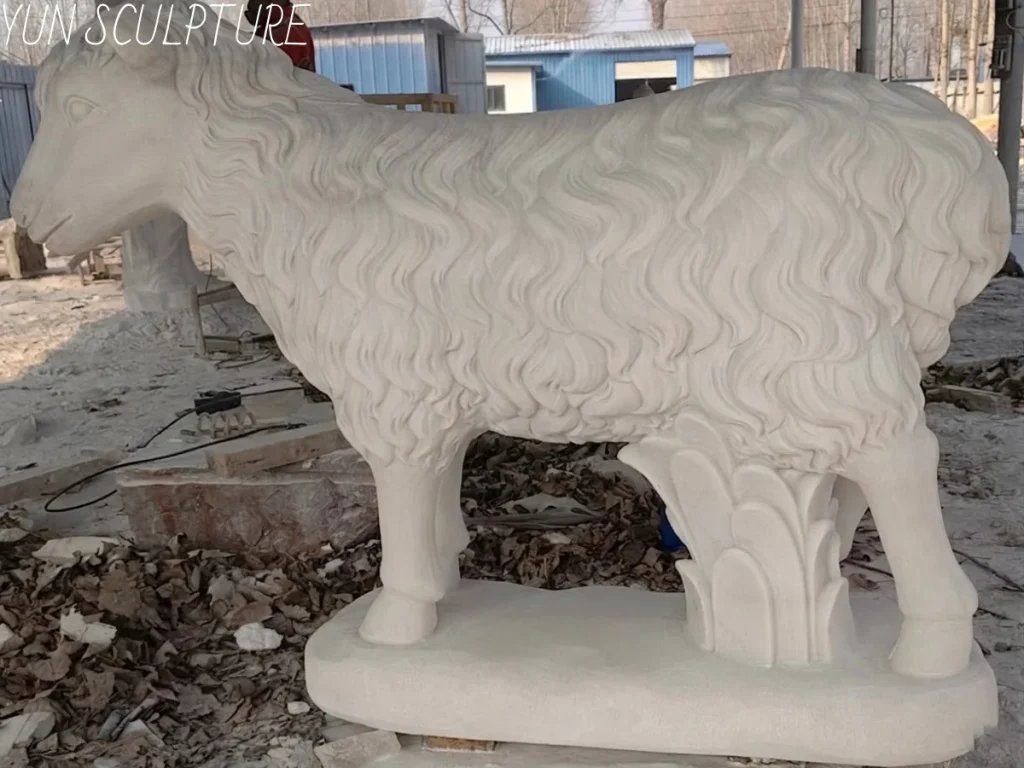
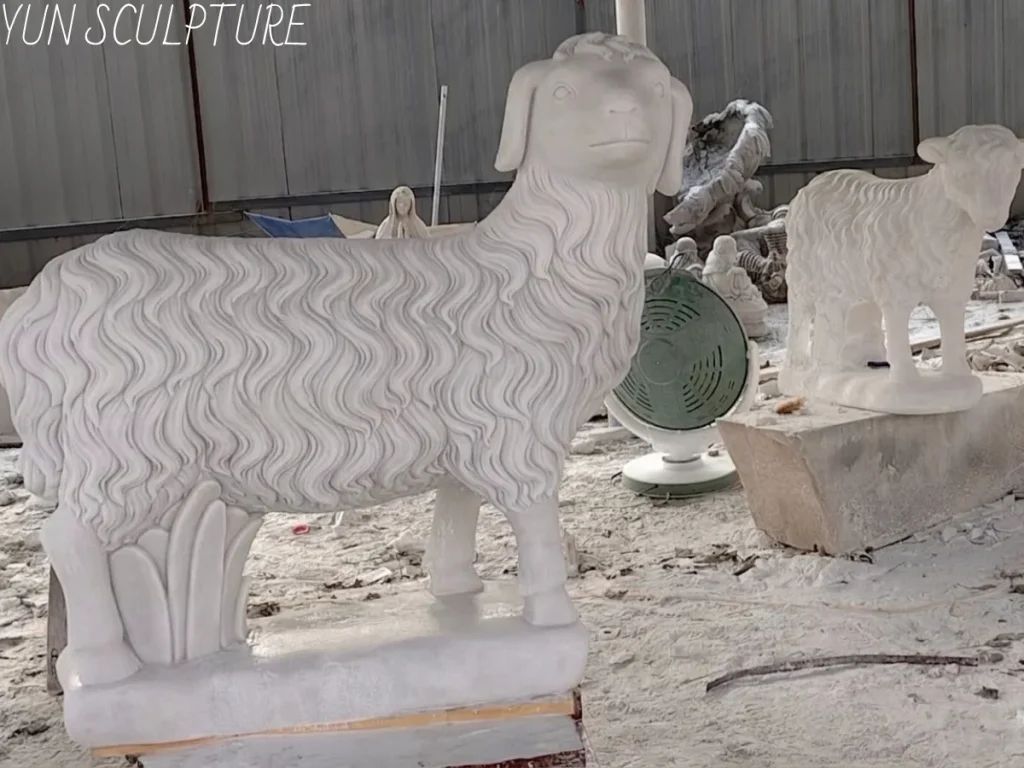
The comparison with concrete jesus statue production deserves directness. Standard decorative concrete absorbs 6–10% water by weight. Carrara marble absorbs less than 0.2%. Under freeze-thaw cycling, that difference is the difference between a statue that lasts decades and one that begins to spall within years. The apparent cost advantage of concrete dissolves entirely when maintenance and replacement cycles are calculated.
Modern Stainless Steel: The Industrial Collision
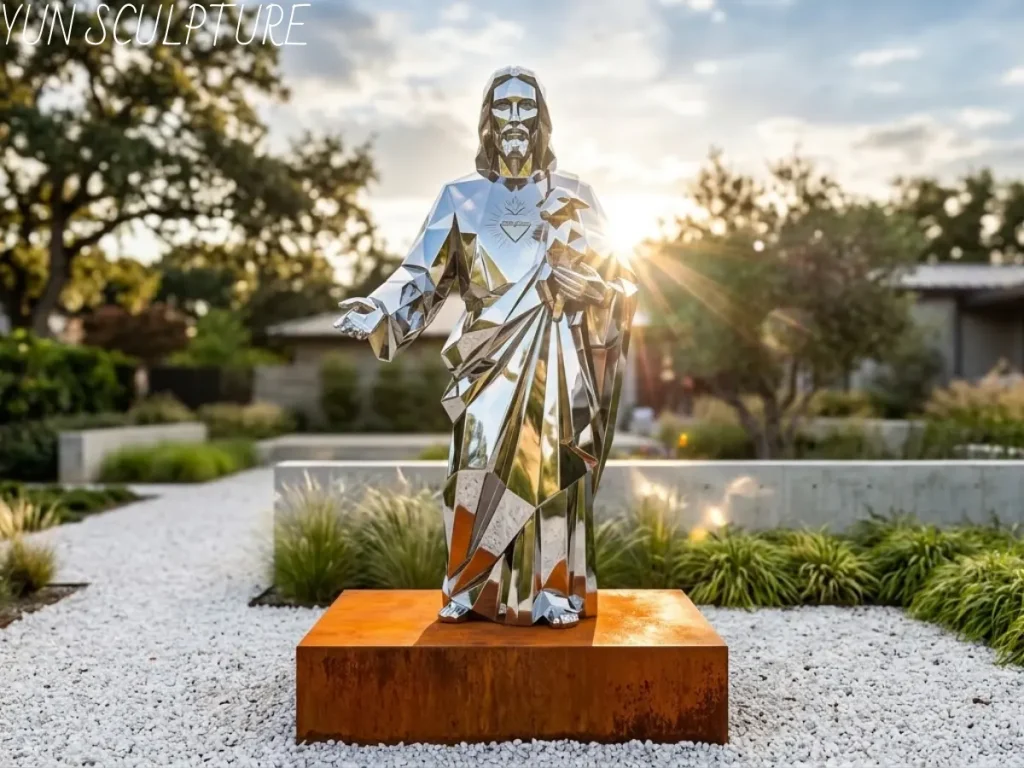

For coastal estates—those within two kilometers of salt water—316L Marine Grade stainless steel is the only responsible specification. The “L” designation indicates low carbon content, which eliminates carbide precipitation at weld zones and prevents the crevice corrosion that destroys standard 304-grade steel in chloride-rich environments.
Mirror-polished steel maximizes light reflection—dramatic in rooftop gardens or minimalist courtyards where the sky itself becomes part of the sculpture’s surface. Brushed finishes diffuse light and reduce visual weight, making a large form feel quieter in a planted garden setting. Both are valid; the choice depends on whether the garden’s design vocabulary asks the sculpture to announce itself or to belong.
The Climate Adaptation Material Matrix
Before any aesthetic decision is made, climate must be resolved. The matrix below is the framework we apply at the start of every international commission.
Climate Adaptation Material Matrix
| Climate Type | Recommended Materials | Avoid | Special Notes |
|---|---|---|---|
| Tropical / Subtropical (Philippines, Florida, SE Asia) | Bronze, 316L Stainless Steel | Untreated marble | Anti-mold silane coating required on all porous surfaces |
| Mediterranean (California, Spain, SW Australia) | Carrara Marble, Bronze | — | Annual beeswax seal on bronze; stone requires no special treatment |
| Continental / Extreme Cold (Northern Europe, Canada, Northern China) | Granite, Bronze | Travertine | Penetrating anti-freeze sealant required for any marble specification |
| Coastal / Marine (Beachfront estates globally) | 316L Stainless Steel, Bronze | Standard iron fittings | Salt spray significantly accelerates bronze patina; plan for earlier aesthetic maturity |
Landscape Engineering and Installation: Bringing the Sculpture to Life
The Science of Scale and Proportion
Scale is not a matter of preference. It is a matter of psychology.
The relationship between a sculpture’s height and its primary viewing distance follows a proportion that landscape architects and classical monument designers have applied for centuries: Sculpture Height ≈ Viewing Distance ÷ 8. A figure placed at the end of a twenty-metre garden path should stand approximately 2.5 metres to command the space with authority. A figure in an intimate courtyard viewed from four metres should stand no taller than fifty centimetres to avoid overwhelming the enclosure. Violate this ratio in either direction and the composition unsettles the viewer without their knowing why.
A life size jesus statue at approximately 180cm occupies the most psychologically potent zone. At this height, the sculpture meets an adult visitor in direct eye contact—or, in the case of the Good Shepherd’s downward gaze, appears to look toward the ground just ahead of where you stand. The effect is conversational rather than monumental. For clients searching for a jesus statue 180cm tall for sale, this scale consistently produces the strongest report of personal resonance in garden settings.
The small jesus statue—between 60 and 90 centimetres—serves an entirely different compositional role. Placed at a path’s bend, half-concealed by clipped yew or emerging from a bed of white agapanthus, it creates what Japanese garden theory calls a Moment of Discovery: the sculpture is not presented to the visitor, it is found. This principle of sequential revelation—concealment before disclosure—generates emotional impact disproportionate to the figure’s physical size.
The large jesus statue at two metres and above crosses into structural engineering territory. Wind load calculations, foundation depth, and anchor bolt specifications become primary design documents before any aesthetic decision is finalised. These commissions require a structural assessment of the installation site before fabrication begins.
Pedestal Design and Lighting
The pedestal is not a platform. It is the final sentence of the composition.
Material pairings should follow an internal logic: a bronze figure on a grey granite base reads as grounded and timeless; a marble figure on a matching marble plinth achieves formal unity; a stainless steel sculpture on a Corten steel base creates a deliberate industrial dialogue between oxidised and polished surfaces. Mismatched pairings—particularly bronze on poured concrete—undermine the quality signal of the sculpture itself.
Pedestal height governs the emotional register of the encounter. A base of zero to thirty centimetres places the sculpture at human scale, emphasising Intimacy—the figure exists in your world, not above it. A base of sixty centimetres or more introduces upward gaze and a degree of reverence, appropriate for estate entrances or chapel gardens where the intention is ceremonial. Framing the base with a low ring of evergreen shrubs—clipped box, dwarf pittosporum, or compact rhododendron—creates a green stage that separates the sculpture from the surrounding ground plane and draws the eye directly to the figure.
On the engineering side, no installation specification is complete without a lighting plan. Uplighting with low-voltage LED ground fixtures, positioned at a forty-five degree angle to the sculpture’s primary face, produces a dramatic chiaroscuro that transforms the composition entirely after dark. The critical decision is made before the base is poured: electrical conduit for low-voltage lines must be pre-buried during foundation construction. Retrofitting conduit through finished paving is expensive and disruptive. A single sixty-watt-equivalent warm LED uplight, correctly positioned, increases the sculpture’s visual presence at dusk by an order of magnitude that no daytime photograph can fully convey.
Safe Installation Engineering

The ground beneath a garden is rarely as stable as it appears.
For installations on lawn or planted soil, a reinforced concrete pile foundation is non-negotiable for any sculpture above one hundred kilograms. As a working reference: a 500kg bronze statue requires a minimum concrete pad of 1.2m × 1.2m × 0.6m depth in standard loam soil, with a central threaded rod anchor pre-cast into the pad to accept the sculpture’s base plate. Soil bearing capacity must be assessed—not assumed.
Wind pressure governs anchor bolt specification. In hurricane-exposure zones including coastal Florida and the Philippines, large jesus statue installations must be engineered to withstand sustained winds of Category 3 equivalence or above. This translates to a minimum of four M20 stainless steel anchor bolts with a minimum embedment depth of 300mm into the concrete foundation, with chemical anchor adhesive rather than mechanical expansion anchors, which can loosen under cyclic loading. These specifications are not conservative estimates—they are the baseline for responsible installation in high-wind regions.
The Custom Workflow: From Your Garden Photo to the Final Masterpiece
The 7-Stage Customization Timeline
A commission of this nature is not a purchase. It is a collaboration across months and thousands of kilometres. The timeline below is the framework Yun Sculpture applies to every bespoke order, from a 90cm garden figure to a monumental estate installation.
Stage 1 — Initial Consultation (3–5 days) The client submits garden photographs from the primary viewing angle, a site plan if available, and reference images representing their aesthetic direction. Our team returns with a material recommendation, scale proposal, and preliminary budget range. No commitment is required at this stage.
Stage 2 — 2D Compositional Proposal (7–10 days) Our design team produces scaled renderings of the proposed sculpture within the actual garden photograph—allowing the client to visualise proportion, material tone, and placement before any physical work begins.
Stage 3 — Maquette (15–20 days) A Maquette—a 1:10 scale clay model—is produced and documented in a 360° video for remote client review. This stage resolves posture, gesture, and compositional balance before committing to full-scale production. Revisions are incorporated here, not later.
Stage 4 — Full-scale Clay Model (30–45 days) The Full-scale Clay Model at 1:1 ratio is the most important approval gate in the process. Clients are invited to visit the studio in person; for international commissions, a comprehensive video review session is scheduled. No casting or carving begins until written approval is received.
Stage 5 — Casting or Carving (45–90 days) Bronze commissions follow the lost-wax process: silicone rubber mould, wax positive, ceramic shell investment, bronze pour, metal chasing, and patination. Stone commissions begin with CNC roughing from the approved digital model, followed by hand-finishing by our senior stone carvers—the details that define quality are always completed by hand.
Stage 6 — Quality Control and Documentation (7 days) Every completed sculpture is photographed in 360° under controlled lighting before leaving the studio. Structural integrity—base plate weld quality, anchor point load testing, surface finish review—is documented and provided to the client as a permanent record.
Stage 7 — Packaging and Shipping (7–21 days) Dependent on destination port and customs processing time.
Tailoring the Scene and Global Logistics
Within the Good Shepherd’s established iconographic framework, personalisation is both possible and encouraged.
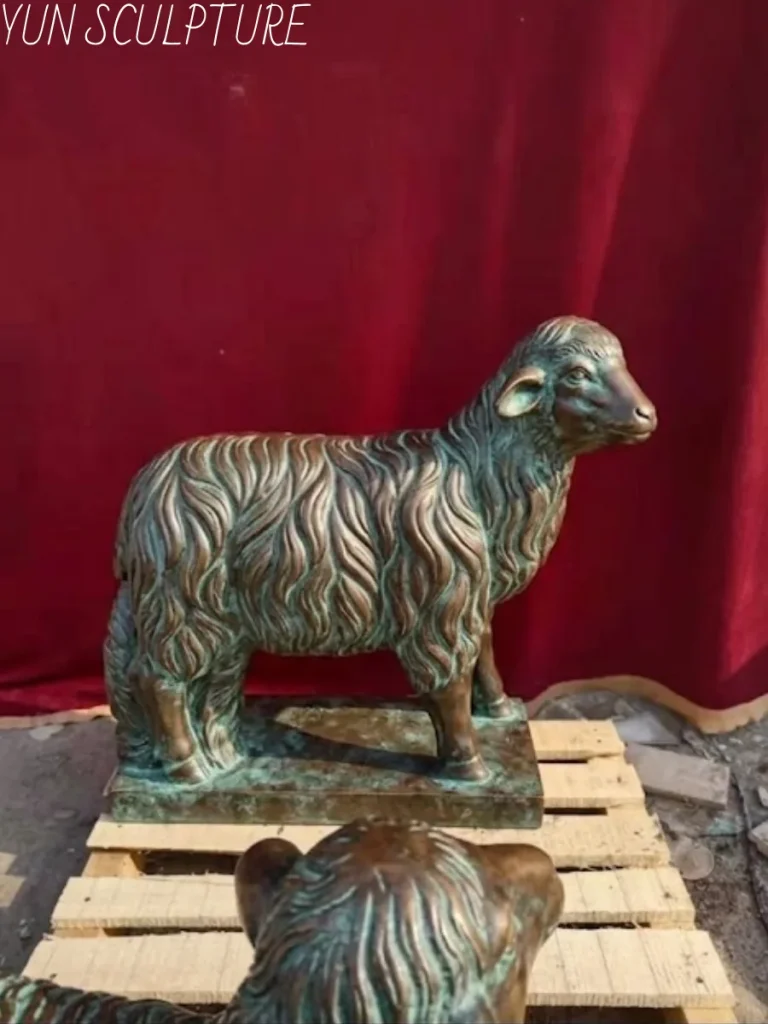
Clients with working farms or ranches have commissioned figures holding specific breeds—a Merino lamb rather than a generic form, a Dorper with its characteristic dark head. Memorial commissions regularly incorporate inscribed text on the base: a name, a date, a verse. The base plinth itself can be carved with local flora—olive branches for a Mediterranean estate, native ferns for a New Zealand property—creating a work that is iconographically universal and geographically specific simultaneously.
On the logistics side, every international shipment leaves our facility in a custom-engineered timber crate lined with high-density EPE foam, with void-fill support at all protruding points—the staff, the lamb, the outstretched hand. Calibrated shock-indicator labels are fixed to the interior; if the crate is mishandled in transit, the evidence is captured. For sculptures above 300kg, the crate is engineered to accept forklift tines from any orientation.
All Yun Sculpture shipments are classified under HS Code 9703—original sculptures and statuary—which carries preferential tariff treatment in most importing countries, including zero or reduced import duty in the European Union, United Kingdom, and under several ASEAN bilateral trade frameworks. For clients inquiring about a risen christ statue for sale philippines or other Southeast Asian destinations, our team coordinates directly with Manila-based licensed customs brokers and maintains working relationships with regional installation contractors who understand local permit requirements and site-specific logistics. DDP (Delivered Duty Paid) terms are available for clients who prefer a single point of responsibility from our studio to their garden gate.
Frequently Asked Questions: Expert Insights for Buyers
What is the name of the Jesus statue in Brazil?
The landmark standing above Rio de Janeiro is Cristo Redentor—Christ the Redeemer—completed in 1931 and now recognised as one of the defining monuments of the twentieth century. Its open arms address an entire city, an entire coastline, an entire civilisation. That is its purpose and its scale.
A private estate’s Good Shepherd operates in a completely different register. Where Cristo Redentor speaks to millions from a mountaintop, the Good Shepherd speaks to one person at the end of a garden path. The power is not diminished by the intimacy—it is made possible by it.
What is the difference between a Good Shepherd statue and a Risen Christ statue?
A resurrected jesus statue—the Risen Christ—is defined by upward movement. Arms lift, the gaze ascends, the body’s entire posture communicates transcendence and victory. It is the grammar of Easter: rupture, triumph, the crossing of a threshold between death and life. Placed in a garden, it draws the eye and the spirit skyward.
The Good Shepherd does the opposite. He looks down. He holds something small and vulnerable in his arms or at his side. Every line of his posture communicates presence rather than transcendence—not the divine breaking free of the earth, but the divine choosing to remain close to it. For private gardens and memorial landscapes, this distinction in gesture is a distinction in meaning.
How much does a custom bronze Good Shepherd statue cost?
There is no catalogue price for a work of this kind, and any supplier who offers one without understanding your project should be treated with caution. Final cost is determined by a specific combination of factors: finished height, the complexity of the lost-wax casting (the lamb’s wool, the robe folds, the staff—each adds mould time and chasing labour), the patina specification, crate engineering for your destination port, and whether you require DDP delivery with full customs clearance included.
We encourage every prospective client to submit their garden photographs and scale requirements through our consultation form. We return a precise, itemised door-to-door quotation—no ranges, no estimates.
How do I maintain a bronze Jesus statue in my garden?
Bronze is among the lowest-maintenance materials available for outdoor sculpture, which is one of the principal engineering arguments for specifying it. Once a year, wash the surface with mild soap and lukewarm water, using a soft brush on textured areas. Never use a pressure washer, and never use any acidic or abrasive cleaner—both will strip the patina unevenly and permanently.
Following the wash, apply a thin coat of microcrystalline wax or natural beeswax with a soft cloth and buff to a light sheen. This annual application seals the patina against UV degradation and acid rain. In climates with sustained sub-zero winters, a breathable cover during the coldest months adds an additional layer of protection that extends the interval between wax applications.
Can marble Jesus statues withstand freezing winters?
The answer depends entirely on which stone you are specifying. Granite, with a water absorption rate below 0.4%, is effectively impervious to freeze-thaw cycling and requires no special winter treatment in any climate currently inhabited by human beings.
Marble is porous by comparison and must be treated with a professional penetrating anti-freeze sealer before the first winter season—and reapplied on a schedule appropriate to your climate. Travertine is the most porous of the three and carries genuine structural risk in extreme freeze-thaw environments; we do not specify it for continental climates without a full protective treatment protocol in place and a client who is committed to maintaining it.
What size Jesus garden statue is right for my garden?
Apply the golden ratio: Sculpture Height ≈ Viewing Distance ÷ 8. Measure the distance from the intended installation point to the primary point from which it will be viewed—a terrace, a path entrance, a garden bench—and divide by eight. That number is your recommended sculpture height in centimetres.
A life-size figure at 180cm is calibrated for the end of a long primary axis, a driveway terminus, or a formal courtyard where the viewing distance is typically twelve to eighteen metres. A 60–90cm figure belongs in an intimate enclosure—a garden nook, a water feature surround, a path bend—where the viewing distance is short and the intention is discovery rather than destination.
How long does it take to custom make a Good Shepherd statue?
The complete process—from initial 3D modelling and maquette approval through 1:1 full-scale clay sculpting, casting or carving, patination or surface finishing, quality documentation, crating, and international shipping—runs between sixty and one hundred days for most commissions. Complex multi-figure compositions or unusually large scales extend that window.
We consistently advise clients to begin the consultation process four to six months before their intended installation date. Estate unveilings, memorial anniversaries, and garden dedications carry fixed dates that cannot be moved. The fabrication timeline cannot be compressed without compromising quality. Beginning early is the only variable entirely within your control.
A Closing Word
A garden changes with every season. Plants grow and are cut back. Light shifts through the year. What was in shadow in March is illuminated in July. The living components of a landscape are in constant, beautiful negotiation with time.
A sculpture does not negotiate. It remains.
The decision to place a custom Good Shepherd statue at the heart of your estate is a decision of a different order than any other landscape choice you will make. It is not a feature. It is not an amenity. It is the point around which everything else in the garden orients itself—the fixed soul of a living composition, a presence that will outlast the hedges, the plantings, the structures, and very likely the people who commissioned it.
Generations from now, someone will walk that same misty path. The figure will still be there. Still holding the lamb. Still looking down with that same patient, particular care.
That is what we build at Yun Sculpture. Not ornaments. Guardians.
We invite you to begin.
— Elena Zhang & Donghui Zhang , Yun Sculpture