Get in touch with Yun-Sculpture company
The Finder of Lost Things: The Ultimate Guide to Custom St. Anthony of Padua Statues in Marble, Bronze, and Steel

In the sweltering heat of June 1231, a thirty-five-year-old Franciscan friar drew his final breath in the Italian city of Padua. Within hours, children ran weeping through the cobblestone streets. They shouted a single, heartbreaking refrain: “The Saint is dead!” The devotion he inspired was a consuming fire across Europe, prompting the Catholic Church to canonize him less than a year later.
Fast forward to the year 2023, high in the coastal hills of Lisbon. A Franciscan college approached our atelier with a sacred architectural mandate to build a monumental, outdoor st anthony of padua statue. The internal stainless-steel armature had to account for the intense wind shear and seismic activity common to the Iberian Peninsula. The bronze itself needed to withstand the relentless, salt-heavy Atlantic winds for centuries without compromising its structural integrity.
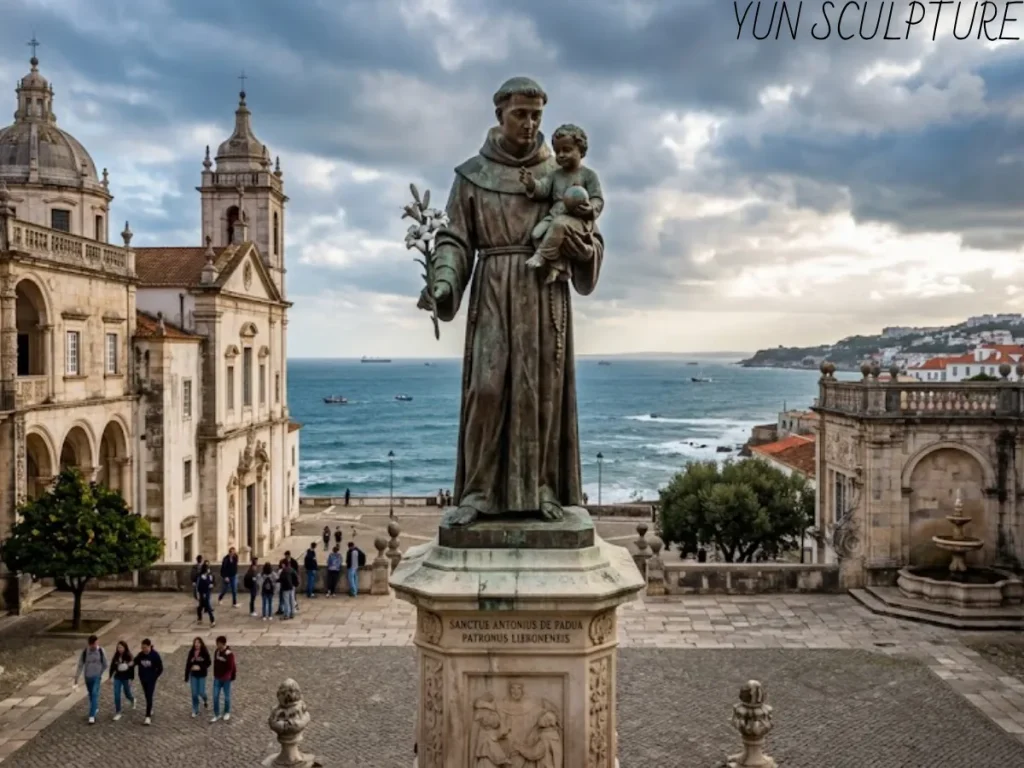
These parallel moments—ancient spiritual fervor and modern structural longevity—define our daily work at Yun Sculpture. We stand precisely at the intersection of divine devotion and metallurgical endurance. A custom st anthony statue is never just a piece of carved stone or cast bronze. It functions as an eternal anchor of faith, demanding that the material weight of the sculpture match the spiritual weight of the subject.
People worldwide seek the familiar comfort of a statue of st. anthony to grace their sanctuaries, public squares, and private chapels. He remains an enduring beacon of hope in a fractured world. Yet, before the first chisel strikes Carrara marble or the foundry furnace ignites, a vital challenge presents itself. Who is this man, and how do we structurally and theologically build his image?
Table of Contents
Table of Contents
Who Is St. Anthony of Padua? — The Theology and Iconography of the World’s Most Popular Saint
The Man Behind the Statue — Eight Centuries of Devotion
To sculpt the saint accurately, one must first map the contours of his remarkable life. He was born Fernando Martins in Lisbon in the year 1195 to a wealthy and noble family. His early spiritual journey began within the quiet, ordered cloisters of the Augustinian order. He spent years immersed in rigorous theological study, ancient manuscripts, and silent contemplation.
Drawn eventually by the radical call of absolute poverty, he traded his comfortable Augustinian robes for the humble, rough-spun garb of the Franciscans. He adopted the name Anthony and embarked on a relentless journey of faith. His fiery, eloquent sermons captivated massive crowds across Italy and France, ultimately drawing him to preach in Padua. He possessed a voice that pierced through the noise of medieval city squares, offering salvation to the marginalized.
Death came swiftly on June 13, 1231, ending a remarkably short but explosive earthly ministry. His brilliance in scripture and preaching was virtually unmatched in his era. Recognizing his monumental theological contributions to the Church, Pope Pius XII officially declared him “Doctor Evangelicus” in 1946. This elevated title acknowledged that his teachings held universal importance for the entire Catholic faith.
Today, he carries a vast and heavy mantle of global patronage. He is universally venerated as the Finder of Lost Things, an intercessor for those who have misplaced both physical objects and spiritual direction. Yet, his holy intercession extends far beyond missing items.
He serves as the celestial patron of the poor, weary travelers, and seekers of love. He also stands as the fiercely beloved patron saint of both his birth country of Portugal and his final resting place of Padua. Understanding these multifaceted roles reveals the true st anthony statue meaning. A patron of the poor requires an expression of boundless empathy carved into the marble, not the stern judgment of a detached academic.
Three Saints Named Anthony — The Iconographic Confusion You Must Resolve First
Religious sculptural commissions demand absolute iconographic precision from the very first conceptual sketch. A single misplaced visual attribute renders a sacred work theologically inaccurate and unfit for liturgical blessing. At Yun Sculpture, we frequently encounter parishes and private patrons who confuse the great Saints named Anthony. This confusion can lead to disastrous architectural and theological missteps if not immediately corrected.
Differentiating these holy men is our crucial first step in the armature design and clay modeling process. The most frequently commissioned figure is St. Anthony of Padua, who lived from 1195 to 1231. His standard, Church-approved iconography dictates a young Franciscan friar wearing a simple brown habit tied with a three-knotted cord representing poverty, chastity, and obedience. He gently cradles the Infant Jesus in his arms and holds a white lily signifying total purity.
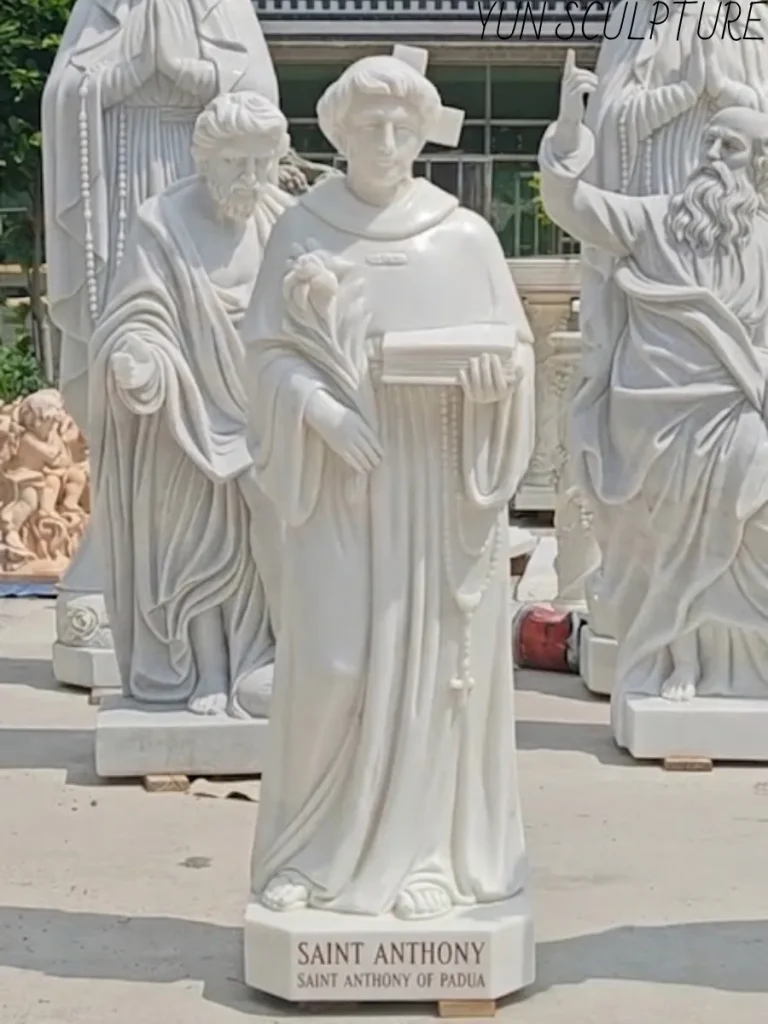
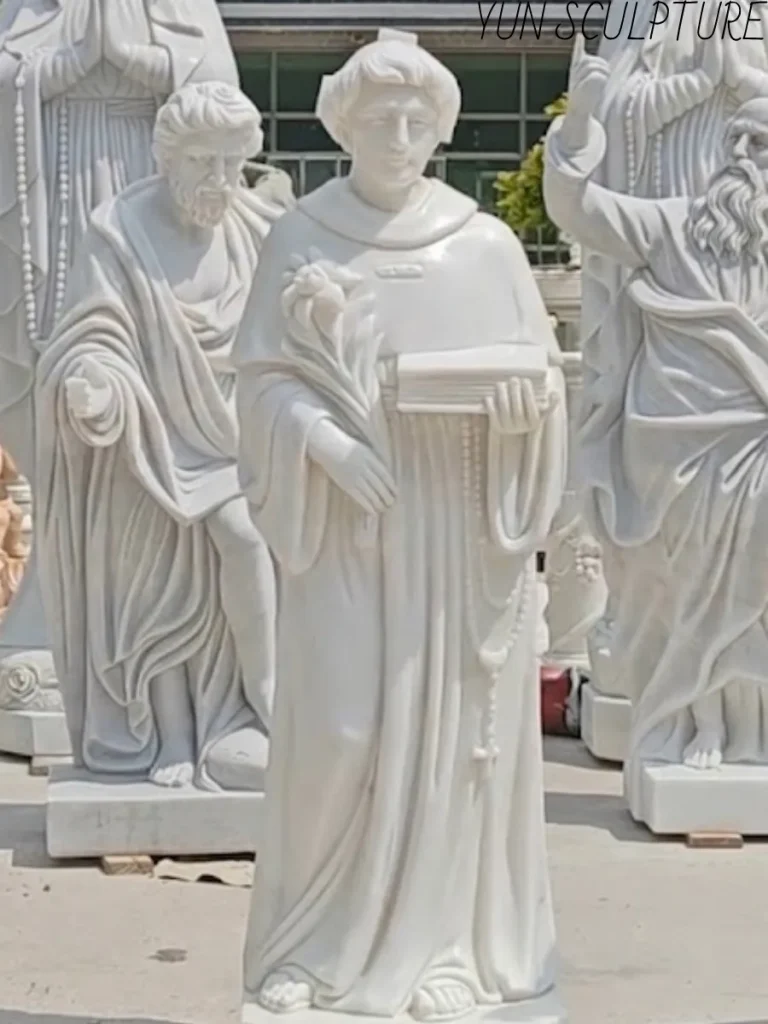
The second figure represents an entirely distinct historical and theological entity. St. Anthony the Abbot lived centuries earlier, from 251 to 356. Creating an accurate st anthony the abbot statue requires an entirely different visual and structural vocabulary to reflect his rugged, isolated life in the harsh wilderness.
He was a desert hermit who battled intense spiritual warfare for decades. The correct depiction shows an elderly, bearded man in a dark or black monastic habit. He grasps a heavy T-shaped staff, and is frequently accompanied by a pig at his feet. This specific animal signifies his ultimate victory over demonic temptations and his established patronage of domestic animals.
Finally, there is the title of St. Anthony of Egypt. Parishes must understand that this refers to the exact same historical figure as the Abbot. When a diocese requests a st anthony of the desert statue, we apply the identical ascetic attributes of the ancient hermit. We entirely discard the gentle Franciscan lily and the Holy Child in favor of the stark, heavy symbols of the Egyptian sands.
The Iconographic Elements — What Every St. Anthony of Padua Statue Must Include
To achieve canonical accuracy, a sculptor must master the specific visual vocabulary of the saint. The Church relies on these sacred visual cues to instruct the faithful without a single spoken word. Each attribute carries profound theological weight. Simultaneously, each attribute presents a distinct structural demand in the atelier.
- The Franciscan Habit: St. Anthony wore the rough-spun tunic of the Order of Friars Minor. The artistic challenge lies in the textural contrast. We cannot carve or cast this garment to resemble the flowing silk of a Renaissance nobleman. The folds must fall with the heavy, unyielding drape of coarse medieval wool. Our stonemasons use specialized tooth chisels to scar the marble surface slightly, ensuring the fabric absorbs light rather than reflecting it. The three-knotted cord, symbolizing poverty, chastity, and obedience, must demonstrate severe physical tension against the heavy cloth.
- The Infant Jesus: Historical accounts describe a miraculous vision where the Christ Child appeared to Anthony in his private quarters. A standard st anthony statue with baby jesus captures this moment of profound, quiet intimacy between the friar and his Savior. However, modern parishes frequently request a specialized saint anthony statue with removable infant jesus. This specific liturgical design allows the parish to physically remove the Christ Child during the penitential season of Advent, returning Him to the saint’s arms precisely at Midnight Mass. Engineering this requires absolute precision. In marble, we drill and install concealed brass sleeves. In bronze, we engineer internal, load-bearing locking mechanisms. A solid bronze infant can weigh forty pounds; the locking joint must endure decades of handling without compromising the aesthetic line of the saint’s embrace.
- The White Lily: The lily stands as the universal Church symbol of absolute purity and innocence. Creating a st anthony lily statue demands exceptional caution and structural foresight from our master carvers. Carving an isolated, thin flower stem from a solid block of Carrara marble presents a severe risk of fracturing. The crystalline structure of natural stone possesses immense compressive strength but poor tensile strength. To achieve architectural longevity in a marble statue of st. anthony, we must anchor the lily stem directly to the saint’s chest or forearm. Alternatively, we fabricate a discrete, hand-forged bronze lily to insert into the stone hand, entirely removing the tensile risk from the delicate fingers.
- The Holy Bible: The scriptures symbolize his elite status as “Doctor Evangelicus.” The Word of God is the absolute foundation of his preaching and his enduring legacy. Often, our compositional designs place the heavy, open book directly in his hands. This creates a flat, highly stable architectural plane for the Infant Jesus to stand upon, brilliantly unifying his deep theological intellect with his divine visions.
The Miracle of the Donkey — The Most Extraordinary Iconographic Scene
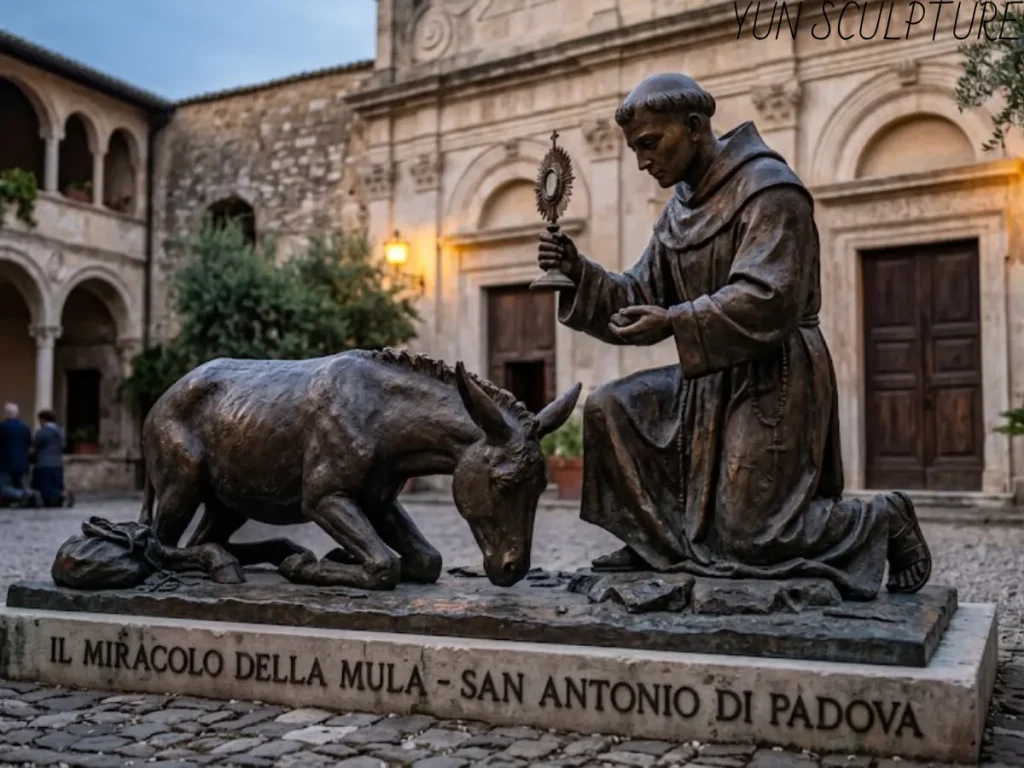
Beyond standard portraiture, the life of St. Anthony offers scenes of spectacular theological triumph. None is more visually striking than the Miracle of the Eucharist in Rimini. A local heretic named Bononillo publicly mocked the Catholic doctrine of the Real Presence. He aggressively challenged Anthony to prove that Christ was truly present in the consecrated host.
The terms of the challenge were brutal and public. Bononillo locked his own work mule in a pen and starved the animal for three entire days. On the appointed hour, a massive, tense crowd gathered in the city square. Bononillo confidently brought forward a large pile of fresh, fragrant oats. St. Anthony stood opposite him in total silence, holding the Blessed Sacrament in a gleaming golden monstrance.
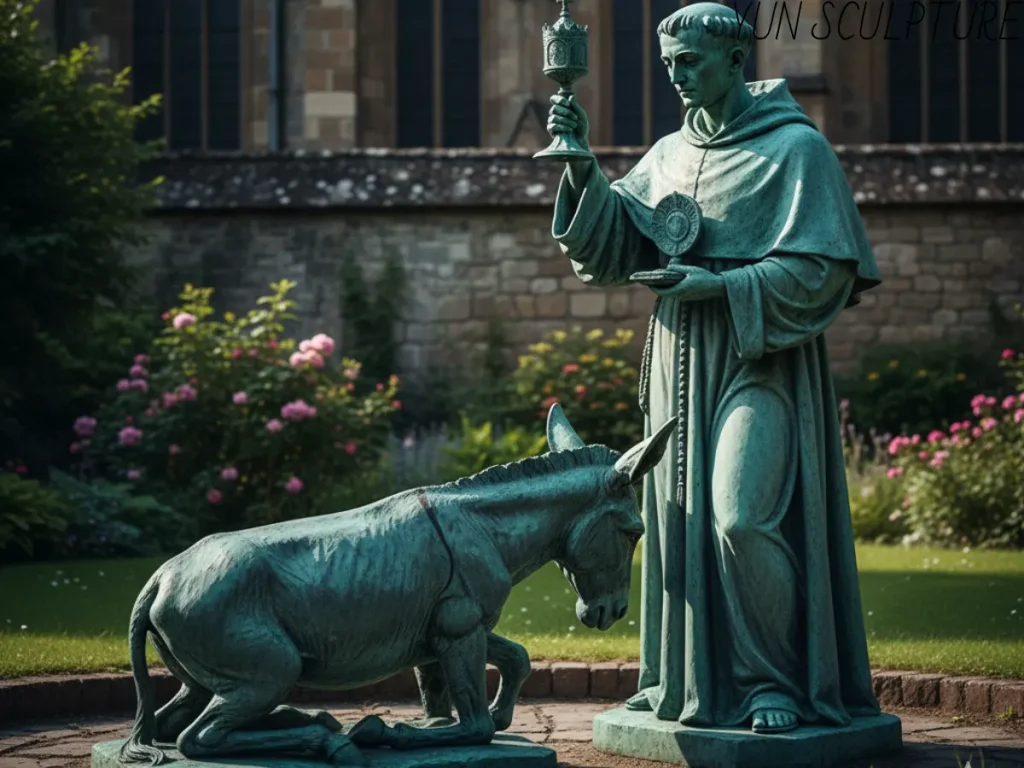
Upon its release, the starving beast entirely ignored the desperately needed fodder. Instead, the animal walked directly toward the barefoot friar. It miraculously bent its front legs, bowing its heavy head to the cobblestones in absolute adoration of the Eucharist. The stunned heretic immediately fell to his knees weeping, converting to the faith on the spot.
Translating this theological victory into a permanent monument results in our most complex dual-figure commission: the st anthony and the donkey statue. The structural demands of this scene multiply exponentially. We are no longer calculating the vertical load bearing of a single, upright human figure. We must seamlessly synthesize two entirely different anatomical structures within a unified, dramatic narrative.
The primary engineering hurdle is proportional harmony. A full-scale working beast possesses massive physical volume compared to a slender, fasting friar. If the animal is modeled too large, it visually swallows the saint and dominates the composition. If modeled too small, the majestic, overwhelming nature of the miracle is trivialized into a cartoonish caricature.
Furthermore, articulating the animal’s kneeling posture requires relentless anatomical study. A kneeling ungulate is a complex, unnatural biomechanical event. A beast of burden’s front knees do not simply hinge; the joints fold under immense muscular strain. We must sculpt the skeletal structure pressing violently against the hide. This proves the animal is actively supporting its massive weight in a miraculous posture of reverence, rather than simply collapsing from starvation.
Finally, the bronze or stone plinth itself demands rigorous structural engineering. The shared base must flawlessly accommodate severe weight disparities. The standing friar exerts a narrow, concentrated vertical load. The kneeling beast spreads thousands of pounds of material across an extended, horizontal axis. We design immense internal stainless-steel armatures that permanently link both figures deep within the base. This guarantees that catastrophic weather shear or seismic shifts will never separate the adoring beast from the triumphant saint.
The Hidden Traditions — Spiritual Practices Around the St. Anthony Statue
St. Anthony as Finder of Lost Things — The Prayer Tradition
“St. Anthony, St. Anthony, please come down. Something is lost and must be found.” This simple rhyming prayer echoes through generations of Catholic households. Millions rely on the friar to recover misplaced keys, documents, or wedding rings. Yet, the profound st anthony statue meaning transcends the recovery of mere physical objects.
Theologically, his intercession directly addresses the deepest, most agonizing spiritual losses of the human condition. The faithful kneel before his image when they have lost their health, their closest personal relationships, or the guiding light of their faith. He acts as the ultimate seeker of lost souls, a divine detective searching the shadows for those who have wandered away from grace.
St. Anthony as Finder of Love — The Upside-Down Tradition
In the vibrant cultural landscapes of Brazil and Portugal, a unique and demanding folk tradition flourishes during his feast day. Unmarried women seeking a devoted husband will intentionally turn their st anthony statue upside down. They playfully threaten to leave the friar stranded on his head until he successfully intercedes and delivers a worthy spouse. While orthodox Catholic theology formally discourages this somewhat coercive practice, it remains deeply entrenched in local expressions of faith.
As structural engineers, we must anticipate exactly how patrons will physically interact with their commissions. We routinely receive inquiries from South American dioceses requesting statues specifically designed to accommodate this inversion tradition. To ensure the sculpture survives this rigorous handling, we engineer exceptionally stable, perfectly flush bases. We also apply specialized frosted treatments to the absolute bottom of the stone or bronze, guaranteeing the inverted sculpture will not scratch the polished wood of domestic furniture or church altars.
Burying St. Anthony to Sell Your House — The Real Estate Tradition
Another widespread folk practice involves desperate homeowners attempting to bury st anthony statue to sell house properties quickly. This represents a fundamental categorical error in popular devotion. The actual real estate tradition belongs entirely to the earthly father of Christ. Homeowners traditionally bury a statue sleeping st joseph or a st joseph lying down statue facing the desired property line. St. Anthony, unfortunately, suffers from cases of mistaken identity in the turbulent housing market.
Our atelier strictly designs sacred art for elevated veneration, never for subterranean burial. However, this popular confusion highlights a critical environmental reality for our outdoor commissions. Statues placed in garden shrines frequently rest directly on damp, acidic topsoil. To combat this aggressive environment, we engineer absolute defense mechanisms against ground-level moisture. We deploy marine-grade anti-corrosion chemical treatments and integrate 316L stainless steel sub-bases, ensuring the sculpture remains pristine even in permanently saturated earth.
The Sculptor’s Challenge — Three Figures in One Commission
The St. Anthony with Infant Jesus — A Dual-Figure Commission
Engineering an adult male supporting a heavy infant on a single, extended arm presents a distinct biomechanical dilemma. We cannot mask structural supports under billowing, voluminous fabric as we routinely do with the Virgin Mary’s wide mantle. The humble Franciscan habit rests flat and tight against the saint’s anatomy. Consequently, the saint’s sculpted cuff and his projecting forearm become high-risk suspended areas. These unsupported horizontal planes demand extreme internal tensile reinforcement to prevent sheer failure under the weight of the Christ Child.
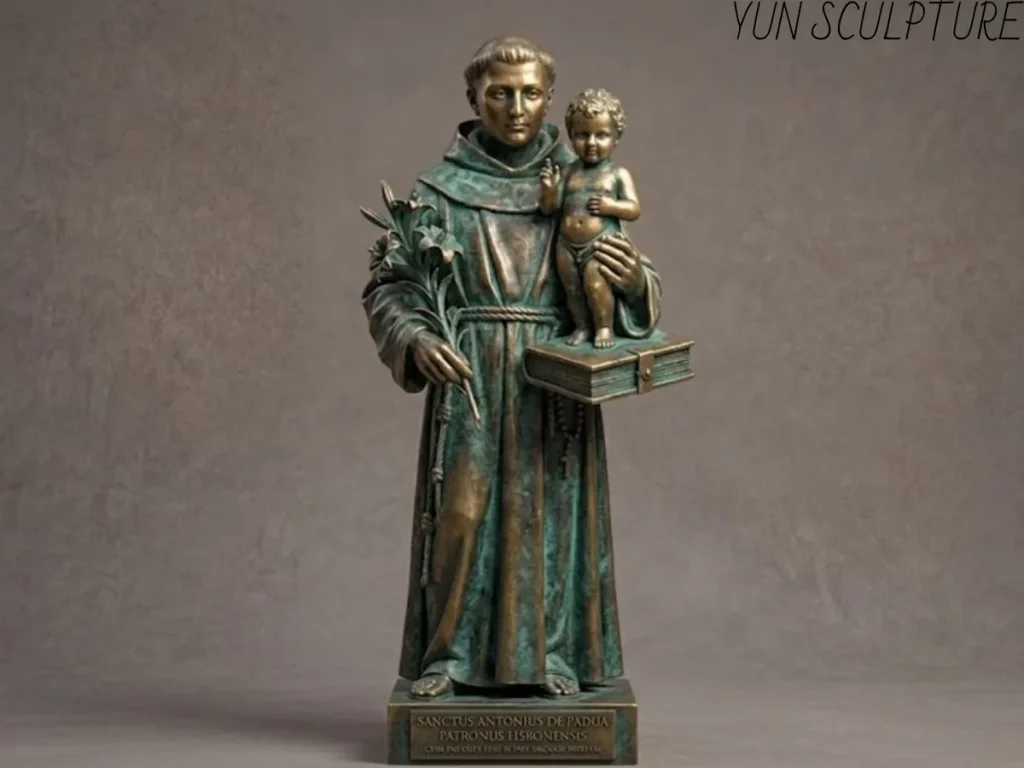
This structural reality brings us to a closely guarded industry secret regarding the saint’s most fragile attribute. To prevent catastrophic breakage, we never carve a freestanding marble lily stem from pure stone. Instead, we carefully drill and embed a 4-6mm 304 stainless steel core rod directly inside the delicate stone stem. For cast bronze commissions, the metallic stem can be considerably thinner. However, this narrow channel requires highly specialized investment molds and advanced thermal gating systems to prevent microscopic casting porosity.
The increasing liturgical demand for a removable infant introduces profound mechanical complexities. In our marble commissions, we execute a flawless precision mortise and tenon joint. This joint is milled to an exacting tolerance of ±0.1mm and hand-polished to achieve a secure, vacuum-like friction fit. For our bronze masterpieces, we entirely eliminate visible hardware. We embed an invisible, industrial-grade neodymium magnetic locking system deep within the saint’s arm, ensuring the heavy bronze child clicks seamlessly and securely into place.
The Vintage St. Anthony — Replicating Antique Originals
Many legacy parishes flatly refuse modern aesthetic interpretations, demanding instead a true vintage st anthony statue. These nineteenth-century devotional styles carry a distinct, historical visual signature that must be respected. Authentic antique models feature decidedly squarer facial structures, deeply shadowed, prominent brow bones, and highly stylized, rigid folds in the monastic habit. Furthermore, historical iterations almost always feature a proportionally much larger, older Infant Jesus compared to contemporary, lifelike baby figures.
Replicating these fragile, often crumbling antiques requires an intense synthesis of digital preservation and traditional handcrafting. We first deploy laser scanners to extract precise 3D topographical data directly from archival photographs or severely broken plaster originals. Our master artisans then hand-sculpt the clay maquette over the 3D-printed armature. This critical manual step retains the organic, imperfect “period feel” of the antique. Finally, we cast the work in solid bronze, applying an accelerated chemical patina to perfectly simulate the oxidized depth of century-old cast iron.
Material Guide — Marble, Bronze, and Stainless Steel for St. Anthony
The choice of a physical medium dictates the entire spiritual dialogue between the sacred artwork and the surrounding architecture. In ecclesiastical art, materials do not merely provide mass and physical form. They carry profound symbolic weight that must align precisely with the theology of the subject. Elena and Zhang emphasize that for St. Anthony of Padua, we carefully evaluate three primary materials—marble, bronze, and stainless steel—to anchor his holy presence in both private and public sacred spaces. This guaranteed alignment makes every commission a perfect balance of divine reverence and engineering integrity. We will guide you through the structural and theological merits of each choice.
Marble — The Scholar’s Material
St. Anthony carries the official ecclesiastical title of “Doctor Evangelicus,” recognizing his immense contributions to the Church’s teachings. Elena points out that white marble’s clarity perfectly matches his intellectual purity. Because of this profound match between the stone and the saint, we frequently recommend pure white marble for his representation. The exceptional clarity of premium white marble directly mirrors the radiant theological brilliance of the great saint.
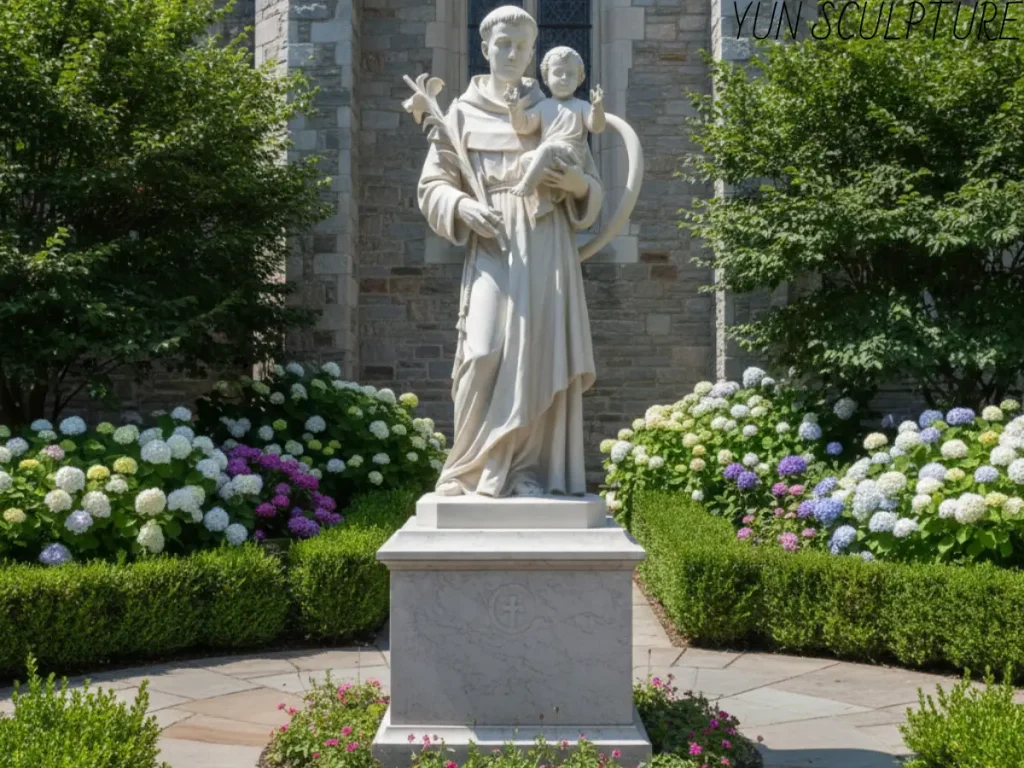
To bring the cold stone to life and avoid a flat visual plane, Donghui Zhang oversees a highly controlled polishing gradient across the composition. Our master carvers execute a radiant, high-gloss finish specifically for his face, his hands, and the delicate figure of the Infant Jesus. We also apply a high-gloss finish for the lily held in his arms, ensuring these focal elements actively capture and reflect sanctuary light.
The outer surfaces of the Franciscan habit receive a contrasting medium polish. Conversely, the deep, recessed folds of the rough cloth receive a flat, matte finish that absorbs light. This precise polishing gradient prevents the stone from appearing monolithic to the viewer. This traditional medium remains the premier choice for a statue of st. anthony or a st anthony small statue placed directly on indoor altars and private devotional niches.
Bronze — For Gardens, Parishes, and Outdoor Landmarks
Elena emphasizes that the Franciscan spirit always emphasizes nature above all else. Consequently, executing a st anthony garden statue, a st anthony outdoor statue, or a st anthony yard statue in cast bronze honors his monastic heritage perfectly. It places the saint directly into the living environment of the faithful, honoring the classic Franciscan love for the outdoors.
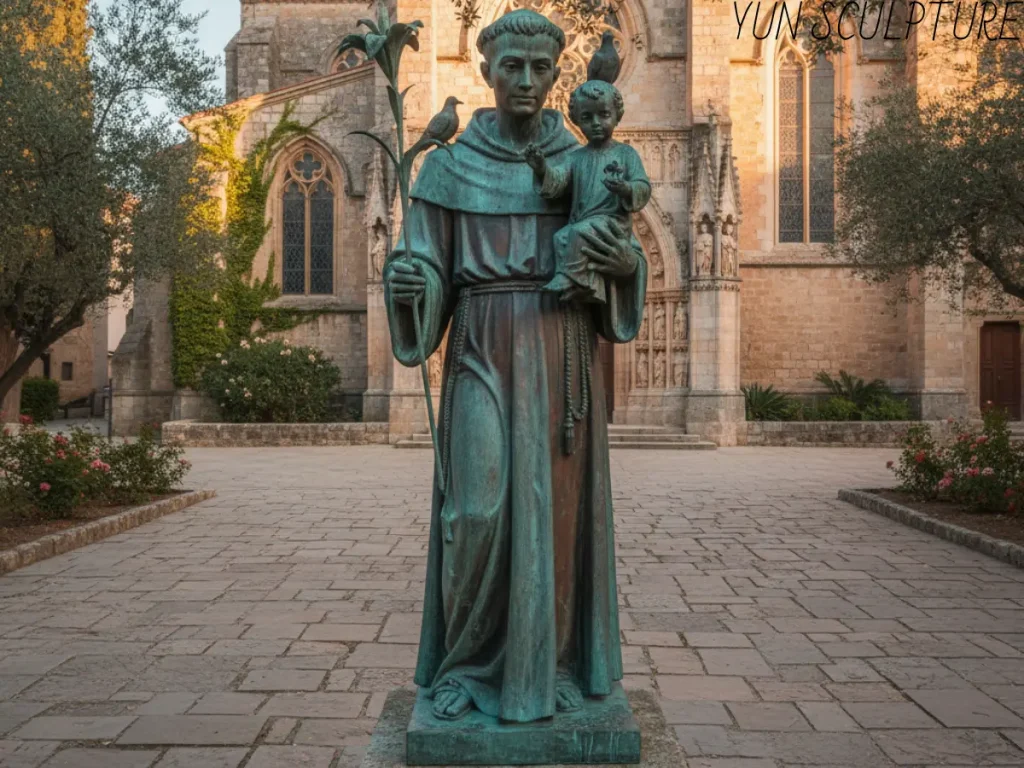
Donghui Zhang explains that bronze allows our atelier to utilize advanced chemical patinas to achieve exact iconographic colors across the sculpture. We apply a specific patina of deep statuary brown for the habit worn by the saint. We treat the leaves and stem of the lily with a cupric patina to achieve a natural, organic green. For the skin of the Infant Jesus, we apply a warm gold that visually separates the divine Child from the earthly friar.
When parishes commission a st anthony statue large in scale for an exterior courtyard or landmark, we conduct rigorous environmental engineering. We perform exhaustive wind load analysis to ensure the heavy metal composition withstands severe atmospheric shear without tilting or swaying. For installations near active coastlines, we apply multi-layered anti-salt spray treatments to shield the metal from corrosive ocean air, preserving the specific chemical patina for centuries.
Stainless Steel — The Contemporary Anthony for Modern Sacred Spaces
Modern ecclesiastical architecture occasionally demands a departure from traditional artistic mediums. Donghui Zhang champions stainless steel as perfect for modern university chapels or hospital entrances. High-grade stainless steel offers a striking, modern interpretation of the beloved saint for these specific institutions, matching their clean aesthetics perfectly. This material is the ultimate modern choice for contemporary installations.
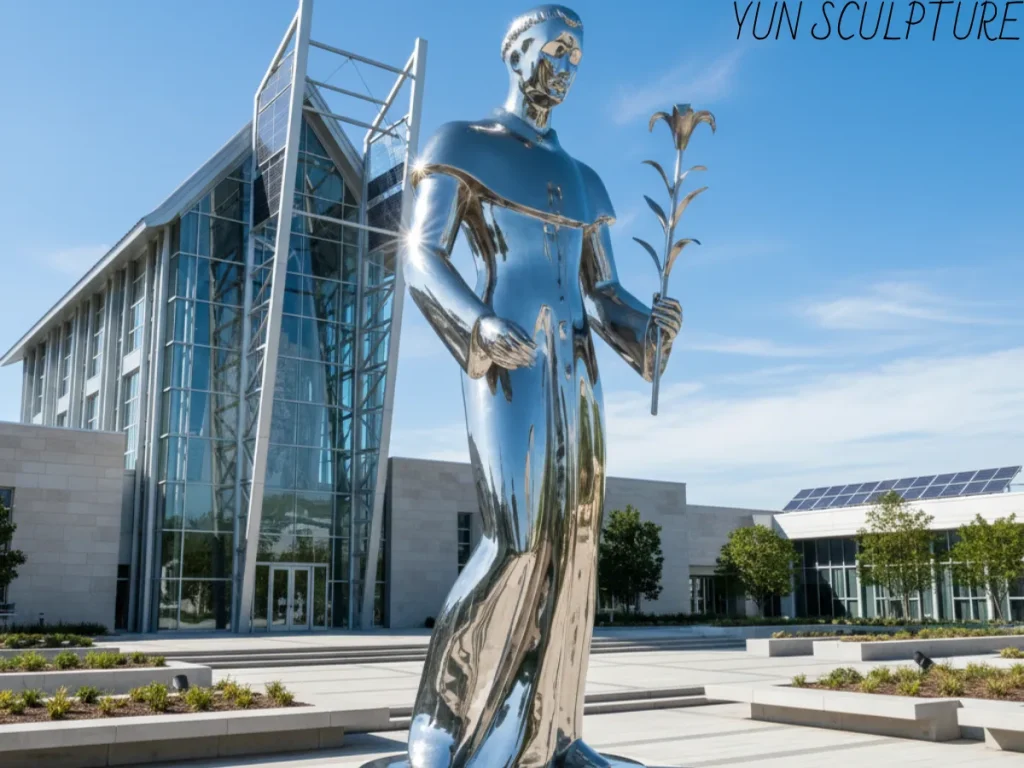
The material provides unparalleled structural capabilities for our engineering team. Donghui Zhang points out that stainless steel’s bending strength is approximately 100 times that of marble. This extreme tensile strength allows us to manufacture an incredibly thin lily stem measuring a mere 8mm in diameter with absolutely zero breakage risk for the delicate flower part.
We offer two distinct surface treatments for these modern installations to suit the specific lighting of the space. A full mirror polish allows for environmental integration as the sculpture flawlessly reflects the surrounding environment and the visitors. Conversely, a hand-applied brushed matte finish diffuses the light, offering a softer, spiritually warm texture that invites quiet touch and contemplation.
Material Comparison Table
To assist parishes, dioceses, and private patrons in making an informed architectural decision, we have quantified the mechanical and aesthetic properties of these three distinct mediums. The following table contrasts the capabilities of marble, bronze, and stainless steel in representing the friar based on the criteria discussed in this guide. Patrons can choose the perfect fit for their specific sanctuary depending on these engineering and aesthetic data points.
| Criterion | Marble | Bronze | Stainless Steel |
| Recommended Percentage | 60% | 30% | 10% |
| Best Scene | Indoor Altar | Outdoor Garden | Modern/Medical |
| Lily Stem Safety | Needs steel core | Naturally safe | Safest |
| Removable Infant | Mortise/Tenon | Magnetic | Magnetic |
| Antique Replica Suitability | Best | Excellent | Poor |
| Outdoor Weathering | Indoor only | Perfect | Best |
| Franciscan Brown Expression | Needs tinting | Exact patina | Modern interpretation |
| 100-Year State | Pristine indoors, erodes outdoors | Noble protective patina | Virtually unchanged |
Sizing Guide — From Pocket Devotional to Parish Landmark
Dimensional scale directly dictates both the theological impact and the structural engineering of a sacred sculpture. An intimate desktop piece requires entirely different metallurgical calculations than a monolithic plaza centerpiece. At Yun Sculpture, we categorize our commissions into three distinct dimensional tiers, ensuring absolute precision at every scale.
Devotional and Personal Scale
Personal devotion requires accessible, tactile art. However, miniaturization presents severe material limitations. Casting microscopic details in bronze is possible, whereas carving them in marble risks immediate fracture. When patrons search for a st anthony statue online, they must understand these strict material constraints before ordering. We engineer personal devotionals according to rigid scaling rules.
| Size Range | Application | Material & Detail Limitations |
| 10-20cm | Pocket/Travel | Bronze only, no lily due to fragility |
| 20-40cm | Home Altar/Desk | Standard st anthony small statue |
| 40-60cm | Office/Prayer Room | Full facial details and distinct lily |
Institutional and Chapel Scale
Mid-sized commissions serve as the visual anchors for intimate congregational spaces. These dimensions perfectly bridge the gap between private prayer and public liturgy. At this scale, the weight of solid Carrara marble becomes a significant architectural factor. Floors and pedestals must be verified for load-bearing capacity before installation.
| Size Range | Application | Recommended Material |
| 60-90cm | Small Chapel/College | Marble or Bronze |
| 90-120cm | Parish Church/Monastery | Marble (Indoor) / Bronze (Outdoor) |
| 120-150cm | Large Cathedral Altar | Solid Carrara Marble |
Outdoor Landmark Scale
Monumental dimensions introduce intense environmental and gravitational warfare. A st anthony outdoor statue at this scale faces relentless wind shear, thermal expansion, and potential seismic activity. Designing a st anthony statue large enough to dominate a public plaza requires heavy industry infrastructure. We deploy internal stainless-steel armatures and massive chemical anchors to guarantee public safety.
| Size Range | Application | Engineering Requirement |
| 150-180cm | Parish Garden Landmark | Standard concrete base (Bronze) |
| 180-220cm | Shrine/Plaza | Engineered base + anchor bolts (Bronze) |
| 220-300cm | City Landmark | Structural engineering design (Bronze/Steel) |
| 300cm+ | National Shrine | Infrastructure grade engineering (Steel) |
Who Commissions a St. Anthony of Padua Statue?
Over decades of ecclesiastical sculpting, we have identified seven distinct patron profiles. Each group brings precise theological requirements to the drafting table. Understanding the patron is as critical as understanding the saint.
- Franciscan Parishes and Friaries: These communities demand absolute canonical accuracy. They commission a strict st anthony of padua statue emphasizing the coarse texture of his habit and his radical vow of poverty.
- Portuguese and Brazilian Catholic Communities: They venerate him fiercely as their national patron. They commission highly durable bronzes for massive June 13th street festivals and heavily stabilized bases for the traditional upside-down intercession practices.
- Italian Catholic Communities: Driven by a profound historical connection to his final resting place. Their commissions often mirror the high-Renaissance aesthetic found near the Pontifical Basilica of Saint Anthony in Padua.
- Catholic Hospitals and Healthcare: He remains a powerful patron of the sick and suffering. Hospital chaplains request serene, empathetic facial expressions to bring comfort to grieving families in clinical environments.
- Catholic Schools and Universities: Academic institutions commission statues honoring his elite status as “Doctor Evangelicus.” We prominently feature the Holy Bible in these designs to emphasize his unmatched scriptural literacy.
- Private Collectors and Heritage Families: These patrons often seek to digitally preserve and perfectly replicate a crumbling vintage st anthony statue that has remained in their family for generations.
- Religious Gift and Commemorative Market: Dioceses frequently search for a premium st anthony statue for sale to commemorate a priestly ordination or a centennial parish anniversary. Much like patrons asking where can i buy a sleeping st joseph statue, they demand lasting, heirloom-quality craftsmanship rather than mass-produced resin.
The Commission Process — From Padua to Your Parish
Translating divine inspiration into heavy stone or cast metal requires an unforgiving, disciplined workflow. A single miscommunication during the design phase results in permanent theological or structural failure. We execute every commission through three non-negotiable phases.
- Iconographic Identification Brief: We establish the exact theological parameters immediately. We confirm whether the patron requires the Franciscan friar of Padua or the ascetic hermit of the Egyptian Desert. We then finalize the exact attributes: the presence of the Infant, the inclusion of the Lily, the Miracle of the Donkey, or the complex engineering of a Removable Infant.
- Style Reference: We lock in the visual vocabulary of the sculpture. We guide the patron through options ranging from contemporary, hyper-realistic anatomy to classical, highly stylized liturgical forms, or exact antique replication.
- 1:1 Clay Sculpting: This remains the most critical structural juncture in the atelier. Before any mold is poured or stone is cut, we build a full-scale clay maquette. During this phase, we map the exact internal trajectory for the steel core inside the lily stem. We also physically test the mortise and tenon joint mechanics for the removable infant, ensuring flawless friction fit in the final medium.
FAQ — 14 Core Questions Answered
What is a St. Anthony of Padua statue?
A custom st anthony of padua statue represents the profoundly venerated thirteenth-century Franciscan friar. Historically recognized as the ultimate Finder of Lost Things and the brilliant “Doctor Evangelicus” of the Church, his image commands immense global devotion. We engineer these sacred works to honor both his radical vow of poverty and his unmatched theological intellect.
What is the meaning of a St. Anthony statue?
The true st anthony statue meaning extends far beyond the simple recovery of misplaced household items. Theologically, the sculpture symbolizes absolute humility, spiritual purity, and profound scriptural wisdom. It serves as an eternal anchor of comfort for the faithful who are desperately seeking lost health, fractured relationships, or a return to divine grace.
What does St. Anthony hold in his statue?
In strict accordance with canonical iconography, the saint consistently cradles the Infant Jesus in his arms. He is frequently commissioned as a st anthony lily statue, grasping a delicate white flower to signal his immaculate life. Finally, he securely rests his hands upon a heavy, open Bible, establishing his elite status as a Doctor of the Church.
What flowers does St. Anthony hold and what do they mean?
Parishes frequently ask our design team what flowers does st anthony hold in classical depictions. The canonical answer is always a pristine white lily. This fragile bloom stands as the absolute Church symbol for total purity, lifelong chastity, and his ultimate spiritual victory over earthly temptations.
Who is St. Anthony the Abbot and how is he different?
Commissioning a st anthony the abbot statue requires an entirely different visual and structural vocabulary. This third-century desert hermit is completely distinct from the thirteenth-century Franciscan friar. We depict the ancient Abbot wearing a dark monastic habit, grasping a heavy T-shaped staff, and accompanied by a wild pig at his feet.
Why is there a baby Jesus in St. Anthony’s statue?
The iconic st anthony statue with baby jesus illustrates one of the most intimate miracles of his earthly life. Historical texts describe a profound divine vision where the Christ Child miraculously appeared in the friar’s private quarters. The Infant rested peacefully in his arms as the saint knelt in fervent, silent prayer.
Can the infant Jesus in the statue be removable?
Yes, liturgical demands frequently require a specific saint anthony statue with removable infant jesus. Donghui Zhang guarantees absolute mechanical precision for this delicate interaction. We mill exact ±0.1mm mortise-and-tenon joints in Carrara marble, and we embed invisible, industrial-grade neodymium magnetic locking systems within our bronze castings.
What is the tradition of turning a St. Anthony statue upside down?
Turning a st anthony statue upside down is a highly popular, albeit theologically discouraged, folk tradition. In the vibrant cultures of Brazil and Portugal, unmarried women playfully invert the friar on his feast day. They demand he remain stranded on his head until he successfully intercedes to deliver a worthy husband.
Is it true you can bury a St. Anthony statue to sell your house?
Desperate real estate markets often lead people to mistakenly bury st anthony statue to sell house properties. This is a fundamental categorical error, as subterranean burial is the specific folk tradition of Sleeping St. Joseph. While some homeowners stubbornly attempt it, orthodox Catholic theology absolutely does not endorse burying this saint in the dirt.
What is the best material for an outdoor St. Anthony statue?
For a permanent st anthony outdoor statue, foundry bronze remains the absolute gold standard. Bronze offers unmatched tensile durability and develops a rich, protective patina over decades of weathering. However, if a parish is commissioning a st anthony garden statue near a corrosive coastline, we mandate marine-grade 316L stainless steel to combat salt spray.
What sizes are available for a custom St. Anthony statue?
Yun Sculpture operates without dimensional limitations. We cast everything from 30cm devotional bronzes for private home altars to a st anthony statue large enough to dominate a cathedral plaza. These monumental city landmarks require heavy industry infrastructure, internal steel armatures, and exhaustive wind load engineering.
Where can I buy a high-quality St. Anthony statue?
When searching for a premium st anthony statue for sale, you must bypass mass-produced resin catalogs. We strongly advise parishes to commission directly from a professional religious foundry like Yun Sculpture. This guarantees rigorous anatomical accuracy, elite metallurgical materials, and absolute liturgical compliance approved by the Church.
How long does a custom bronze St. Anthony statue take?
A flawlessly engineered, custom bronze st anthony statue generally requires a production cycle of 60 to 100 days. This timeline accommodates the unforgiving, multi-stage process of traditional lost-wax casting. Our artisans require this extended duration to perfect the intricate textures of the monastic robes and the hyper-fragile petals of the bronze lily.
What is the difference between St. Anthony of Padua and St. Anthony of the Desert?
A st anthony of the desert statue portrays the exact same historical figure as St. Anthony the Abbot. He was a rugged, ascetic hermit who battled demons in the sands of Egypt during the third century. He remains completely theologically and historically distinct from the gentle, thirteenth-century Franciscan preacher from Padua.
Conclusion: A Legacy Forged in Fire and Stone
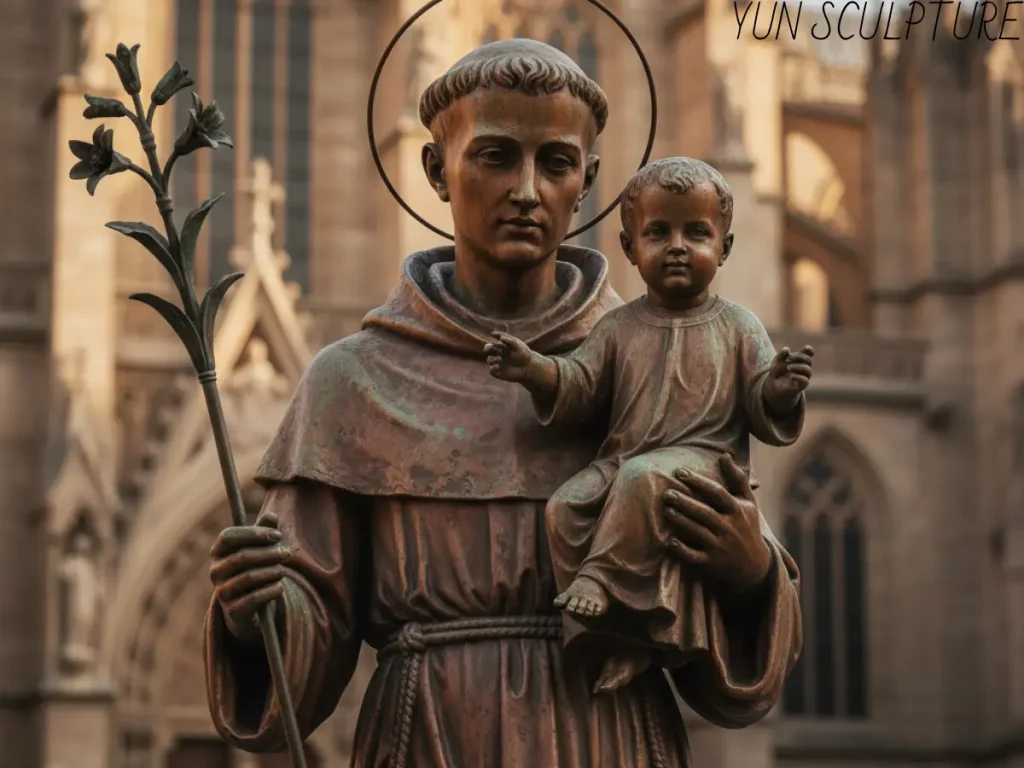
Let us return to the high coastal hills of Lisbon. The Franciscan college we introduced at the beginning of this architectural guide ultimately finalized their monumental commission. After rigorous environmental and theological consultations, they decisively chose heavy foundry bronze for their patron saint. This elite metallurgical choice guarantees the monumental sculpture will effortlessly withstand the relentless, corrosive Atlantic salt spray. Over the coming centuries, the harsh ocean air will not destroy the monument, but rather naturally oxidize the metal, developing a rich, deeply historic patina that perfectly honors his ancient legacy.
For eight hundred years, the global faithful have shaped this beloved friar out of degrading wood, fragile plaster, and mass-produced resin. These temporary, earthly mediums inevitably crack, fade, and eventually crumble into dust under the weight of time. Yet, his sacred visual tradition continues to survive and thrive across the centuries for one profoundly simple reason.
It survives because in every single generation, enough devoted parishes and patrons believe his holy image is worth forging perfectly. They refuse the temporary and instead demand his likeness be captured in the uncompromising, eternal permanence of Carrara marble, solid bronze, and structural stainless steel. They understand that a monument to the Finder of Lost Things must never be lost to time itself. At Yun Sculpture, we are immensely proud to be among those exact people.
– Elena Zhang & Donghui Zhang, Yun Sculpture