Get in touch with Yun-Sculpture company
The Grotto and the Lady: The Ultimate Guide to Custom Our Lady of Lourdes Statues and Grotto Landscape Design

In 2021, an 1887 Catholic school in County Cork, Ireland, contacted us with an intricate commission requiring both profound spiritual reverence and precise structural engineering. They asked us not just to replace a shattered, centuries-old plaster our lady of lourdes grotto statue. They required us to engineer a complete architectural rebirth of their historic sanctuary space. We were tasked to carefully rebuild their crumbling Victorian limestone grotto from the ground up, securing every massive stone against further decay.
The mandate from the historic Irish parish was clear, absolute, and structurally demanding. The newly commissioned our lady of lourdes statue needed to look as though it had never left the stone embrace of the cave. Every architectural measurement had to honor the original Victorian footprint while providing a perfectly stabilized foundation for the new sculptural installation.

The roots of this specific landscape architectural necessity trace back directly to the year 1858. The setting was the humble Massabielle grotto, located in the rugged French Pyrenees. There, a 14-year-old girl named Bernadette Soubirous witnessed a vision that permanently altered the trajectory of global Catholic devotion.
The sacred relationship between the divine figure and the rocky alcove was forged permanently in that exact historical moment. An our lady of lourdes outdoor statue is never merely a freestanding figure placed arbitrarily on a manicured lawn. The visual, spatial, and structural relationship between the earthly stone and the sacred figure is paramount to the site’s ultimate design.
Designing this specific type of space is fundamentally about the entire sacred landscape. The architectural interplay of rough stone, deep shadow, and brilliantly sculpted marble dictates the spiritual gravity of the sanctuary. Our structural planning must always elevate the theological weight of the site, ensuring the stone cave properly frames the heavenly vision.
Table of Contents
Table of Contents
The Vision of Lourdes — Theology, History, and the Iconographic Standard
The Apparitions of 1858 — The Precise Visual Record
Between February 11 and July 16, 1858, Bernadette Soubirous experienced a sequence of 18 distinct apparitions. These sacred encounters occurred strictly within the damp, shallow cave of the Massabielle rock formation. The profound theology of these encounters crystallized definitively during the specific apparition on March 25.
On that historic date, the apparition finally spoke her title directly to the young peasant girl. The Lady stated simply and clearly, “I am the Immaculate Conception.” Grasping the true our lady of lourdes statue meaning requires acknowledging the monumental theological weight of this specific dogmatic declaration.
The our lady of lourdes statue history is entirely governed by Bernadette’s unwavering eyewitness testimony. Every authentic sculptural representation must adhere rigidly to the young saint’s highly detailed memory of the encounters. We treat her recorded descriptions as an unbreakable architectural and artistic blueprint for every block of marble we carve.
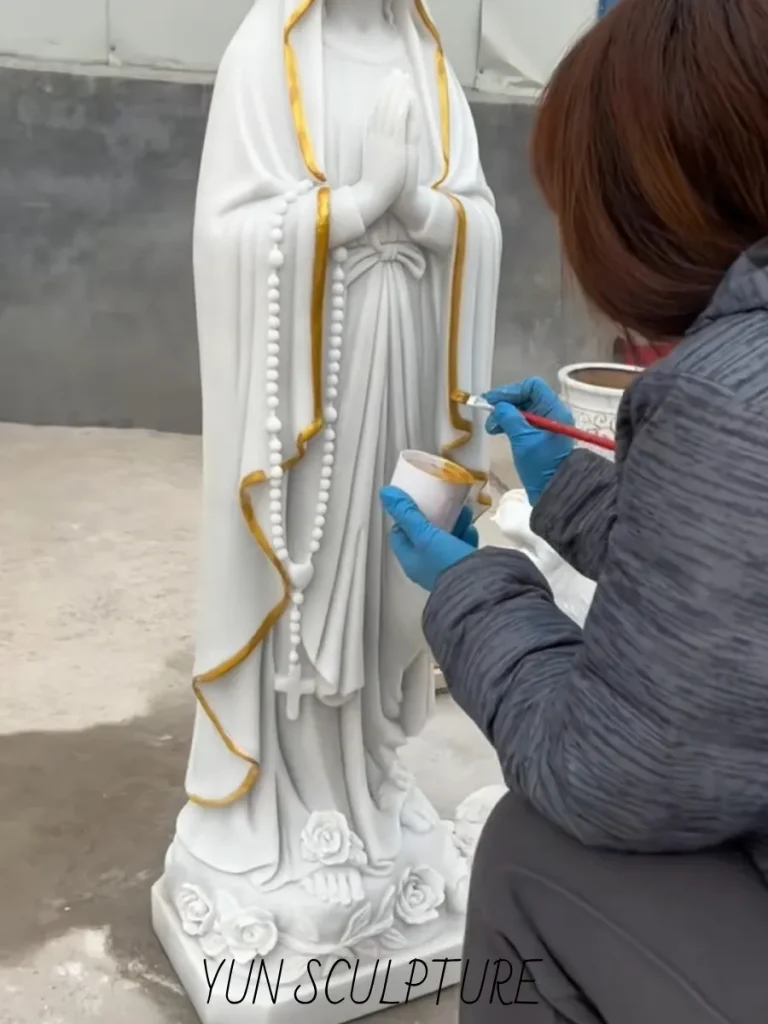
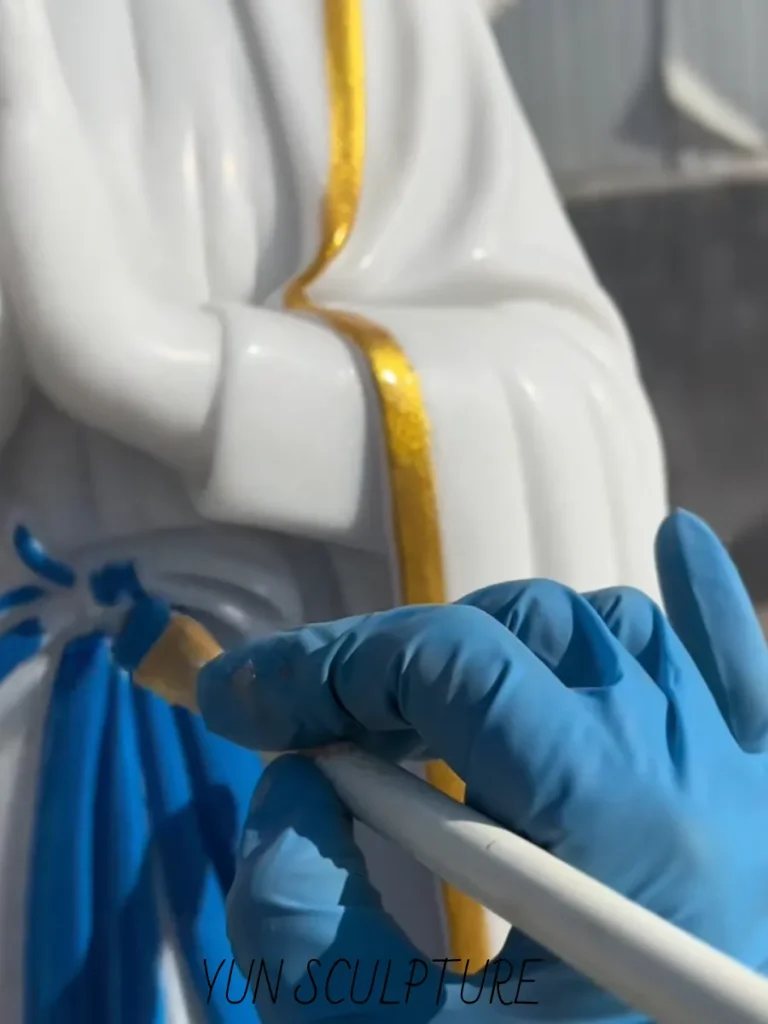
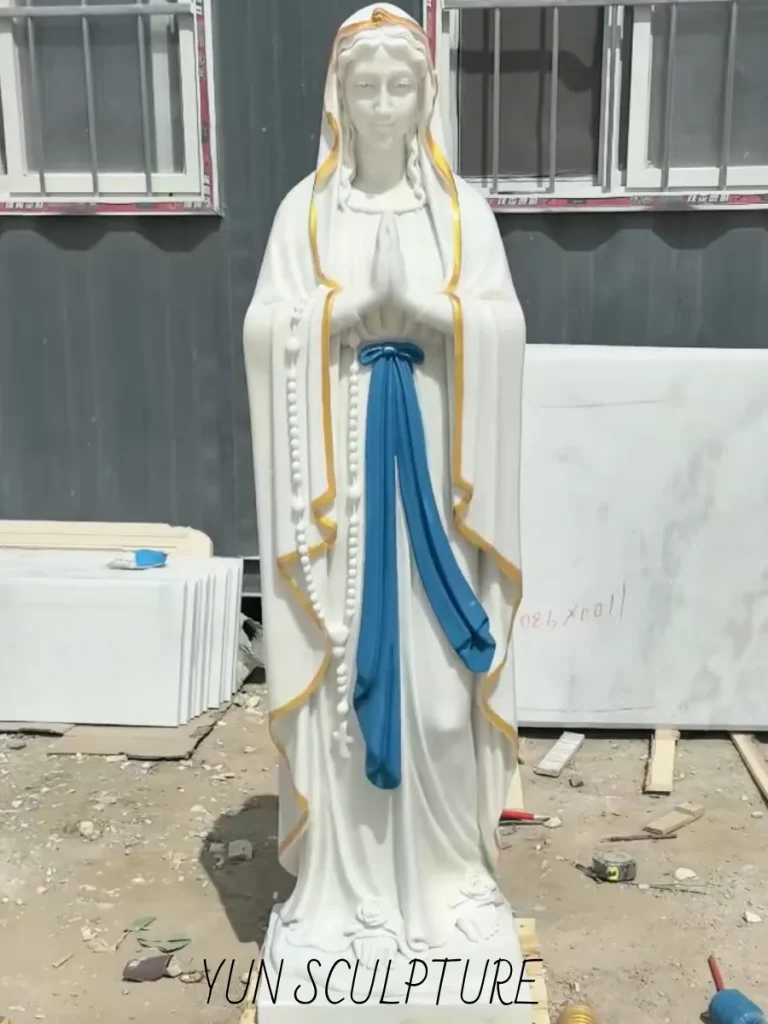
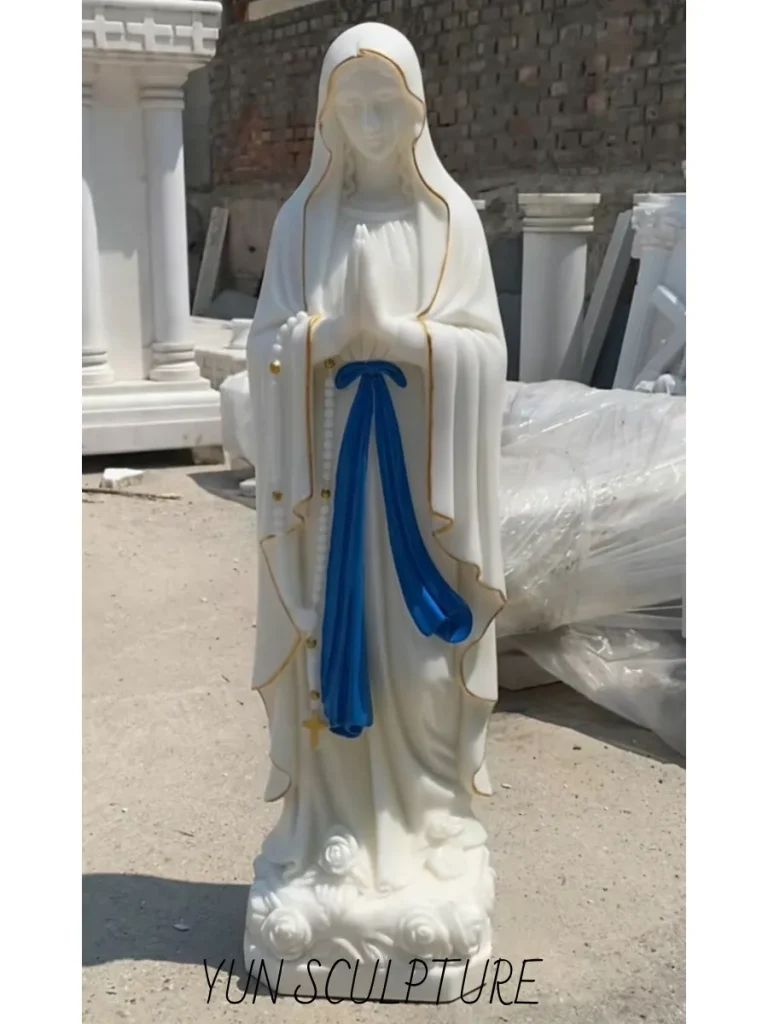
Bernadette provided a precise visual record that serves as the strict iconographic constitution for our studio. There are exactly seven specific visual elements that must be flawlessly executed in the stone. First, the sculpted figure must wear a brilliant white robe that falls completely to the ankles, obscuring the physical form in holy modesty.
Second, a distinct blue sash must be knotted at the waist, providing a stark visual contrast to the heavy white garment. Third, a flowing white veil must drape softly over the head and shoulders, framing the delicate silhouette of the Virgin. Fourth, the hands must be joined in prayer directly at the chest, signifying deep and perpetual intercession.
Fifth, a rosary must hang gracefully on the right wrist of the apparition. This specific rosary must feature white beads linked by a gold chain, terminating in a solid gold cross. Sixth, a distinct, intricately carved golden rose must rest lightly upon each bare foot.
Finally, the sculptor must capture a very specific countenance for the Virgin’s face. The expression must be remarkably young, radiantly beautiful, and profoundly merciful to the observer. It must be entirely devoid of any severe, rigid, or stern majesty, perfectly reflecting the gentle grace reported by Bernadette.
From Lourdes to the World — The Iconographic Transmission
The definitive template for the statue of our lady of lourdes was established shortly after the 18 apparitions ceased. In 1864, the renowned sculptor Joseph Fabisch carved a marble effigy. This monumental piece was commissioned to be installed directly within the actual Massabielle sanctuary cave.
This specific our lady of lourdes statue france installation became the permanent global reference point for all subsequent devotional art. Despite Fabisch’s immense technical skill and rigorous classical training, Bernadette herself offered a famously poignant critique of the masterwork. Upon viewing the installation, she stated the classical interpretation was “too beautiful” and “too artificial” compared to her actual vision.
Capturing the transcendent, earthly simplicity of the apparition remains the greatest technical challenge for any religious sculptor today. The establishment of the Massabielle shrine triggered a massive wave of devotion and artistic replication across the globe. A late 19th-century boom in grotto-building swept across Europe and beyond, changing religious landscape design forever.

This rapid architectural expansion was heavily fueled by highly skilled Carrara marble exports shipped directly from Italian quarries. Parishes, schools, and convents worldwide sought to recreate the exact spatial and spiritual dynamics of the French hillside. This devotional landscape movement traveled vast distances across the globe, crossing treacherous oceans and continents.
We see a highly prominent our lady of lourdes statue australia trend brought directly by subsequent waves of Irish Catholic immigrants. They carried the structural tradition of the grotto to the southern hemisphere, building massive stone sanctuaries in their new communities. Today, many of these historical grottos built in the 19th and early 20th centuries are facing severe structural decline.
They now require intensive heritage restoration to preserve their sacred landscape. Our engineering and artistic teams work to ensure the structural integrity survives for future generations. The stone must hold the vision securely, just as it did in Massabielle.
The Bernadette Factor — When One Statue Becomes Two
The Double-Figure Commission — Our Lady with Bernadette
The theological dynamic shifts fundamentally when a client commissions an our lady of lourdes statue with bernadette. The lone figure of Mary commands quiet, solitary veneration from the observer. However, the double-figure composition demands a precise relational narrative between the divine apparition and the mortal witness. In an our lady of lourdes and bernadette statue, the young saint always kneels below on the earthly plane, her gaze fixed sharply upward toward the rock.
This creates our most crucial engineering and artistic challenge during the complex sculpting process. We refer to this critical spatial dynamic as the “Line of Sight” calculation. The exact angle of Bernadette looking up and Mary looking down absolutely must intersect perfectly in three-dimensional space. If this invisible line is broken, the spiritual tension of the entire installation is immediately severed.
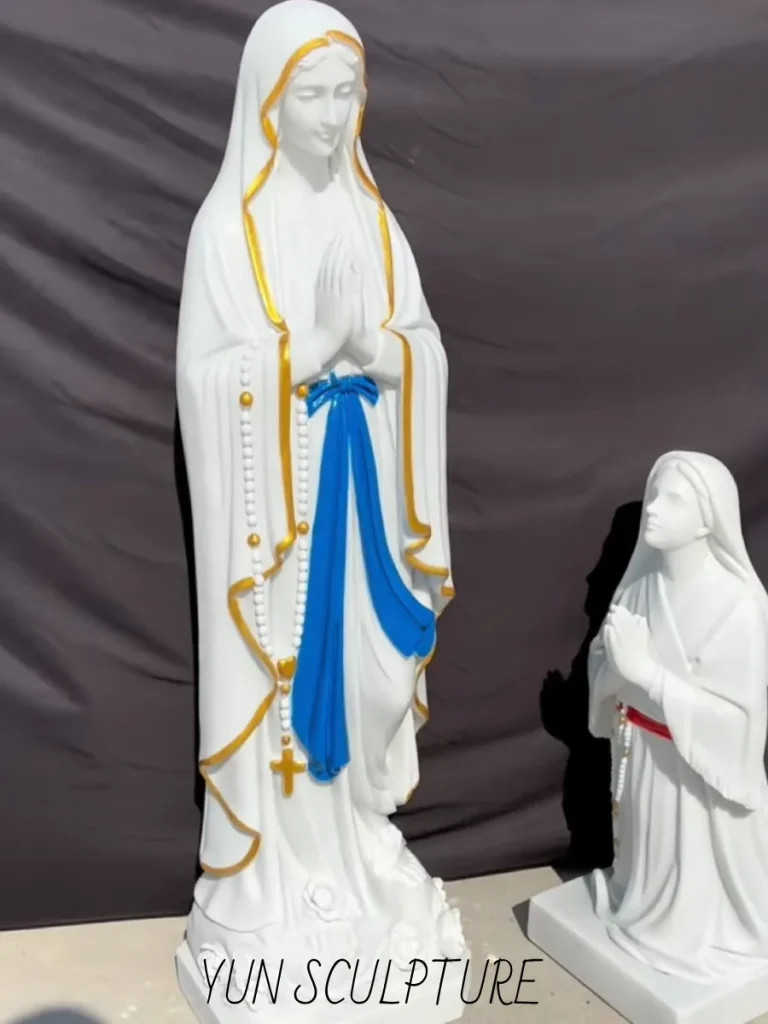
Bernadette’s iconography is historically fixed to authentic 19th-century French peasant attire. Sculptors must carve her heavy capulet (a traditional hooded cloak), her textured work apron, and her wooden sabots with absolute historical authenticity. She is permanently depicted kneeling on the rough stone, her hands clasped firmly in desperate prayer.
Capturing her face is notoriously the hardest expression to sculpt in religious art. The cold marble must simultaneously mix sudden surprise, deep awe, and unwavering trust. The artisan must chisel a countenance that recognizes the Queen of Heaven while remaining entirely grounded in rural peasant humility.
From a structural perspective, the dramatic height difference between the figures requires rigorous spatial mathematics. Mary is traditionally positioned 50-80cm higher than the kneeling visionary within the architecture of the cave system. This exact elevation change requires precise calculation during the raw clay model phase, long before any bronze casting or stone carving begins.
Our engineering team must account for the exact thickness of the final stone plinths beneath both figures. If the final installation elevation is off by even a few centimeters, the carefully sculpted intersecting gaze breaks entirely. The two statues will look past each other, destroying the sacred intimacy of the Massabielle encounter.
The Grotto — Engineering a Complete Sacred Landscape
At Yun Sculpture, we do not merely manufacture isolated figures to be dropped arbitrarily onto a manicured parish lawn. We meticulously engineer the exact spatial environment of the statue of our lady of lourdes in the grotto. The engineered stone cave itself operates as the necessary sacred vessel for the Marian figure. A poorly constructed grotto will inevitably compromise both the structural integrity and the spiritual weight of the finest marble carving.
What Is a Lourdes Grotto? — Architecture, Not Just a Statue
A true Lourdes grotto is fundamentally a crypta. It is a purposefully constructed cave sanctuary demanding rigorous architectural planning and long-term structural foresight. It operates as an integrated landscape ecosystem, not merely a decorative, superficial backdrop for a sculpture.

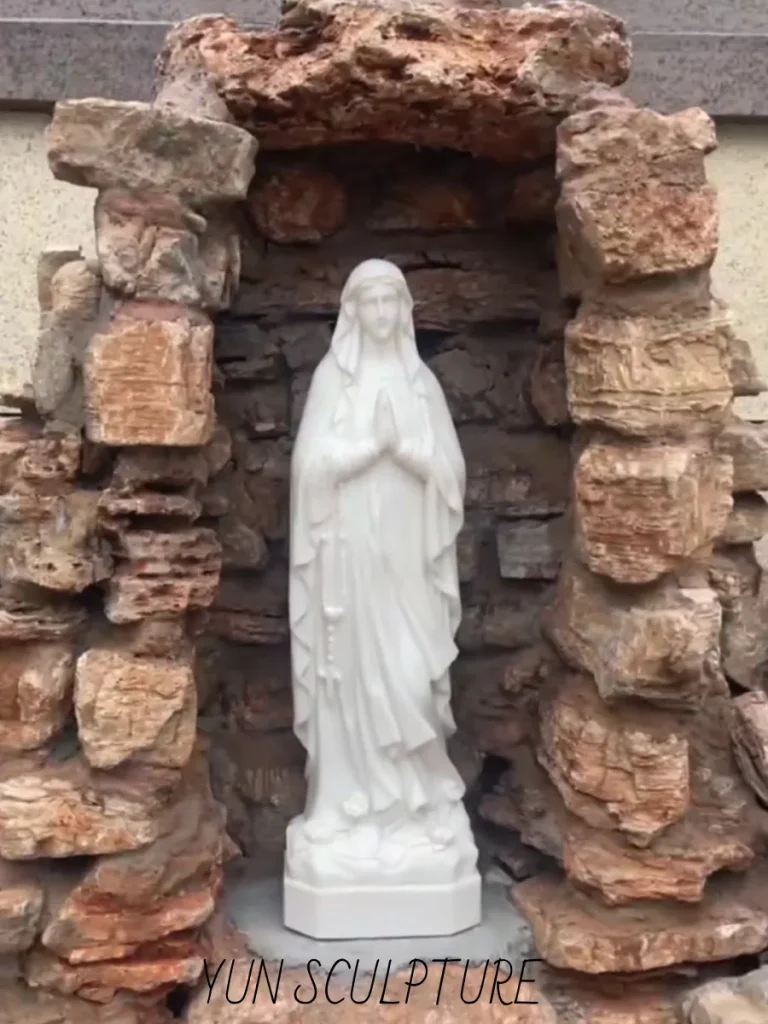
To successfully engineer a complete our lady of lourdes grotto garden statue landscape, we must synchronize seven distinct spatial elements perfectly. If any single element fails, the site loses its historical and theological resonance.
- Grotto Structure: The engineered stone cavern that frames, elevates, and physically protects the holy figures from wind and erosion.
- Mary Statue: The primary theological focal point, mathematically positioned and securely elevated within the upper right niche of the stone cave.
- Bernadette Statue: The secondary narrative figure, permanently anchored below on the lower left, grounding the viewer’s mortal perspective.
- Water Feature: A dynamic hydraulic element strictly honoring the miraculous Massabielle spring uncovered by the saint in the mud.
- Lighting System: Concealed electrical illumination dictating the nocturnal atmosphere and highlighting architectural stone textures safely.
- Prayer Space: The hardscape paving structurally designed to safely accommodate kneeling individuals and larger congregational gatherings.
- Plant Landscape: The living perimeter, strictly utilizing white flowers and dense evergreens to maintain year-round solemnity and visual purity.
Rock Selection and Grotto Structure Engineering
The structural foundation of the cave dictates the ultimate lifespan of the entire sanctuary. We evaluate three primary engineering solutions based heavily on the client’s budget, local climate freeze-thaw cycles, and heavy machinery site access. Each material demands a completely different approach to load-bearing mathematics.

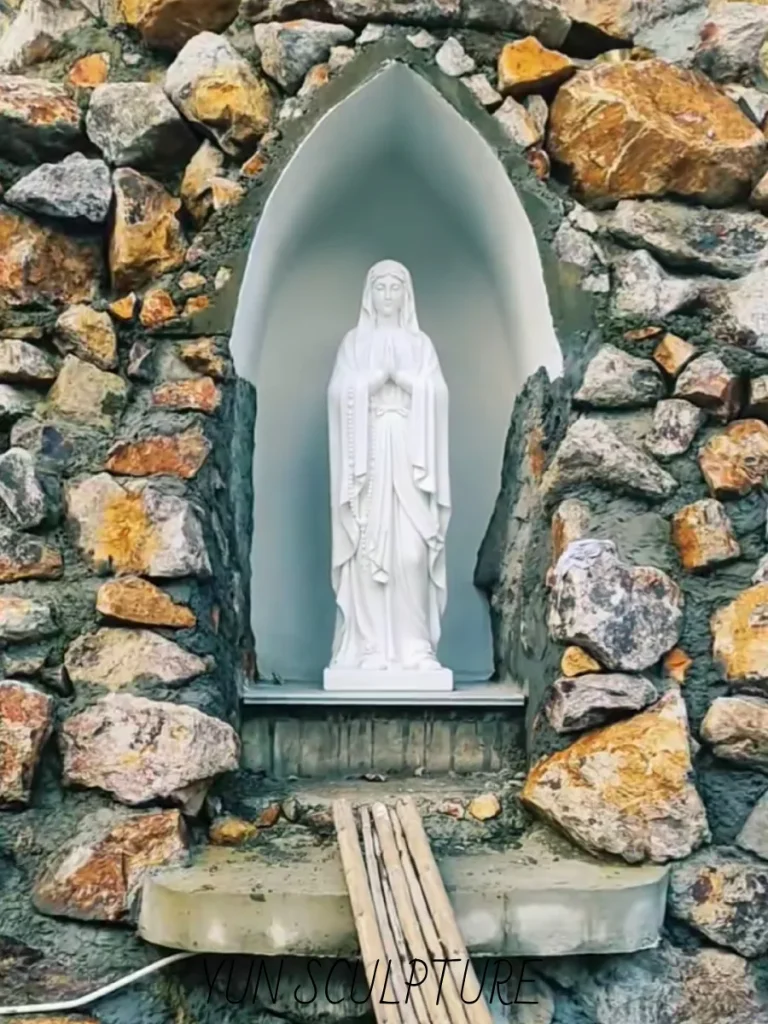
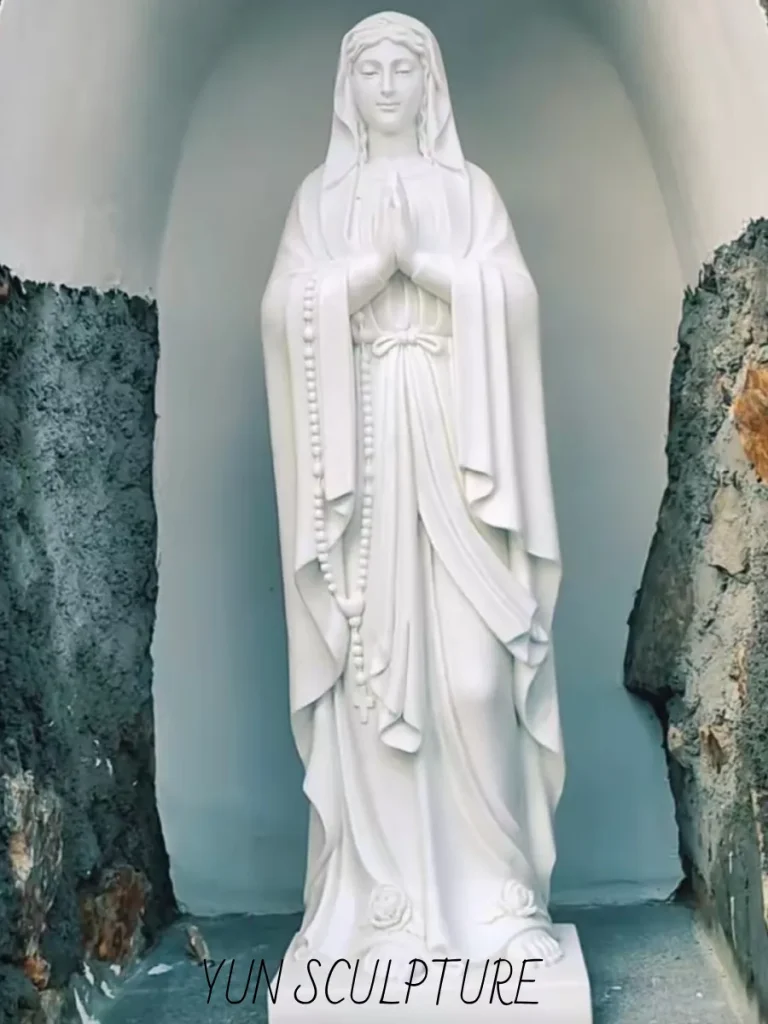
- Natural Rock: The premier historical standard, utilizing massive, genuine boulders sourced from local quarries. This is the most expensive and permanent method. It requires our structural engineers to mathematically calculate the center of gravity for every individual stone block to prevent catastrophic shifting over decades.
- GFRC/Shotcrete: Glass Fiber Reinforced Concrete offers a lightweight, highly customizable alternative for complex cave geometries. It allows for rapid construction and precise shaping. However, clients must note the material inherently degrades in 20-30 years, requiring guaranteed future resurfacing and structural patching.
- Hybrid Assembly: Our most frequently recommended engineering standard. This method utilizes a heavily reinforced GFRC core for immediate, guaranteed structural stability. The concrete core is then clad tightly with a natural stone veneer, providing lasting historical authenticity without the massive weight of solid boulders.
Niche engineering requires uncompromising precision long before the finished statues arrive on site. The interior carved niche must be exactly 20% larger than the base of the Marian statue. This critical negative space allows for safe installation rigging and vital future masonry maintenance behind the figure.
The niche floor demands a specialized waterproof membrane and a calculated drainage slope to prevent ice expansion behind the statue. Most critically, the rock directly above must feature a precision-cut drip edge. This simple architectural undercut prevents acidic rainwater from sheeting directly onto the delicate marble face of the Virgin.
The Water Element — Honoring the Lourdes Spring
Bernadette’s direct instruction from the apparition to “drink at the spring and wash in it” makes water a mandatory element in high-end sanctuary design. We engineer four distinct hydraulic solutions based heavily on the client’s long-term maintenance capacity and local climate.
- Simple Basin: A static, carved stone font requiring manual filling and cleaning. This is ideal for intimate garden spaces lacking underground utility access.
- Overflow Pool: A continuously brimming basin powered by a hidden circulation pump. It provides the visual cue of a living, endless spring without excessive noise or splashing.
- Cascading Waterfall: A dynamic system requiring strict hydraulic flow calculations. We specify exact pump power ratios to create a thin, perfectly quiet sheet of water over the stones, avoiding the chaotic acoustic echoes of a commercial fountain.
- Anti-Freeze Systems: Absolutely mandatory for all cold-climate installations. We engineer insulated subterranean piping and automatic drainage valves that purge the water lines before the first hard freeze, preventing catastrophic pipe bursts inside the grotto walls.
Lighting Design — The Grotto at Night
The profound spiritual resonance of the sanctuary must persist long after sunset. Professional grotto illumination requires strict adherence to technical safety protocols and aesthetic specifications. All exterior electrical fixtures must carry a verified IP65+ waterproof rating to survive relentless environmental exposure, heavy rain, and winter snowpack.

We exclusively specify 2700K warm white LED diodes for all sacred grotto sites. This precise color temperature perfectly replicates the soft, flickering warmth of traditional devotional candlelight. It completely rejects the harsh, sterile blue glare associated with modern commercial security lighting.
The main directional light source must strike Mary from the sides and slightly below. This specific angle catches the deep, carved folds of the sculpted veil, creating a dramatic interplay of light and shadow. Secondary, completely hidden ambient light must wash the rough interior cavern walls, creating deep visual contrast behind the brilliant white marble.
Zero direct glare can ever be permitted to reach the eyes of praying visitors kneeling on the paving below. This exact lighting protocol ultimately resolved our challenging County Cork school commission. By installing carefully concealed 2700K uplighting deep within the restored limestone crevices, we illuminated the newly rebuilt cavern with a soft, ancient warmth.
The Irish school’s new statue glowed perfectly from within the historic rock. Thanks to the seamless integration of Victorian masonry and modern hidden LEDs, the new marble figure appeared exactly as though it had been resting there peacefully since 1887.
Material Guide — Marble, Bronze, and Stainless Steel for Our Lady of Lourdes
Marble — The Lourdes Tradition Material
The foundational aesthetic of the Lourdes vision is inextricably linked to the translucency of white stone. Joseph Fabisch’s 1864 original was carved from solid marble, establishing the definitive historical precedent. At Yun Sculpture, we continue the prestigious our lady of lourdes statue italy tradition, sourcing the finest AAA-grade Carrara marble to capture the ethereal quality of the Virgin’s white robe.

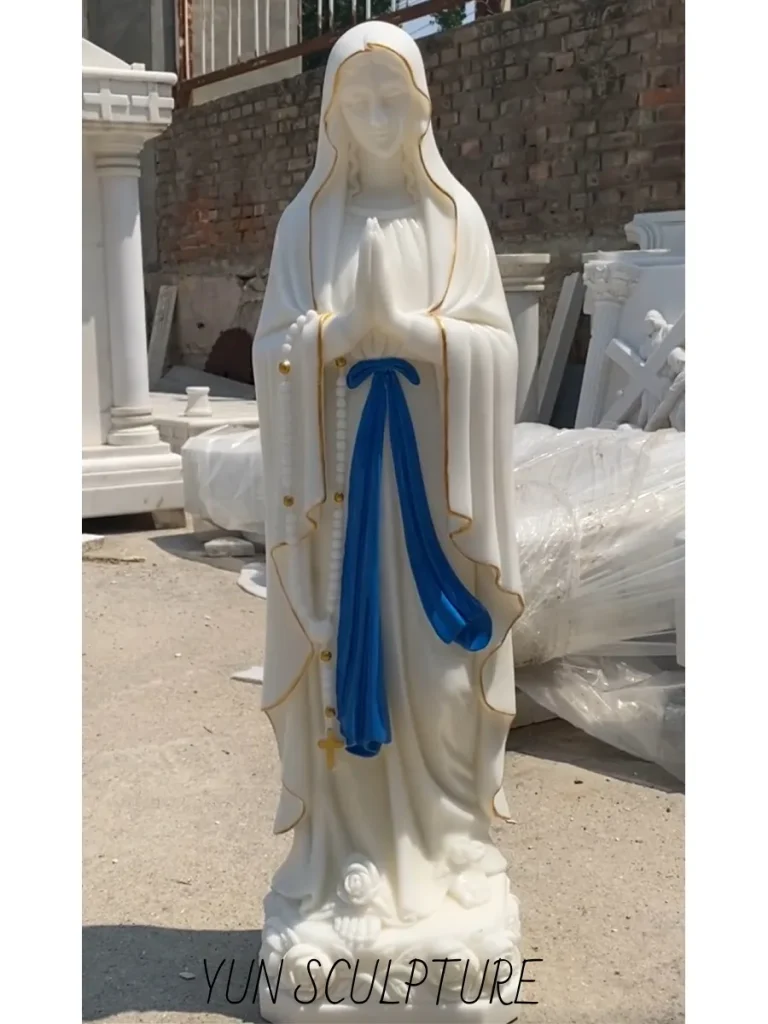
From a structural standpoint, the “White Robe Theology” demands a material that allows light to penetrate the surface rather than simply bouncing off it. Marble provides this internal glow, but it presents significant engineering challenges for a high-end our lady of lourdes garden statue. The intricate rosary, for instance, cannot be carved purely from fragile stone; we individually hand-carve each marble bead and thread them onto a concealed stainless steel wire anchored deep into the marble wrist.
Furthermore, the “Golden Rose” requirement necessitates a sophisticated material interplay. We precision-mill circular recesses into the marble feet to inlay gilded bronze roses, ensuring they remain flush and structurally sound for decades. The veil itself is a masterpiece of technical carving; to achieve a realistic drape, we must thin the marble to a delicate 8mm, requiring internal structural reinforcement points hidden within the folds to prevent stress fractures.
Bronze — For Open-Air Grottos and Landmark Installations
For sites subjected to extreme environmental stress, we specify bronze as the primary medium for our lady of lourdes statues outdoor. Bronze is the most resilient material for coastal shrines or grottos integrated with active, splashing water features. An outdoor our lady of lourdes statue in bronze offers a structural permanence that stone cannot match in high-humidity or high-salinity environments.
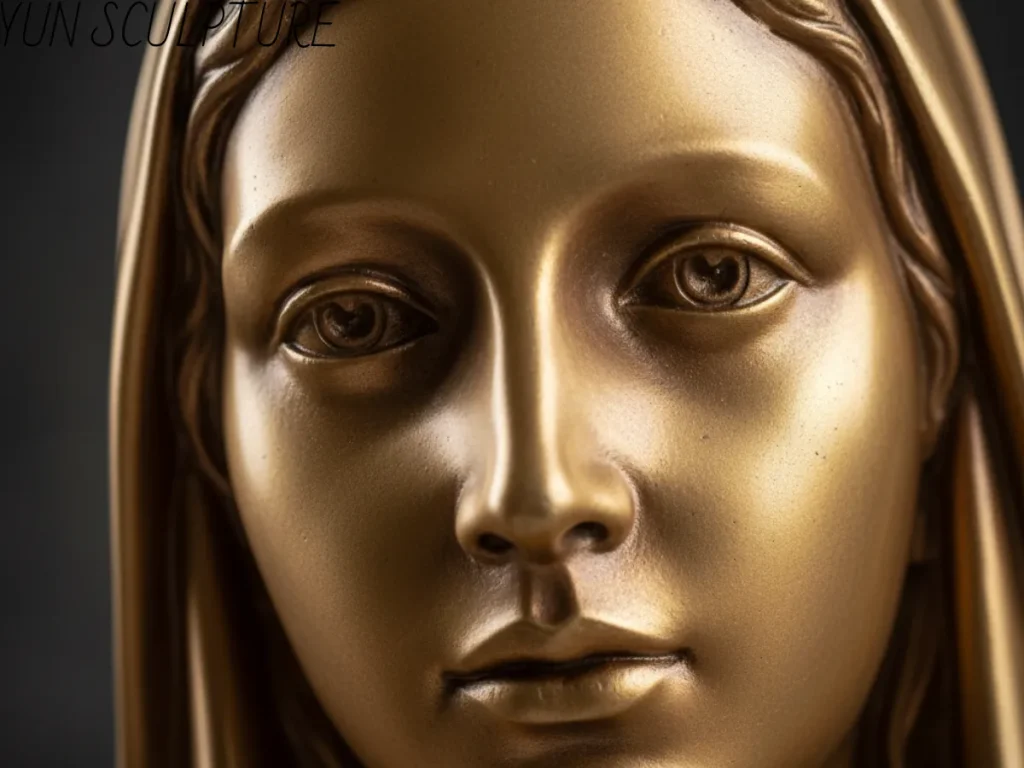
We employ an exclusive “5-Zone Patina Strategy” to ensure theological accuracy without the need for fragile surface paints. Unlike a cheap our lady of lourdes painted outdoor statue made of resin—which typically flakes and fades within five years—our bronze utilizes permanent chemical thermal patinas:
- White Robe: A specialized silver-brown light patina that catches natural highlights.
- Blue Sash: A deep indigo chemical patina fused into the metal.
- Golden Roses: 24K gold leaf gilding or a high-mirror polish on the bronze surface.
- White Rosary: Inlaid mother-of-pearl or ceramic beads for distinct texture.
- Face and Hands: A warm, translucent gold-toned patina to evoke a living presence.
Stainless Steel — The Contemporary Grotto Landmark
For modern architectural contexts, such as a state-of-the-art our lady of lourdes hospital statue, 316L Marine Grade Stainless Steel offers a striking contemporary alternative. The mirror-polished finish serves a specific theological purpose: it reflects the praying believer directly into the silhouette of Mary, visually representing the concept of spiritual reflection and intercession.
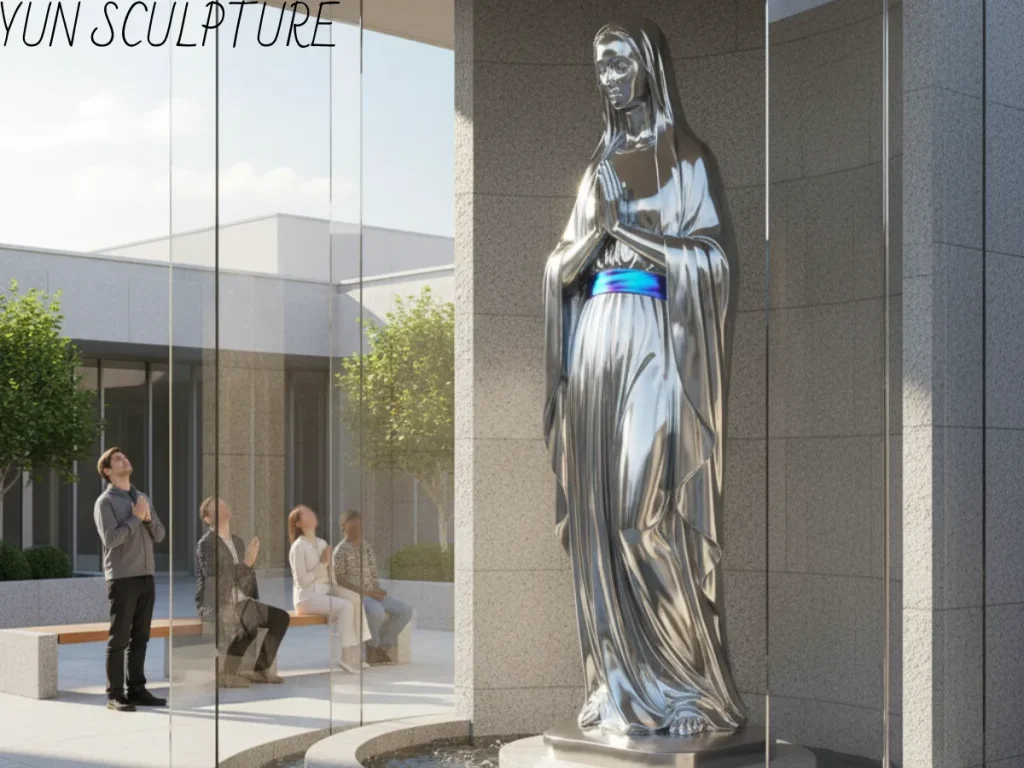
The iconic blue sash is achieved through high-tech anodizing or PVD coating, ensuring the color is part of the metal’s molecular structure rather than a surface layer. This material is virtually maintenance-free and provides the highest level of resistance to the caustic chemicals often used in hospital cleaning protocols.
Material Comparison Table
| Feature | Marble (Italy/Carrara) | Bronze (Cast/Patina) | Stainless Steel (316L) |
| Rec. Percentage | 50% (Traditional) | 40% (Durability) | 10% (Modern) |
| Best Grotto Type | Sheltered niche / Indoor | Open-air / Water-integrated | Modern / Hospital Landmark |
| White Robe Expression | Best translucency | Good light-reflective patina | Mirror or Matte finish |
| Blue Sash Craft | Hand-tinted pigment | Chemical thermal patina | Anodized / PVD Coating |
| Golden Rose | Gilded bronze inlay | Gilded polish | Gold PVD / Laser polish |
| Rosary | Relief / Wire-inlay beads | Inlaid pearl / Ceramic | Laser etched or Relief |
| Outdoor Weathering | Needs sheltered niche | Perfect for all climates | Best for extreme exposure |
| Condensation | Needs protective wax | Stable, develops character | Most stable / Self-cleaning |
Sizing Guide — From Home Garden to Parish Landmark
Selecting the correct scale for an outdoor our lady of lourdes statue is a matter of both perspective and site geometry. A statue that is too small will be swallowed by the rockwork; one that is too large will feel oppressive rather than inviting.
1. Single-Figure Commissions
| Height Range | Intended Environment | Recommended Materials |
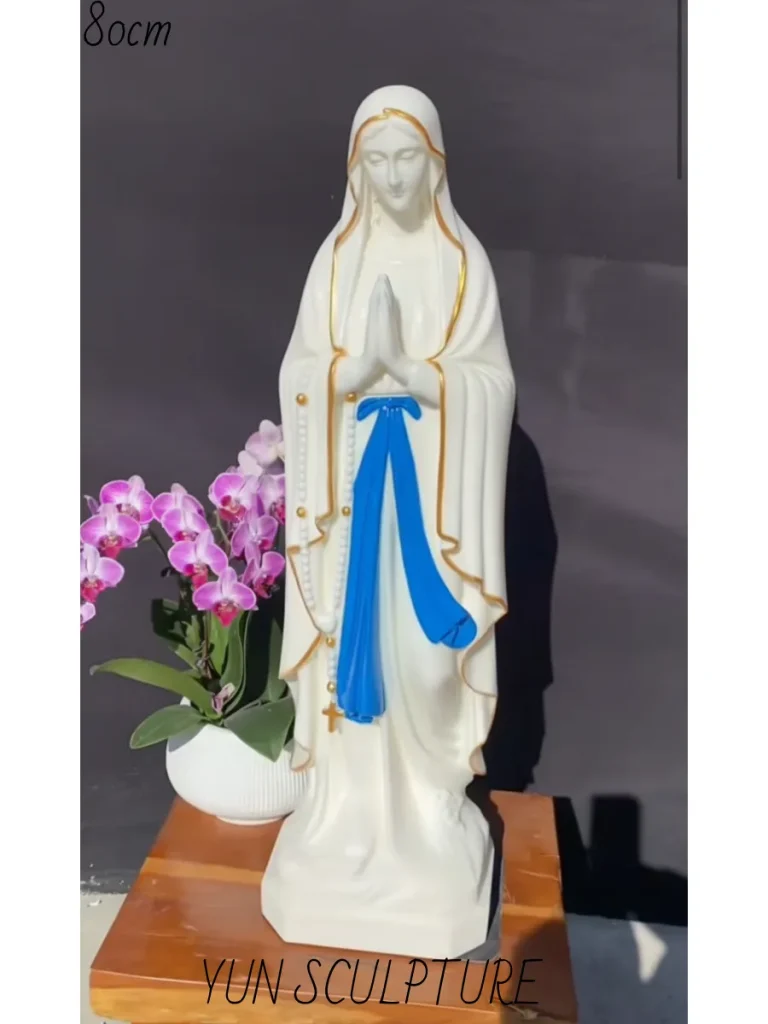
| 30cm – 60cm | Private Devotion / Indoor Niche | Marble / Bronze |
| 60cm – 90cm | Small Private Garden / Courtyard | Bronze / Marble |
| 90cm – 120cm | Small Parish / School Entryway | Marble / Bronze |
| 120cm – 150cm | Standard Parish Church Exterior | Marble / Bronze |
| 150cm – 180cm | Large Parish / Regional Shrine | Bronze / Steel |
| 180cm+ (Large) | National Cathedral / Iconic Landmark | Bronze / Steel |
2. Double-Figure (with Bernadette) Scale Ratio
When installing outdoor statues of our lady of lourdes involving the visionary, the “Height Hierarchy” must be strictly maintained to ensure visual harmony.
- Minimum Mary Height: 90cm (Smaller scales lose facial detail in the grotto depth).
- Height Ratio: Mary must be 1.3x to 1.5x the height of the kneeling Bernadette.
- Horizontal Distance: The kneeling figure should be placed at a distance equal to 60-80% of Mary’s total height to maintain the intimate “Line of Sight.”
3. Complete Grotto Landscape Project Timeline
| Project Scale | Engineering Features | Typical Lead Time |
| Small Home | GFRC Shell / Small Basin | 45 – 60 Days |
| Medium School | Custom GFRC / Overflow Pool | 60 – 90 Days |
| Large Parish/Hospital | Full Landscape / Cascading Water | 90 – 150 Days |
| Landmark Shrine | Architectural Engineering / CAD | 150+ Days |
Who Commissions a Lourdes Grotto?
The commissioning of an our lady of lourdes statue large scale project is a significant undertaking that unites diverse sectors of the community. At Yun Sculpture, we serve seven distinct buyer profiles, providing the specific technical documentation each requires.
- Catholic Parishes and Dioceses: Often commissioning statues for new church grounds or as centennial memorial gifts.
- Catholic Schools and Universities: Focused on creating outdoor “prayer corners” that serve as quiet retreats for students.
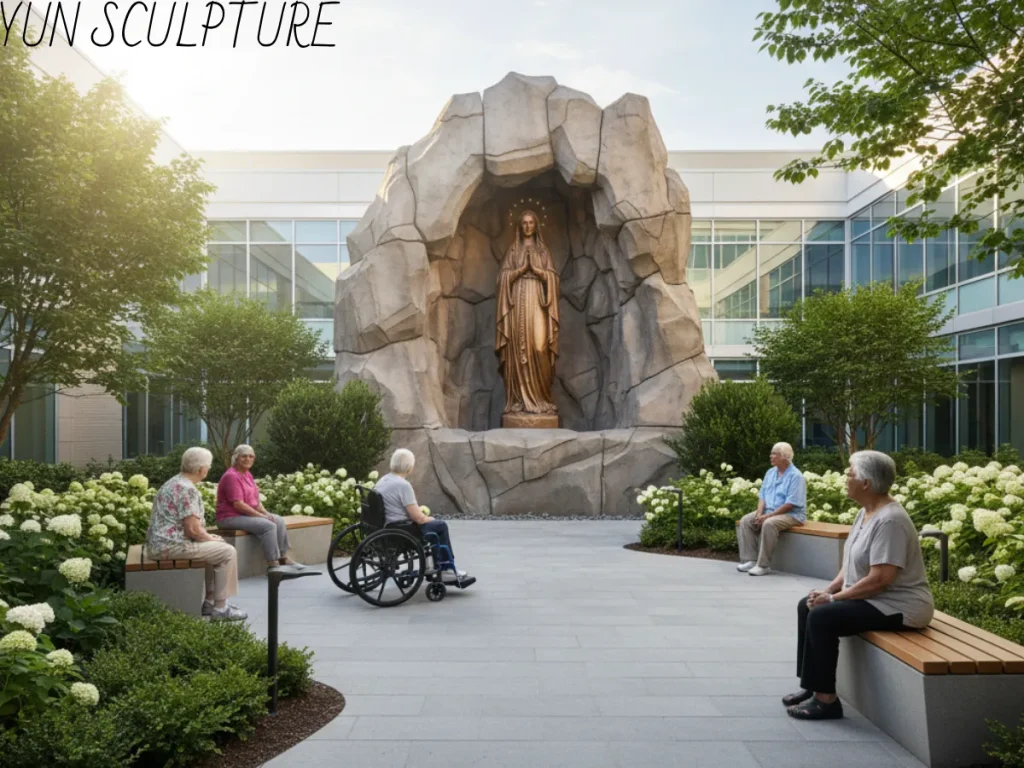
- Catholic Hospitals and Healthcare: We specialize in “Healing Grottos” designed with ADA-compliant, wheelchair-accessible pathways.
- Pilgrimage Sites and Shrines: Large-scale installations requiring high-durability bronze to withstand thousands of visitors annually.
- Landscape Architects and Church Design Firms: We act as technical sub-contractors, providing CAD files, load-bearing calculations, and material certifications.
- Heritage Restoration Projects: Expertly matching 19th-century limestone textures and applying antique patinas to new bronze to match existing historical sites.
- Private Estates and Family Gardens: Creating intimate, high-end sanctuary spaces for multi-generational family estates.
The Commission Process — From Apparition to Landscape
The transition from a theological vision to a physical sanctuary requires a rigorous, multi-disciplinary workflow. At Yun Sculpture, our process bridges the gap between the 1858 apparitions and modern structural engineering. Every commission follows a seven-step protocol to ensure the final installation is both spiritually resonant and architecturally sound.
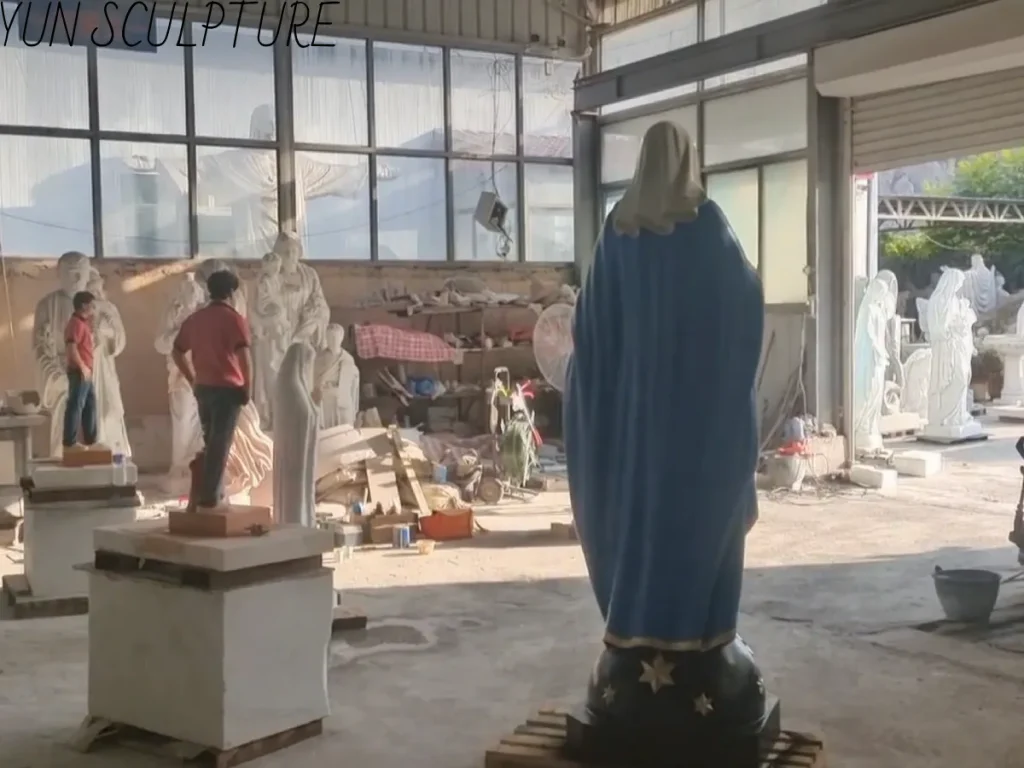
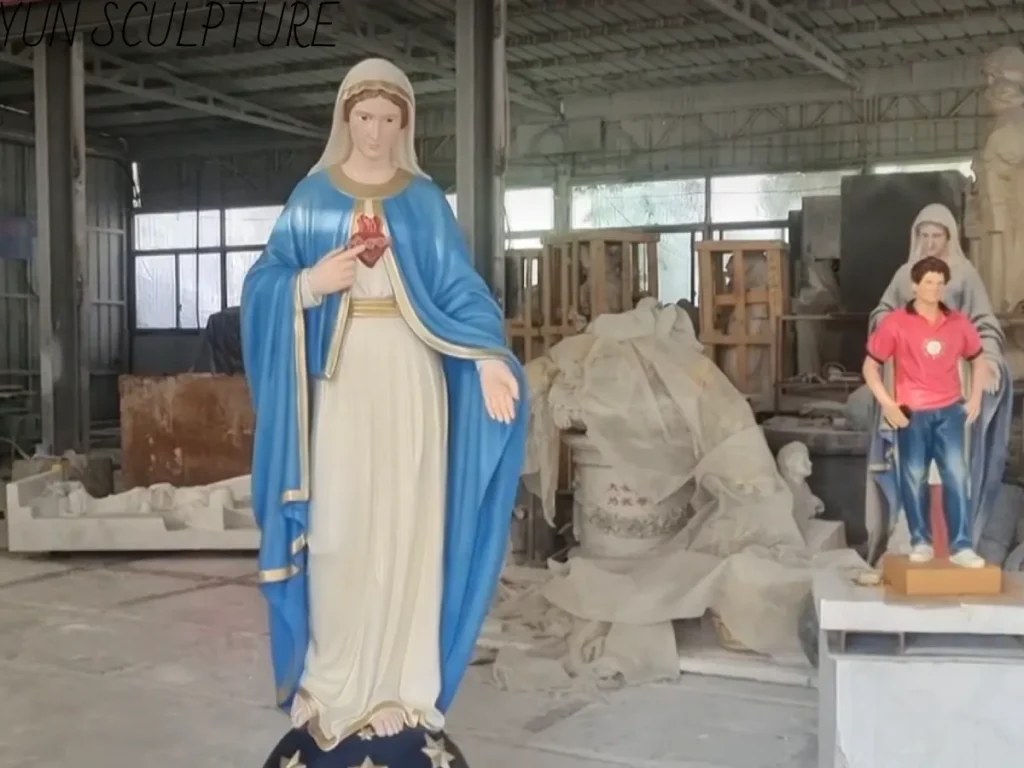
- Iconographic and Landscape Brief: We define the primary parameters, choosing between a single figure or a double-figure commission. We determine the grotto material and the specific hydraulic and electrical requirements for the site.
- Site Assessment: Donghui Zhang’s team evaluates the physical location. This includes calculating soil bearing capacity, verifying drainage slopes, and assessing local wind load requirements for large-scale structures.
- Landscape Design: We produce comprehensive 3D grotto plans. This stage includes “Line-of-Sight” confirmation to ensure the spatial relationship between Mary and Bernadette—and the kneeling pilgrim—is mathematically perfect.
- Sculpture Production (Steps 4-6): Our artisans begin with a precision clay model to capture the “merciful face” described by Bernadette. This is followed by high-fidelity casting in foundry bronze or hand-carving in AAA Carrara marble, concluded with our signature 5-zone patination.
- Landscape Construction and Installation: The final stage involves building the grotto structure on-site using natural stone or GFRC. We integrate the spring’s plumbing, install the hidden 2700K lighting, and securely anchor the statues to withstand a century of exposure.
FAQ — 12 Core Questions Answered
What is the Our Lady of Lourdes statue?
The statue depicts the Blessed Virgin Mary exactly as she appeared to 14-year-old Bernadette Soubirous in 1858 at the Massabielle grotto in Lourdes, France. During these eighteen sacred encounters, she identified herself with the profound theological title, “I am the Immaculate Conception.”
What is the history of the Our Lady of Lourdes statue?
The iconographic history began with a marble masterpiece sculpted by Joseph Fabisch in 1864, which was placed directly into the Massabielle niche. This original work sparked a global movement, leading parishes and schools worldwide to build replica grottos to honor the site of the apparitions.
What does Our Lady of Lourdes look like in a statue?
According to the visionary’s records, she wears a brilliant white robe, a blue sash knotted at the waist, and a flowing white veil. A golden rose rests upon each of her bare feet, and her hands are joined in prayer with a rosary draped over her right arm.
Who is Bernadette in the Lourdes statue?
St. Bernadette is the young peasant visionary who first witnessed the Lady’s grace. In a double-figure commission, she is depicted kneeling in her traditional 19th-century French peasant dress, her face etched with a mix of awe and trust as she looks up at the Virgin.
What is a Lourdes grotto and how is it built?
A grotto is a cave-like shrine designed to replicate the rugged terrain of the Massabielle rock. It is constructed using either massive natural boulders or structural GFRC, incorporating a specific niche for the statue, a circulating water feature, and concealed ambient lighting.
What material is best for an outdoor Lourdes statue?
Foundry bronze is the undisputed gold standard for an outdoor our lady of lourdes statue due to its superior resistance to the elements. While natural Carrara marble is historically prestigious, it is best reserved for sheltered niches where it is protected from direct rain and the destructive force of freeze-thaw cycles.
What is the original Our Lady of Lourdes statue in France?
The original is a Carrara marble sculpture completed in 1864 by the artist Joseph Fabisch. It remains today in the exact upper niche of the Massabielle grotto in France, standing as the primary pilgrimage point for millions of believers annually.
Can the blue sash and golden roses be accurately reproduced in bronze?
Yes, this is a specialty of our structural team. We utilize a complex 5-zone chemical patination process that creates a permanent indigo oxidation for the sash and utilizes gilded bronze inlays for the roses. This ensures the colors remain vivid for decades without the use of superficial, peeling paints.
What size grotto statue is appropriate for a parish garden?
For a standard parish garden, a 120-150cm (4-5 ft) statue provides the necessary presence for congregational prayer. However, if the statue is to be elevated high within a large architectural grotto, we recommend a 150-180cm (life-size) figure to maintain proper visual proportions from the ground.
How long does a complete Lourdes grotto commission take?
The production of a standalone bronze or marble statue typically requires 60-90 days of artisan labor. A complete grotto landscape project, which includes structural engineering, water feature integration, and the casting of double figures, generally spans 90 to 150+ days.
Where can I buy a high-quality Our Lady of Lourdes statue?
When researching where to buy our lady of lourdes statue, it is vital to distinguish between commercial replicas and liturgical art. While you may find an our lady of lourdes statue online made of mass-produced resin, these lack the durability and iconographic accuracy of a professional foundry commission. Look for our lady of lourdes statue for sale through firms that specialize in religious art history and structural engineering.
Do you ship Our Lady of Lourdes statues to Australia?
Yes, we provide international DDP (Delivered Duty Paid) shipping, handling all customs and duties for our clients. We use ISPM-15 compliant crating to safely transport statues to Australia, Ireland, and the United States, often supporting complex heritage grotto restoration projects across the globe.
The restoration of the 1887 grotto in County Cork, Ireland, remains a testament to the intersection of faith and engineering. By utilizing a GFRC core with a hand-selected Victorian limestone veneer, we were able to recreate the rugged authenticity of the original 19th-century sanctuary.
The new marble statue, sculpted with a countenance closer to Bernadette’s humble description of the “young and merciful” Lady, now sits perfectly within its reinforced niche. With its hidden 2700K lighting and modernized drainage, the grotto stands ready to witness the prayers of the next century.
– Elena Zhang & Donghui Zhang, Yun Sculpture