Get in touch with Yun-Sculpture company
The Saint Who Sleeps: The Ultimate Guide to Custom Sleeping St. Joseph Statues in Marble, Bronze, and Steel

In 2013, shortly after his election, Pope Francis quietly revealed a personal devotional practice that would travel across the world. On his desk sits a small sleeping st joseph statue. When burdens arise—decisions, conflicts, global concerns—he writes them on a piece of paper and slips the note beneath the statue, trusting Saint Joseph to carry these worries into his dreams and place them before God.
The gesture is disarmingly simple. No public spectacle, no elaborate ritual. Just a sleeping saint, a folded note, and an act of trust.
This small devotional object ignited global attention. Catholics, architects, and collectors began searching for a st joseph sleeping statue or statue of st joseph sleeping, hoping to bring the same quiet spiritual presence into their homes, chapels, and gardens. Workshops across the world responded with mass-produced resin figures—lightweight, inexpensive, and widely distributed.
Yet something essential was lost in this translation.
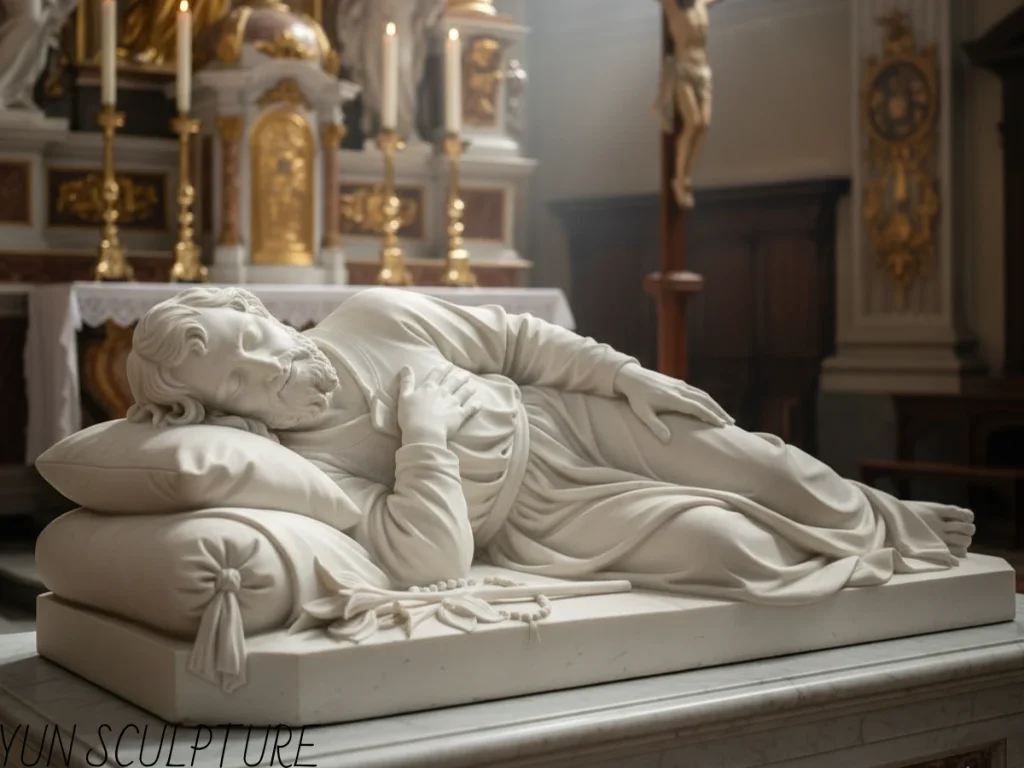
A sleeping Saint Joseph is not merely a decorative figure. It is a theological statement carved into form. His stillness represents surrender, his rest represents obedience, and his presence represents trust in divine guidance. When rendered in permanent materials—marble shaped by chisels, bronze cast in fire, or steel engineered for permanence—the statue becomes an architectural object of devotion rather than a temporary ornament.
At Yun Sculpture, we approach this sacred image as both historians and engineers. Every custom sleeping st joseph statue is treated as a structural and spiritual commission. The proportions must reflect classical iconography. The posture must carry theological meaning. The material must endure generations of prayer.
A sacred image that speaks of trust should itself be built to last.
Table of Contents
Table of Contents
The Story Behind the Sleeping St. Joseph Statue — Theology, History, and Pope Francis
The Biblical Foundation — A Man Who Heard God in His Sleep
Saint Joseph speaks no recorded words in Scripture. His silence is not emptiness; it is obedience.
The Gospel of Matthew presents Joseph as a man guided entirely through dreams. Four times, divine instruction comes to him in sleep, and each time he acts without hesitation.
In Matthew 1:20, an angel appears in a dream and tells him not to fear taking Mary as his wife. Joseph wakes and obeys.
In Matthew 2:13, he is warned to flee to Egypt to protect the Child from Herod. He rises in the night and departs immediately.
In Matthew 2:19, he is told it is safe to return to Israel. Again, he obeys.
In Matthew 2:22, he is guided to settle in Nazareth for safety. Once more, he follows the divine instruction.
These dreams define his mission.
The sleeping st joseph statue meaning emerges directly from this biblical pattern. Joseph’s sleep is not passivity. It is readiness. Even in rest, his heart is open to God’s voice.
This answers the deeper question: what is the meaning of the sleeping st joseph statue?
It represents a man who trusts completely in divine providence. A man who does not control events, but listens for God’s direction and responds with courage.
His closed eyes symbolize faith beyond sight. His relaxed posture symbolizes surrender without fear. His sleep becomes an act of spiritual vigilance.
In sacred art, sleep often represents vulnerability. In Joseph’s case, it becomes the opposite—an image of total confidence in God’s protection.
This is why the statue resonates so deeply in modern spiritual life. In a world driven by constant anxiety and control, the image of a saint who rests in God’s will becomes profoundly meaningful.
Joseph teaches that sometimes the holiest action is not movement, but trust.
The Historical Origin — From 19th Century Naples to the Pope’s Desk
The story behind sleeping st joseph statue does not begin in modern Rome. It begins in southern Italy.

In 19th-century Naples, devotional woodcarvers created intimate household statues of Saint Joseph in repose. These were not grand cathedral sculptures. They were small, personal images meant for private prayer and family devotion.
The figure was typically shown lying on his side, resting on his right arm. His face carried a peaceful expression, neither deeply asleep nor fully awake. Nearby, simple carpenter’s tools were sometimes included, quietly reminding viewers of his earthly vocation.
The composition was intentionally humble.
Joseph is not enthroned. He is not holding the Child. He is not standing in authority. He rests like a worker after labor, entrusted entirely to God.
This Neapolitan devotional tradition remained relatively localized for decades. The statue existed quietly in churches and homes, known primarily in Italian spirituality.
Then it reached the Vatican.
The pope francis sleeping st joseph statue brought this image into global consciousness. Pope Francis has spoken openly about his devotion, explaining that he places written prayers beneath the statue so that Joseph may “dream” about them and present them to God.
This simple practice transformed a regional devotional image into a worldwide symbol.
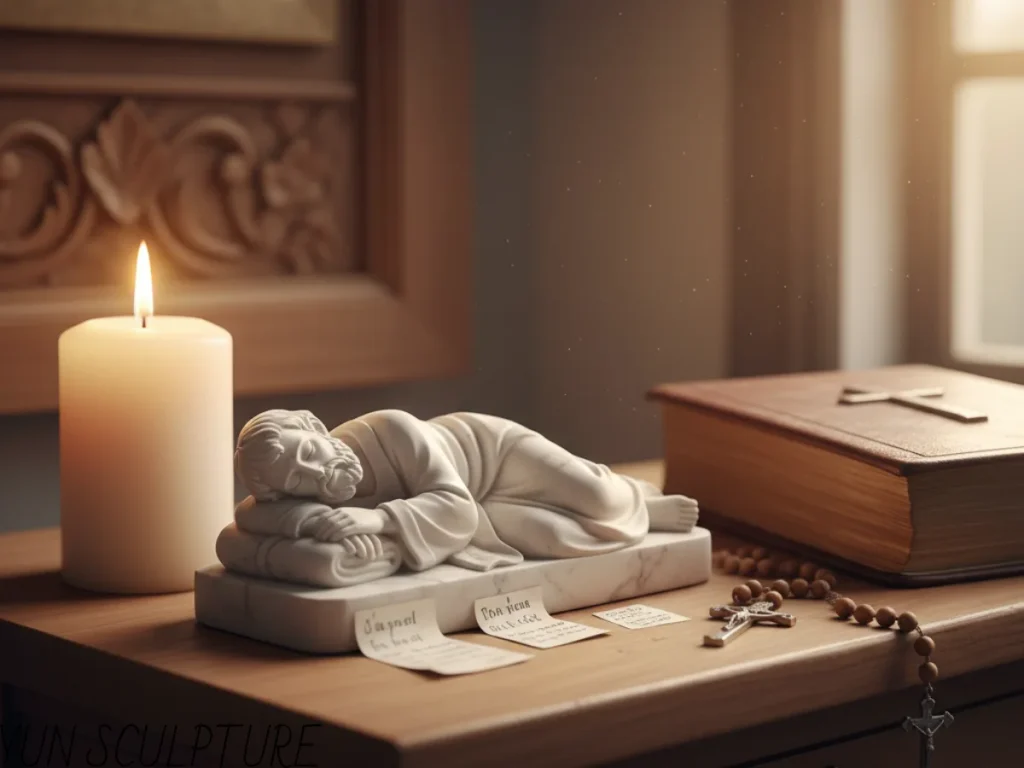
The sleeping st joseph statue pope francis connection gave theological and pastoral legitimacy to the tradition. Churches, families, and religious communities began adopting the practice. Demand increased dramatically.
However, the global spread of this devotion created a new challenge.
Mass-produced statues could replicate the pose, but not the spiritual gravity. Resin figures could imitate the form, but not the permanence of sacred art.
The original Neapolitan carvings were crafted with reverence and intention. The modern devotional movement calls for the same seriousness in material and design.
A sacred image entrusted with human worries deserves structural dignity.
The Significance — What Makes This Image Spiritually Unique
Saint Joseph appears in many forms throughout Christian art.
St. Joseph the Worker represents labor and responsibility. He stands with tools in hand, embodying dedication and daily effort.
St. Joseph with the Child represents fatherly protection and tenderness. He holds Jesus, symbolizing guardianship and love.
The sleeping Joseph presents something entirely different.
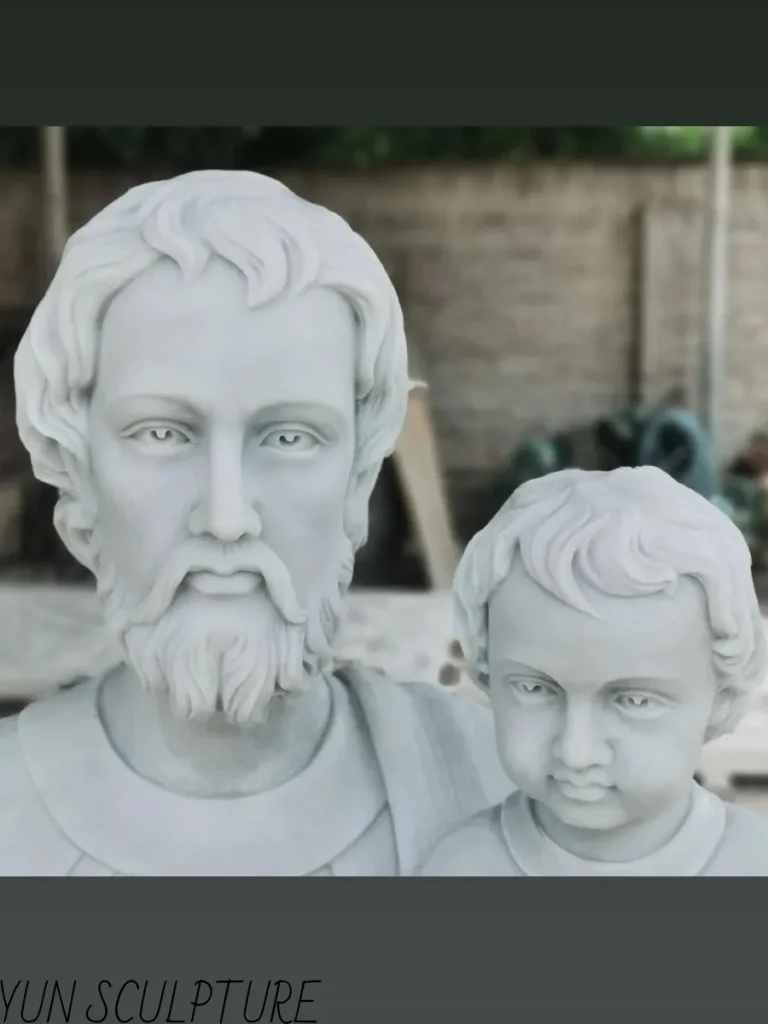

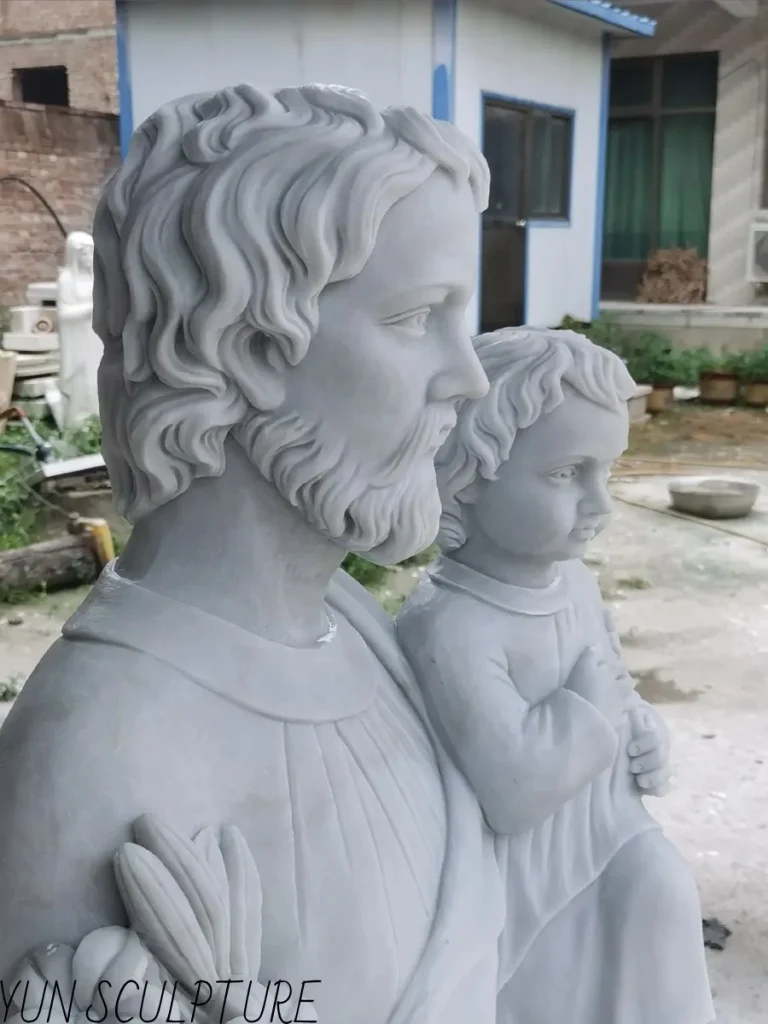
To understand what is the significance of the sleeping st joseph statue, one must look at what is absent.
There is no movement.
No tools in action.
No protective gesture.
Only stillness.
The sleeping st joseph statue story communicates a spiritual paradox: strength through surrender.
In an age defined by urgency, this image teaches patience.
In a culture defined by control, it teaches trust.
In a world filled with noise, it teaches silence.
The saint who once protected the Holy Family now protects the worries of the faithful—not through action, but through intercession.
This is why the statue has become deeply meaningful in modern spiritual practice. It offers a visual theology of letting go.
Not abandonment of responsibility, but surrender to divine wisdom.
Joseph sleeps so that believers may rest in faith.
The Prayer to the Sleeping St. Joseph
The devotional practice surrounding the statue is both intimate and structured.
The prayer to sleeping st joseph statue is often simple and personal. Believers write their worries, decisions, or struggles on small pieces of paper and place them beneath the statue, entrusting these concerns to Joseph’s intercession.
This practice reflects the spiritual logic of the image.
Joseph listens in dreams.
Joseph receives silent burdens.
Joseph carries them to God.
The sleeping st joseph statue prayer therefore becomes less about formal words and more about surrender. It is an act of placing human anxiety into divine care through the intercession of the saint who trusted completely.
In many chapels and homes, this ritual creates a quiet rhythm of faith. Notes accumulate beneath the statue, each one a silent petition. Over time, the statue becomes a witness to countless prayers.

From an engineering perspective, this devotion introduces a specific architectural requirement.
Donghui Zhang often emphasizes that a custom sleeping st joseph statue must accommodate this spiritual practice structurally. The base cannot be purely decorative. It must include a carefully engineered cavity or chamber where prayer notes can be placed without compromising the stability of marble or bronze.
Theological meaning shapes physical design.
A sacred sculpture is not only seen.
It is used in prayer.
It becomes part of lived devotion.
For this reason, the base of a custom statue is designed with internal reinforcement, discreet access points, and structural balance, ensuring that the act of placing prayer notes remains safe, durable, and dignified for generations.
The sleeping saint receives the worries of the faithful.
And the sculpture itself must be built to carry them.
The Sculptor’s Challenge — Capturing Sleep in Permanent Material
Why a Sleeping Figure Is Technically Different from Every Other Commission
Donghui Zhang often explains that a sleeping figure appears peaceful to the viewer, but to the sculptor and structural engineer it is one of the most complex forms in sacred sculpture.
A standing saint follows gravity.
A seated saint distributes weight downward through the base.
A reclining statue sleeping st joseph must resist gravity from multiple directions at once.
This transforms the commission from simple carving into structural engineering.
In vertical statues, the internal load path is predictable. Weight travels from the head through the torso, down the legs, and into the base. The structure behaves like a column.
A sleeping Saint Joseph behaves like a bridge.
The body stretches horizontally. The pressure shifts across several contact points, and each of these points must be calculated with precision. Without careful planning, stress fractures form over time, especially in marble and bronze exposed to outdoor conditions.
Donghui Zhang approaches the design by mapping the statue as a load-bearing system.
The key engineering challenges include:
- Support Points
The weight is distributed across the side of the body—shoulder, hip, forearm, thigh, and lower leg. Each contact point must transfer weight into the base evenly. If one point carries too much load, the stone will crack or the bronze will deform over decades. The internal structure must quietly stabilize the posture while preserving the natural appearance of rest. - Suspended Sections
The most delicate area is the head resting on the arm. This creates a suspended load where the forearm supports both the head and upper torso. In marble, this requires hidden internal reinforcement or carefully calculated stone thickness.
Draped robes hanging from the legs create another risk. Flowing folds appear soft, but in stone they behave like thin structural extensions. Without precise mass distribution, these sections are vulnerable to snapping during transport or installation. - The Base Cavity for Prayer Notes
The devotional tradition of placing written prayers beneath the statue introduces a unique architectural demand. The base must maintain full-length contact with the figure to ensure structural stability. At the same time, it must include a discreet cavity where prayer notes can be placed safely.
This cavity cannot weaken the foundation. Internal reinforcement, weight distribution channels, and concealed structural ribs must be engineered so the base remains solid while still serving its spiritual function.
This is where engineering becomes theology in physical form.
The statue must appear to rest effortlessly, yet internally it must carry hidden strength. The faithful see peace. The engineer sees load distribution, reinforcement lines, and structural equilibrium.
Only when both perspectives align does the sculpture become truly complete.
The Spiritual Anatomy of Rest — What the Face Must Communicate
The most difficult part of a sleeping Saint Joseph is not the body.
It is the face.
A sleeping face cannot be exaggerated. It cannot be theatrical. Even the smallest error transforms peaceful rest into tension or lifelessness.
The sculptor must study real human sleep anatomy to achieve authenticity.
Key anatomical elements include:
- Eyelids naturally drooping
The eyelids must rest gently, never squeezed shut. Tight eyelids suggest strain or fear. True sleep requires softness and natural curvature. - A slightly relaxed jaw
The jaw cannot be rigid. Muscles relax during sleep, creating a subtle softness around the mouth and chin. This gives the face a human warmth and prevents the statue from appearing frozen. - The gravity of the cheek resting on the arm
When a person sleeps on their side, the cheek settles naturally into the supporting surface. The skin compresses slightly, creating gentle pressure and realism. In sculpture, this must be modeled carefully to avoid distortion while still showing natural weight. - Half-curled fingers
Sleeping hands never form fists and never remain perfectly straight. The fingers relax into a gentle curve. This small detail brings life to the entire figure and communicates true physical rest.
These details require extensive clay modeling before carving or casting begins.
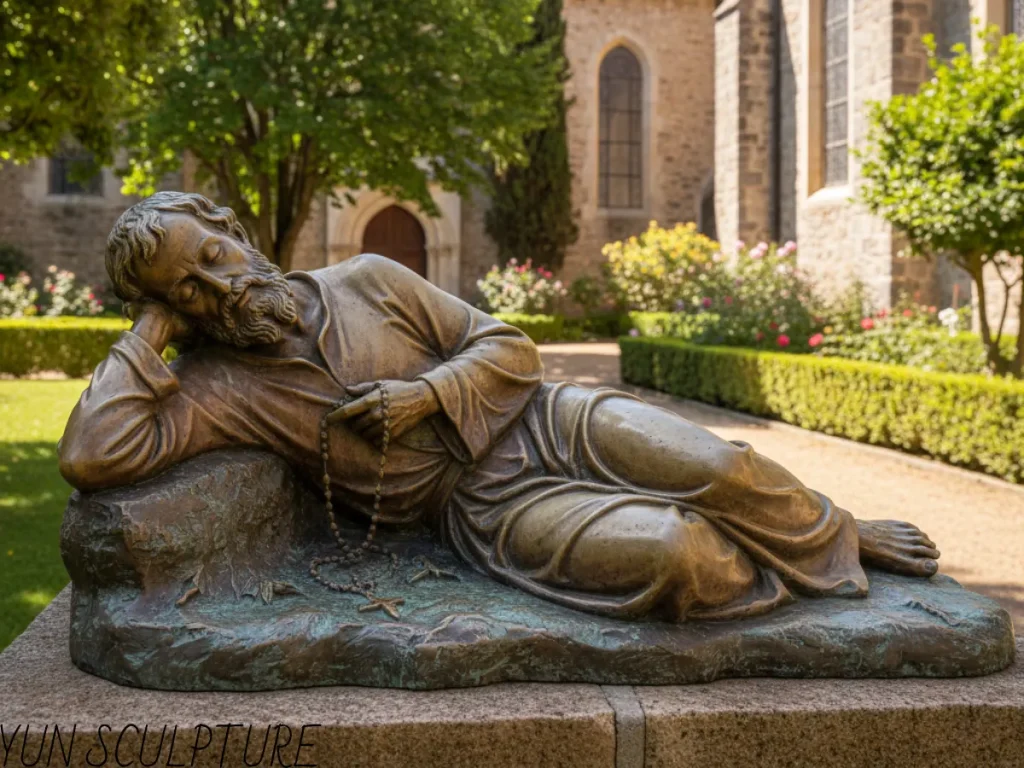
The face of a sleeping Saint Joseph often takes more time than the entire body. Multiple clay studies are created to refine the expression. Slight adjustments to the eyelids or mouth can change the emotional tone completely.
Elena emphasizes that this is not only anatomical accuracy. It is spiritual expression.
The face must communicate three realities at once:
- Physical rest after labor
- Spiritual alertness to God’s voice
- Complete trust and inner peace
Joseph is sleeping, but he is ready.
He is resting, but he is listening.
He is still, but his soul remains attentive to divine guidance.
This balance is extraordinarily difficult to achieve.
Too much relaxation, and the statue appears lifeless.
Too much tension, and the statue appears anxious.
Too much serenity, and the statue loses spiritual depth.
The sculptor must find the precise emotional equilibrium where sleep becomes prayer.
In this moment, sacred art transcends technique. The clay model becomes a meditation on trust, and the final sculpture becomes a visible expression of faith carved into permanent material.
This is the true challenge of a sleeping Saint Joseph.
Not simply to sculpt a resting body.
But to sculpt a soul that listens in silence.
Material Guide — Marble, Bronze, and Steel for the Sleeping St. Joseph
Marble — The Material of Sacred Rest
White marble has always been associated with sacred stillness. In classical religious sculpture, it carries a quiet luminosity known in Italian workshops as morbidezza—a softness of light that allows stone to resemble living flesh. For sleeping st joseph statues, this quality becomes profoundly meaningful.
Elena Zhang often describes marble as the material closest to theological rest. Light enters the surface slightly and diffuses beneath it, creating a gentle warmth that resembles human skin. In a sleeping Saint Joseph, this translucency allows the face, hands, and folded robes to feel calm and alive rather than rigid.
Sleep, in sacred symbolism, reflects trust and surrender. Marble reinforces this message by presenting the body in a peaceful, eternal stillness. The saint appears at rest not only physically, but spiritually—held in quiet permanence.
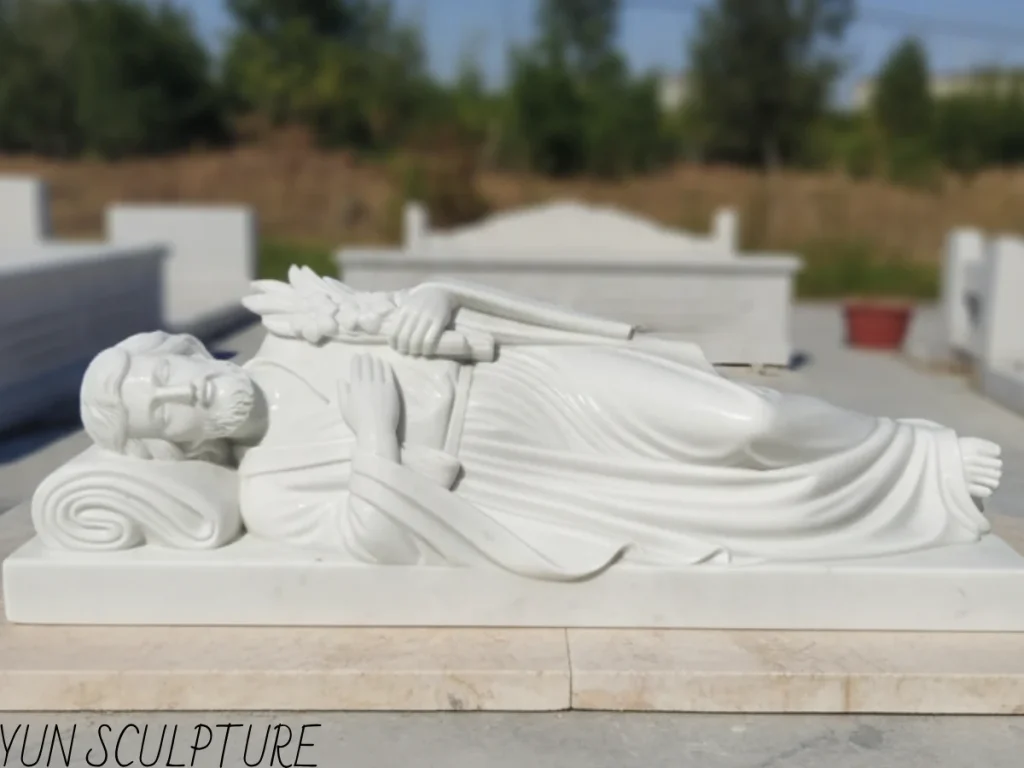
From an engineering perspective, marble requires disciplined structural control.
Marble has high compressive strength, meaning it supports vertical pressure extremely well. This makes it ideal for reclining figures resting fully on a base. However, marble has lower bending strength, which creates risk in thin or suspended sections.
Donghui Zhang addresses this through precise mass calculation.
The draped robes beneath the legs must be thick enough to carry load without appearing heavy. The forearm supporting the head must be reinforced through internal mass balance. Every curve is designed to transfer weight smoothly into the base.
The devotional practice of placing prayer notes beneath the statue adds another engineering layer.
For marble commissions, the base is often designed with a removable marble lid integrated into the structure. This allows the faithful to place written prayers safely inside without weakening the foundation. Internal cavities are reinforced with structural ribs so that the stone remains stable over generations of use.
The result is a sculpture that appears serene and effortless, while internally engineered for permanence.
Marble allows Saint Joseph to sleep in sacred stillness, supported by centuries of sculptural tradition and structural precision.
Bronze — For Outdoor Gardens and Permanent Landmarks
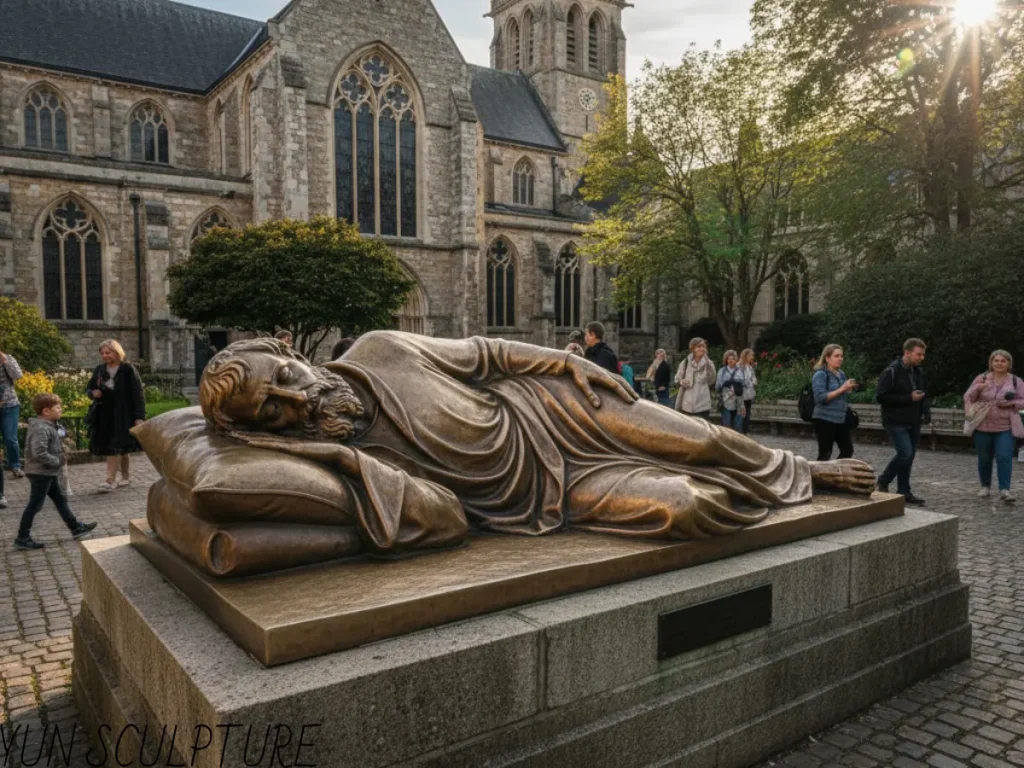
Bronze introduces durability and environmental strength, making it ideal for outdoor devotion. A st joseph garden statue in bronze can be placed in monastery courtyards, church gardens, pilgrimage paths, or memorial landscapes without risk of structural degradation.
Unlike marble, bronze is cast rather than carved. This allows the sculptor to capture deep folds, soft skin textures, and natural anatomical transitions with exceptional detail. The sleeping posture becomes fluid and organic, especially in life-size installations.
Donghui Zhang often compares bronze installations to large-scale religious landmarks, similar in structural planning to a life size jesus statue placed in an outdoor sanctuary. The sculpture must withstand weather, temperature changes, and human interaction while maintaining visual calm and dignity.
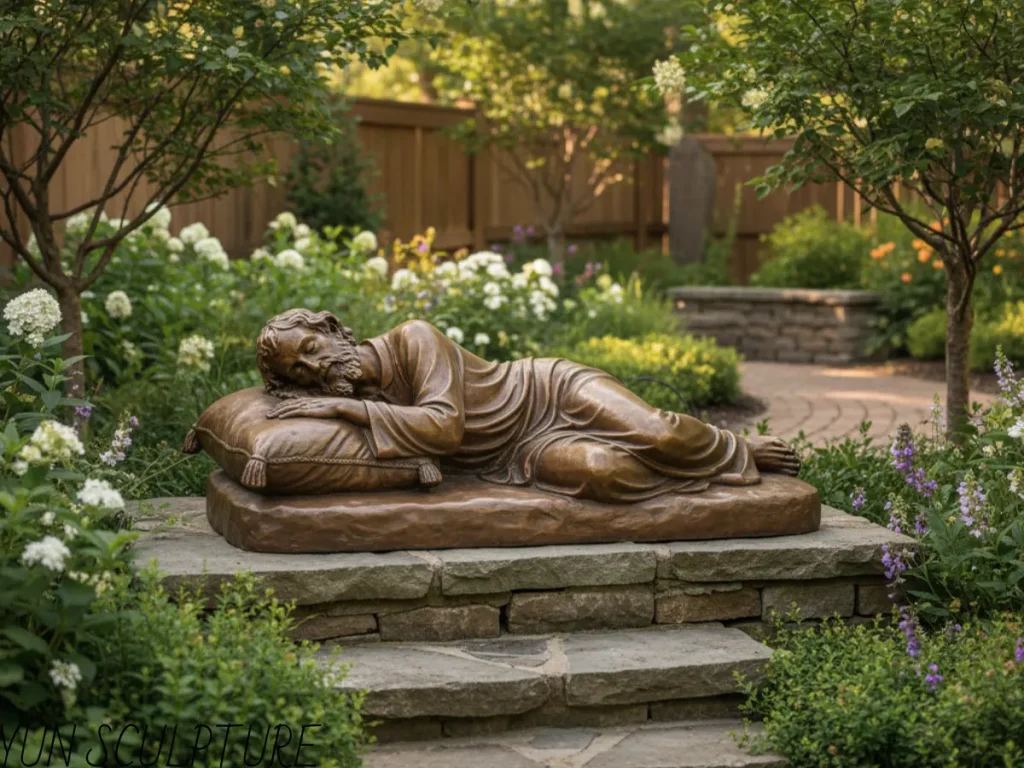
Patina plays a crucial role in bronze sleeping Saint Joseph sculptures.
Typical finishes include:
- Warm statuary brown for the face and hands, creating a natural skin tone
- Verde antique for robes, symbolizing humility and age
- Subtle tonal transitions to highlight folds and resting surfaces
These patinas deepen over time, enhancing the spiritual character of the statue rather than degrading it.
Installation engineering is especially important for a horizontal bronze figure.
A sleeping Saint Joseph cannot rely on a single anchor point. Instead, a full-length anchoring system is required, connecting multiple structural points of the sculpture to the foundation. This ensures long-term stability even in outdoor environments.
Water management is equally critical.
Since the figure is horizontal, rainwater can collect in folds of robes or around the head and arms. Engineers design hidden drainage channels and slope adjustments to prevent water pooling. This protects both the patina and the structural integrity of the sculpture.
Bronze transforms the sleeping Saint Joseph into a permanent outdoor presence—strong enough for nature, yet gentle enough for prayer.
Stainless Steel — The Contemporary Sacred Landmark
Stainless steel represents a new frontier in sacred sculpture. While still rare in traditional religious iconography, it offers unique advantages for modern architecture and spiritual environments.
Donghui Zhang sees stainless steel as particularly suitable for contemporary chapels, hospitals, and meditation spaces.
Its clean surface communicates purity and clarity. Its resistance to corrosion ensures longevity. Its structural strength allows bold yet refined designs.
Compared to marble, stainless steel has significantly higher bending strength. This allows thinner sections and lighter structures, which is especially beneficial for a reclining figure. Draped robes can appear lighter and more fluid without risking breakage.
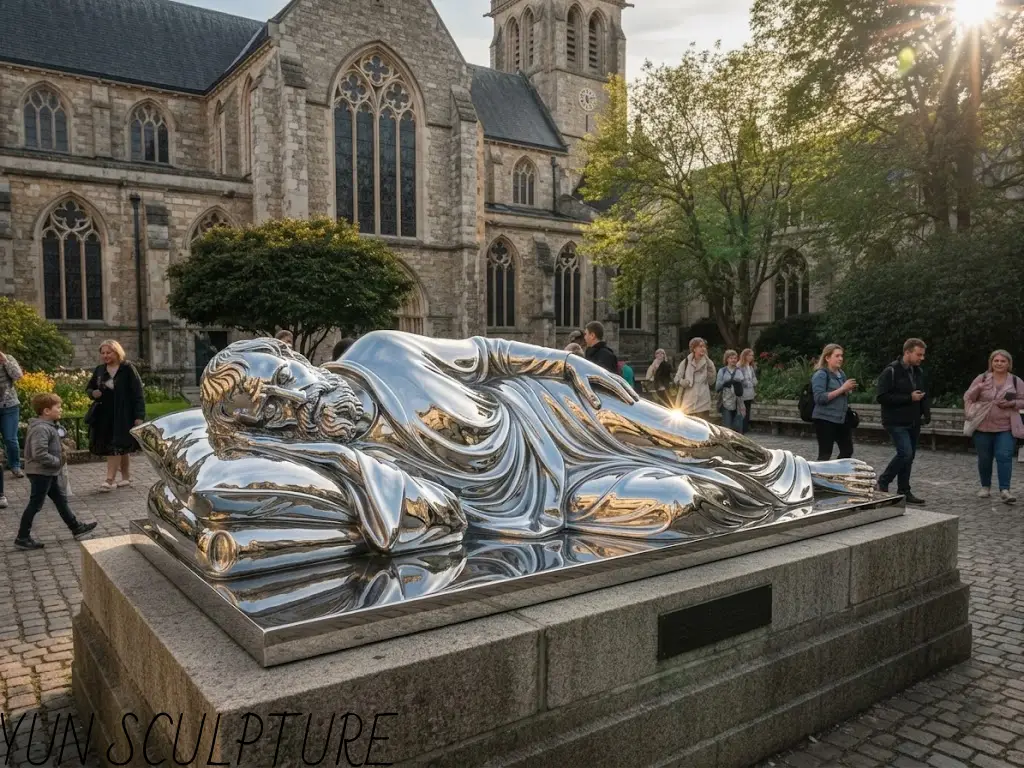
This opens new possibilities for modern sleeping st joseph statues in minimalist environments.
Coastal regions require special consideration.
For projects such as a sleeping st joseph statue australia, the recommended material is 316L stainless steel. This marine-grade alloy resists salt corrosion and harsh coastal climates, ensuring long-term durability even in humid or oceanfront environments.
Surface finish becomes a spiritual decision.
Two primary finishes are commonly used:
- Mirror polish — creates a reflective surface that allows viewers to see themselves in the sculpture, encouraging meditation and personal reflection
- Brushed matte finish — reduces glare and creates a calm, architectural presence suitable for hospitals and chapels
Both finishes maintain structural strength while shaping the emotional experience of the viewer.
Stainless steel transforms the sleeping Saint Joseph into a contemporary sacred landmark—modern in material, timeless in meaning.
Material Comparison — Choosing the Right Material for Your Commission
| Category | Marble | Bronze | Stainless Steel |
|---|---|---|---|
| Recommended Percentage | 60% | 30% | 10% |
| Best Scene | Indoor Altar | Outdoor Garden | Modern / Medical Spaces |
| Sleep Texture Expression | Best | Excellent | Excellent |
| Outdoor Suitability | Indoor primarily | Yes | Yes |
| “Prayer Note” Base Feature | Customizable | Customizable | Customizable |
| 100-Year State | Stable and dignified indoors | Deepened patina and structural stability | Minimal aging, highly durable |
This comparison helps clients align theology, environment, and engineering into a single material decision.
Each material offers a different interpretation of sacred rest.
Marble speaks of eternal peace.
Bronze speaks of enduring presence.
Steel speaks of modern contemplation.
The choice ultimately depends on where Saint Joseph will sleep—and how his silent trust will serve the faithful for generations.
Sizing Guide — From Desk Devotional to Garden Landmark
Choosing the correct size for a sleeping Saint Joseph is not only a visual decision. It determines how the statue will be used in prayer, how it will be installed, and how it will interact with architecture and landscape.
A reclining figure occupies horizontal space rather than vertical space. This means the sleeping st joseph statue for sale category must be approached differently from standing saints. The length of the body, the depth of the base, and the accessibility of the prayer-note cavity all influence the final design.
Donghui Zhang often reminds clients that scale defines devotion.
A small statue invites private prayer.
A chapel statue invites community reflection.
A garden landmark invites pilgrimage.
Each size serves a different spiritual and architectural purpose.
Devotional Scale — The Pope Francis Format
The smallest format follows the tradition made famous by Pope Francis. These statues are designed for desks, home altars, and private prayer spaces.
Typical sizes include:
- 15–30 cm length — personal desk devotional format
- 30–60 cm length — home altar or prayer room format
At first glance, small statues appear easier to produce. In reality, they are among the most technically demanding.
At this scale, facial expression becomes extremely difficult to carve. The eyelids, lips, and fingers must still communicate peace and spiritual alertness, but the sculptor works within millimeters. A slight error can distort the entire emotional tone.
This is why high-quality devotional statues require careful modeling even at small sizes.
Many people searching for a sleeping st joseph statue online or sleeping st joseph statue for sale encounter mass-produced resin versions. These are accessible and affordable, but they rarely capture anatomical realism or theological expression.
A custom devotional statue focuses on precision.
The face must remain peaceful.
The posture must remain natural.
The base must still allow prayer notes to be placed safely.
Even at 30 cm, engineering discipline remains essential.
The Pope Francis format proves that sacred devotion does not require monumental scale. It requires spiritual clarity and thoughtful craftsmanship.
Chapel and Institutional Scale
When the statue moves from private devotion into a chapel or institutional environment, the scale increases significantly.
Typical sizes include:
- 60–90 cm length — chapel niches and prayer corners
- 90–120 cm length — parish halls, monastery corridors, retreat centers
At this size, the statue becomes a shared devotional object rather than a personal one.
Elena Zhang often describes this scale as the “community Joseph.” The faithful approach the statue together, placing written prayers beneath it and returning over time to reflect in silence.
Architecturally, the base becomes more important.
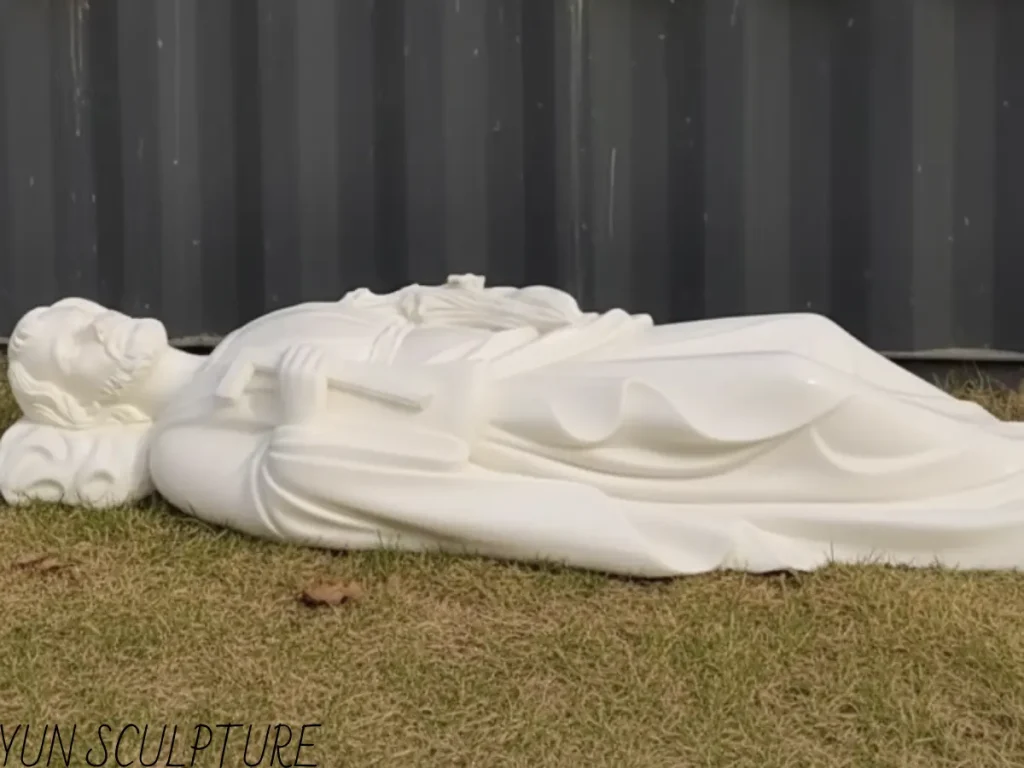
A reclining figure requires a low, elongated base that matches the body length. This prevents visual imbalance and ensures structural stability. The base should never be taller than necessary, as excessive height breaks the sense of rest.
The standardized prayer note cavity is usually integrated at the center of the base, with a discreet access point. This allows multiple users to place notes without disturbing the sculpture or creating crowding around it.
Lighting also plays a role at this scale.
Soft side lighting enhances the folds of the robes and the calm expression of the face, creating a peaceful atmosphere in chapels and institutional spaces.
The statue becomes a silent focal point of prayer—quiet, stable, and deeply human.
Garden and Landmark Scale
Outdoor and landmark installations require a completely different structural approach. The statue must resist weather, physical contact, and long-term environmental stress.
Below is the recommended scale guide.
| Installation Type | Length | Weight | Material |
|---|---|---|---|
| Home Garden | 60–90 cm | 30–80 kg | Bronze |
| Parish Garden | 90–120 cm | 80–150 kg | Bronze |
| Life-Size Landmark | 170–180 cm | 200–350 kg | Bronze / Steel |
| Large Shrine | 200 cm+ | 400 kg+ | Steel |
Donghui Zhang emphasizes that a st joseph lying down statue at this scale behaves structurally like a horizontal monument.
The anchoring system becomes critical.
Small statues may rely on gravity and base weight. Garden and landmark statues require engineered anchoring.
Two primary systems are used:
- Full-length anchor bolts
Multiple anchor points run along the base, distributing weight evenly and preventing movement over time. This is the safest method for large bronze and steel statues. - Distributed load foundation
The concrete foundation is calculated to match the full length of the statue. Weight is spread evenly across the structure, reducing stress and preventing settling or tilting.
Single-point anchoring is never recommended for reclining statues.
The body must rest evenly, just as a sleeping human rests across a bed. Engineering follows the logic of the posture.
Drainage, wind resistance, and maintenance access are also calculated during the design phase.
At this scale, Saint Joseph becomes more than a devotional image. He becomes a landmark of peace within the landscape.
The Sleeping Holy Family — An Extended Commission
A sleeping holy family statue represents one of the rarest and most complex commissions in sacred sculpture.
Instead of a single reclining figure, the composition includes Saint Joseph, the Virgin Mary, and the Child Jesus resting together. The emotional tone shifts from individual trust to familial protection and divine harmony.
Elena Zhang describes this composition as a visual triangle of peace.
Joseph anchors the structure with stability.
Mary provides maternal calm and balance.
The Child rests at the center, representing divine presence.

From an artistic perspective, the challenge lies in maintaining harmony among three horizontal figures. Each body must feel natural and relaxed, yet the overall composition must remain unified and structurally balanced.
From an engineering perspective, the difficulty increases significantly.
Three reclining figures create multiple support points, varied weight distribution, and complex base design requirements. The structure must hold all figures securely while maintaining visual softness and spiritual intimacy.
The result, when executed properly, becomes a powerful symbol of divine rest and human trust.
It is not simply a sculpture. It is a sacred narrative carved into form.
Who Commissions a Sleeping St. Joseph Statue?
The demand for sleeping Saint Joseph statues comes from diverse communities, each with unique spiritual and architectural needs.
Elena Zhang identifies six primary buyer profiles.
1. Catholic Parish and Diocese
Parishes often commission medium to large statues for prayer gardens, chapels, and retreat centers.
The goal is to create a quiet devotional focal point where parishioners can leave written prayers and reflect in silence. The statue becomes part of daily spiritual life within the church community.
2. Seminary and Religious Community
Seminaries and religious houses frequently commission sleeping Saint Joseph statues for meditation spaces.
Joseph represents obedience and discernment, making him an ideal spiritual companion for those preparing for religious life. The statue reinforces the theology of listening to God in silence.
These commissions often emphasize simplicity and theological clarity.
3. Hospital, Hospice, and Palliative Care
Hospitals and hospice centers represent one of the most meaningful contexts for this statue.
The sleeping Saint Joseph symbolizes peaceful trust in God, which connects deeply with the Christian understanding of a good and dignified death. Patients and families often find comfort in the image of a saint resting peacefully in divine care.
Stainless steel is particularly suitable in this environment.
It is clean, durable, easy to maintain, and visually calm. The reflective surface encourages quiet contemplation while maintaining strict hygiene standards required in medical settings.
In this setting, Saint Joseph becomes a silent guardian of peace and hope.
4. Private Devotional Commission
Private commissions are often deeply personal.
Families request custom statues for home gardens, private chapels, or memorial spaces. The most common request is the integrated prayer note cavity, allowing personal worries and intentions to be placed beneath the statue.
This is where questions like where can i buy a sleeping st joseph statue or where to buy sleeping st joseph statue naturally arise.
The answer lies in custom craftsmanship rather than mass production.
A custom statue allows families to choose material, size, facial expression, and devotional features, creating a spiritual object that reflects their personal faith and prayer life.
5. Irish and Australian Communities
Certain regions show particularly strong devotion to Saint Joseph.
Communities in Ireland and Australia often commission sleeping Saint Joseph statues for parish gardens and pilgrimage spaces. The devotion aligns with cultural traditions of family protection, quiet faith, and trust in divine providence.
Requests for sleeping st joseph statue ireland or Australian installations frequently involve outdoor bronze or stainless steel sculptures designed to withstand coastal climates and public use.
These commissions reflect both cultural identity and spiritual devotion.
6. Catholic Gift and Commemorative Commission
Sleeping Saint Joseph statues are also commissioned as memorial or commemorative works.
They may be created to honor a priest, celebrate a church anniversary, or serve as a lasting devotional gift. The peaceful posture of Joseph makes the statue appropriate for remembrance and spiritual legacy.
In this role, the sculpture becomes a gift of prayer that continues for generations.
The Commission Process — From Slumber to Stone
Creating a custom sleeping Saint Joseph statue follows a structured and reverent process. Each step ensures that theology, engineering, and craftsmanship remain aligned.
1. Devotional Brief
The process begins with understanding the spiritual intention.
Clients are asked to define:
- The emotional tone of Joseph (deep rest or listening readiness)
- The intended location
- The need for a prayer-note cavity
- The material and scale
This ensures the sculpture reflects the devotional purpose from the very beginning.
2. Pose Configuration
Next comes the selection of posture.
Common configurations include:
- Right arm supporting the head
- Arms crossed under the head
- One arm extended along the body
Each pose affects both emotional expression and structural engineering. The final choice balances theology, stability, and visual harmony.
3. 1:1 Clay Sculpting
The final stage is full-scale clay modeling.
A life-size or scaled clay model is created, and clients participate in a three-round facial expression approval process.
- Round 1: General posture and proportion approval
- Round 2: Facial expression refinement
- Round 3: Final emotional tone confirmation
Only after full approval does carving or casting begin.
This process ensures that Saint Joseph’s peaceful sleep is not rushed.
It is carefully shaped, patiently refined, and faithfully translated into marble, bronze, or steel—so that the silent saint may continue to receive prayers for generations.
FAQ — 14 Core Questions Answered
What is the Sleeping St. Joseph statue?
It is a depiction of Saint Joseph resting horizontally, usually lying on his side with his head supported by his arm. The sculpture represents the biblical moments in the Gospel of Matthew when Joseph received divine guidance through dreams.
This visual form transforms Scripture into sacred art, presenting Joseph as a man who listens to God even in sleep.
What is the meaning of the Sleeping St. Joseph statue?
The sleeping St. Joseph statue signifies profound trust and surrender to God’s will. His peaceful rest reflects a spiritual posture of obedience, showing that even in silence and stillness, God continues to guide human life.
The image teaches believers that sleep is not inactivity but confidence in divine providence. Joseph rests because he trusts completely.
What is the significance of the Sleeping St. Joseph statue?
In a world shaped by pressure, anxiety, and constant decision-making, the statue symbolizes the courage to let go of control. It offers a visual reminder that faith sometimes means placing burdens into God’s hands and waiting with patience.
The significance lies in its quiet spiritual comfort. The sleeping Joseph becomes a symbol of peaceful trust in divine wisdom.
What is the story behind the Sleeping St. Joseph statue?
The devotion originates from 19th-century Naples, where small woodcarvings of a reclining Saint Joseph were created for household prayer. These intimate devotional figures portrayed Joseph resting peacefully, emphasizing his biblical dreams and obedience.
The image spread globally when Pope Francis revealed that he keeps a sleeping Saint Joseph statue on his desk and entrusts his prayer requests to it, bringing international attention to the tradition.
Why does Pope Francis have a Sleeping St. Joseph statue?
Pope Francis uses the statue as a devotional practice of trust and surrender. He writes his worries and prayer intentions on small pieces of paper and places them under the statue.
He has explained that he trusts Saint Joseph to “dream about it” and bring these concerns before God. This simple act reflects deep spiritual confidence in Joseph’s intercession.
What is the prayer to the Sleeping St. Joseph?
The prayer to the sleeping St. Joseph is a devotional act asking him to carry personal worries into his dreams and present them before God. It is not limited to a single fixed formula and is often expressed through personal intention and silent trust.
The prayer is usually accompanied by writing down concerns and placing them beneath the statue, turning the physical act into a spiritual offering.
How do you use the Sleeping St. Joseph statue for prayer?
The practice is simple and deeply personal. Believers write their concerns, decisions, or intentions on a small piece of paper and place it beneath the statue before going to sleep.
This act symbolizes surrendering the problem to Saint Joseph’s intercession and trusting God to provide guidance and peace in time.
What materials are available for a custom Sleeping St. Joseph?
Mass-produced versions often use resin or wood, including a wood sleeping st joseph statue, which is common in devotional catalogs. These are suitable for simple personal use but lack long-term durability.
For permanent sacred sculpture, museum-grade materials are recommended: Carrara Marble for sacred stillness, Foundry Bronze for outdoor durability, and 316L Stainless Steel for contemporary environments.
What is the best size for a Sleeping St. Joseph for home?
For personal devotion, a 15–30 cm statue is ideal for desks or nightstands, following the format made popular by Pope Francis. This size allows quiet daily prayer without requiring large space.
For a dedicated home altar or garden niche, a 30–60 cm statue provides a stronger visual presence and a more contemplative atmosphere while still remaining intimate.
Can you make a life-size outdoor Sleeping St. Joseph in bronze?
Yes. Life-size bronze sleeping Saint Joseph statues are engineered for outdoor installation in monastery courtyards, parish gardens, and pilgrimage spaces.
They require full-length anchoring systems, reinforced bases, and proper drainage to ensure stability and durability under weather conditions. With correct engineering, bronze becomes a permanent devotional landmark.
Where can I buy a high-quality Sleeping St. Joseph statue?
High-quality sleeping Saint Joseph statues should be commissioned from professional sculpture workshops rather than purchased from mass-produced resin catalogs. Custom commissions ensure accurate anatomy, durable materials, and proper devotional features.
A professional foundry such as Yun Sculpture can customize material, size, posture, and base design, including structural cavities for prayer notes and architectural integration.
How long does a custom marble Sleeping St. Joseph take?
A custom marble sleeping Saint Joseph typically requires 60 to 100 days to complete. The timeline depends on size, material selection, and the complexity of hand-carving the relaxed facial expression and draped robes.
The most time-consuming stage is the sculpting and refinement of the face, where the peaceful sleeping expression must be perfected before final carving.
Can the base be designed to hold prayer notes?
Yes. This is one of the most requested custom features.
Donghui Zhang designs a discreet structural cavity inside the marble or bronze base that allows written prayer notes to be placed safely. The cavity is reinforced internally to maintain stability while preserving the devotional function.
The structure remains strong while quietly serving its spiritual purpose.
What is the difference between Sleeping St. Joseph and St. Joseph the Worker?
A st joseph the worker statue presents Joseph standing with carpenter tools, emphasizing labor, responsibility, and daily work. It reflects active service and dedication to family and vocation.
The sleeping Saint Joseph statue presents him lying down in peaceful rest, emphasizing trust, surrender, and spiritual listening. One represents action, the other represents faith in divine guidance.
Conclusion: A Choice of Eternal Companionship
In the quiet of his study, Pope Francis still places handwritten worries beneath his sleeping Saint Joseph. The gesture remains simple, almost childlike in its trust. A folded note, a silent prayer, and the belief that Joseph will carry these burdens into the presence of God.
This is the heart of the devotion. Joseph sleeps, and yet he listens. Joseph rests, and yet he protects. Joseph remains, always ready to receive the concerns placed under his care.
From an engineering perspective, this devotion carries a clear implication.
The statue must endure.
A resin figure may serve for a season, but time will leave its marks—fading surfaces, chipped edges, weakened structure. Sacred companionship deserves greater permanence. A sleeping Saint Joseph carved in marble or cast in bronze becomes something entirely different: a lasting presence in a home, a parish, a hospital, or a garden of prayer.
Stone does not forget.
Bronze does not abandon.
Steel does not grow tired.
These materials allow Saint Joseph to remain beside the faithful for generations, silently receiving prayers long after the original commissioner is gone.
In the end, choosing a sleeping Saint Joseph statue is not simply a decision about size or material.
It is a decision about companionship across time.
This is not just a choice of material.
It is a choice of how long this spiritual companionship should last.
– Elena Zhang & Donghui Zhang, Yun Sculpture