Get in touch with Yun-Sculpture company
What Does a St. Francis Statue Mean? Every Symbol Explained

A St. Francis of Assisi statue represents peace, humility, and harmony between humanity and the natural world. But beyond that general meaning, every detail on the sculpture — the birds, the wolf, the rope belt, the position of his hands — carries a specific message rooted in centuries of tradition. Know what each symbol means, and you will pick the right statue — not just the pretty one.
Table of Contents
Table of Contents
Why Is St. Francis the Most Popular Garden Saint?
St. Francis of Assisi (1181–1226) gave up a life of wealth to live in radical simplicity among animals and nature. He preached to birds, made peace with a wolf that had terrorized an entire town, and saw every living creature as worthy of respect. That life made him the patron saint of animals and the environment — which is why his statue never looks out of place among living things.
Unlike other saints whose symbolism belongs inside churches, Francis belongs outdoors. His presence in a landscape does not feel imposed. It feels like he wandered in and decided to stay.
What Do the Birds on a St. Francis Statue Mean?
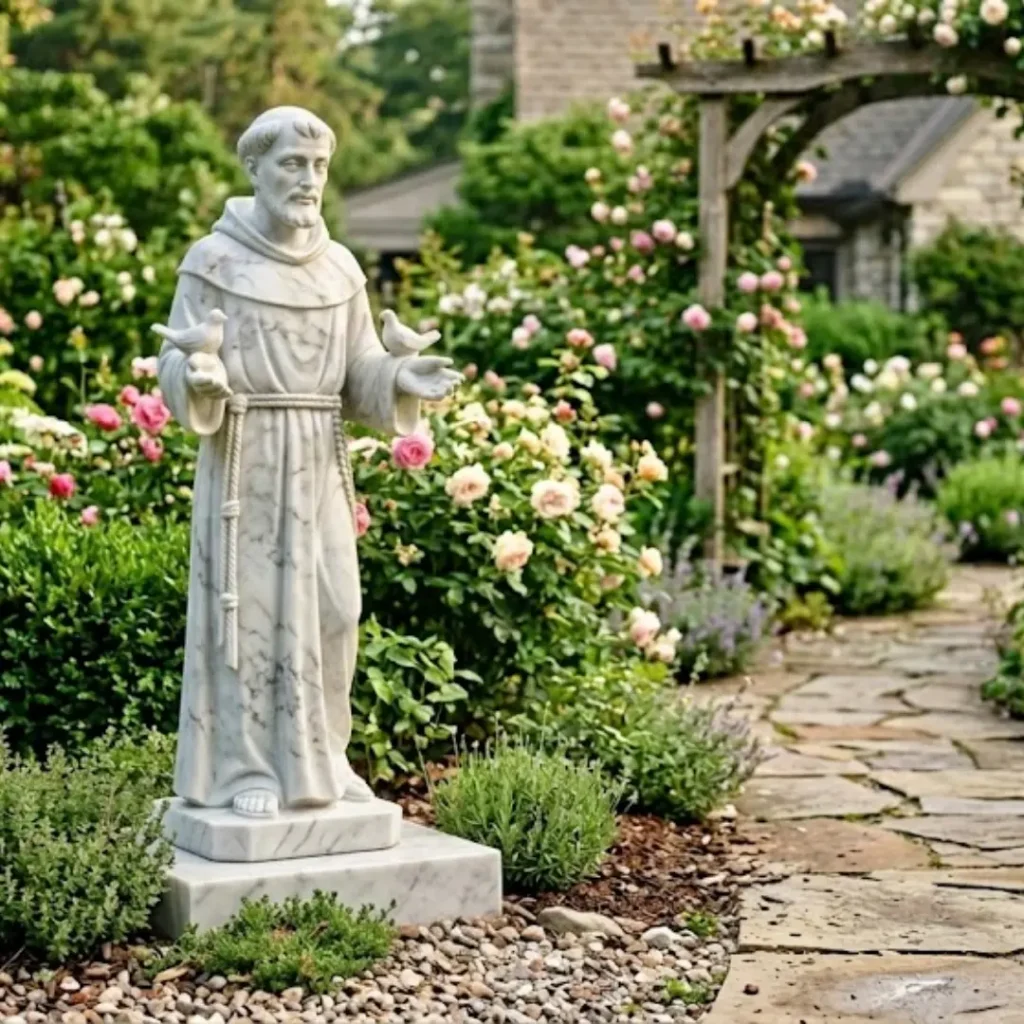
The birds represent the moment when Francis preached a sermon to a flock of birds in a field near Bevagna — and instead of flying away, they stayed and listened. In sculpture, a bird on the saint’s shoulder or hand symbolizes harmony between humanity and nature: kindness draws the living world closer.
Bird placement is also a structural question. In our workshop, the bird is always sculpted directly into the shoulder or hand as a single piece — never attached separately. A bird extending out on a thin perch might look delicate and charming in a catalog photo, but outdoors it becomes a breakage point within a few seasons. We learned this the hard way early on, and now every bird is engineered to survive the same decades as the figure itself.
What Does the Wolf at St. Francis’ Feet Mean?
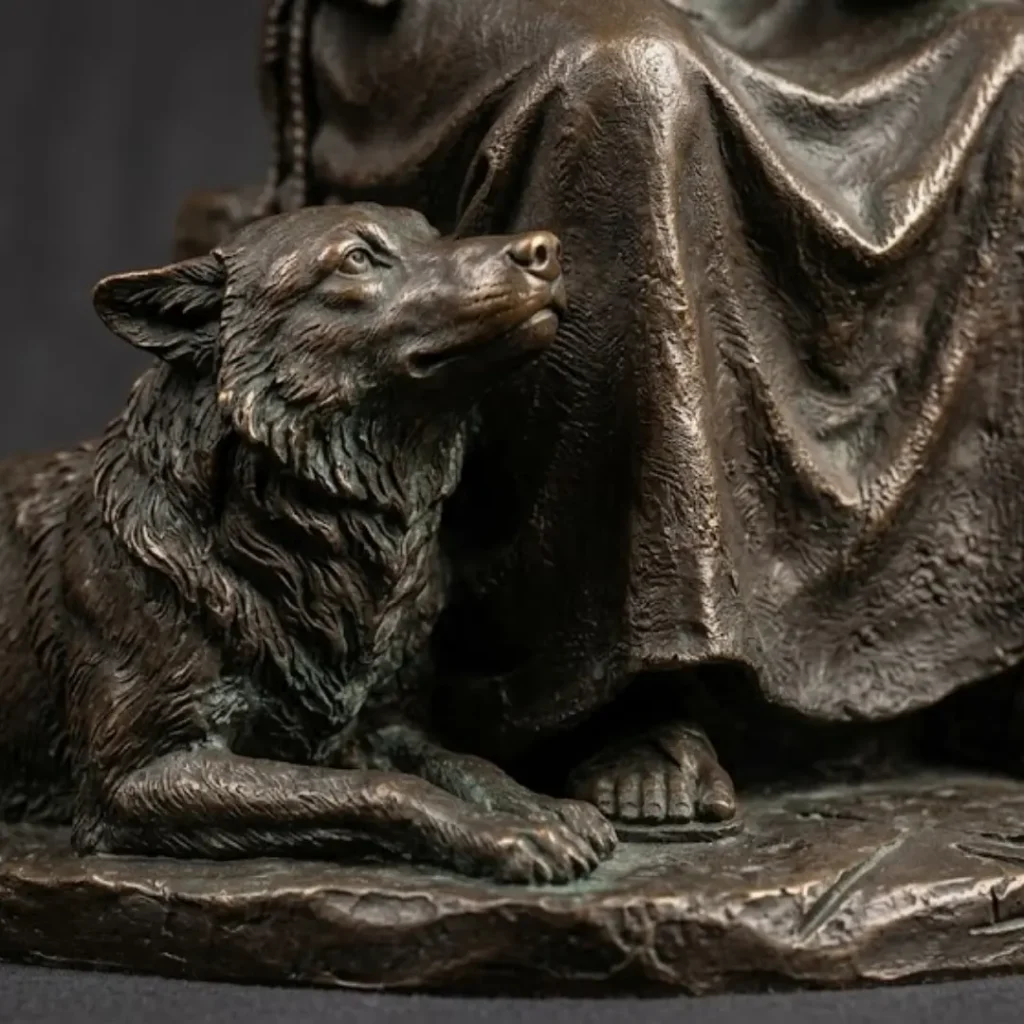
The wolf comes from the story of the Wolf of Gubbio — a fierce animal that had been terrorizing a town until Francis walked out alone, spoke gently, and brokered peace between the wolf and the townspeople.
In sculpture, the wolf sits calmly at the saint’s feet. Not aggressive, but reconciled. I find this version carries the most emotional weight of any St. Francis design. It speaks to people who have lived through difficulty and found their way back to peace. A client in Virginia once chose the wolf version for her family chapel after losing her husband. The story of reconciliation between the wolf and the town — fear replaced by trust — resonated with her deeply. That is the kind of connection these symbols create when chosen with intention.
The wolf version also anchors heavier spaces well — stone walls, old trees, shaded courtyards. It would feel too intense beside a sunny flower bed. If your garden has a quiet, sheltered corner, that is where the wolf belongs.
What Does the Rope Belt with Three Knots Mean?
The rope belt is part of the Franciscan habit, and the three knots represent the three vows every Franciscan takes: poverty, chastity, and obedience.
This small detail is one of the quickest ways to judge whether a statue was crafted with genuine understanding. A well-made St. Francis will show three distinct knots in the rope. Mass-produced versions often blur them into a generic belt or skip them entirely. We see this constantly when clients send us photos of statues they bought elsewhere and ask us to evaluate them — the knots are almost always missing or vague.
If you have a statue you are unsure about, send us a photo — we are happy to help you identify whether it follows traditional iconography.
Why Is St. Francis Sometimes Holding a Skull?
The skull is a memento mori — a traditional symbol reminding viewers that earthly life is temporary. It represents meditation on mortality and the importance of living with purpose.
Not every St. Francis includes a skull. It appears most often in older European traditions and in statues designed for monasteries or contemplative spaces. For garden settings, most of our clients prefer the bird or animal versions, which emphasize life and harmony. But for a private prayer corner or a monastery, the skull version carries a quiet power. Personally, I think it works best in spaces where people go to be still — not to entertain guests.
What Do the Hand Positions Mean?
The hands define the spiritual tone of the entire sculpture.
Hands folded in prayer represent inner contemplation. This is the most meditative version — quiet, inward-focused, often chosen for memorial spaces and cemeteries.
Hands outstretched express openness and welcome. Personally, I find this the most moving pose — there is something generous about a saint who greets you before you even reach the garden gate. It works beautifully at entrances and along pathways.
One hand holding a bird or animal, the other resting at the side balances gentleness with calm presence. This is the most versatile version for residential gardens and the one we produce most often.
When choosing between these, think about who will encounter the statue and how. A prayer pose fits a private corner. Outstretched hands welcome visitors. The animal pose anchors a garden focal point. Each serves a different purpose in the space.
Frequently Asked Questions
Why is St. Francis holding a skull?
The skull is a memento mori — a reminder that earthly life is temporary. It appears mainly on statues for monasteries and contemplative spaces. We explain this symbol in detail above.
What animal represents St. Francis?
Birds (especially doves), the wolf of Gubbio, and deer are the animals most closely associated with St. Francis. Each creates a different tone in sculpture — birds suggest harmony, the wolf suggests healing, and deer suggest gentle coexistence. The choice depends on the message you want the statue to carry.
What is the story of St. Francis and the birds?
Francis was walking near Bevagna when he stopped to preach to a flock of birds about gratitude and God’s care for all creatures. The birds stayed and listened rather than flying away. This moment became one of the most iconic images in Christian art, which is why so many St. Francis garden statues feature a bird on the saint’s shoulder.
What animal did St. Francis tame?
The Wolf of Gubbio — a fierce animal terrorizing a town until Francis brokered a peace agreement between the wolf and the townspeople. This story is the origin of the St. Francis with wolf statue design, which we discuss in detail above.
Did St. Francis say animals go to Heaven?
There is no direct quote from Francis on this topic. However, he treated all animals as fellow members of creation, calling them “brothers” and “sisters.” This attitude made him the patron saint of animals and a comforting figure for families who have lost pets — which is why small St. Francis statues are often placed near pet memorials.
What does the T-shaped cross on a St. Francis statue mean?
The T-shaped cross is called the Tau cross. Francis adopted it as his personal symbol after hearing Pope Innocent III reference the Tau in a sermon. It became the signature of the Franciscan order and appears on many statues — as a pendant, carved into the robe, or held in his hand. If you see a Tau on a statue, the sculptor understood Franciscan tradition.
What miracle did St. Francis perform?
The most visually significant miracle for sculpture is the stigmata — the appearance of Christ’s wounds on his hands, feet, and side during a vision on Mount Alverna in 1224. Francis is widely considered the first recorded person to bear the stigmata. Some statues show faint marks on his hands. We have carved stigmata marks on only a handful of commissions over the years — mostly for Franciscan monasteries in Europe. For garden statues, most clients prefer not to include them.
What are 5 key facts about St. Francis of Assisi?
He was born in 1181 in Assisi, Italy, to a wealthy merchant family. He renounced his wealth and chose voluntary poverty. He founded the Franciscan order, one of the largest religious orders in the Catholic Church. He is the patron saint of animals and the environment. And he received the stigmata in 1224 — reportedly the first recorded person to bear Christ’s wounds. These facts shaped every visual tradition that sculptors still follow today.
Choosing Your St. Francis
Now that you understand what each symbol represents, choosing becomes clearer. The birds speak to harmony. The wolf speaks to healing. The skull speaks to contemplation. The hands define whether the statue welcomes, meditates, or protects.
For help matching the right symbol to your garden, read our complete choosing guide, or browse our bronze vs. marble comparison if you are also deciding on material. You can always reach out directly to discuss which design fits your space.
— Elena Zhang, Yun Sculpture