Get in touch with Yun-Sculpture company
St. Joseph Statue for Selling a House: The Tradition, the Theology, and a More Lasting Alternative

The tradition of burying a st joseph statue to sell a house is one of the most widespread popular devotions in American Catholic culture — and one of the most theologically contested. Millions of homeowners have done it. Catholic priests have publicly urged them to stop. Neither side is entirely wrong. This guide explains where the tradition came from, what the Church actually teaches, and why a growing number of serious Catholics are choosing a different approach entirely.
Table of Contents
Table of Contents
Why Do People Bury a St. Joseph Statue to Sell Their House?
The tradition has surprisingly deep roots — though not quite where most people think.
The most credible origin traces to St. Teresa of Avila in the 16th century. While establishing new convents, she and her fellow nuns buried medals of St. Joseph in land they hoped to acquire for their communities, praying for his intercession. Over centuries, medals became small statues, land acquisition became home selling, and a private monastic practice became mainstream real estate folklore.
The tradition reached peak popularity in the United States around 1990, when real estate agents began recommending it informally and Catholic supply stores started selling dedicated kits. By that point, the theological origins had largely faded. The practice had become a good-luck ritual — accessible, inexpensive, and carrying just enough religious weight to feel meaningful during one of life’s most stressful transactions.
The logic behind it is actually coherent, even if the execution has drifted. St. Joseph is the patron of the home and family. He led the Holy Family through multiple displacements — the journey to Bethlehem, the flight to Egypt, the return to Nazareth. He understood, better than most, what it means to uproot a household and establish a new one. Asking for his intercession during a home sale is theologically reasonable. It is the burying that creates the problem.
What Does the Church Actually Say About Burying a St. Joseph Statue?
More than one Catholic priest has addressed this directly, and their position is consistent.
Father Donald Calloway, a recognized expert on St. Joseph, writes plainly that the burial practice concerns him. His reasoning is precise: statues are not made to be buried. A statue is a sacred object — a representation of a holy person, created to be venerated, displayed, and honored. Placing it upside down in the dirt, as the most common instructions direct, treats it as a talisman or lucky charm rather than a devotional image.
The deeper theological problem is the transactional framing. Some versions of the burial tradition explicitly instruct the homeowner to leave Joseph buried until the house sells — the implication being that the saint is somehow coerced into helping by the discomfort of being underground. Father Tom Margevicius, director of worship for the Archdiocese of St. Paul and Minneapolis, describes this as substituting superstition for prayer: “Instead of surrendering myself to the providential care of the Lord, I try to manipulate factors that are ordinarily beyond my control.”
Neither priest dismisses the underlying devotion. Asking St. Joseph for help with housing is entirely appropriate — he is, after all, the patron of the home. What they object to is the method: concealment, inversion, and the implicit suggestion that a plastic figurine buried face-down constitutes spiritual leverage.
The tradition of burying small medals or items while praying is ancient and legitimate in Catholic practice. The specific instructions attached to modern home-selling kits — upside down, facing the house, near the For Sale sign, left buried until closing — represent a folk elaboration that has moved well beyond its origins.
What Is the St. Joseph Home Selling Kit?
The standard kit, available on Amazon for $6–$15, contains three items: a small plastic or resin statue, a prayer card, and a set of burial instructions.
The statue is typically 3–4 inches tall, beige or off-white, made of solid resin or a resin-stone composite. It depicts St. Joseph in his traditional guardian form — robed, calm, sometimes holding a lily or the Child Jesus. The instructions vary slightly by manufacturer but generally direct the homeowner to bury the statue upside down in the front yard, near the For Sale sign, and to pray daily until the house sells.
After the sale, instructions typically say to dig up the statue and bring it to the new home as a gesture of gratitude.
These kits serve a real need — they give anxious homeowners something concrete to do, a focal point for prayer during a stressful process. There is nothing wrong with that impulse. The question is whether a $6 resin figurine buried in the ground is the right expression of it.
If you are drawn to St. Joseph’s intercession during a home transition, there is a version of this devotion that honors both the tradition and the saint. We describe it in the next section.
What Is the Respectful Modern Alternative to Burying a St. Joseph Statue?
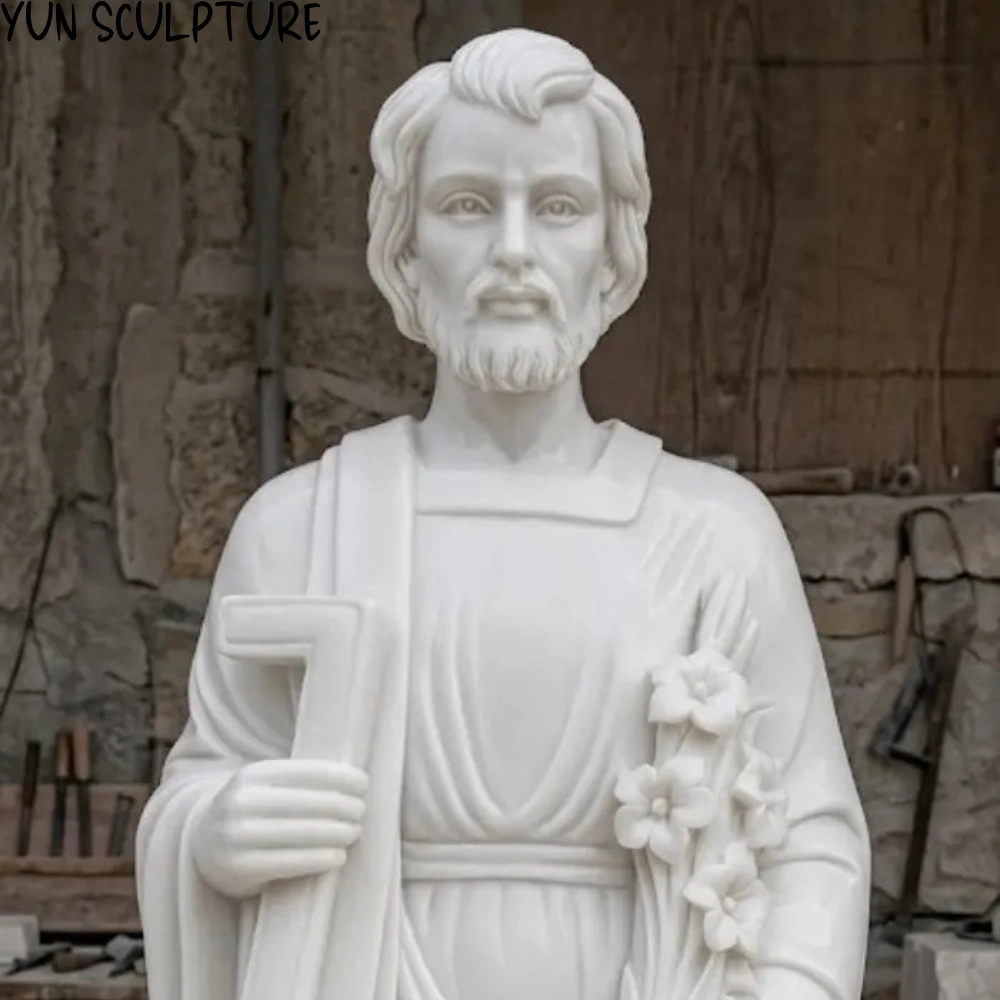
The alternative is simple: instead of burying Joseph, place him where he belongs — standing, visible, blessing the property.
A well-crafted marble or bronze St. Joseph statue placed in the garden or at the entrance of the home does everything the burial tradition intends, without the theological problems. Joseph stands as a visible guardian of the property. His presence communicates blessing and protection to anyone who approaches. The homeowner prays in front of him daily — not to coerce an outcome, but to seek intercession and trust in God’s providence.
When the house sells, the statue becomes a gift to the new owners.
This is the gesture I find genuinely moving about this approach. Instead of digging up a plastic figurine and taking it with you, you leave a lasting blessing behind. A family moving into a new home finds Joseph already there, already standing watch. The sculpture becomes a point of continuity between households — a visible sign that the home has been prayed over and cared for.
I heard from a client in Connecticut last year who did exactly this. She commissioned a 72-inch white marble St. Joseph from us while her historic farmhouse was on the market — not as a selling tactic, she was careful to say, but as a proper way to ask for his blessing on the transition. She placed it at the garden entrance, prayed there each morning, and left it for the buyers when the house sold after six weeks. She told me the buyers called her after closing to say they had kept the statue exactly where she placed it. That detail stayed with me.
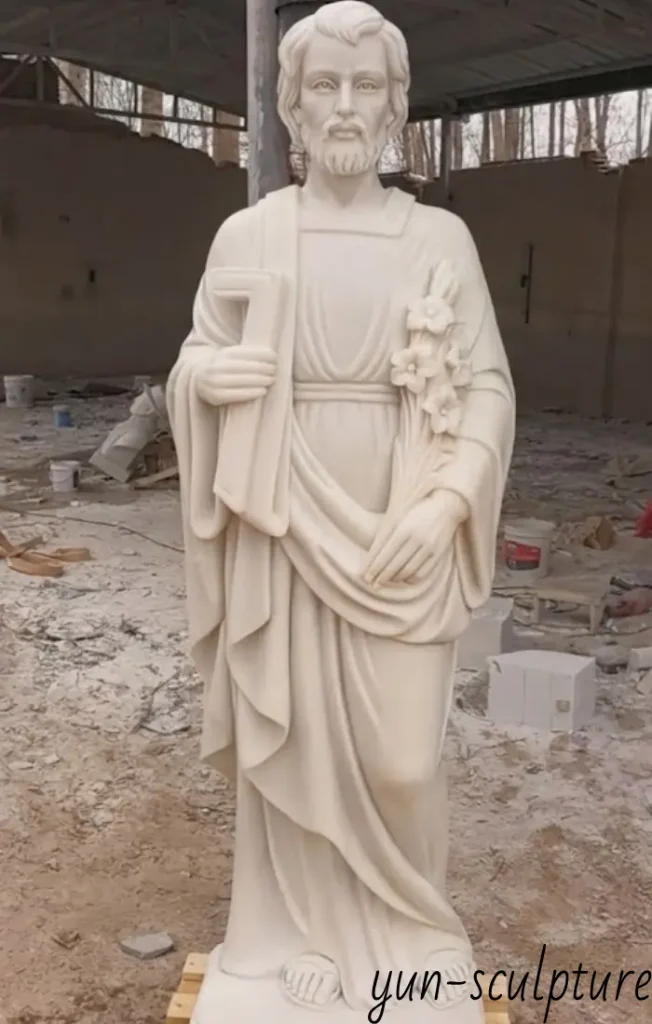
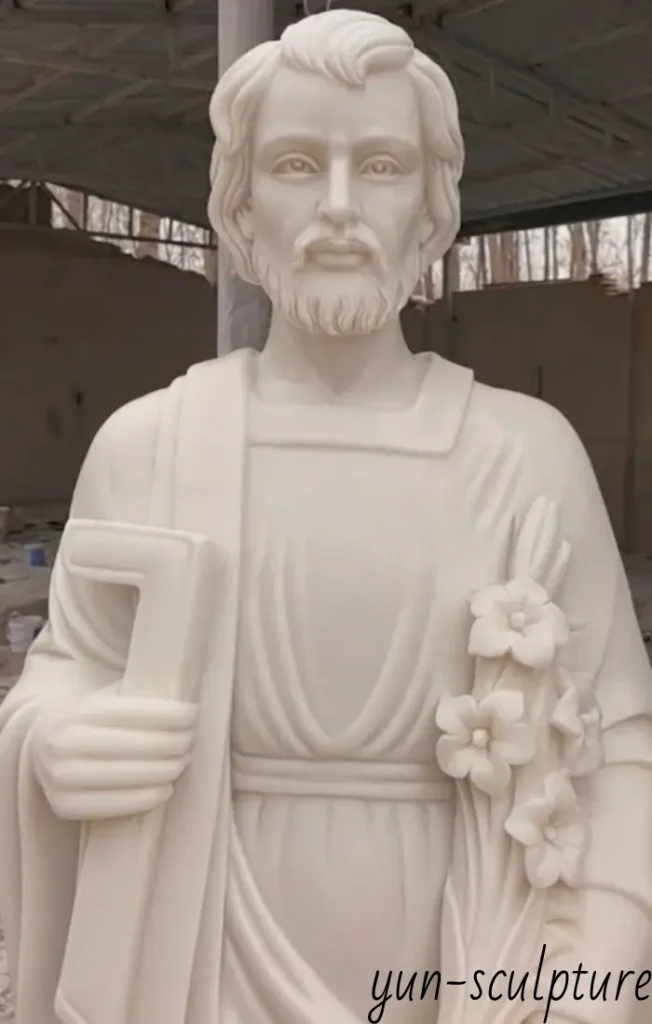
A quality marble garden statue suitable for this purpose starts at a different price point than a kit from Amazon — but it is also a permanent object, one that will still be standing in that garden in twenty years. For homeowners who take the devotion seriously, the comparison is not really between a $15 kit and a $6,500 statue. It is between a disposable good-luck object and a lasting act of faith.
For more on St. Joseph as protector of the home and what a properly commissioned statue looks like in marble or bronze, our St. Joseph the Worker statue guide covers material selection and sizing in detail. And if the contemplative, restful image of Joseph appeals more than the worker figure, our sleeping St. Joseph statue commission guide walks through that specific devotional form — which has become one of the most requested versions for home and garden settings.
FAQ
Where should I bury my St. Joseph statue?
Traditional instructions suggest burying the statue in the front yard, near the For Sale sign or close to the road. Some versions say near the back yard boundary facing the house. The directions vary significantly across different kit manufacturers and folk traditions, with no authoritative Catholic source endorsing any specific location. Given that Catholic teaching cautions against the burial practice altogether — recommending instead that statues be displayed and venerated rather than concealed — the more theologically consistent approach is placing the statue in a visible, honored position near the entrance of the home rather than underground.
Which way should St. Joseph face when buried?
Most kit instructions say upside down, facing the house — the reasoning being that Joseph will be motivated to “right himself” by selling the home quickly. Other versions say facing away from the house toward potential buyers. The contradictory instructions across different sources reflect the folk rather than doctrinal nature of the practice. Catholic clergy who have addressed the tradition note that the directional requirements have no theological basis. If Joseph is to be placed outside, the more respectful position is standing upright, facing outward to greet and bless those who approach the property.
What do you do with St. Joseph after selling a house?
The traditional instruction is to dig up the statue, thank St. Joseph, and bring it to your new home where it should be given a place of honor. This aftercare reflects an appropriate instinct — the statue should be honored, not left buried or discarded. An alternative that many homeowners find more meaningful is leaving the statue as a gift for the new owners, placed visibly in the garden or near the entrance. This transforms the devotion from a personal transaction into an act of generosity: a blessing passed forward from one family to the next, with Joseph continuing to stand watch over the home he helped protect.
Can you reuse a St. Joseph statue?
Yes. There is no theological reason a St. Joseph statue cannot be used in more than one home sale, and Catholic teaching would actually prefer a statue be kept, honored, and reused rather than discarded after a single use. If the statue has been buried, it should be cleaned carefully and placed in a position of honor rather than stored in a drawer or thrown away. A quality marble or bronze statue, by contrast, is naturally suited to permanent placement — in a garden, at a front entrance, or in an interior prayer space — and its value increases over time rather than diminishing after one transaction.
What if I don’t have a yard for St. Joseph?
For apartment and condo dwellers, traditional instructions suggest burying the statue in a potted plant near the front door, or placing it on a windowsill overlooking the street or any visible For Sale signage. The more straightforward approach for those without outdoor space is simply placing a small statue in a position of honor inside the home — near the main entrance, on a shelf visible to visitors, or beside a window. The devotional purpose is prayer and intercession, not the specific act of burial. A statue placed with intention and prayed before daily fulfills the spiritual purpose more completely than one buried in a pot.
Place Joseph Where He Can Be Seen
A saint defined by his role as protector of the home deserves to stand in the home — not face-down in the dirt.
Browse our St. Joseph garden statue collection →
Commission a marble or bronze St. Joseph for your garden — receive a free quote within 24 hours →