Get in touch with Yun-Sculpture company
Hercules Statue: Bronze & Marble Guide for Estate, Garden & Commercial Space

The Farnese Hercules is the most misunderstood commission brief I receive. The client says they want strength. What they are actually requesting — if they commission correctly — is something more difficult to achieve and more lasting in a permanent installation than strength: the credibility of strength that has already been exercised. The Farnese Hercules is not displaying his power. He has used it, exhausted it across twelve impossible tasks, and now stands leaning on his club with the golden apples hidden behind his back. The weight of accomplished things, not the posture of things about to happen. This distinction between strength-in-action and strength-after-completion is why the Farnese type has been placed in royal palaces, corporate headquarters, and luxury hotel lobbies for five hundred years — and why a hercules statue commission requires understanding which type you are actually placing before any other decision is made.
Table of Contents
Table of Contents
Three Hercules Types — Which Commission Are You Placing
Hercules exists in three distinct sculptural types, each representing a different moment in the hero’s mythology and each making a fundamentally different statement in a permanent installation. Selecting the wrong type is the most common error in a Hercules commission — not a material error or a scale error, but a conceptual one that no amount of craftsmanship can correct after the piece is complete.
The Farnese Hercules represents the hero in repose after the completion of his Labors. He stands leaning on his club, his back slightly rounded with fatigue, his left hand behind his back concealing the golden apples of the Hesperides — the objective of his final labor. He does not display his trophies. He has earned them, but the exhaustion of the earning is what the figure shows. The original was carved by Glycon of Athens, working from a Lysippos bronze of the 4th century BCE, and found in the Baths of Caracalla in Rome in 1540. It now stands in the Museo Nazionale in Naples at 317 centimeters — over ten feet tall. For five centuries, this type has been the most commissioned Hercules in estate, institutional, and commercial settings because it communicates authority without aggression: the man who has done the work, not the man who is about to.

The Hercules-in-Combat type shows the hero in active struggle — fighting the Nemean lion, battling the Hydra, engaged in one of the Labors as they happen rather than in their aftermath. This type has directional energy that the Farnese does not: the figure is moving, straining, applying force. For outdoor garden settings where the statue will be encountered from a distance and needs to read immediately as a figure in action, the combat type has advantages over the meditative Farnese. For interiors and formal entrance settings, the combat pose introduces an energy that can feel less controlled in enclosed spaces.
The Hercules-and-Antaeus type is a multi-figure commission — Hercules lifting the giant Antaeus off the ground, the act that kills him by separating him from the earth his mother Gaia had charged with his strength. This is a landmark commission rather than a standard figure: it requires greater space, greater pedestal engineering, and significantly more production time than either single-figure type. The Hofburg Palace in Vienna holds the most famous version. For buyers who need a singular installation piece — a courtyard centerpiece, a hotel lobby focal point of genuine monumental ambition — this type has no equal in the Hercules commission category.
1
Most Commissioned · Estate · Corporate · Luxury Hospitality
Farnese Hercules — Repose After the Labors
The hero leans on his club after completing twelve impossible tasks. Golden apples concealed behind his back — retrieved, but not displayed. The weight of accomplished things rather than the posture of strength about to be applied. Original by Glycon of Athens after Lysippos; found in the Baths of Caracalla 1540; now in the Museo Nazionale in Naples at 317 cm. The correct institutional and commercial commission for any space where authority without aggression is the required register.
2
Action · Garden · Sports Facility · Outdoor Setting
Hercules in Combat — Active Struggle
The hero engaged in one of the Labors: wrestling the Nemean lion, battling the Hydra, in direct physical contest. Directional energy and implied motion that reads clearly at distance. Best suited to open outdoor garden settings where the figure needs to compete with landscape scale. Less controlled in enclosed or formal interior settings where the action pose introduces an energy that can feel restless over sustained daily exposure.
3
Landmark Commission · Courtyard Centerpiece · Monumental Scale
Hercules and Antaeus — Multi-Figure Wrestling
Hercules lifts Antaeus from the earth — the act that kills the giant by severing his connection to the ground that gives him strength. A landmark commission rather than a standard figure: requires greater footprint, more complex pedestal engineering, and significantly longer production. The Hofburg Palace version in Vienna is the canonical reference. Correct for hotel lobby centerpieces, large courtyard focal points, and any installation where singular monumental ambition is the brief.
Why the Farnese Type Outperforms Action Poses in Permanent Installations
I have installed both Farnese-type and combat-type Hercules figures in commercial and estate settings over more than twenty years, and the pattern is consistent: the Farnese type ages better in its space. The reason is psychological rather than aesthetic.

An action pose implies a moment in time. A figure mid-strike, mid-wrestle, mid-effort is caught at a specific instant that the viewer’s eye always wants to complete — what happened next? This temporal quality makes action figures compelling for the first encounter and slightly restless for the five hundredth. The Farnese type has no such implied continuation. He is not in a moment; he is in a state. The exhaustion after the work, the hidden trophies, the weight of accomplished things: these are permanent conditions, not instants. A figure in this state can be looked at every day for twenty years and still be complete.
The golden apples hidden behind his back deserve specific mention. Most viewers, encountering a Farnese Hercules reproduction for the first time, are not immediately aware of them. But the back of the figure — which Lysippos designed to be as carefully observed as the front — shows the hand concealing the prizes. This detail communicates something that no action pose can: that the figure has completed the most difficult thing possible, retrieved what he was sent for, and is not making a show of it. For corporate headquarters and institutional settings, this quality of quiet, concealed achievement is more appropriate than displayed triumph.
Material and Structural Considerations
The club in the Farnese Hercules is not a weapon in the sculptural sense — it is a structural element. In the marble version, the club carries a significant portion of the figure’s weight, functioning as a caryatid prop for the leaning body. The lion’s skin draped over the club adds further mass. This structural dependency on the club limits what marble can do with the Farnese pose: the club must be substantial, must connect firmly to the base, and must be treated as a load-bearing element rather than a decorative one.
In a lost-wax bronze casting, the structural dependency disappears. Bronze’s tensile strength means the figure can lean without the club bearing the load — the internal structure of the cast handles the weight distribution. This gives bronze Hercules commissions more freedom in the club’s treatment: it can be thinner, more naturalistic, less obviously structural. For commissions where the club’s realistic appearance matters — where a viewer is likely to look closely at the texture of the wood, the wrapping at the grip — bronze is the correct material.
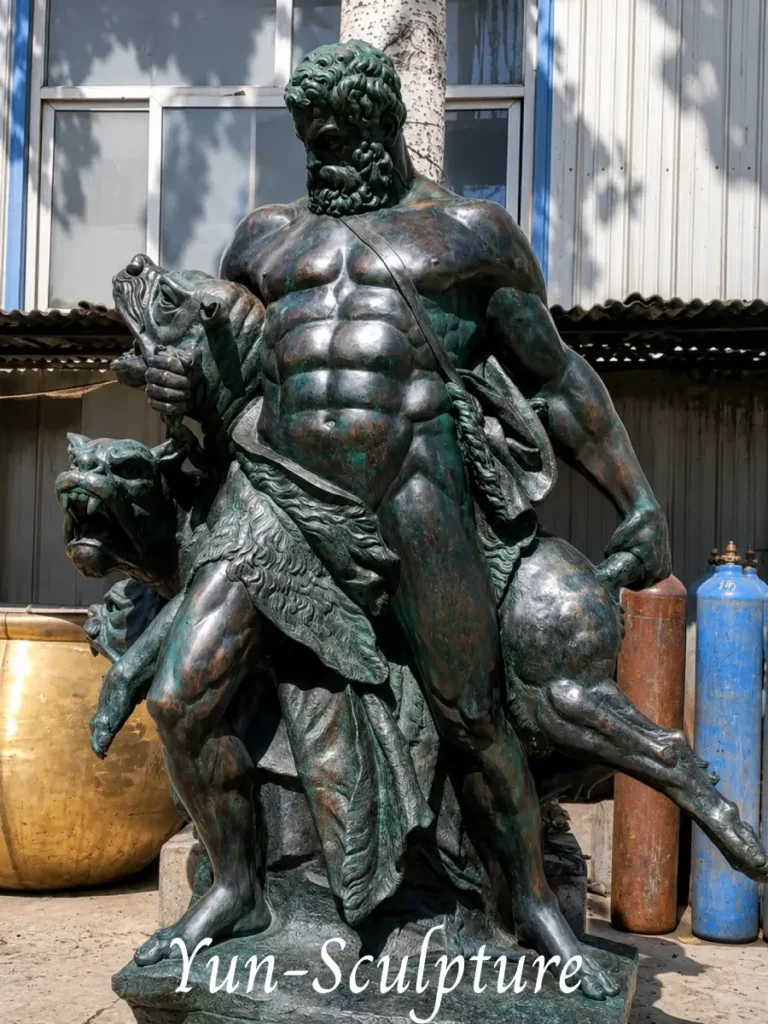
For outdoor installations, bronze is my consistent recommendation for Hercules commissions regardless of which type is selected. The figure’s scale — life-size Farnese runs approximately 210 centimeters in reproduction — means substantial outdoor exposure. Bronze weathers correctly outdoors: the patina deepens, the figure settles into its environment, and after a decade the piece looks as though it has always been there. Natural white marble at this scale outdoors, particularly in climates with freeze-thaw cycling, requires more careful siting and base engineering. For sheltered interior installations or covered outdoor positions, marble produces a quality of surface that bronze cannot match at close range — the Farnese Hercules in white marble in a controlled interior environment is among the most powerful classical presences available in monumental sculpture.
| Setting | Recommended Type | Material | Scale & Placement |
|---|---|---|---|
| Hotel entrance lobby | Farnese Hercules | White marble for grand interiors; bronze for any lobby with humidity variation | 210–250 cm; elevated on pedestal at lobby axis, facing arrivals |
| Corporate headquarters entrance | Farnese Hercules | Bronze for outdoor approach; marble for sheltered interior entrance hall | Life-size (210 cm) minimum; the figure should command the approach, not merely occupy a corner |
| Sports facility / private gym | Hercules in Combat or Farnese | Bronze throughout — humidity from pools and changing rooms rules out marble | Life-size or above; positioned where it is the first thing seen on entry |
| Estate entrance gate | Farnese Hercules (single) or paired flanking figures | Bronze for fully exposed outdoor gate positions | 210–270 cm; elevated 60–80 cm on gate piers or stone pedestals; figure faces inward toward the property |
| Garden focal point | Hercules in Combat or Farnese | Bronze for open exposed positions; marble for sheltered garden niche with backdrop | Life-size on 60 cm pedestal; dark evergreen backdrop essential for white marble |
| Courtyard landmark | Hercules and Antaeus (multi-figure) | Bronze throughout — landmark scale requires structural integrity at all joints | 250 cm+ on an engineered base at courtyard center; allow 4 m clear radius for full appreciation |
Scale Guide
The original Farnese Hercules stands 317 centimeters — over ten feet. This is not a domestic scale. When Glycon carved the original, he was working for a monumental bath complex that covered over 27 hectares. The scale of the figure was calibrated to the scale of the Baths of Caracalla, where it needed to hold its presence in a space built for thousands of people.
For modern commissions, the scale calculation is the same even if the absolute measurements are smaller. The figure needs to hold its presence in the space it occupies. A Farnese Hercules at 210 centimeters — the most common reproduction scale — works in a hotel lobby of reasonable proportions, an estate courtyard, or a corporate headquarters entrance hall. In a large plaza or a commercial building atrium of considerable height, 250 centimeters or above is appropriate. In a private estate garden where the figure will be viewed at 5 to 10 meters from a primary terrace, life-size (210 cm) on a 60 to 80 centimeter pedestal reads correctly.
One scale consideration specific to the Farnese type: the figure is broader at the shoulders and more massive through the torso than any other classical male figure. At life-size, this breadth reads as authority even at distance. At reduced scales — below 120 centimeters — the specific musculature that makes the figure so distinctive begins to compress into a generic muscular male figure. The Farnese Hercules loses its specific character below approximately 100 centimeters. I do not recommend the Farnese type below this scale; other Hercules poses read better at smaller dimensions.
Frequently Asked Questions
What does the Hercules statue symbolize?
The Hercules statue symbolizes strength applied to impossible tasks — but more specifically, in the Farnese type, the credibility of strength that has already been exercised. Hercules is not displaying his power; he has exhausted it completing twelve labors, with the golden apples concealed behind his back. This is why the Farnese type has been placed in royal palaces, corporate headquarters, and luxury hotels for five centuries: authority without aggression, achievement without display. In a permanent installation, this register is more lasting than an action pose that implies ongoing effort.
Why is the Farnese Hercules so famous?
The Farnese Hercules is famous for three compounding reasons. First, its quality: carved by Glycon of Athens after a bronze original by Lysippos — Alexander the Great’s court sculptor — with extraordinary craftsmanship. Second, its discovery: found in the Baths of Caracalla in 1540, it became the centerpiece of the Farnese collection and one of the most discussed sculptures of the Renaissance. Third, its psychological complexity: unlike most ancient heroic figures, it shows the hero exhausted and reflective after his labors — a combination of physical power and psychological depth that influenced Western sculpture for three centuries.
Where is the Farnese Hercules statue?
The original is in the Museo Nazionale Archaeologico in Naples, where it has been since 1787 when the Bourbon kings transferred the Farnese collection from Rome. It stands 317 centimeters — over ten feet tall. Discovered in the Baths of Caracalla in 1540, it was initially installed in the Farnese Palace courtyard in Rome for nearly 250 years. Today it is one of the most visited ancient sculptures in the world and the primary iconographic reference for Hercules commissions in estate, institutional, and commercial settings.
What was the Farnese Hercules built from?
The Farnese Hercules was carved from Pentelic marble — the same high-quality white Greek marble used for the Parthenon — by Glycon of Athens, working in Rome during the early 3rd century CE. It is a Roman marble copy of a bronze original by Lysippos from approximately the 4th century BCE. The original bronze does not survive. Modern reproductions are produced in either natural white marble (hand-carved) or lost-wax bronze, with the choice determined by installation environment and budget.
How tall is the Farnese Hercules?
The original stands 317 centimeters — approximately 10 feet 5 inches — making it one of the largest surviving ancient marble sculptures of a single human figure. Modern reproductions are typically produced at life-size (approximately 210 cm) or at custom scales. At life-size on a 60 to 80 centimeter pedestal, the figure reads correctly in hotel lobbies, estate entrances, and corporate headquarters. For open courtyard or large plaza installations, 250 centimeters or above is more appropriate to hold presence against architectural scale.
Factory Direct · Quyang, China
Commission a Hercules in Bronze or Marble
Farnese type for estates, hotels, and corporate headquarters. Combat pose for gardens and sports facilities. Hercules and Antaeus for landmark courtyard installations. Every commission from clay approval to shipping.