Get in touch with Yun-Sculpture company
Apollo Statue: Sun God Sculpture for Garden, Courtyard & Music Spaces

When Louis XIV commissioned the renovation of the Galerie d’Apollon at the Louvre in 1661, he chose Apollo because Apollo was the only god who could carry the weight of what he wanted to say about himself. He was the Sun King. Apollo was the god whose daily journey across the sky was the organizing principle of light in the world. The gallery’s ceiling depicted that journey — dawn, noon, dusk — and Louis placed himself at the center of it. The most powerful monarch in Europe understood that an apollo statue is not merely a beautiful figure. It is a statement about the relationship between the space and the light that moves through it. This guide covers why that relationship still matters for every Apollo commission placed today — in a garden, a courtyard, a music room, or a villa atrium — and what it means for every decision from type to material to orientation.
Table of Contents
Table of Contents
Apollo and Light — The Orientation Principle That Applies to No Other God
Every god has a domain. But Apollo’s domain is not a place or a quality or a category of human experience — it is a phenomenon that moves. The sun rises in the east, reaches its height at noon, and sets in the west. Apollo’s chariot makes this journey every day without exception. This means that positioning an Apollo statue is not simply a question of where in a garden or room the figure looks best. It is a question of where the light comes from, and whether the figure is positioned to receive it correctly.
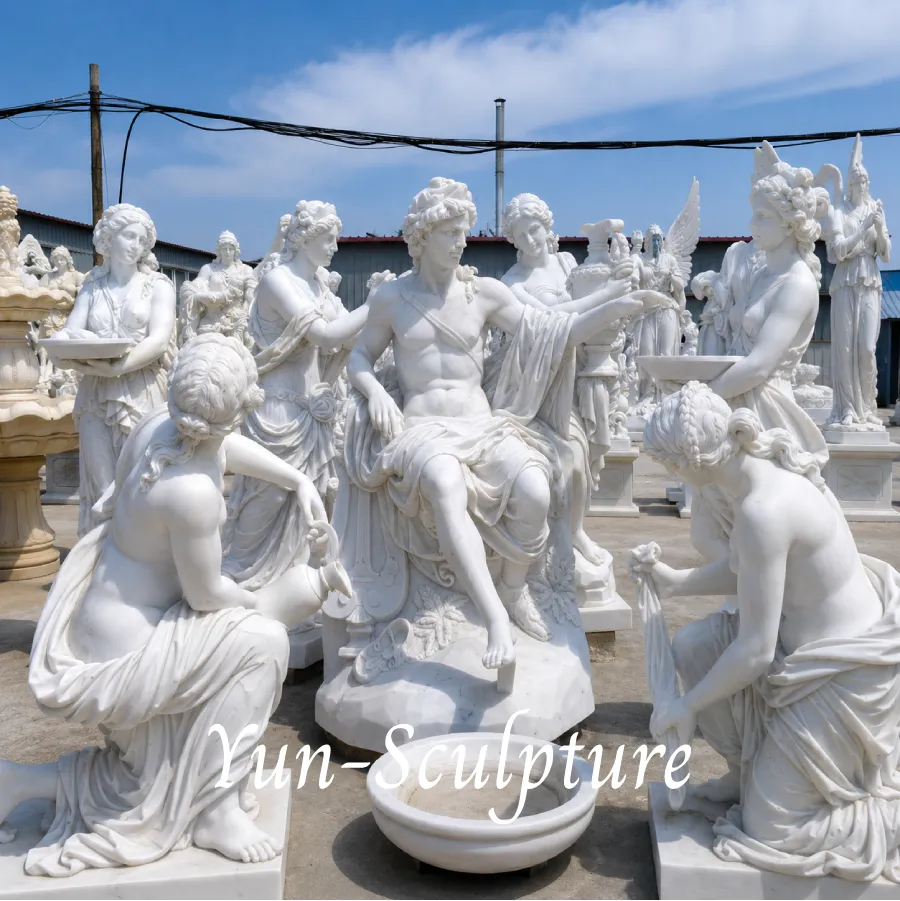
A south-facing garden — the orientation that receives the most direct sunlight in the northern hemisphere — is Apollo’s natural environment. A courtyard that catches morning light from the east, a terrace that faces the afternoon sun from the west, a music room with a large window toward the horizon: these are the spaces where an Apollo figure will perform as the mythology intends. The god of the sun should be placed where the sun finds him. An Apollo in a north-facing corner, behind a tall building, or in a space without natural light is not incorrectly commissioned — but it is incompletely placed.
The Apollo Belvedere, which became the canonical image of classical beauty for five centuries of Western art, was placed in the Belvedere court of the Vatican by Pope Julius II around 1511. Belvedere means beautiful view — and the court was designed to receive the light of the Roman sky and frame the statues within it against open air and changing light. The name is not accidental. Apollo was placed where the view was beautiful precisely because he is the god who makes beautiful views possible.
Music · Poetry · Creative Arts
Apollo Musagetes — With Lyre
The lyre in Apollo’s hand is not an attribute but a fact: music exists because Apollo exists. For music rooms, rehearsal spaces, recording studios, conservatories, concert halls, and any space organized around the practice or enjoyment of music. White marble for interior positions; bronze for outdoor creative courtyards. The only correct Apollo type when the space is defined by its relationship to music or creative work.
Garden · Terrace · Purposeful Outdoor Space
Apollo Archer — With Bow
The archer’s posture has directionality that the Belvedere type does not: it points toward something, implies a target, gives a garden a subtle energy and sense of purpose. Correct for south-facing terraces, open garden settings where the figure needs to read at distance, and outdoor spaces where the owner’s values include precision and purposeful action as well as beauty. Bronze for outdoor positions; the bow is a projecting element requiring bronze’s structural integrity.
Garden Focal Point · Villa Atrium · Pure Classical Beauty
Apollo Belvedere — Contrapposto Youth
The most copied male figure in the history of Western sculpture. No projecting weapon elements; the contrapposto stands on its own. Correct for any setting where pure classical authority and beauty are the organizing values — a formal garden axis, a villa entrance court, an interior atrium. White marble for sheltered positions; bronze for fully exposed outdoor settings. The figure that five centuries of monarchs, institutions, and collectors have placed at their most significant spaces.
The Apollo Belvedere — Why One Figure Became the Canon
The Apollo Belvedere was discovered near Rome around 1489 and placed in the Vatican collections by Julius II, where it has remained — with brief interruptions — for five hundred years. When Johann Joachim Winckelmann described it in 1755 as embodying “edle Einfalt, stille Größe” — noble simplicity, quiet grandeur — he gave language to what European culture had already intuitively understood for two centuries: this figure is the most complete visual expression of the classical ideal of masculine beauty.
What makes the Apollo Belvedere canonical is not its beauty in isolation but its specific emotional quality. The god has just acted — he has released the arrow, or struck down the Python, or performed some decisive deed — and now stands in the aftermath: arm extended, head slightly turned, the energy of the action not yet fully dissipated. He is beautiful in motion’s aftermath, sovereign in the moment after effort. This quality — presence without aggression, authority without display — is what no other figure in the canon quite replicates, and what makes the Apollo Belvedere the correct choice for any space where the owner wants to embody that specific register of authority.
The figure has been reproduced continuously since the Renaissance. Every major European royal collection had a cast or marble copy. The first full-scale plaster cast to arrive in England was sent to Henry VIII. Napoleon removed the original to Paris after his Italian campaign, and its return to Rome after Waterloo was celebrated as a major cultural event. No other ancient sculpture has traveled so far or been copied so many times, and no other ancient sculpture has defined so clearly what Western culture means when it uses the word “classical.”
Where Apollo Belongs — Settings for Every Type
Apollo’s domain covers music, poetry, light, medicine, and prophecy — a broader range of human creative and intellectual activity than any other Olympian. This breadth means that his figure suits a wider range of settings than gods with more specific domains, but the choice of which Apollo type to commission — lyre, bow, or Belvedere — should be driven by what the specific space is for.
For music rooms, rehearsal spaces, recording studios, concert halls, conservatories, and any space organized around the practice or enjoyment of music, Apollo with lyre is the correct and only choice. He is not adjacent to music — he is its divine origin. The lyre in his hand is not an attribute but a fact: music exists because Apollo exists, in the mythological understanding that has organized Western culture’s relationship to music since antiquity. A conservatory or music room with an Apollo Musagetes is not decorated; it is identified.
For garden focal points, villa atriums, and any space where pure classical beauty is the organizing value, the Apollo Belvedere type is correct. No other figure in the Western tradition carries the same accumulated authority for this purpose. A life-size or larger Apollo Belvedere at the axis of a formal garden, elevated on a pedestal, in a position that receives afternoon light from the west: this is a placement that five centuries of collectors, monarchs, and institutions have already confirmed as correct.
For open gardens, south-facing terraces, and outdoor settings where the figure needs a purposeful rather than purely aesthetic register, Apollo Archer — the god with bow raised or in the aftermath of the shot — reads more powerfully than the Belvedere at distance. The archer’s posture has directionality that the Belvedere’s contrapposto does not; it points toward something, implies a target, gives the garden a subtle sense of purpose and energy that the contemplative Belvedere does not provide.
| Setting | Apollo Type | Material | Orientation Note |
|---|---|---|---|
| Music room / Studio / Conservatory | Apollo Musagetes with lyre | White marble — interior sheltered position | Face the figure toward the primary playing or listening position |
| South-facing garden | Apollo Belvedere or Apollo Archer | Bronze for exposed; marble for sheltered/covered | Position to receive afternoon light — the face should catch the sun at its warmest angle |
| Villa courtyard / Atrium | Apollo Belvedere | White marble — controlled interior or covered exterior | Place on axis of the courtyard; light should cross the figure rather than backlight it |
| Creative office / Arts institution | Apollo Musagetes with lyre | White marble or bronze depending on indoor/outdoor position | Place where natural light from a window or skylight falls on the figure during working hours |
| Formal garden entrance / Axis focal point | Apollo Belvedere at life-size or heroic scale | Bronze for fully exposed; marble for protected niche | Face the figure toward the garden’s primary approach; he should be the destination of the axis |
| Paired garden entrance with Artemis | Apollo Archer (right) + Artemis (left) | Matched material — both bronze or both marble | Produced simultaneously; Apollo faces slightly inward toward Artemis; both elevated on matched pedestals |
Apollo and Artemis — The Twin Configuration
Apollo and Artemis are twins, and their pairing in garden and institutional settings has a documented history going back to the earliest Roman temple art. The Temple of Apollo at Pompeii was excavated to reveal both figures flanking the entrance — the sun god and the moon goddess, light and darkness, the day hunt and the night hunt, facing each other across the sacred space.
For formal gardens with a main axis — where the primary viewing line runs between two flanking positions at the garden’s far end — an Apollo and Artemis pair is the most historically grounded and visually coherent classical configuration. Apollo on the right, facing the garden’s primary approach; Artemis on the left, her bow and quiver identifying her immediately from the complementary position. Both at the same scale, produced simultaneously to ensure proportion matching, elevated on matched pedestals.
The pairing works because the two figures complete each other’s emotional register. Apollo brings the ordered light of the sun, the discipline of music, the authority of reason. Artemis brings the wildness of the moon, the independence of the hunt, the reminder that not all beauty is domesticated. Together they frame the garden the way the sun and moon frame the sky: the cultivated and the wild, the day and the night, the form and the force that resists it.
Frequently Asked Questions
What does the Apollo statue symbolize?
The Apollo statue symbolizes beauty as an active, ordered quality — the harmony that separates beauty from chaos and form from raw force. He governs music, poetry, light, medicine, and prophecy: all the domains where human creative activity reaches toward something higher than the merely functional. In a garden, courtyard, or creative space, an Apollo declares that beauty here is intentional and governed by the same principles Apollo embodies — light, order, proportion, and the disciplined realization of something excellent.
What does the Apollo Belvedere represent?
The Apollo Belvedere represents the classical ideal of masculine beauty and sovereign authority at their highest point — power through the quality of presence itself, not through force. Discovered around 1489 and placed in the Vatican’s Belvedere court around 1511, the figure shows Apollo in the moment after decisive action: arm extended, head turned, energy not yet fully resolved. Winckelmann described it in 1755 as embodying “noble simplicity, quiet grandeur” — the phrase that defined the classical ideal for the entire European Enlightenment.
What does Apollo represent spiritually?
Apollo represents the spiritual principle that beauty is ordered, not accidental — that light follows a path, music follows laws, excellence follows disciplines that can be learned and practiced. His presence invites the ordering of raw experience into form, the discipline required to make something beautiful rather than merely expressive, and the clarity of light as a governing metaphor for clarity of mind. For musicians, architects, writers, and artists, an Apollo is a declaration about the values that govern the work — not decoration, but honest identification.
What three things is Apollo associated with?
Apollo’s three primary associations are music and the arts (he invented the lyre and led the Muses), light and the sun (he drove the solar chariot and was identified with Helios in later tradition), and prophecy and truth (his oracle at Delphi was the most significant in the ancient world). These map directly onto the three major Apollo sculpture types: Apollo Musagetes with lyre (arts and music), Apollo Archer (directed power and purposeful action), and Apollo Belvedere (the pure ordered beauty of light itself).
What is the most famous statue of Apollo?
The most famous Apollo statue is the Apollo Belvedere — a Roman marble copy of a Greek bronze original, now in the Vatican Museums. Placed in the Belvedere court around 1511, it became the defining image of classical beauty for the European Renaissance and Enlightenment. Winckelmann called it the summit of ancient art. For modern commissions, both the Belvedere pose and the Apollo Musagetes (with lyre) are regularly produced, with the Belvedere remaining the most commonly commissioned for garden focal points and formal settings.
Factory Direct · Quyang, China
Commission an Apollo for Your Garden, Courtyard or Music Space
Apollo Belvedere for garden focal points. Apollo Musagetes with lyre for music rooms and creative studios. Apollo Archer for south-facing terraces. Paired with Artemis on request.