Get in touch with Yun-Sculpture company
Padre Pio Statue: The Science of Portrait Fidelity for a Modern Saint

Commissioning a padre pio statue is not an act of simple devotion. It is an encounter with memory, with a face the world has already seen and recognized. Unlike medieval saints shaped by imagination and symbolic tradition, Padre Pio belongs to the age of photography—his gaze preserved in silver halide and early film, his features known intimately by millions.
This reality transforms the sculptor’s task. Accuracy is no longer interpretive; it is accountable. A deviation in the curvature of the cheek or the depth of the eye is not merely artistic—it is immediately felt as absence. The faithful do not accept approximation when the true face is so deeply imprinted in collective memory.
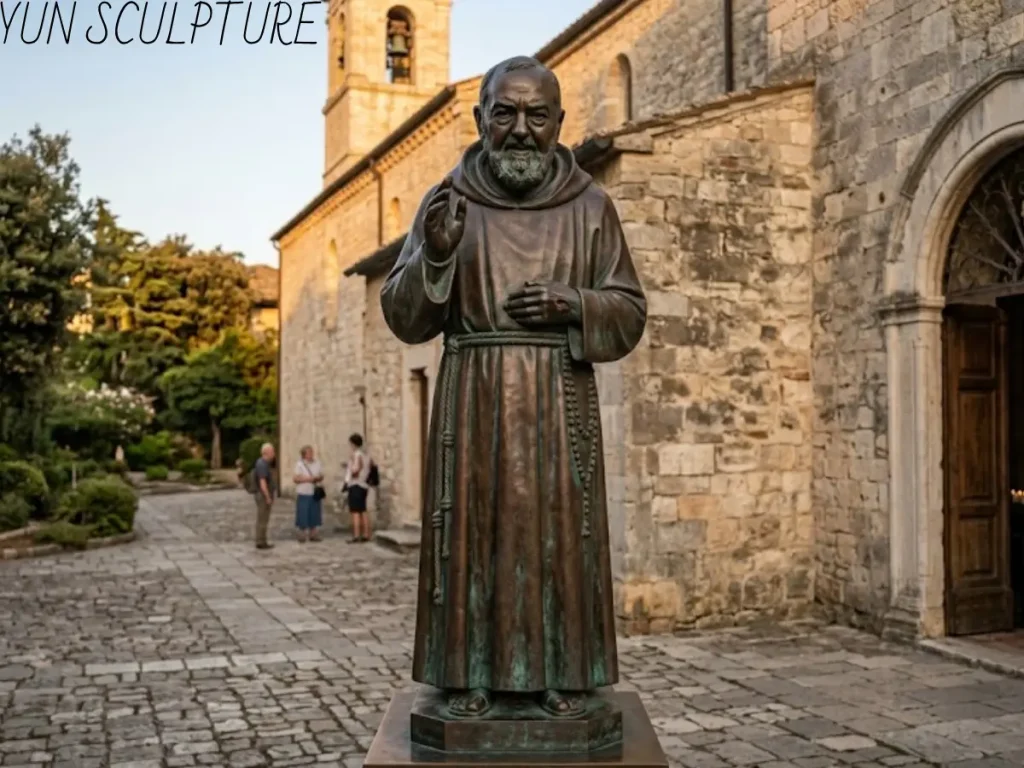
In this guide, we approach the creation of a saint padre pio statue with both reverence and technical rigor. We examine the demands of marble, bronze, and wood. We study the sacred concealment of the stigmata beneath his gloves. Above all, we return to the central challenge: rendering the face of a man whom history has already rendered in light.
Table of Contents
Table of Contents
The Modern Saint Problem: Why Padre Pio Is Unlike Any Other Commission
The Challenge
For centuries, sculptors approached saints through texts, oral traditions, and inherited iconography. Consider Saint Francis of Assisi: his image evolved through devotional imagination, not photographic certainty. Artists conveyed spirit through symbol—gauntness, humility, the robe, the gesture—without obligation to a fixed likeness.
Padre Pio (1887–1968) stands in stark contrast. He lived in the modern era, leaving behind hundreds of photographs that document his life across decades. These images are not abstract references; they are precise records. Devotees recognize the exact structure of his face, the weight he carried in later years, the distinctive fall of his eyelids.
This creates a unique tension. Many mass-produced padre pio statues fail not because of poor intention, but because of compromised anatomy. Proportions drift. Eyes become hollow or generic. The result is a figure that resembles a type, not the man himself. The spiritual connection weakens when the likeness dissolves.
The issue is most evident in the face. Padre Pio’s expression was never neutral. His gaze held intensity, fatigue, compassion, and discipline all at once. When sculptors flatten this complexity into symmetry or exaggeration, the statue loses its authority as a devotional object.
The Solution
At Yun Sculpture, we approach this challenge as both historians and engineers. The creation of a padre pio statue made in italy has long been considered a benchmark of quality, rooted in artisanal lineage and material excellence. Our objective is not to imitate that tradition, but to meet and rival its standard through contemporary precision.
We begin with archival reconstruction. High-resolution photographs from the 1950s and 1960s—when Padre Pio’s features were most fully documented—are analyzed across multiple angles. These images are translated into a three-dimensional digital model, allowing us to resolve inconsistencies caused by lighting, lens distortion, and aging.
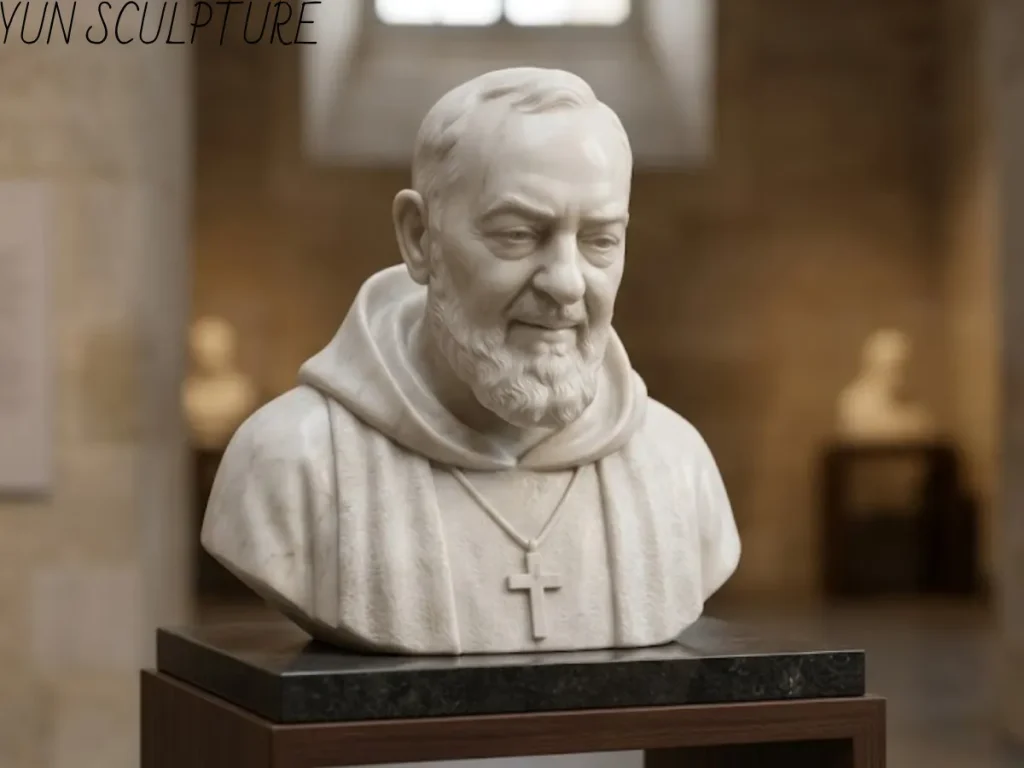
This process is not mechanical replication. It is a disciplined interpretation guided by anatomical truth. The resulting digital portrait becomes the foundation for sculptural work in marble, bronze, or wood. Each material then demands its own technical translation while preserving the integrity of the original likeness.
In this way, the saint padre pio statue becomes more than an object. It becomes a convergence of historical record, devotional intent, and structural accuracy. It restores confidence that the face encountered in prayer is the face remembered by history.
Portrait Anatomy: The Five Features That Define an Accurate Padre Pio Statue
The 5 Pillars of Portrait Fidelity
| Feature | Description |
|---|---|
| The Face (Age & Weight) | Padre Pio’s later years define the most recognized image of him. The face carries visible weight, with pronounced nasolabial folds and slightly drooping eyelids that reflect age and spiritual burden. Our modeling relies on high-definition photographs from the 1960s, ensuring that the geometry of the cheeks, jawline, and brow aligns with documented reality rather than idealized youth. |
| The Eyes (Depth of Gaze) | The eyes are the center of recognition. His gaze was piercing, often described as penetrating yet compassionate. In marble, this requires deep carving to create shadow within the աչ orbital cavity, allowing light to form a living contrast. In bronze, pupil definition is achieved through subtle recesses and patina control, creating the illusion of depth without literal carving of the iris. |
| The Beard (Texture & Density) | Padre Pio’s beard was short, dense, and greying, never wild or elongated. Cheap casting methods often produce a jagged or overly stylized texture that breaks realism. Each strand cluster must be hand-carved or carefully tooled to create a natural density, with controlled variation that reflects real hair growth rather than repetitive patterning. |
| The Gloves (The Stigmata’s Veil) | The half-gloves are among the most iconic elements of any padre pio statue. They conceal the stigmata while simultaneously drawing attention to their presence. Sculpturally, they require a delicate balance: the fabric must appear soft and draped, yet the underlying bone structure of the hand must remain perceptible. This duality—concealment and revelation—is central to their meaning. |
| The Habit (Capuchin Specificity) | The Capuchin Franciscan habit is not generic monastic clothing. Its cut, hood shape, and drape follow specific historical garments worn by the order. Accurate rendering requires study of archival references, ensuring that folds fall naturally from the shoulders and that the hood maintains its characteristic volume. The habit frames the face, guiding the viewer’s attention upward toward the portrait. |
The Stigmata Question: How to Commission the Sacred Wounds
Visible vs. Veiled — Two Iconographic Traditions
The question of the stigmata is not merely artistic. It is theological, pastoral, and deeply personal. Every padre pio statue must ultimately answer this: should the wounds be revealed, or reverently concealed?
The veiled tradition presents Padre Pio wearing his characteristic half-gloves. This choice reflects his lifelong humility. He did not seek to display the wounds; he bore them in obedience and often in silence. For private devotion, especially in home shrines, this form is preferred. It allows the faithful to approach him as a spiritual father rather than a spectacle of suffering.
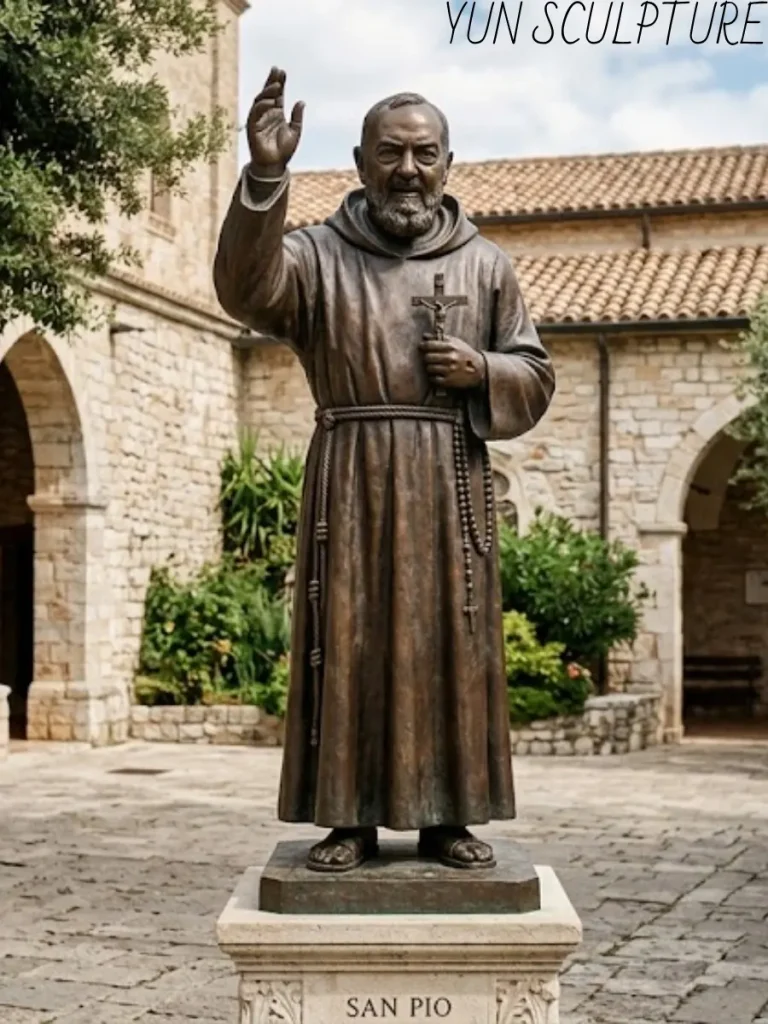
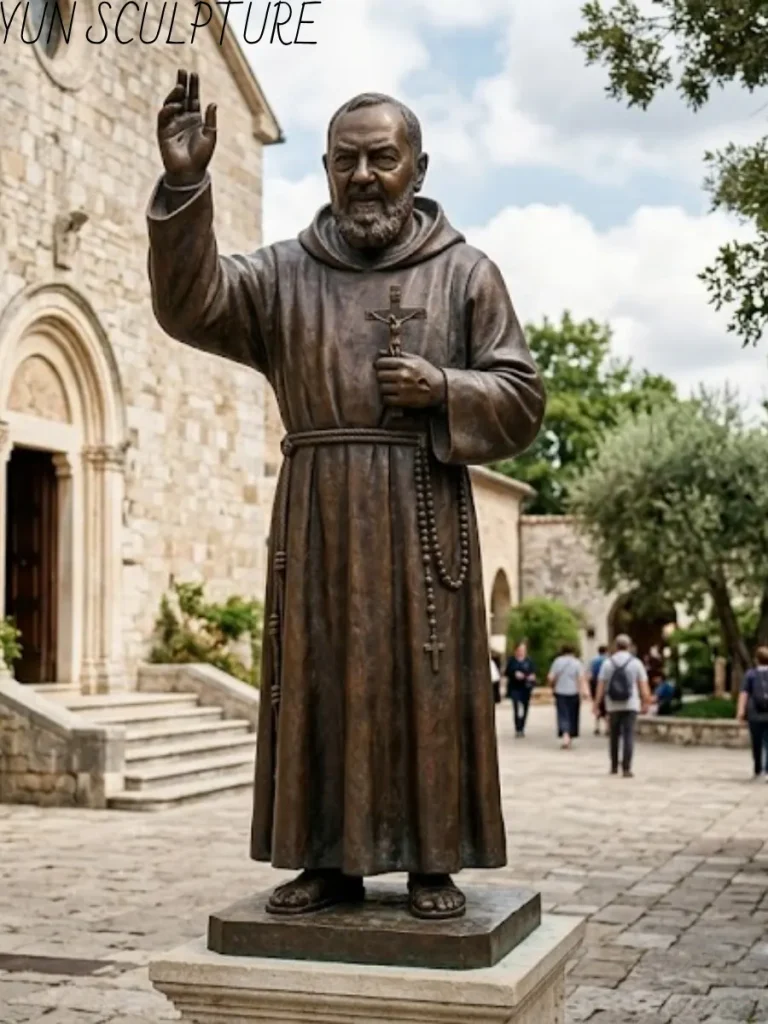
From a sculptural standpoint, the veiled approach demands mastery of fabric. The gloves must feel light, almost weightless, yet structurally convincing. Each fold must follow the anatomy of the hand beneath it. The tension lies in suggestion—the viewer must sense the hidden wound without seeing it. This requires restraint, precision, and a disciplined refusal of exaggeration.
The visible tradition, by contrast, reveals the stigmata openly on the palms. This is the language of witness. In churches and pilgrimage sites, where the role of the statue extends beyond personal devotion into collective proclamation, the visible wounds speak of the miraculous. They affirm Padre Pio’s participation in the Passion in a direct and undeniable way.
Here, the sculptural challenge shifts entirely. The wounds must be rendered with anatomical credibility, not theatrical excess. Blood flow, skin rupture, and depth must be studied carefully. In marble, this involves subtle carving that creates shallow depressions and controlled channels, allowing light to define the wound without overwhelming the surrounding form. In bronze, patina becomes essential—variations in tone must suggest living tissue while maintaining dignity.
Both traditions are correct. Both are rooted in truth. The decision rests on the intended spiritual environment. A padre pio marble statue italy style often leans toward classical restraint, but contemporary commissions increasingly balance reverence with clarity of testimony.
The Confessor Pose — St. Pio in the Sacrament of Reconciliation
Among the many representations of Padre Pio, one stands apart in both historical accuracy and pastoral significance: the padre pio confession statue.
Padre Pio spent extraordinary lengths of time in the confessional—often up to sixteen hours a day. This was not incidental to his vocation. It was the center of it. Pilgrims traveled great distances not only to see him, but to confess to him, seeking guidance, absolution, and spiritual clarity.
The confessor pose captures this reality with quiet authority. He is typically seated, the body inclined slightly forward. This forward lean is essential. It expresses attention, readiness, and an active engagement with the unseen penitent. The statue does not dominate space; it invites approach.
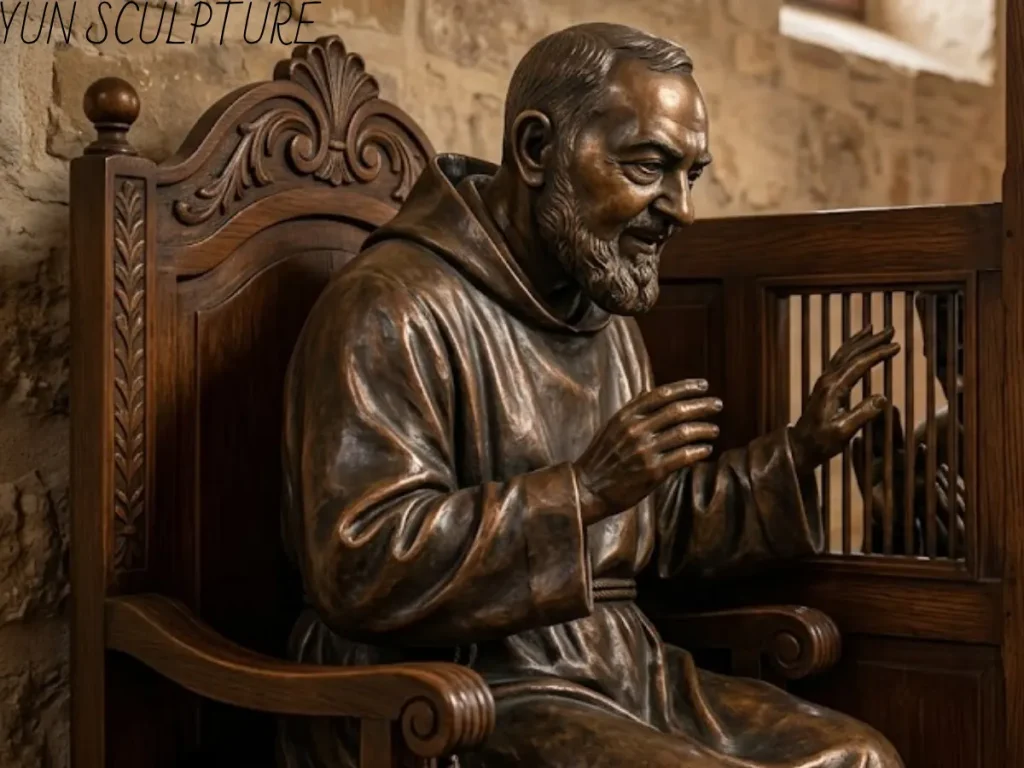
The hands are equally significant. In some interpretations, they are gently folded, suggesting contemplation and listening. In others, one hand extends subtly, as if guiding or blessing. These gestures must remain restrained. Over-articulation breaks the intimacy of the moment.
The face, once again, carries the weight of the composition. In this pose, the gaze is not distant or ascetic. It is focused, almost searching, as though encountering the soul before him. This requires a delicate adjustment from the more iconic frontal stare seen in standing statues.
Architecturally, the padre pio confession statue is particularly suited to transitional spaces—church hallways, reconciliation chapels, pilgrimage corridors. It functions as both presence and passage. The faithful do not simply observe it; they move past it, often preparing themselves inwardly for the sacrament it represents.
This form of representation demands a different kind of fidelity. It is not only about likeness, but about posture, gesture, and psychological truth. When executed correctly, it becomes one of the most powerful devotional sculptures within a sacred environment.
“Made in Italy” vs. Factory Direct: An Honest Comparison
What “Made in Italy” Actually Guarantees
The phrase “Made in Italy” carries immense cultural weight, especially in the realm of religious sculpture. It evokes centuries of artistic lineage, from Renaissance masters to modern ecclesiastical workshops. For many, a padre pio marble statue italy represents the highest standard of craftsmanship and authenticity.
This reputation is not unfounded. Italy, particularly regions such as Carrara, has unparalleled access to some of the world’s finest marble. The tradition of hand-carving, passed down through generations, ensures a deep understanding of material and form. Italian studios have shaped the visual language of Catholic art for centuries.
Yet the designation also has practical boundaries. Labor costs in Italy are among the highest in the world for skilled artisans. This directly impacts the final price of any commissioned work. Additionally, many workshops operate at limited capacity, focusing on smaller-scale or highly selective projects.
There is also the structure of the market itself. Galleries, intermediaries, and exporters often stand between the sculptor and the client. Each layer introduces markup. The final cost of a padre pio statue can therefore reflect not only the craftsmanship, but the complexity of its distribution.
None of this diminishes the value of Italian work. It clarifies what the label guarantees—and what it does not. It guarantees origin and tradition. It does not automatically guarantee exclusivity of technique or superiority of execution in every case.
The Factory Direct Equivalence — Where Quality Actually Lives
From an engineering and production standpoint, quality is not determined by geography. It is determined by process, material, and discipline.
At Yun Sculpture, we operate with full transparency in these three domains. The marble we use is the same Carrara marble sourced by Italian studios. Its density, grain, and luminosity are identical. The difference lies not in the stone, but in the pathway it takes from quarry to finished form.
For bronze works, we employ the traditional lost-wax casting method—the same technique used for centuries in Europe. Each stage, from wax modeling to mold preparation to metal pouring, follows established standards. Surface finishing and patination are executed by hand, ensuring that each piece retains individuality within precision.
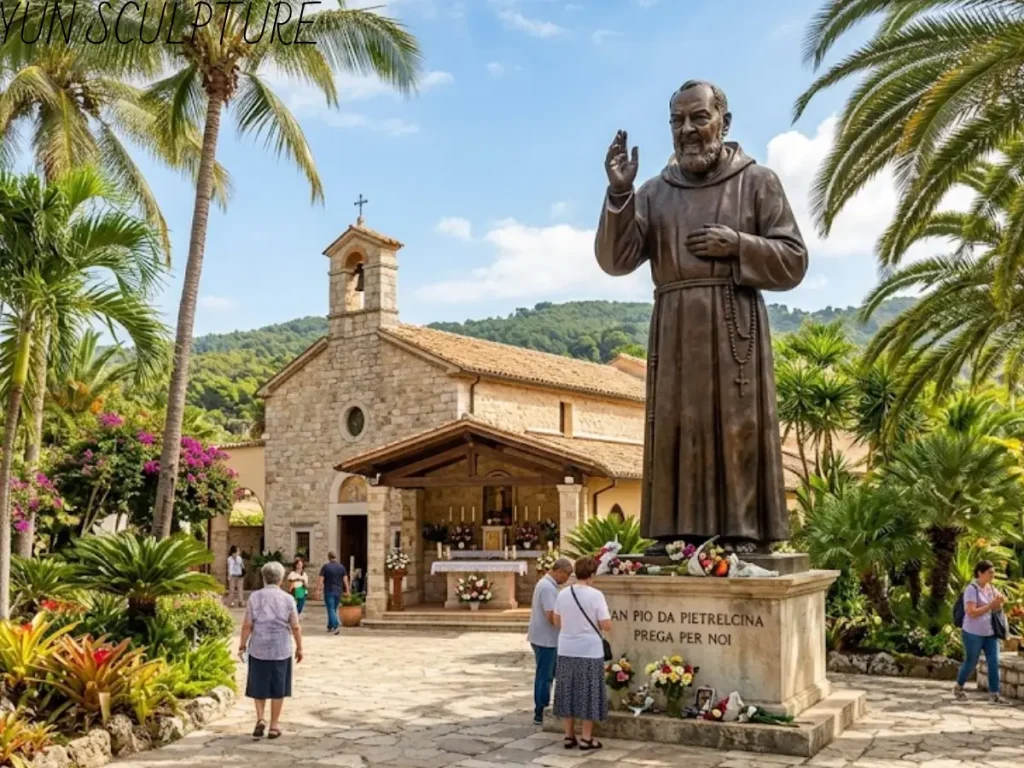
Hand-carving remains central to our practice. Digital modeling provides the foundation for accuracy, but the final articulation of surface—skin, fabric, hair—is always resolved by skilled artisans. This hybrid approach allows us to achieve both fidelity and refinement.
The advantage of the factory-direct model is structural clarity. There are no galleries or import intermediaries introducing layered costs. Clients engage directly with the source of creation. This results in pricing that reflects the work itself, not the chain of distribution.
Equally important is capacity. While traditional studios may be constrained by scale, we are equipped to handle multiple monumental commissions simultaneously. This does not dilute quality; it is made possible by coordinated teams, standardized processes, and rigorous oversight at every stage.
In the end, the question is not whether a padre pio statue made in italy holds value. It does. The deeper question is where quality truly resides. When materials, techniques, and artistic discipline align, excellence is no longer confined to a single geography. It becomes a matter of method—and of commitment to truth in form.
Material Deep Dive: Marble, Bronze, Wood & the Unexpected Silver
Marble — Capturing the Skin of an Aged Saint
A marble padre pio statue demands more than technical execution. It requires an understanding of how stone interacts with light to suggest living presence. Marble is not inert when properly selected; it carries a translucency that allows illumination to penetrate slightly beneath the surface, echoing the softness of human skin.
For Padre Pio, this quality is decisive. His later years were marked by visible weight, fatigue, and deepened facial structure. Stark white marble, while historically associated with classical sculpture, often imposes an artificial purity that contradicts the lived reality of his face.
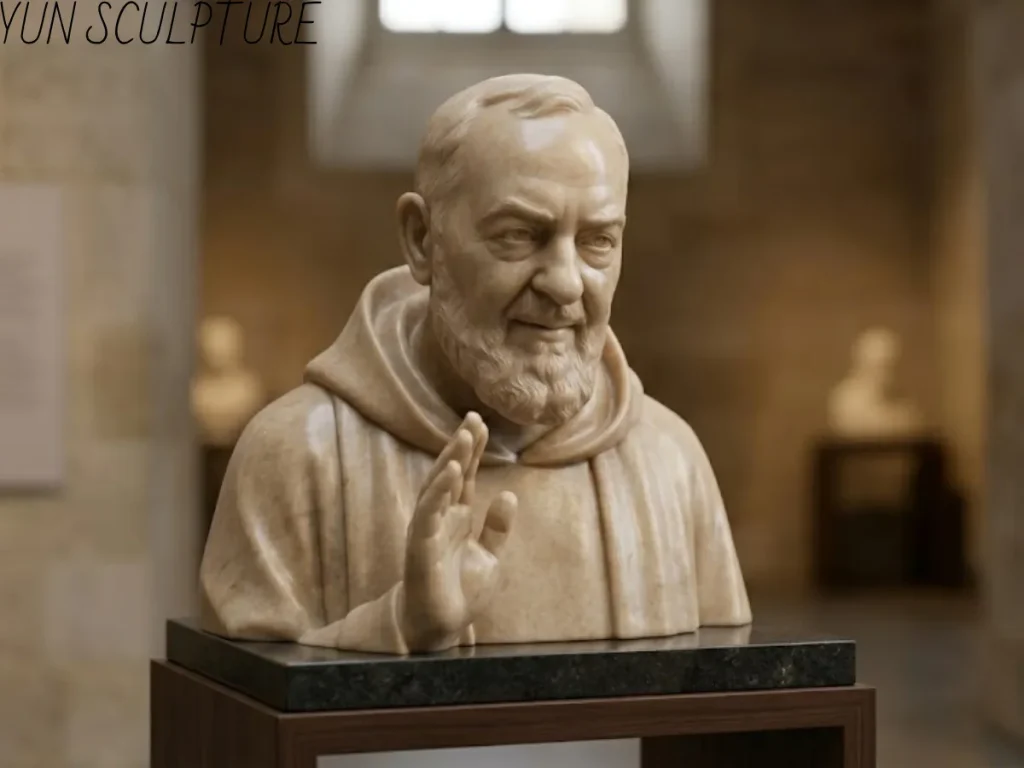
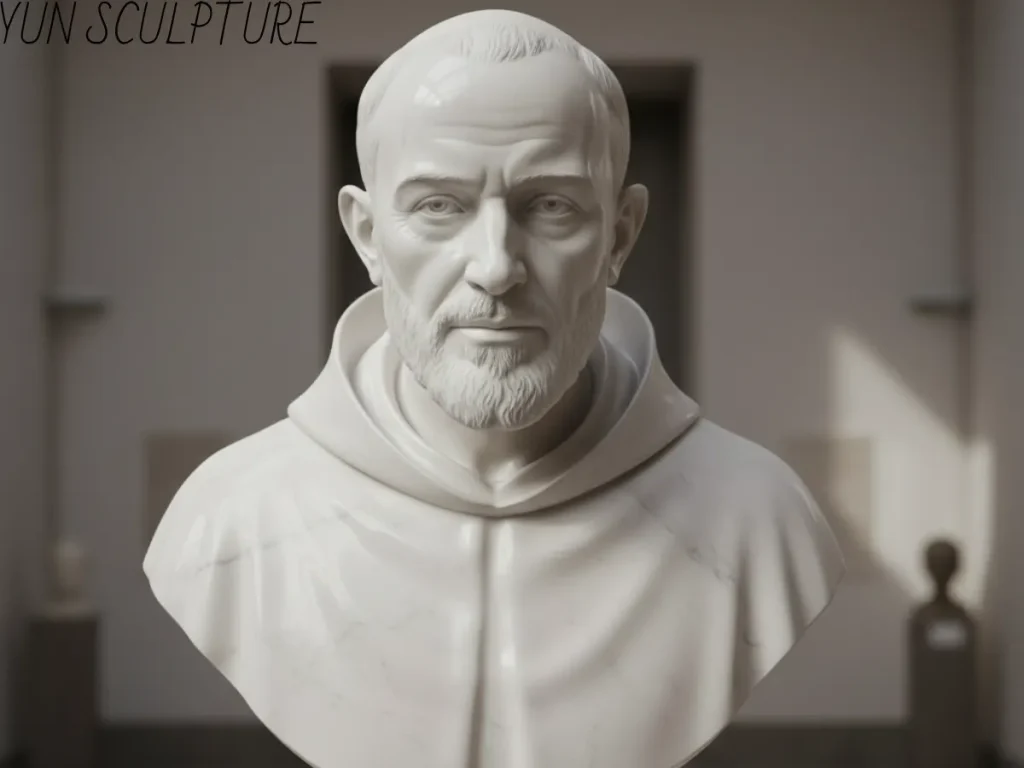
We therefore prioritize warm and beige-toned marble. These stones possess subtle variations—creams, light ochres, faint veining—that mirror the tonal complexity of aged skin. When carved with restraint, they allow the nasolabial folds, the softened jawline, and the drooping eyelids to emerge with quiet realism.
Surface finishing becomes critical. Over-polishing erases character. Under-finishing leaves the form lifeless. The correct balance produces a surface that diffuses light gently, preserving both anatomical truth and spiritual dignity.
In this material, the padre pio statue achieves a contemplative stillness. It does not shine; it breathes.
Bronze — For Outdoor Shrines & San Giovanni Rotondo Style
The statua padre pio bronzo belongs to a different architectural and environmental context. Bronze is the material of endurance, chosen for open-air installations where climate, time, and public interaction must all be withstood without compromise.
In San Giovanni Rotondo, monumental bronze representations of Padre Pio establish a visual language of permanence. These works do not seek intimacy alone; they command presence across plazas and pilgrimage grounds. The mass of bronze allows for broader gestures, deeper undercuts, and a structural integrity that stone cannot always sustain at scale.
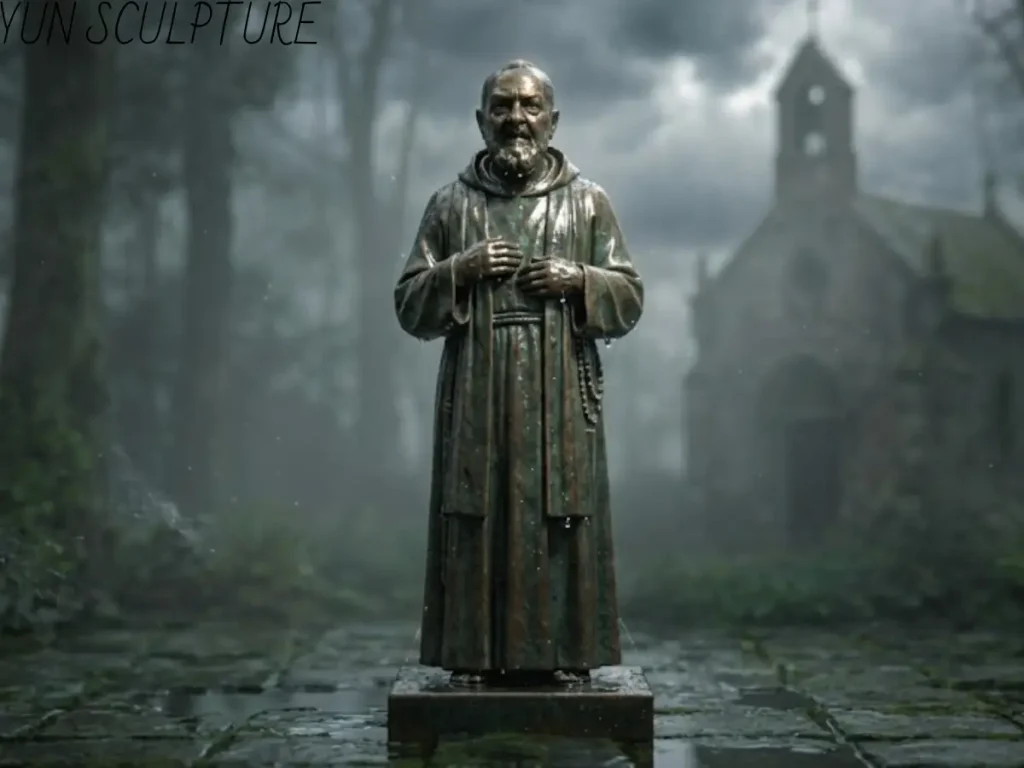
For a padre pio outdoor statue, patina is not a secondary consideration. It is integral to the final form. The controlled oxidation of bronze produces tones ranging from deep brown to verdant green. This green patina, often associated with historical monuments, adds a sense of temporal depth—as though the statue has already endured decades of devotion.
From an engineering perspective, bronze offers resilience. It tolerates temperature fluctuation, moisture, and physical contact. Internally, reinforcement systems ensure stability even in large-scale compositions.
The result is a sculpture that does not retreat from its environment. It stands within it, absorbing weather and time while maintaining clarity of form.
Wood — The Devotional Carving Tradition
The tradition of padre pio statues wood is rooted in intimacy. Wood carries warmth that neither marble nor bronze can replicate. It invites proximity, touch, and personal devotion.
Within the Capuchin Franciscan context, woodcarving holds particular resonance. The simplicity of the material aligns with the order’s emphasis on humility and austerity. Historically, many devotional figures in Italian communities were carved in wood, then painted or lightly finished to preserve the grain beneath.
Technically, wood demands a different discipline. It is anisotropic—its strength and behavior vary along the grain. This requires careful orientation during carving to prevent splitting, especially in delicate areas such as fingers, folds of the habit, and the edges of the hood.
Detailing must also respond to the material’s nature. Excessively fine carving can weaken the structure. Instead, forms are resolved with slightly broader transitions, allowing the inherent texture of the wood to contribute to the final appearance.
For indoor settings, particularly within homes or small chapels, wooden statues offer a devotional immediacy. They feel less monumental, more companionable. The presence of Padre Pio in this medium becomes quietly personal.
Stainless Steel Finish — The Reflective Devotional Aesthetic
The padre pio statue in stainless steel draws from a modern, reflective aesthetic that aligns with contemporary devotional practices. Stainless steel, with its mirror-like surface, symbolizes purity, permanence, and the transcendence of earthly constraints.
While solid silver offers a radiant visual appeal, it comes with practical limitations: high cost, softness, and vulnerability to wear. Stainless steel, by contrast, is a more durable, cost-effective material that allows for striking visual effects while maintaining structural integrity at scale.
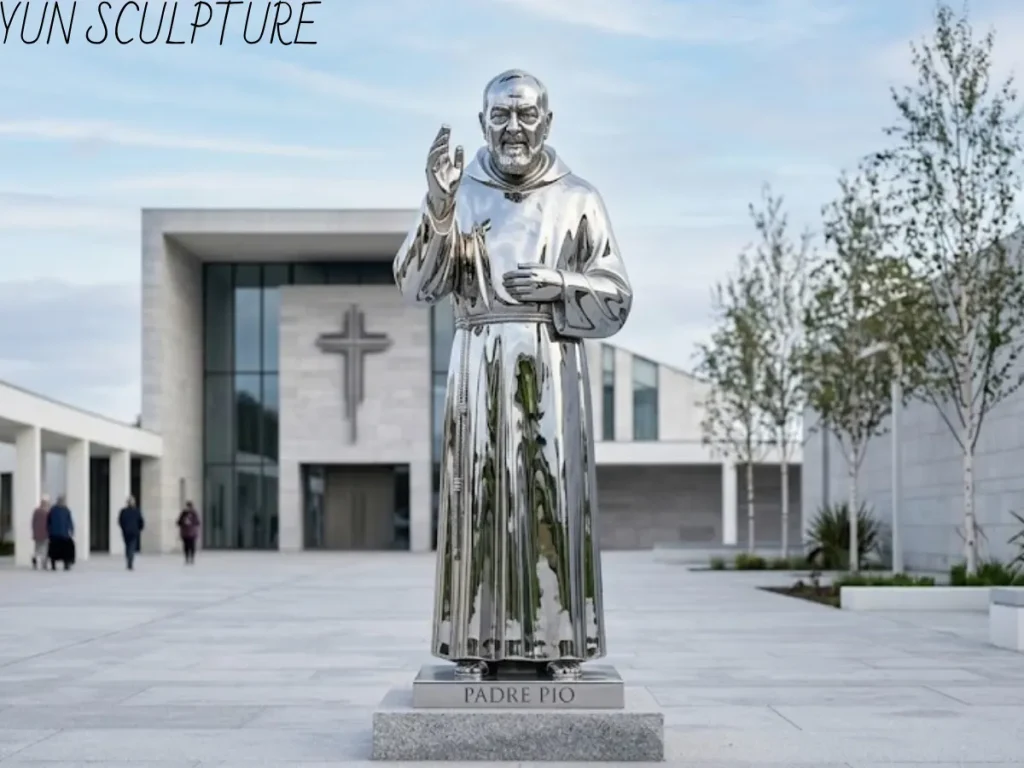
The process begins with high-precision stainless steel casting, ensuring that every anatomical and textural detail of the statue is perfectly realized. Once the core sculpture is formed, the surface undergoes polishing to achieve a flawless, mirror-like finish. The reflective surface enhances the statue’s luminous quality, catching light in ways that create a dynamic interplay of brightness and shadow across the form.
Unlike marble or patinated bronze, which absorb and diffuse light, the mirror finish of stainless steel allows the statue to reflect its environment, bringing the sacred presence of Padre Pio into dialogue with the space around it. The edges glimmer with light, while the recessed areas retain shadows, emphasizing the sculptural contours and creating a sense of depth.
In devotional terms, the stainless steel finish elevates the statue beyond a mere representation of Padre Pio. It becomes a symbol of faith that interacts with the surrounding world, reflecting the devotion of those who approach it and transforming the material into an offering of light.
What Is “Bond d Marble” — And Why to Avoid It
The term padre pio statue bond d marble often arises from a misunderstanding of materials. What is commonly meant is “bonded marble”—a composite made from crushed stone dust mixed with resin.
At first glance, bonded marble can resemble natural stone. It can be cast into molds, allowing for rapid and inexpensive production. For mass-market objects, this efficiency is attractive.
However, from both artistic and structural perspectives, the limitations are significant. Bonded marble lacks the internal crystalline structure of natural stone. It does not transmit light beneath the surface. The result is a flat, opaque appearance that fails to capture the subtle vitality required for a true padre pio statue.
Durability is also compromised. Resin components can degrade over time, particularly under exposure to sunlight and temperature variation. Fine details, often achieved through molds rather than carving, tend to appear softened or repetitive.
For these reasons, we do not employ bonded materials. Every marble work we produce is carved from solid natural stone. This commitment ensures that the sculpture possesses not only visual authenticity, but structural integrity that endures.
The Underwater Padre Pio: Extreme Environment Installations
In recent decades, a remarkable phenomenon has emerged: the statua padre pio sommersa—underwater statues installed by divers as acts of devotion and guardianship. Found in regions of Italy and the Philippines, these submerged figures serve as both spiritual symbols and markers of marine protection.
From an engineering standpoint, such installations represent one of the most demanding environments a sculpture can inhabit. Saltwater is relentlessly corrosive. Currents exert continuous force. Biological growth alters surfaces over time.
Material selection becomes critical. Standard bronze is insufficient without modification. Instead, naval-grade brass and specialized bronze alloys are employed, formulated to resist saltwater corrosion while maintaining structural coherence.
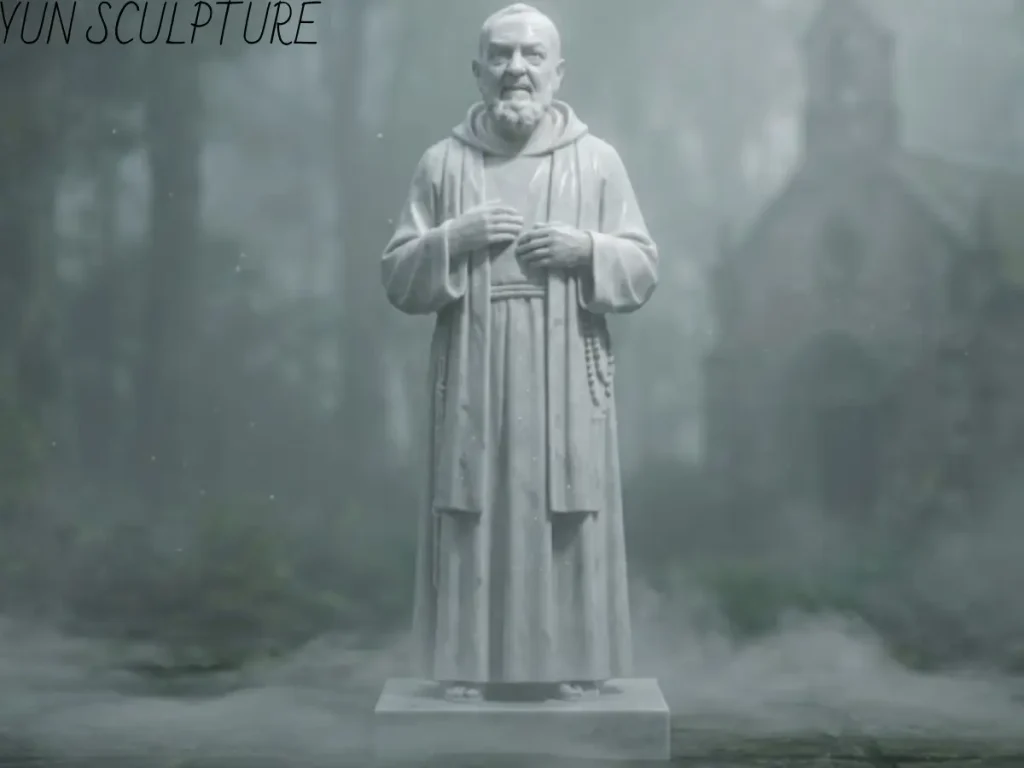
Stone installations require equal consideration. Non-porous granite is favored over marble in submerged contexts, as it resists water infiltration and erosion. The density of the material ensures that fine details are not rapidly degraded by marine conditions.
Anchoring systems must be engineered with precision. Stainless steel frameworks, often embedded into the seabed, secure the statue against shifting currents. These systems are calculated based on weight, drag coefficients, and local hydrodynamic data.
Installation itself is a coordinated operation involving divers, lifting equipment, and environmental assessment. The statue must descend in a controlled manner, avoiding impact that could compromise its integrity or disturb the surrounding ecosystem.
These underwater works demonstrate a fundamental truth about sculptural engineering. When a workshop can design for the ocean—accounting for corrosion, pressure, and motion—it can address any terrestrial condition with confidence.
A padre pio outdoor statue placed in a garden, a plaza, or a mountainside shrine becomes, by comparison, a resolved challenge. The discipline required for submerged installations elevates every other project. It ensures that devotion, once cast into form, remains steadfast in any environment.
Regional Devotion: Philippines, New York & the San Giovanni Rotondo Connection
San Giovanni Rotondo — The Benchmark of All Padre Pio Statues
No discussion of a padre pio statue can begin without reference to the statue padre pio san giovanni rotondo. This sanctuary, where Padre Pio lived, confessed, and was ultimately laid to rest, establishes the global standard for his likeness.
The statues found here are not interpretations shaped by distance. They are grounded in proximity—created within the cultural and historical environment that knew him directly. Every proportion, every fold of the habit, every nuance of expression reflects a lineage of observation and devotion.
At Yun Sculpture, these works serve as primary references in our 3D reconstruction process. They are studied alongside archival photographs, ensuring that each saint padre pio statue we produce aligns with the most authoritative visual record available.
This connection anchors the entire discipline of portrait fidelity. Without it, the sculpture risks drifting into approximation.
The Philippines — A Nation’s Devotion at Scale
Few countries have embraced Padre Pio with the same intensity as the Philippines. The demand for the padre pio statue philippines reflects a living, expanding devotion that spans cities, provinces, and pilgrimage destinations.
At the center of this movement stands the national shrine, often associated with the padre pio statue in bulacan. Here, large-scale statues serve not only as devotional images, but as focal points for mass gatherings, processions, and collective prayer.
This environment shapes the type of commissions requested. There is strong demand for monumental bronze works—durable, weather-resistant, and capable of commanding open пространства. Painted statues, designed for processional use, also remain deeply rooted in local tradition.
Scale becomes essential. A large padre pio statue in this context is not an exception; it is the expectation. The figure must be visible across crowds, elevated platforms, and expansive courtyards.
The Philippines demonstrates how devotion transforms sculpture into public presence. It is not confined to the interior of a church. It lives in movement, in procession, in shared space.
New York — The Italian-American Devotion Hub
In the United States, the strongest concentration of Padre Pio devotion is found within Italian-American communities. The padre pio statue new york and padre pio statue nyc are not isolated objects; they are extensions of cultural memory carried across generations.
Shrines such as Our Lady of Grace in Brooklyn stand as focal points for this devotion. Here, statues of Padre Pio function as anchors of identity—linking immigrant heritage with contemporary faith practice.
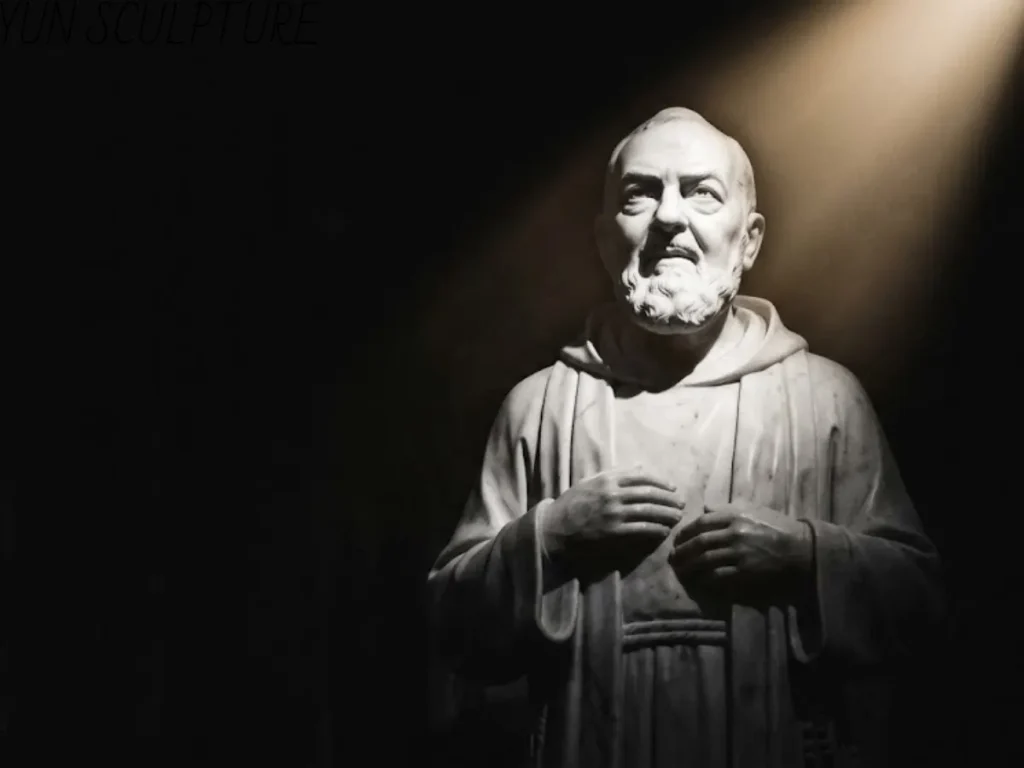
The stylistic preference often reflects this lineage. There is a strong inclination toward traditional forms, echoing the visual language of Southern Italy. Marble and bronze dominate, with careful attention to facial accuracy and the Capuchin habit.
Scale varies according to setting. Urban constraints may favor mid-sized installations, while parish courtyards allow for more expansive works. In both cases, the expectation remains constant: the likeness must be immediately recognizable.
In New York, the padre pio statues are not only devotional. They are cultural. They preserve continuity between place of origin and place of belonging.
FAQ: Padre Pio Statue — Your Questions Answered
What makes a Padre Pio statue “accurate”?
Accuracy in a padre pio statue is defined by photographic fidelity. Unlike ancient saints shaped by generalized iconography, Padre Pio’s face is historically documented in detail.
An accurate sculpture must capture his deep nasolabial folds, slightly drooping eyelids, piercing gaze, and dense beard. The Capuchin habit must also be rendered with historical specificity. Without these elements, the likeness fails.
Should the Padre Pio statue show the stigmata or the gloves?
Both approaches are correct, but they serve different devotional contexts.
The veiled form, with gloves, reflects Padre Pio’s humility and is best suited for private homes and personal prayer spaces. The visible stigmata emphasizes the miraculous and is more appropriate for church altars and public shrines.
Is a “Made in Italy” Padre Pio statue better than factory-commissioned ones?
Not necessarily. A padre pio statue made in italy guarantees tradition and origin, but not exclusive access to materials or techniques.
We use the same Carrara marble and lost-wax bronze casting methods as Italian studios. The difference lies in structure—our factory-direct model removes importer markups and allows us to execute monumental projects with greater efficiency.
What is “bond d marble” in Padre Pio statues?
The term refers to bonded marble, a mixture of resin and crushed stone dust.
While it is cost-effective, it lacks the translucency and durability of natural stone. A true marble padre pio statue must be carved from solid marble to achieve the luminous, skin-like quality required for portrait fidelity.
What is the underwater Padre Pio statue?
The statua padre pio sommersa refers to statues installed on the ocean floor by diving communities in Italy and the Philippines.
These works act as marine protectors and devotional markers. They require specialized engineering, including naval-grade bronze alloys and corrosion-resistant anchoring systems, to withstand saltwater conditions.
Where is the most famous Padre Pio statue located?
The most authoritative statues are located at the sanctuary in San Giovanni Rotondo, Italy.
These works serve as the global benchmark for Padre Pio’s likeness. They inform both traditional and contemporary sculptural interpretations worldwide.
Where can I buy a Padre Pio statue?
For those searching padre pio statue for sale, padre pio statues to buy, or padre pio statues for sale, the key consideration is not availability, but authenticity.
Commissioning directly from a professional foundry ensures that the statue is built with accurate proportions, solid materials, and proper structural integrity. This approach avoids the compromises of mass-produced alternatives.
What size Padre Pio statue is best for outdoor use?
Size must correspond to environment.
A 24 inch padre pio statue is appropriate for a small private garden niche or indoor devotional corner. For outdoor church courtyards or public shrines, a large padre pio statue—typically life-size (5–6 feet) or greater—is necessary to maintain visual presence and proportion within the space.
Commission a Padre Pio Statue He Would Recognize
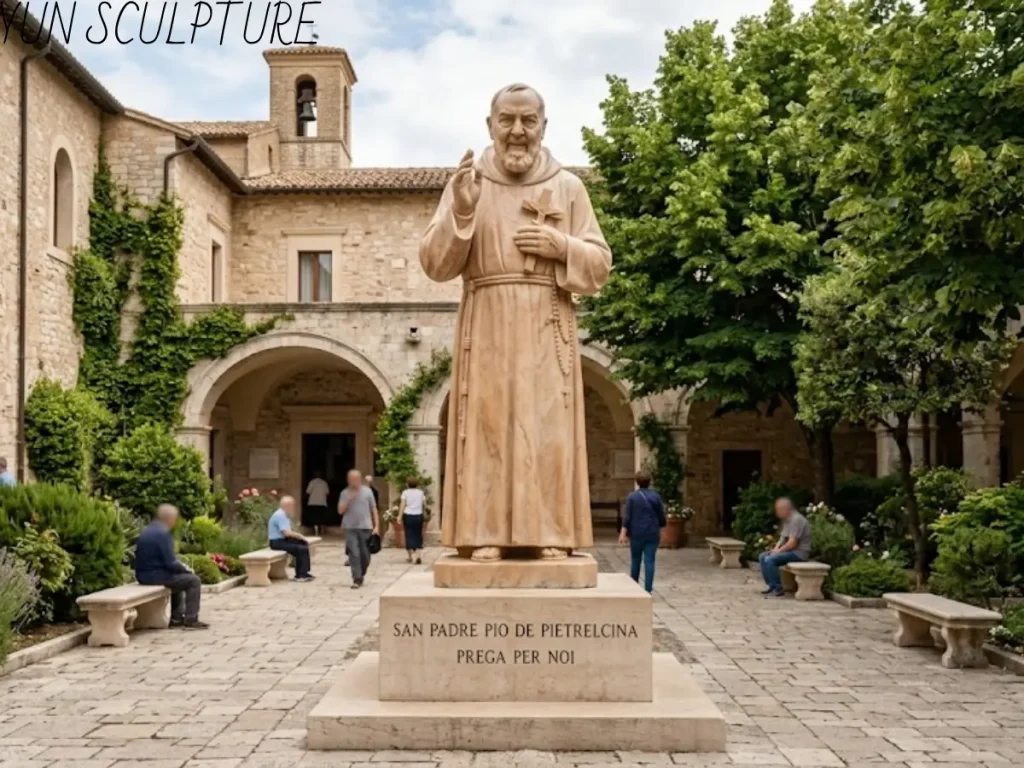
A padre pio statue is not simply acquired. It is entrusted.
Ready to commission a Padre Pio statue with photographic accuracy? Send us your reference photos and ideal size. Our portrait sculptors will develop a clay model for your approval before any stone is touched.
Planning an outdoor shrine, church installation, or pilgrimage landmark? Our foundry has delivered Padre Pio statues to parishes across the Philippines, Europe, and North America. We understand scale, environment, and the responsibility of sacred placement.
Still exploring? Browse our full collection of modern saint statues, or share your vision with us. You will receive a detailed quote within 24 hours.
– Elena Zhang & Donghui Zhang, Yun Sculpture