Get in touch with Yun-Sculpture company
Advocate for the Impossible: The Ultimate Guide to Custom St. Jude Statues in Marble, Bronze, and Steel

In the spring of 2019, the director of a palliative care facility on Chicago’s North Side sent us a commission brief with one unusual requirement.
She needed a st jude outdoor statue for the facility’s central garden — large enough to be visible from the patient rooms above, positioned so that someone lying in a hospital bed could see it through the window without sitting up. She had specific requirements about the pedestal height, the orientation relative to the afternoon sun, the angle of the figure’s face.
Then she said: “I need this to still be here after we close.”
Not after she retired. After the institution itself had ceased to exist.
We understood immediately. This is the specific weight that attaches to a commission for the patron of impossible causes. The people who come to him have already tried everything else. The objects built in his name must be built to match the permanence of that last resort.
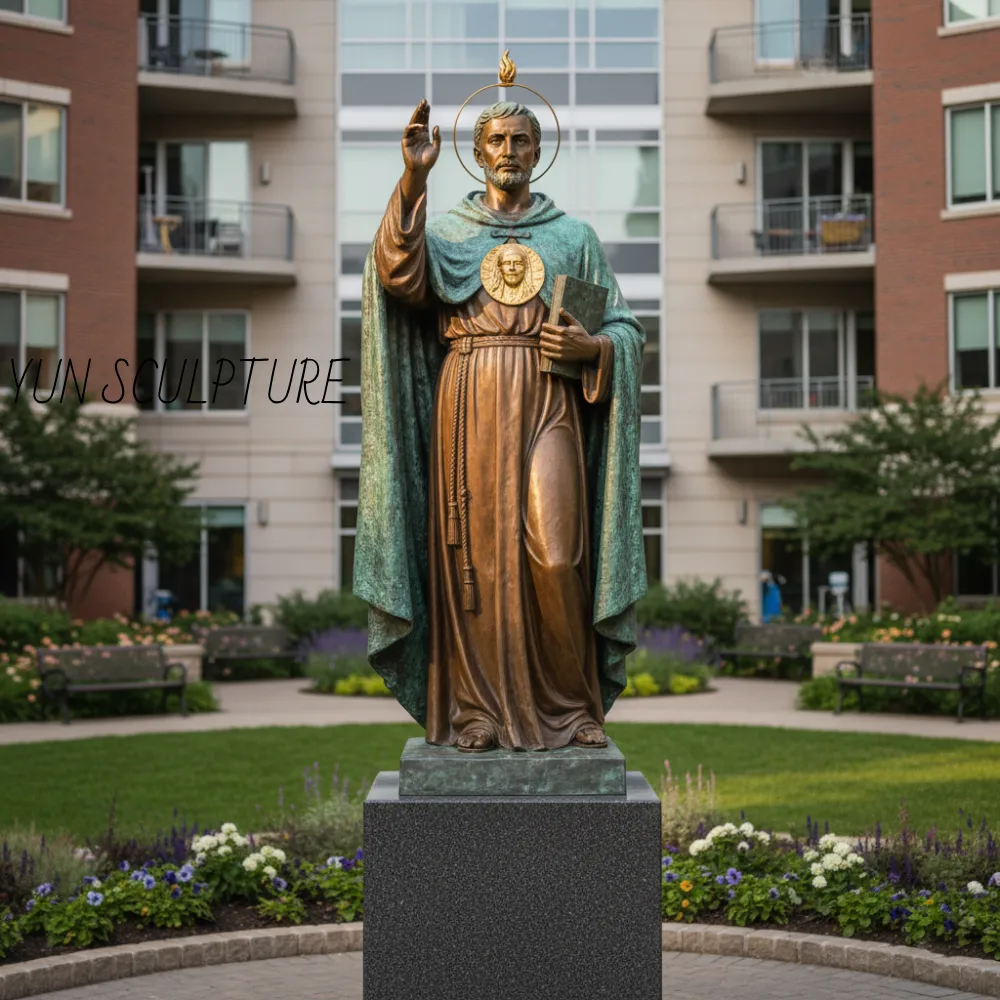
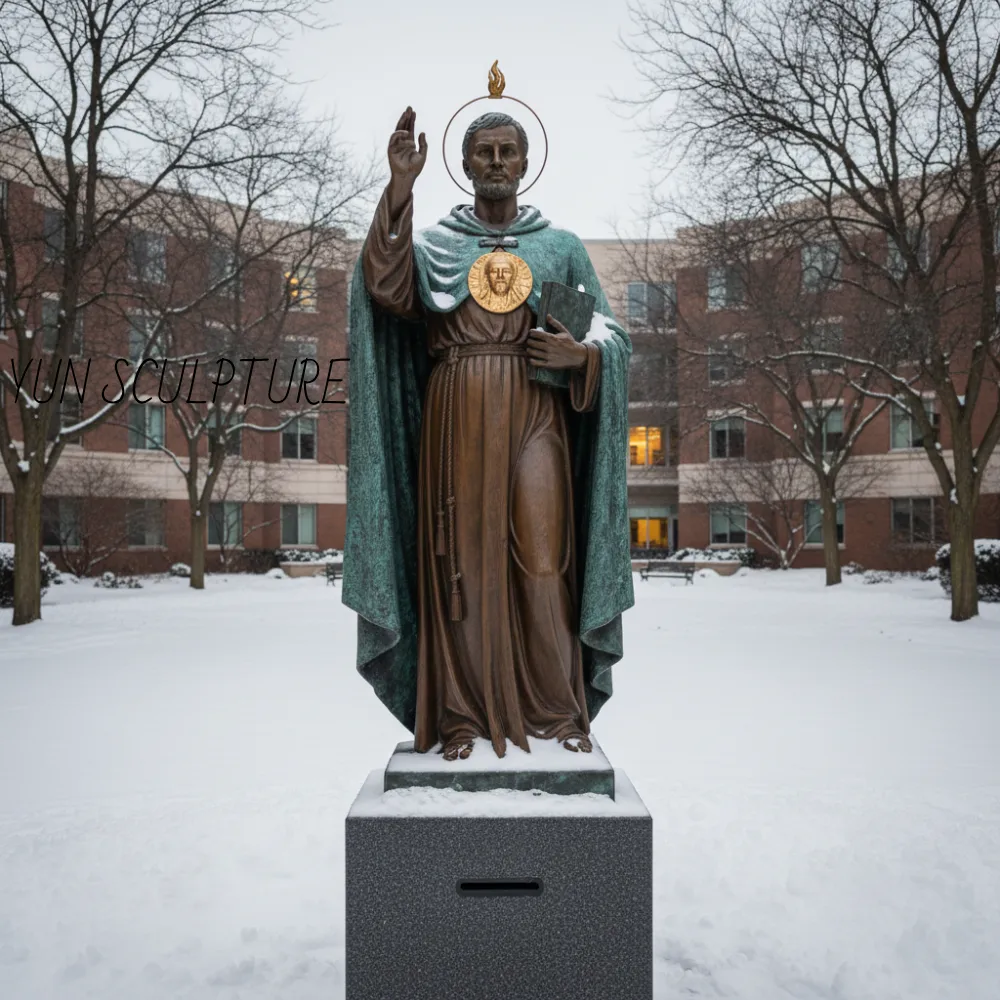
The st jude statue we delivered was cast in Grade A Foundry Bronze, anchored on an engineered concrete foundation with 316-grade stainless steel bolts. The flame above his head was internally reinforced against Chicago’s lateral wind loads. The patina on his cloak was treated to the verde antique that tradition assigns to his garments.
It has been standing in that garden for six years. It will be standing there long after everyone involved in its making is gone.
This is the standard a st jude thaddeus statue demands. This guide exists to explain why — and how to meet it.
Table of Contents
Table of Contents
Who Is St. Jude? — Theology, Iconography, and the Name That Changed Everything
The Man and the Confusion
His full name was Jude Thaddaeus — one of the twelve apostles, author of the short New Testament epistle that bears his name, and a missionary who tradition records as dying a martyr’s death in Persia around 65 AD alongside the apostle Simon.
He is not Judas Iscariot. The similarity of the names — identical in Aramaic — caused a confusion in Catholic devotion that persisted for centuries. Believers avoided petitioning him, fearing their prayers would reach the betrayer instead.
The theological consequence was paradoxical. Because no one asked St. Jude for anything, he became the saint of last resort. When all other intercessors had been approached, when all other methods had failed, people turned to the one they had been avoiding. He became the patron of impossible causes precisely because he had been left available for them.
This is the st jude statue meaning that no other sacred image in the Catholic tradition shares. A statue of st jude placed in a hospital, a recovery center, or a palliative care garden is not a general invitation to prayer. It is a specific architectural declaration: this is a place for people who have nowhere else to go, and we have built it accordingly.
The Church addresses the name confusion by using his full designation — Thaddaeus — in formal contexts. This is the origin of st jude thaddeus statue as a distinct iconographic specification: not a redundancy but a centuries-old disambiguation.
The Iconographic Elements — What Every St. Jude Statue Must Include
The Flame. A tongue of fire at or above the crown of the head — marking St. Jude as a witness to Pentecost, when the Holy Spirit descended as fire upon the assembled disciples. It is the most immediately identifying element of the statue of st jude tradition, and — as detailed in the engineering section — its most structurally demanding one.
The Medallion. An oval or rectangular plate bearing the image of Christ’s face, held against the chest or worn as a pectoral element. Its source is the legend of St. Jude carrying a miraculous image of Christ to heal King Abgar of Edessa. It is, in sculptural terms, a second portrait embedded within the primary figure — a face within a face — and it receives independent sculptural treatment at every scale of commission.
The Book. Representing his New Testament epistle, held in one hand or tucked at the side. In the st jude holding a bible statue format, the book identifies him as an apostolic author and provides compositional balance to the medallion on the opposite side.
The Axe or Spear. The instrument of martyrdom — axe in Western tradition, spear in Byzantine — held in the hand opposite the book. In large outdoor versions this element introduces the most demanding structural calculation of the entire commission.
The Cloak Color. The traditional color assignment for st jude colors to paint statue specifications is a blue-green or teal — the color associated in medieval pigment tradition with hope. For clients requesting a st jude statue beige or natural finish, a departure from this tradition is fully legitimate in contemporary institutional contexts.
Folk Traditions — Coins, Houses, and Answered Prayers
The Coin Tradition. The practice of leaving coins — most commonly quarters in American Catholic communities — at the base of a st jude hospital statue is a widespread folk devotional practice. Coins are left as petition deposits or gratitude offerings. Some institutions collect and donate them to charity. Our studio has developed a standard offering slot specification for institutional bases — a concealed aperture, integrated into the casting rather than added as a surface modification — for commissions where this practice is part of the community’s devotional life.
The House-Selling Tradition. The practice of burying a saint’s statue to facilitate a house sale is primarily associated with St. Joseph — addressed in full in our companion Sleeping St. Joseph guide. Its extension to St. Jude exists in some regional Catholic communities but represents a confusion between the two saints. We design all commissions for installation and permanence. The two objectives are, in engineering terms, incompatible with burial.
The Answered Prayer Tradition. The practice of publishing public announcements thanking St. Jude for answered prayers — common in American Catholic periodicals since the early 20th century — has produced a vast archive of devotional photography that constitutes one of the primary channels through which specific regional st jude statue iconographic styles have been preserved and circulated.
The Sculptor’s Challenge — Three Structural Problems in One Commission
The st jude statue is the most structurally complex single-figure commission in our range — not the tallest or the heaviest, but the most demanding — because it combines three independent structural complications in the same figure, each requiring its own engineering solution.
The Flame. The tongue of fire occupies the highest point of the installation. In a life-size figure on a one-meter pedestal, the flame tip stands approximately 280 to 300 centimeters above grade. At this height, wind velocity and dynamic pressure are at their maximum. The flame’s visual requirement — delicate, tapering, light — is in direct tension with its structural requirement: sufficient cross-section at the base connection to resist the bending moment of lateral wind force.
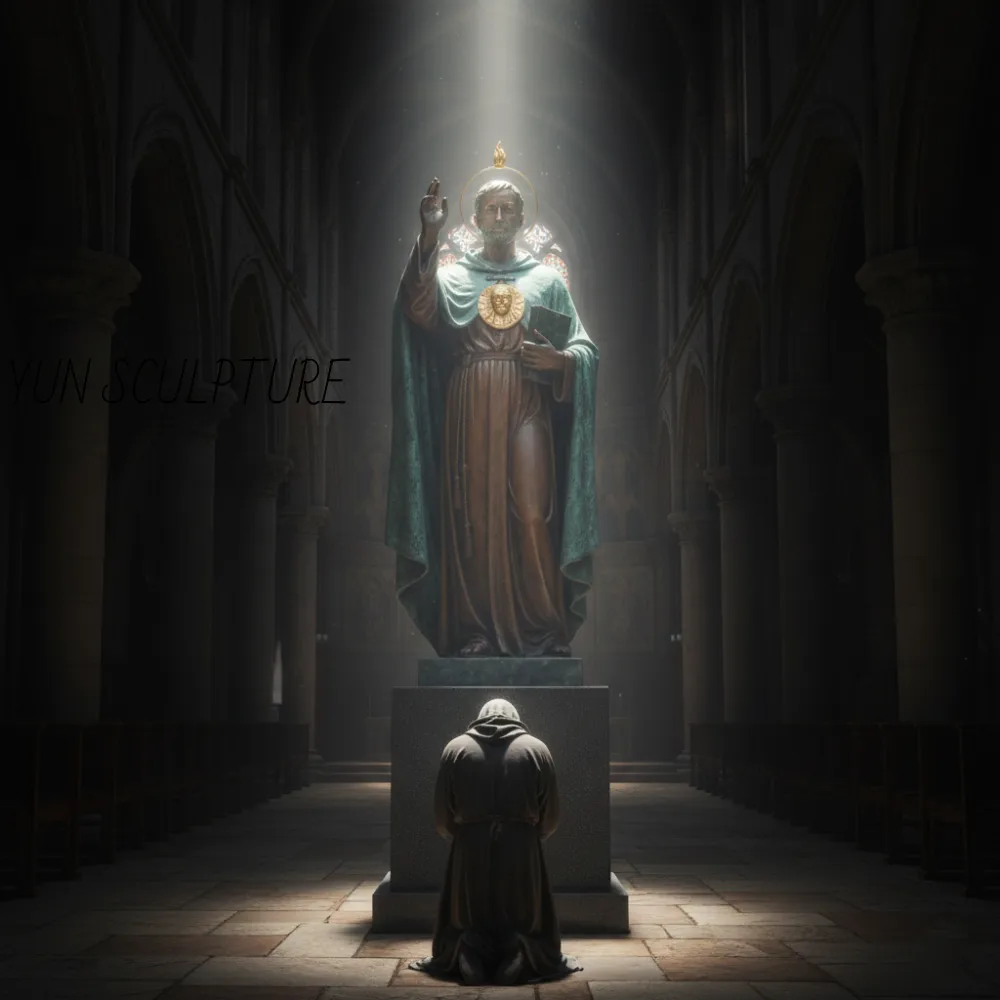
Our solutions by material: In bronze, a continuous 8-millimeter stainless steel rod runs the full height of the flame interior, welded to the primary head armature, with bronze cast around it at a minimum 6-millimeter wall thickness. In marble, a 10-millimeter 304 stainless steel rod is bonded into a pre-drilled channel with structural epoxy, functioning as a composite tensile system with the stone. In stainless steel, no supplementary reinforcement is required — the material’s 500 MPa tensile strength is adequate at the visual proportions the flame demands. All flame elements are load-tested independently to a safety factor of 3.0 above the site’s recorded maximum wind speed before final assembly approval.
The Medallion. The Christ face on St. Jude’s chest is approximately 8 to 12 centimeters in its longest dimension on a life-size figure. At a typical viewing distance of 10 meters, this face subtends roughly half a degree at the viewer’s eye — the threshold at which human face recognition begins to become unreliable under normal conditions.
The sculptural consequence: the medallion face cannot be modeled as a miniature of the primary figure. The relief depth must be greater, the plane transitions more emphatic, the light-and-shadow differentiation stronger than naturalistic modeling at full scale would produce. Our sculptors assess the medallion clay model at the installation viewing distance — not at the studio arm’s length of primary figure review — before any approval is granted.
The Axe or Spear. In a life-size figure, the implement handle extends 90 to 120 centimeters from the grip point. In a three-meter monumental version, this reaches 150 to 200 centimeters — a significant cantilever from a connection point elevated and off-axis from the figure’s structural center. The wind load on this element, combined with its offset position, generates an overturning moment at the foundation anchors substantially larger than any other element in the commission.
Our standard construction uses a hollow bronze casting over a continuous 316-grade stainless steel core rod, sized by structural calculation to the specific wind load and implement length of each commission, welded to the primary armature at the grip connection and, where length requires it, at a secondary connection within the garment folds.
Material Guide — Marble, Bronze, and Stainless Steel
Marble — The Sanctuary Material
White marble is the correct material for interior st jude statue commissions for reasons that are simultaneously theological and physical.
Carrara marble from the Apuan Alps transmits light 2 to 4 millimeters into its polished surface before scattering and returning — the property Renaissance sculptors called morbidezza, the visual suggestion of warmth beneath the surface. For a st jude marble statue placed in a hospital chapel or sanctuary where people in crisis come to pray, this is not an aesthetic luxury. A figure that appears warm, that carries the visual suggestion of presence, functions differently as a devotional object than one that does not.
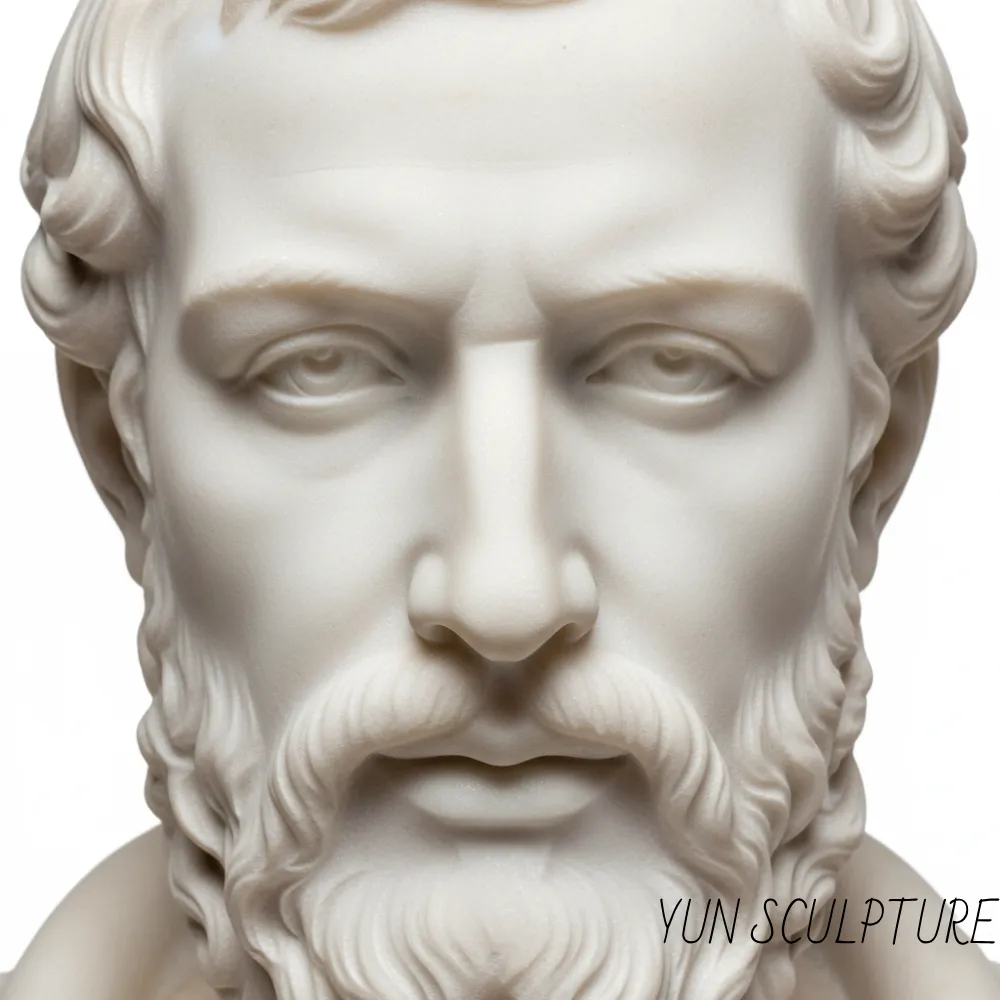
The specific challenges of marble for this iconographic subject: the flame requires the stainless steel composite system described above — we do not produce marble flame elements without internal reinforcement. The axe handle is modified to approximately 60 percent of its proportional full length, with the lower portion absorbed into garment folds, reducing the cantilever to a structurally safe dimension without visual compromise. The medallion Christ face receives the highest polish of any surface in the composition — full mirror finish — while the surrounding garment transitions through graduated levels to a matte honed finish in the deepest recesses.
Absolute constraint: interior installation only. Marble’s micro-porosity makes it incompatible with outdoor exposure in any climate with significant precipitation or temperature variation. We do not supply marble figures for outdoor installation.
Bronze — The Outdoor Landmark Material
For the st jude outdoor statue, st jude garden statue, and life size outdoor cast bronze statue of st jude categories, bronze is the only material whose physical properties are adequate.
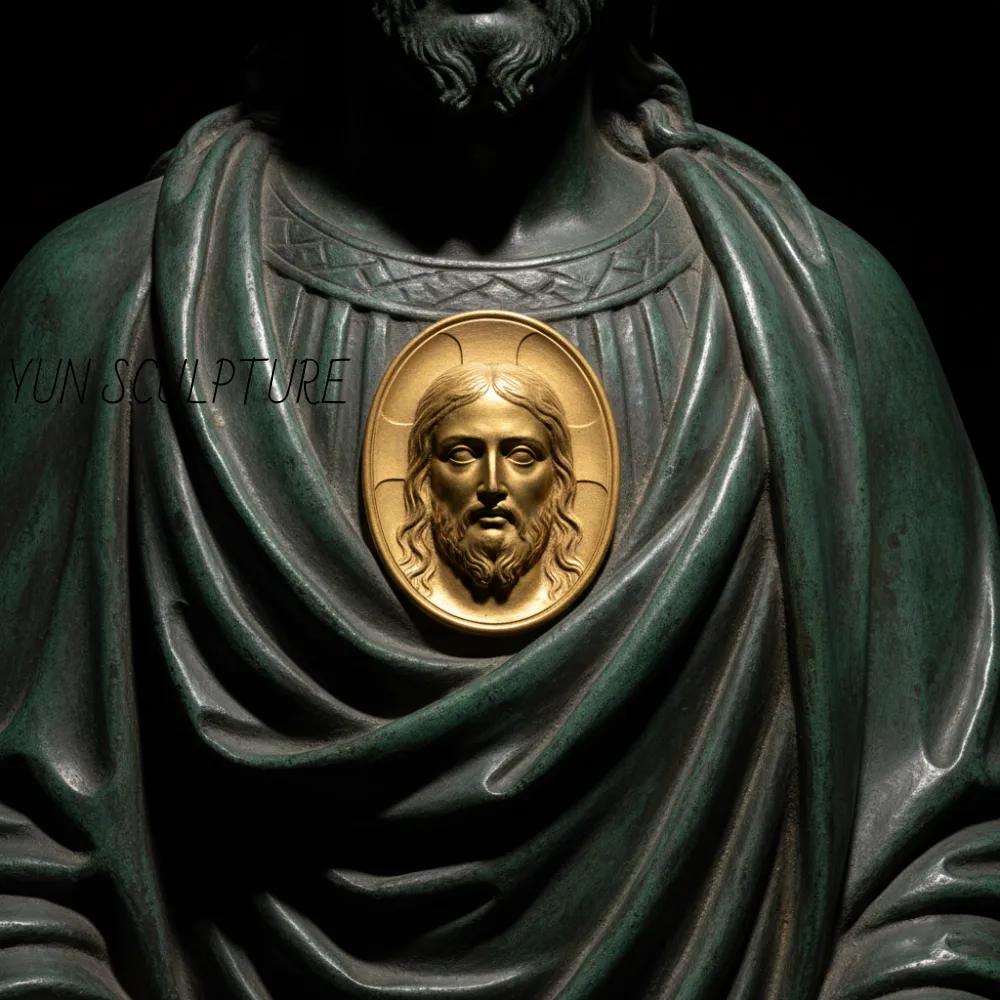
The patination strategy for a bronze St. Jude commission is more complex than for most other sacred figures because the traditional iconographic color program assigns specific chromatic values to specific elements. The cloak receives a ferric nitrate and ammonia-fumed treatment producing a stable blue-green oxide — permanent, self-deepening, the metal itself chemically altered rather than coated. The primary garment receives deep statuary brown. The face and hands receive a warmer gold-tone treatment directing the viewer’s eye to the emotional center. The medallion Christ face receives the brightest gold in the composition — the theological focal point reinforced by color hierarchy. The flame receives a calibrated gold treatment adjusted for the specific lighting conditions of the installation site.
The offering slot base — our standard specification for st jude hospital statue institutional commissions — is integrated into the bronze base casting: a 12-centimeter-wide aperture opening into a stainless-steel-lined interior cavity, positioned at 45 centimeters from grade for wheelchair accessibility, designed for periodic emptying without tool access.
Stainless Steel — The Medical and Contemporary Material
Stainless steel’s role in St. Jude commissions is more substantial than in any other sacred figure in our range. The connection between St. Jude and medical institutions — established culturally through the Memphis children’s hospital and theologically through his patronage of the sick — has produced an institutional commission market with specific material preferences.
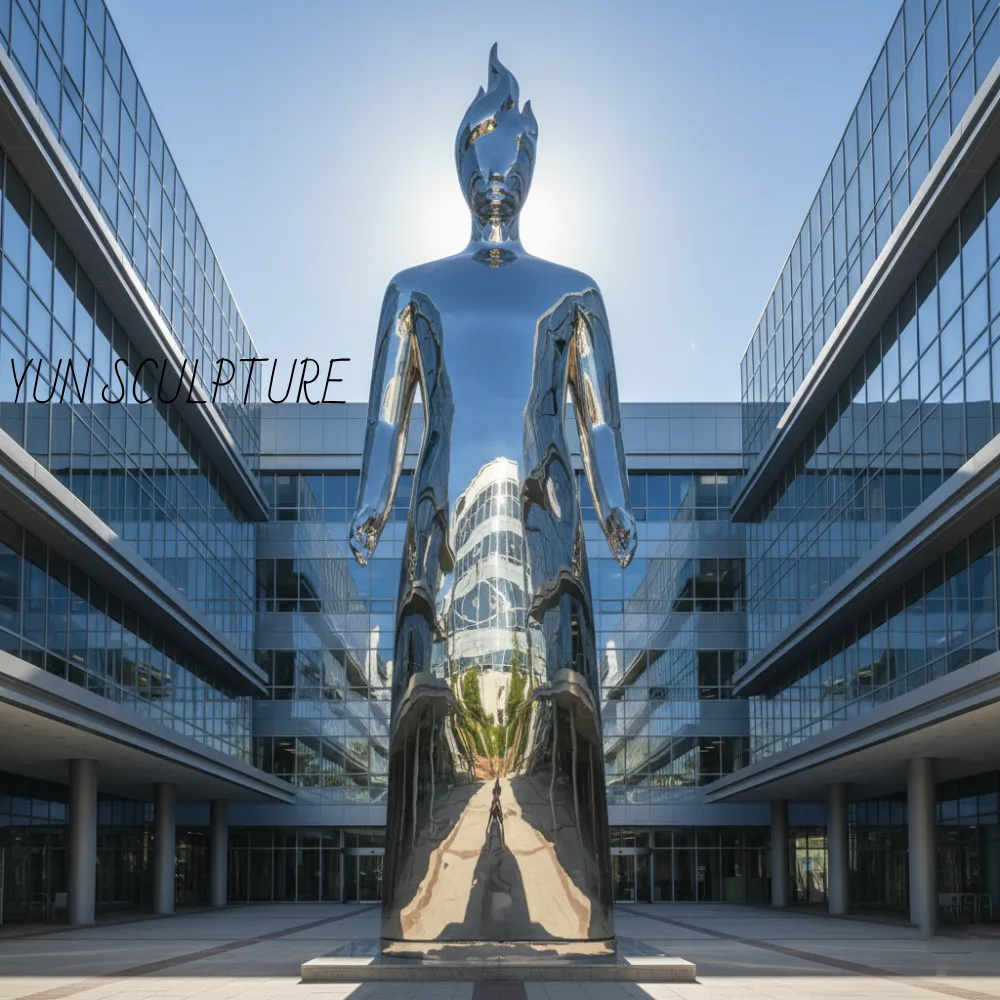
Medical architecture of the past thirty years uses stainless steel as a primary visual element. A stainless steel st jude hospital statue does not read as a departure from sacred tradition in this context. It reads as a figure native to its environment. The material’s surface has no porosity — it tolerates hospital-grade disinfectants, steam cleaning, and the infection control protocols applied to all physical assets in clinical spaces.
For the flame element specifically, stainless steel provides the optimal structural solution: no supplementary reinforcement required, visual proportions unconstrained by structural limits, mirror polish producing a dynamic optical effect in sunlight that no other material replicates.
Two finishes: mirror polish for open outdoor spaces where the figure’s engagement with its environment is a deliberate design element; matte brushed for interior medical and hospice installations where visual quietness is therapeutically appropriate. All outdoor commissions specify 316 grade for chloride resistance in coastal, road-salt, and urban acid-rain environments.
Material Comparison
| Attribute | Marble | Bronze | Stainless Steel |
|---|---|---|---|
| Recommended share | 50% | 40% | 20% |
| Best context | Interior chapel / shrine | Outdoor garden / landmark | Hospital / contemporary |
| Flame engineering | Steel composite rod | Internal reinforcement rod | No reinforcement needed |
| Medallion precision | ⭐⭐⭐ | ⭐⭐⭐ | ⭐⭐ |
| Outdoor durability | ❌ Interior only | ✅ Full outdoor | ✅ Superior outdoor |
| Offering slot base | ✅ | ✅ | ✅ |
| Traditional cloak color | Requires tinting | ✅ Patina | Contemporary interpretation |
Sizing Guide
| Figure Height | Context | Notes | Material |
|---|---|---|---|
| 15 – 45 cm | Home / bedside | Flame simplified or omitted | Bronze or marble |
| 45 – 90 cm | Office / clinic room | Complete program, simplified flame | Bronze or marble |
| 90 – 120 cm | Chapel / small parish | Full iconographic program | Marble (int.) / Bronze (ext.) |
| 120 – 150 cm | Parish church / hospital | st jude statue 4 feet standard | Marble (int.) / Bronze (ext.) |
| 150 – 180 cm | Shrine / large institution | Full structural assessment | Bronze / Stainless |
| 180 – 220 cm | Campus landmark | Complete engineering package | Bronze |
| 220 cm + | National shrine / civic | Structural certification required | Bronze / Stainless |
The st jude statue 4 feet specification — 48 inches, approximately 120 centimeters — is among the most frequently requested standard sizes in American parish and institutional sacred art, suited to the altar niches and chapel alcoves of the mid-size parish church or hospital chapel, legible from a nave distance of 15 to 20 meters.
For st jude statue large commissions above 180 centimeters, every structural element discussed in the engineering section applies with full force. Every large outdoor commission includes: site-specific wind load analysis, structural engineering calculations, foundation drawings, anchor bolt specifications, patination documentation, and 25-year maintenance schedule.
Who Commissions a St. Jude Statue?
St. Jude attracts the most institutionally distinctive buyer profile in our commission range. His theological function maps directly onto a set of institutional missions unlike those of any parish or pilgrimage site.
Catholic Hospitals and Healthcare Systems represent the largest single buyer category. Large Catholic healthcare systems — Trinity Health, Ascension, CommonSpirit — each operate dozens to hundreds of hospitals with ongoing sacred art requirements for new construction and renovation. A single campus commission for a st jude hospital statue may involve site assessment, iconographic consultation, structural engineering, foundation design, ADA accessibility compliance, institutional procurement review, and long-term maintenance planning. We have developed a dedicated institutional commission process for healthcare clients that begins with procurement requirements review before artistic consultation, ensuring the commission can navigate the approval process before significant design investment is made.
Hospice and Palliative Care Institutions produce the most emotionally significant commissions we execute. The theological alignment between St. Jude’s patronage and the palliative care mission — accompaniment through impossible medical realities — is precise. Marble is specified for palliative care interior installations more frequently than for any other institutional context in our range. Outdoor palliative care garden commissions specify bronze with patination calibrated toward softness rather than drama — the verde antique cloak in a less saturated tone, the face in the warmest gold available within our standard program.
Drug Rehabilitation and Recovery Centers have a direct relationship with St. Jude’s theological function. The st jude garden statue format — 90 to 150 centimeters, bronze, outdoor garden installation — is the standard for recovery center commissions. These clients also provide the most specific briefs about facial expression we receive in our entire range. Recovery communities have a hard-won understanding of the difference between a face that communicates judgment and one that communicates acceptance. We follow this direction with the same precision we bring to structural engineering.
Prison Ministry and Correctional Chapels represent a steady commission segment. The theological fit is exact. Physical requirements differ from other institutional work: sharp projecting elements must be assessed against facility safety standards, and some configurations require modification. Marble is standard for interior correctional chapel installations — durable, requiring no maintenance that would necessitate contractor access to secure areas.
National Shrines and Pilgrimage Destinations produce the largest individual commissions in our St. Jude range. The National Shrine of St. Jude in Chicago — established 1929, the oldest and most visited in North America — has functioned for nearly a century as the de facto iconographic standard for American Catholic representations of the saint. Clients across the country bring reference photographs of the Chicago figure when commissioning new work. Getting the iconographic reference right at the brief stage is essential: the Chicago St. Jude, the Baltimore St. Jude, and the Roman St. Jude are, in meaningful proportional and gestural ways, different figures.
Private Devotional Commissions — individuals fulfilling a vow made to St. Jude — are the most personally weighted commissions we receive. These clients are not purchasing committees or procurement officers. They are people who asked for the impossible and received it, or who are still asking and want a physical commitment that matches the weight of what they are asking for. We treat these commissions with particular care because the stakes are different from institutional work. The figure we produce will live in a specific room, be seen by specific people, carry a specific history.
FAQ — 10 Core Questions Answered
What is the meaning of a St. Jude statue?
A st jude statue placed in a home, hospital, recovery center, or chapel is a physical statement about the availability of hope in impossible situations. The st jude statue meaning is unique among Catholic sacred images because it is addressed to a specific kind of desperation — and because that specificity, accumulated across centuries of answered prayers and published testimonials, has given the image a devotional weight disproportionate to St. Jude’s relatively modest profile in the broader tradition. He is present for the situation where everything else has already been tried.
What does St. Jude hold in his statue?
A complete st jude holding a bible statue includes three primary elements: a book representing his New Testament epistle, held in one hand; a medallion bearing the image of Christ’s face worn or held against the chest; and an axe or spear — the instrument of his martyrdom — in the opposite hand. The flame above the head is a theological attribute, not a held object, marking his presence at Pentecost. In some representations the book and medallion are combined; in others they appear as independent elements. Smaller commissions below approximately 45 centimeters may simplify or omit the flame for structural reasons.
What is the difference between St. Jude Thaddaeus and Judas Iscariot?
They are entirely different people who share a name common in first-century Galilean culture. Judas Iscariot betrayed Jesus and is recorded as taking his own life. St. Jude Thaddaeus remained faithful through the Crucifixion, witnessed the Resurrection, received the Holy Spirit at Pentecost, and died a martyr in Persia. The st jude thaddeus statue designation — the addition of “Thaddaeus” — is a centuries-old disambiguation that ensures the correct apostle is identified. It is also, as this guide explains, the direct historical cause of St. Jude’s unique patronage of impossible causes.
What colors should a St. Jude statue be painted?
The traditional st jude colors to paint statue program assigns blue-green or teal to the outer cloak, warm earth tones to the primary garment, gold to the medallion Christ face and flame. For st jude statue beige or natural-finish specifications — particularly common in contemporary institutional commissions — Hanbaiyu marble’s slightly warm undertone provides more visual presence than Carrara’s cooler pure white for carved pieces. For bronze, a single-tone statuary brown is a legitimate contemporary choice. The traditional color program is an iconographic convention, not a liturgical requirement.
What is the tradition of placing coins at a St. Jude hospital statue?
Coins — most commonly quarters — are left at the base of a st jude hospital statue as material signs of petition or gratitude. Some institutions collect and donate the accumulated coins to charity. Our studio offers a standard offering slot specification integrated into the base casting for institutional commissions: a concealed aperture at wheelchair-accessible height, opening into a stainless-steel-lined cavity designed for extended accumulation and easy emptying. This is treated as a standard design option for medical institutional commissions rather than a custom request.
What material is best for a large outdoor St. Jude statue?
For any st jude outdoor statue — regardless of climate or institutional context — Grade A Foundry Bronze is the only material we specify without qualification. The flame must be engineered against wind loads. The implement must withstand dynamic forces at full cantilevered length. The surface must maintain visual quality through decades of UV exposure and precipitation. Bronze’s self-protective patina chemistry satisfies all requirements. Marble is not an outdoor material in any climate with significant precipitation or temperature variation. We do not produce marble figures for outdoor installation.
What size is recommended for a hospital garden St. Jude?
For a st jude garden statue in a medical setting visible from patient rooms at 8 to 15 meters distance, a figure in the 90 to 120 centimeter range is appropriate for enclosed garden spaces. For open campus settings with viewing distances of 20 to 40 meters, 150 to 200 centimeters is needed to maintain legibility of the medallion face and flame at the primary viewing distance. For commissions where patient visibility from a horizontal position in a hospital bed is specified — as it was in the Chicago palliative care commission that opens this guide — we conduct a sightline analysis as part of the site assessment before any size is confirmed.
Can you make a life-size outdoor cast bronze St. Jude statue?
Yes, and this is one of our core commission categories. A life size outdoor cast bronze statue of st jude — approximately 170 to 180 centimeters — is among the most technically demanding pieces in our range because of the three simultaneous structural complications specific to this iconographic subject. Every such commission includes structural engineering calculations, site-specific wind load analysis, foundation drawings, anchor bolt specifications, patination documentation, and a 25-year maintenance schedule. We have executed commissions of this type for healthcare institutions, national shrines, parish entrance landmarks, and private devotional estates across the United States, Australia, Ireland, and the Philippines.
Where can I find a high-quality St. Jude statue for sale?
A serious foundry will understand the iconographic distinction between St. Jude Thaddaeus and other saints without prompting. They will have a documented engineering approach to the flame element and be able to explain it. They will produce a full-scale clay model for client approval before metal is poured or stone is cut. They will provide structural engineering documentation for all outdoor installations. And they will be honest about material constraints: a st jude statue for sale in marble is an interior object; a foundry that offers it for outdoor installation is either uninformed or indifferent to your commission’s longevity. For clients with immediate requirements, we maintain a small inventory of standard bronze and marble pieces in the 25 to 45 centimeter range — the only format in our range where inventory rather than custom production is available.
How long does a custom St. Jude statue take?
An interior marble commission in the 90 to 120 centimeter range requires 80 to 110 days from signed approval. A bronze outdoor commission at equivalent scale requires 90 to 120 days, including the four-zone patination program. A life size outdoor cast bronze statue of st jude with full structural engineering and foundation documentation requires 120 to 160 days. These timelines are not compressible. The structural engineering of the flame, the precision modeling of the medallion face, and the multi-zone patination process each require the time they require.
The Saint Who Remains
The Chicago palliative care director asked us whether we could guarantee the bronze would last.
We said: we can guarantee the material. Bronze does not fail under normal outdoor conditions within any human lifespan. The patina is self-protective. The foundation is engineered to the worst wind the site has recorded, safety factor of three. The flame is internally reinforced, rated to three times the design load.
We could not guarantee the institution. We could guarantee the metal.
She said that was enough.
The st jude outdoor statue installed in that North Side garden in 2019 has now stood through six Chicago winters. The patina on the cloak has deepened. The flame tip shed last winter’s ice storm cleanly. The offering slot has been emptied four times.
Patients from the upper floors can see the figure from their beds without sitting up. That was the specification. It has been met.
This is what a st jude statue commission is, at its most serious level: not an artistic object placed in a space, but a structural commitment to the permanence of hope in a place where hope is under maximum pressure. The engineering serves the theology. The theology justifies the engineering. In this commission, for this particular saint, they have never been separable.
St. Jude has been serving impossible causes for two thousand years. The material we build his image in should be adequate to that service.
We are ready when you are.
— Elena Zhang & Donghui Zhang, Yun Sculpture