Get in touch with Yun-Sculpture company
St. Francis Statue for Selling a House? The Real Tradition Explained

If you are searching for a St. Francis statue to help sell your house, I need to clear something up before you spend any money: the house-selling tradition belongs to St. Joseph, not St. Francis. This is one of the most common mix-ups we encounter at our workshop, and it matters — because buying the wrong saint’s statue means the ritual will not follow the tradition at all, and you will have a sculpture that was never designed for that purpose.
Let me explain where the confusion comes from and what each saint is actually for.
Table of Contents
Table of Contents
Why Do People Confuse St. Francis with St. Joseph?
The mix-up happens for a simple reason: St. Francis is the most recognizable garden saint in the world. When people think “saint” and “yard” in the same sentence, St. Francis is the first image that comes to mind — the brown robe, the birds, the peaceful figure standing among flowers.
So when someone hears about a tradition involving burying a saint’s statue in your yard to sell a house, their brain connects “yard” to “St. Francis” automatically. The real tradition involves St. Joseph — Mary’s husband, the patron saint of workers and families — but he is far less visible in garden culture. Most people could not describe what a St. Joseph statue looks like, while nearly everyone recognizes St. Francis.
We get emails about this regularly. A client will write asking for a “St. Francis statue for selling our house,” and Elena or I will gently explain that they are looking for St. Joseph. About half the time, they did not even know the two were different saints.
What Is the St. Joseph House-Selling Tradition?
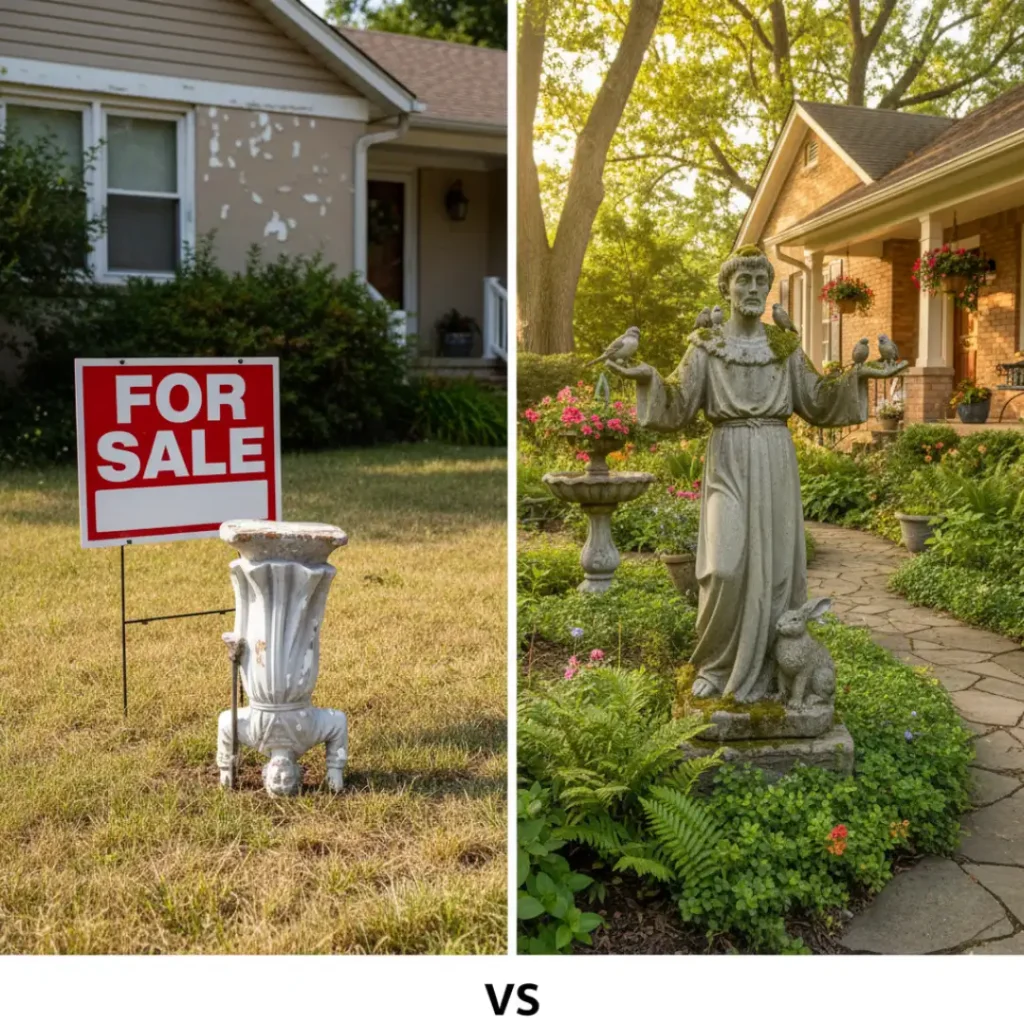
The tradition says that burying a small St. Joseph statue in your yard — typically upside down, near the “For Sale” sign or property line — and praying for his intercession will help the house sell faster. After the sale closes, you dig up the statue and give it a place of honor in your new home.
The origins are debated. One story traces it to St. Teresa of Avila in the 1500s, who buried medals of St. Joseph while praying for land to build a new convent — and soon found it. Another version connects it to Brother André Bessette in Montreal, who planted St. Joseph medals on a property his monastery wanted to purchase. By the 1990s, the practice had become widespread in American real estate culture, with realtors buying small plastic St. Joseph statues in bulk.
It is worth noting that the Catholic Church does not officially endorse this practice. Some priests support it as a harmless expression of faith. Others consider it superstition. Regardless of where you stand on that question, the tradition specifically involves St. Joseph — never St. Francis.
Does Burying the Statue Actually Help Sell a House?
There is no evidence that burying a statue causes a house to sell. What the tradition does provide is a psychological ritual — a concrete action that helps anxious homeowners feel they have done everything possible. Real estate agents who recommend it are usually offering it as a morale boost alongside practical advice about pricing, staging, and marketing.
I am a sculptor, not a theologian or a real estate agent, so I will not tell you whether to follow the tradition or not. But I will say this: if you decide to try it, buy a small, inexpensive St. Joseph statue specifically made for this purpose. Do not bury a high-quality garden sculpture. A $10 resin figure serves the tradition just as well as anything else.
What Is St. Francis Actually For?
St. Francis of Assisi is the patron saint of animals and the environment. His statue belongs in a garden not to help sell a house, but to create a lasting atmosphere of peace, harmony, and spiritual calm.
A St. Francis statue is designed to stay. It is placed upright — never buried, never upside down — in a visible location where it can bless the landscape for decades. His symbolism is rooted in nature, humility, and compassion for all living creatures. That is a fundamentally different purpose from the transactional goal of selling a property.
If anything, a well-placed St. Francis statue is a reason to love your garden more, not to leave it.
For homeowners who are staying in their home and want to add a meaningful presence to their garden, St. Francis is exactly the right choice. Our choosing guide walks through size, material, and style, and our placement guide covers where to position the statue for maximum impact.

What If You Want Both?
Some of our clients do both: they bury a small St. Joseph near the property line while the house is listed, and they take their permanent St. Francis garden statue with them when they move. The St. Joseph serves the short-term tradition. The St. Francis serves the long-term relationship with the garden.
If this is your situation, the one thing I strongly advise is: do not bury the St. Francis. He is not part of that tradition, and a quality stone or bronze sculpture should never go underground. Bury a purpose-made St. Joseph, and let St. Francis stand where he belongs — in the open air, surrounded by the life he was meant to protect.
Frequently Asked Questions
Which saint statue do you bury to sell your home?
St. Joseph — the husband of Mary and patron saint of workers and families. The tradition involves burying a small statue upside down in the front yard, near the “For Sale” sign, and praying for his intercession. After the sale, you dig up the statue and display it in your new home. St. Francis of Assisi has no connection to this practice.
What saint statue helps sell houses?
St. Joseph. He became associated with home sales through a tradition that may date back to St. Teresa of Avila in the 1500s or to Brother André Bessette in early 20th-century Montreal. The practice became widespread in American real estate culture in the 1990s. St. Francis is often confused with St. Joseph because he is the most common garden saint, but the two serve entirely different purposes.
What is the Catholic superstition about selling a home?
The tradition says to bury a small St. Joseph statue upside down in the front yard, facing the house (though instructions vary), while praying daily for a successful sale. The Catholic Church does not officially endorse this practice — some priests view it as a harmless devotion, while others consider it superstition. Either way, it involves St. Joseph specifically, not any other saint.
Does burying the statue actually help sell a house?
There is no documented evidence that burying a statue influences a home sale. The tradition functions primarily as a psychological ritual — a tangible action that helps sellers feel they have done everything in their power. Practical factors like pricing, staging, presentation, and market conditions are what actually determine how quickly a house sells.
Where should you put the St. Joseph statue when selling your home?
The most common instruction is to bury it upside down in the front yard, about 12 inches deep, near the “For Sale” sign or property line, facing the house. Some traditions say to face it toward the street instead. There is no standardized method since the practice is folklore, not official Church teaching. Wrap the statue in cloth or a plastic bag to protect it while buried.
What do Catholics do to sell a house?
Beyond the St. Joseph statue tradition, some Catholics pray a novena (nine days of dedicated prayer) to St. Joseph for help with the sale. Others add red elements to their home staging — red flowers, a red door accent — since red is associated with St. Joseph. Some have the house blessed by a priest before listing it. These are all devotional practices, not guarantees, and the most effective approach is always to work with a competent real estate agent alongside any spiritual tradition.
Can you reuse a St. Joseph statue after selling?
Yes. After the house sells, you should dig up the statue, clean it, and give it a place of honor in your new home — a shelf, a windowsill, or a prayer corner. Leaving it buried after the sale is considered ungrateful in the tradition. Some families reuse the same statue for future home sales. Others prefer to buy a new one each time.
What do you do with St. Joseph’s statue after the house is sold?
Dig it up, clean it, and display it prominently in your new home. Many families place it on a kitchen windowsill, a mantelpiece, or in a small devotional area. This step closes the ritual — you asked for St. Joseph’s help, the house sold, and now you honor him with a visible place in your life. If the statue is damaged from being buried, it is appropriate to dispose of it respectfully — either by burying it permanently in a garden or donating it to a church.
What if I do not have a yard for St. Joseph?
If you live in a condo or apartment, the tradition adapts: bury the St. Joseph statue in a flowerpot near your front door, or place it in a window facing the street. The principle is the same — position St. Joseph near the boundary between your home and the outside world. Some condo sellers simply place the statue upright near the entrance and pray daily without burying it at all.
The Right Saint for the Right Purpose
St. Joseph helps you sell. St. Francis helps you stay.
If you are listing your home, a small St. Joseph statue from any Catholic supply store serves the tradition. If you are creating a garden you want to enjoy for years, a St. Francis statue — in stone or bronze, designed to weather decades — is the right investment.
Not sure where to start? Browse our St. Francis collection or reach out directly to discuss what would work in your space. And if you want a St. Francis bird bath that brings real wildlife into your garden daily, we can help with that too.
— Elena Zhang, Yun Sculpture