Get in touch with Yun-Sculpture company
St. Joseph the Worker Statue: Marble vs. Bronze, Size & Commission Guide

A st joseph the worker statue comes in two materials worth considering — natural marble and cast bronze — and the difference between them is not aesthetic preference. It is structural reality. Marble belongs in sheltered courtyards and chapel interiors. Bronze belongs outdoors, in weather, in public view. Everything else — resin, cast stone, fiberglass — photographs well and fails within a decade in a real garden.
Table of Contents
Table of Contents
What Is the Difference Between St. Joseph and St. Joseph the Worker?
Two feast days. Two distinct images. Two different theological messages.
March 19 honors St. Joseph as spouse of Mary, protector of the Holy Family, and patron of the universal Church. The statue for this feast shows him as a patriarch — composed, holding a lily, often with the Child Jesus at his side. The lily is central. The mood is guardianship.
May 1 honors St. Joseph the Worker, a feast established by Pope Pius XII in 1955 specifically to place a Catholic answer to communist May Day on the calendar. The statue for this feast shows him differently: tools in hand, work apron on, focused expression. The lily may be absent entirely. The mood is labor.
For churches, Catholic schools, vocational programs, and labor organizations, the worker image is almost always the right choice. It speaks directly to institutions whose mission involves work, formation, and the dignity of daily effort. The traditional guardian image serves domestic and family devotional spaces better.
If you are unsure which version fits your setting, the sleeping St. Joseph statue is a third option worth considering — quieter in presence, often chosen for hospital chapels and contemplative spaces.
What Does a St. Joseph the Worker Statue Look Like?
The worker version has a specific visual vocabulary — and the quality of a statue is most visible in how well that vocabulary is executed.
His hands hold tools. The carpenter’s square is most common, representing moral alignment and justice. A saw, hammer, hatchet, or chisel may appear instead or alongside. His expression is focused and calm — not suffering, not triumphant, not regal. The face of a man doing meaningful work. He often wears a work apron over his robes, and this apron is where you separate standard production pieces from serious craftsmanship: leather behaves differently from cloth, and that difference must be carved or cast with depth and precision to read as real.
The Child Jesus may appear beside him in workshop compositions, or be absent in solitary worker images. Both are theologically grounded. The choice affects the emotional register of the sculpture significantly — the father-son scene reads as mentorship and tenderness; the solitary figure reads as vocation and discipline.
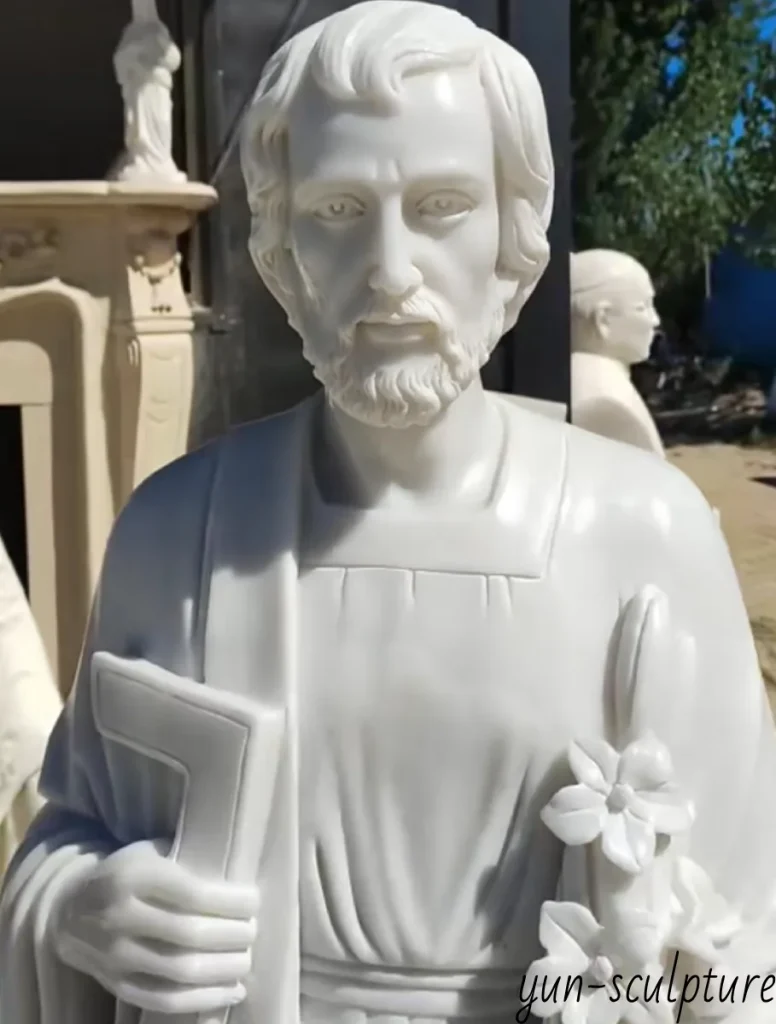
At small scales, much of this disappears. Under 12 inches, saw teeth blur into flat edges and apron folds flatten into surface paint. The theological language of the tools only becomes fully legible at 36 inches and above, which is why serious commissions rarely go smaller.
What Material Is Best for an Outdoor St. Joseph Statue?
I have seen the same mistake made by well-meaning parishes more than once: a beautiful resin statue installed in a garden courtyard, looking exactly right in the first year, and beginning to crack along the base seam by the third winter.
Donghui Zhang, who has been running our foundry for over 20 years, puts it plainly: resin expands under summer heat and contracts in cold. Cast stone absorbs moisture. Neither material was engineered for the freeze-thaw cycles that affect most of North America and Northern Europe. The surface paint fades under UV exposure regardless of how well the piece was finished originally. For an outdoor installation meant to last a generation, these are not acceptable trade-offs.
For open-air outdoor installation: cast bronze. The lost-wax casting process preserves extraordinary surface detail — individual saw teeth, leather apron folds, wood grain on tool handles — and bronze resists corrosion indefinitely. The natural patina that develops over years deepens the surface color and actually protects the metal. A bronze St. Joseph installed in a church courtyard today should look better in twenty years than it does on delivery day.
For sheltered outdoor spaces, covered cloisters, and indoor chapels: natural white marble. Marble holds light differently from any other material — robes develop softness and depth that no synthetic can replicate. What marble cannot do is survive prolonged exposure to acid rain, repeated frost cycles, and pollution without losing fine surface detail over decades. Indoors and in protected settings, it is unmatched.
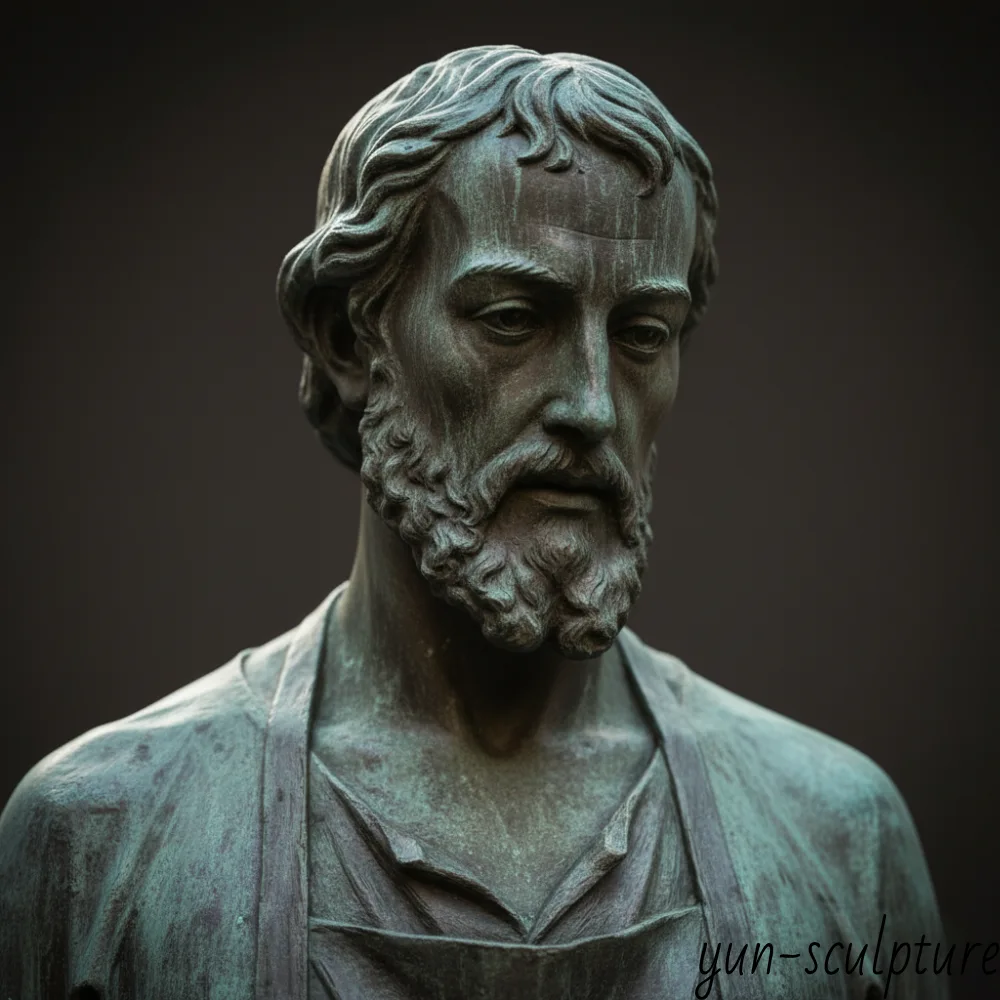
Not sure which material suits your climate and installation setting? Tell us your location and intended placement — we will give you a direct recommendation.
How Big Should a St. Joseph the Worker Statue Be?
Size is not a question of budget or ambition. It is a question of what the tools can communicate from the distance your visitors will be standing.
I have watched clients stand in front of a life-size St. Joseph and go completely quiet — there is a presence that a 24-inch statue simply cannot create, no matter how finely it is carved. But the more practical issue is legibility. At smaller scales, the carpenter’s square loses its sharp angles, the saw becomes a smooth blade with no teeth, and the apron reads as a painted-on shape rather than a real garment.
Donghui’s threshold, based on two decades of commissions:
| Size | Best Setting | What Reads Clearly |
|---|---|---|
| 24–36 inches | Residential garden, home chapel | Basic tool shapes, general pose |
| Life-size (5–6 ft) | Church courtyard, school entrance | Full tool detail, fabric texture, expression |
| 8 ft and above | Public square, large institutional campus | Visible from 20+ meters; requires engineering anchoring |
For life-size outdoor bronze installations, Donghui reinforces every base to accept 18–24 inch concrete anchoring. Statues above 8 feet require steel rod foundation systems and wind load calculations — not because they are fragile, but because the physics of a tall vertical structure in open air demand it.
A life-size St. Joseph the Worker in white marble typically takes 35–45 working days from approved maquette to shipping. The same in bronze runs 40–50 days.
How Much Does a St. Joseph the Worker Statue Cost?
This is the question most buyers arrive with, and it deserves a direct answer.
- Mass-produced resin pieces (Amazon, EWTN, eBay): $30–$300, sizes 4–36 inches. Suitable for home altars and small prayer corners.
- Italian wood or fiberglass institutional pieces (Zieglers, Tonini): $800–$4,000 for standard sizes. Better quality, longer lifespan, but painted surface finishes.
- Custom marble commissions (factory direct, 36 inches–life size): $2,500–$8,000 depending on size and composition complexity.
- Custom bronze commissions (life size and above): $6,000–$25,000+ for institutional outdoor installations.
The institutions commissioning bronze and marble are not paying for luxury. They are paying for permanence. A bronze statue installed in a church courtyard in 2025 will still be standing in 2075. For context on multi-figure outdoor commission costs, our Holy Family statue guide walks through a similar structure here.
What Is the Significance of the St. Joseph the Worker Statue?
Joseph’s silence in the New Testament is the theological foundation of the worker image. He holds no recorded words, yet he protected the Holy Family, provided through skilled labor, and raised the Son of God in a working household. A statue placed in a school entrance, a union hall, or a hospital courtyard declares that the institution’s values are grounded in the dignity of daily work — not through a ceremony that ends, but through a material that remains for generations.
For similar institutional commissions oriented around devotion and healing, the Sacred Heart of Jesus statue guide is worth reading here.
FAQ
What flower represents Saint Joseph?
The white lily is the flower most closely associated with St. Joseph in Catholic tradition, symbolizing purity and faithful service to God. The symbol originates from the tradition of Joseph’s staff miraculously blooming with lilies — the sign used to confirm his selection as Mary’s husband and protector. In traditional St. Joseph statues, the lily appears prominently in his hand. In the worker version, it often moves to the base of the sculpture, with tools taking visual priority. In marble commissions, carved lily petals beside geometric tool shapes create an effective visual contrast between holiness and labor.
Why is St. Joseph so powerful as an intercessor?
Catholic tradition attributes Joseph’s intercessory power to his unique position in salvation history: God entrusted him with the physical protection of both Mary and Jesus — a responsibility given to no other saint. His reliability, obedience, and total dedication make him a trusted advocate across a wide range of needs: employment, family, housing, health, and a peaceful death. He is formally recognized as patron of workers, fathers, craftsmen, the dying, and the universal Church. His complete silence in scripture amplifies rather than diminishes this — a man of such faithfulness, trusted with the most sacred responsibilities in human history, carries exceptional weight as an intercessor.
Does St. Joseph protect your house?
St. Joseph is traditionally venerated as protector of the home and family, not only of workers. The theologically grounded expression of this devotion is placing a quality statue in the garden or at the entrance of the home, where Joseph stands as a visible guardian. A well-crafted marble or bronze statue placed at the entrance communicates blessing, protection, and hospitality — and remains as a permanent spiritual focal point for the household long after any transaction is complete.
Can a St. Joseph the Worker statue be placed indoors?
Yes, and for marble commissions indoors is often the ideal setting. Natural white marble responds beautifully to controlled interior lighting — robes develop depth and softness that outdoor conditions gradually erode. Chapel interiors, covered cloisters, school entrance halls, and hospital prayer rooms are natural environments for marble St. Joseph statues. Bronze works equally well indoors, though its visual authority is most powerful in open outdoor settings where scale and patina read at a distance. The material choice should follow the installation environment: marble for sheltered and interior spaces, bronze for open-air and large-scale outdoor installations.
How long does it take to commission a St. Joseph the Worker statue?
A life-size St. Joseph the Worker in white marble takes approximately 35–45 working days from approved clay maquette to shipping. Cast bronze at the same scale runs 40–50 working days. These schedules assume the design brief is clear from the start — tool selection, pose, base style, and whether a workshop scene with the Child Jesus is included. International shipping to the United States or Europe adds 15–25 days depending on destination port.
Where can I buy a high-quality St. Joseph the Worker statue in marble or bronze?
For mass-produced devotional pieces, Catholic supply retailers including EWTN Religious Catalogue and Roman Inc. carry resin options at accessible price points. For custom marble or bronze commissions designed for institutional outdoor installation, the most reliable path is working directly with a foundry or sculpture workshop that specializes in religious art. Factory-direct workshops eliminate the middleman markup that adds significantly to Italian-import pricing.
Commission Your St. Joseph the Worker Statue
Joseph built in solid materials because his work was meant to last. A statue that represents him should do the same.