Get in touch with Yun-Sculpture company
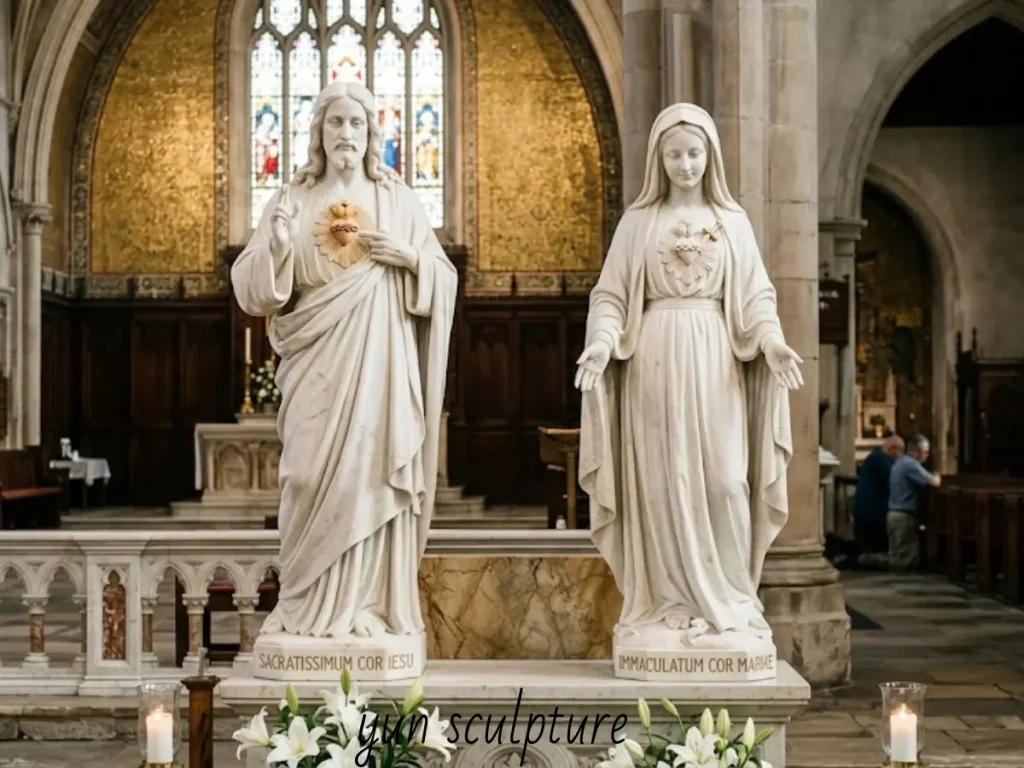
Sacred Heart of Jesus and Immaculate Heart of Mary Statue: The Paired Commission Guide

A sacred heart of jesus and immaculate heart of mary statue commission is not two separate orders placed at the same time. It is one commission that produces two figures. The moment you separate the production process, you introduce scale discrepancies, finish mismatches, and proportion errors that cannot be corrected after casting or carving. I have seen parishes receive two statues from different suppliers that were specified as the same height and arrived looking like they were made for different spaces. This guide covers what a properly executed paired commission actually requires — from theology to engineering to base dimensions.
Table of Contents
Table of Contents
What Do the Two Sacred Hearts Mean Together?
Separately, each heart carries its own theology. Together, they complete a statement that neither can make alone.
The Sacred Heart of Jesus reveals love that initiates — active, redemptive, poured out without reserve. Jesus points to his heart. The gesture is outward, offering, inviting. The theological claim is specific: here is the source of redemption, exposed and accessible.
The Immaculate Heart of Mary reveals love that responds — receptive, participatory, faithful through sorrow. Mary’s hands rest at or gesture toward her heart. The sword pierces it. The posture is inward, contemplative, absorbing what the Sacred Heart gives. The theological claim is equally specific: here is the perfect human response to that offer, sustained even through suffering.
Place them together and the dialogue becomes visible. One figure pours out; the other receives and returns. One reveals divine initiative; the other reveals human consent carried to perfection. Catholic theology holds that this exchange — between God’s love and Mary’s fiat — is the structural core of the Incarnation and the Redemption.
This is why paired installations frame altars rather than decorate walls. The two hearts are not devotional accessories. They are a visual theology of how salvation works.
For the full theological history of this devotion, including how St. John Eudes articulated the unity of the Two Hearts in the 17th century and how the Fatima apparitions deepened it, our Immaculate Heart of Mary statue guide covers the background in detail.
Why Is Mary on the Left?
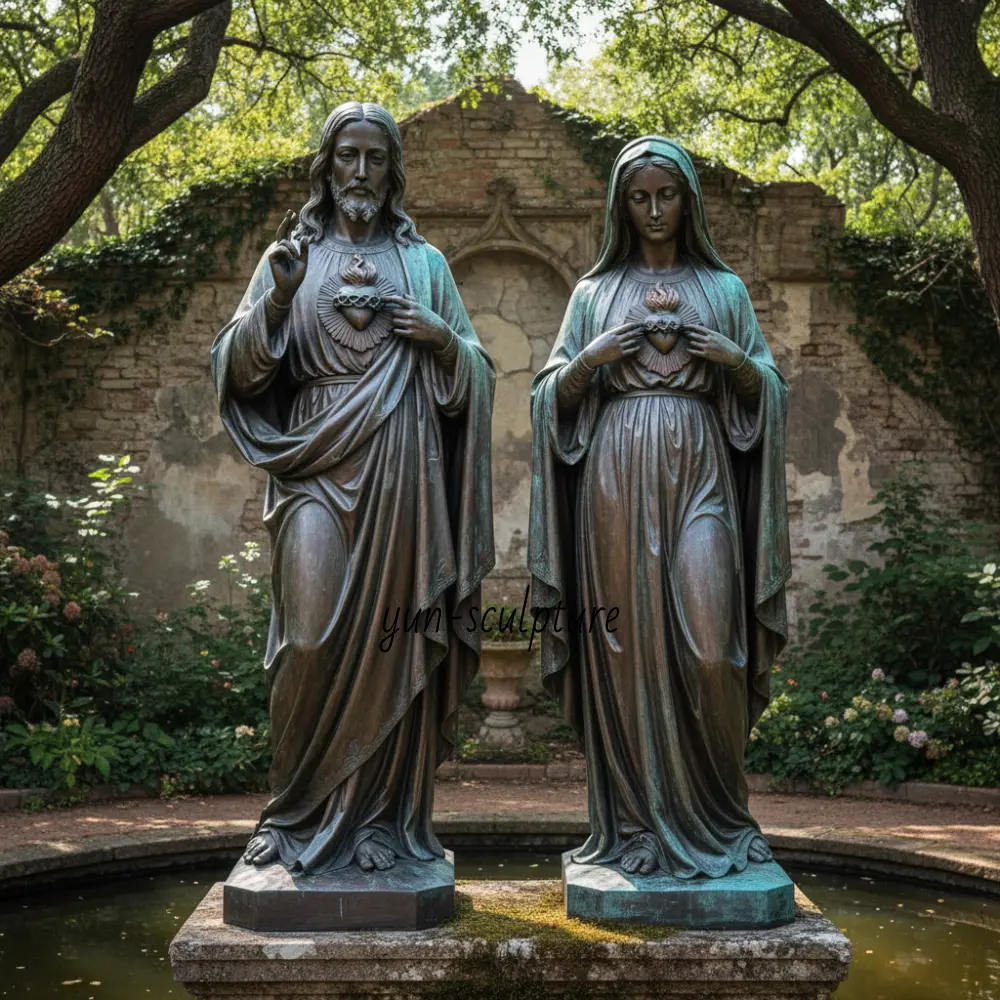
From the viewer’s perspective facing the altar, Mary stands on the left and Jesus on the right. This is the traditional arrangement in Catholic church design, and the structural logic behind it is not arbitrary.
In Western liturgical tradition, the right side of the altar is the position of honor — the Gospel side, the side associated with Christ’s active ministry and authority. Jesus occupies this position. The left side, the Epistle side, is associated with the Church, the faithful, the human response to divine action. Mary occupies this position as the perfect representative of the Church’s response to Christ.
From a sculptural perspective, this arrangement creates a visual dynamic that reinforces the theology. Jesus’s right hand points toward his heart — and that gesture extends naturally toward Mary on his left. The lines of his figure open toward her. Her figure, in its more contemplative posture, receives that directional energy. The composition flows from Christ toward Mary, which is the correct theological sequence: his love precedes and enables hers.
If you reverse the arrangement — Mary on the right, Jesus on the left — Jesus’s pointing gesture extends away from Mary rather than toward her. The dialogue breaks. The figures become two independent devotional objects rather than a unified theological statement.
I mark this on every paired commission drawing before production begins. The facing direction of each figure, the angle of the pointing gesture, and the positioning of Mary’s hands must all be calculated with the final installation layout in mind. A figure designed for the right position cannot simply be placed on the left.
How Do You Design a Paired Installation?
Four engineering and design requirements govern every successful paired commission. None of them are optional.
Simultaneous production. Both figures must be carved or cast in the same production run, using the same reference measurements at every stage. I do not accept separate orders for paired statues even when the client specifies identical dimensions. The human eye detects scale discrepancies of 3–5% that no measuring tape would flag. Two figures produced six months apart by the same workshop will not match the way two figures produced simultaneously will match. For marble, I cut both blocks from the same quarry batch where possible. For bronze, both wax models are scaled in the same session.
Proportional precision. Both figures must stand at identical height — not nominal height, actual height including base. The base designs must be matched so the visual eye-line of both faces sits at the same level. A Sacred Heart figure at 150cm with a 20cm base and an Immaculate Heart figure at 150cm with a 15cm base will look mismatched in installation regardless of the specified figures. I standardize base heights across the pair before any other dimension is confirmed.
Inward orientation. Each figure faces slightly inward — not directly forward, not toward each other at 45 degrees, but at a subtle angle of approximately 10–15 degrees inward from parallel. This creates the sculptural dialogue that makes a paired installation feel like a conversation rather than two statues that happen to share a space. The exact angle depends on the viewing distance and the width of the installation space. For a narrow side chapel where viewers stand 2–3 meters away, 10 degrees reads correctly. For a large church nave where the statues are viewed from 15 meters, the angle needs to open to 15 degrees or the inward orientation disappears entirely.
Base engravings. The traditional inscriptions anchor the statues in living devotion rather than static display. Sacred Heart of Jesus: “Sacred Heart of Jesus, I trust in You.” Immaculate Heart of Mary: “Immaculate Heart of Mary, pray for us.” These are not decorative options — they transform the base from a structural support into a proclamation. In marble, I engrave them before final polishing so the text integrates with the surface rather than sitting on top of it. In bronze, the letters are cast as part of the base design, not applied afterward.
Tell me your installation dimensions and viewing distance — I will calculate the correct orientation angles and base specifications for your specific space.
What Material and Size Should a Paired Commission Be?
The material decision is driven by the installation environment. The size decision is driven by the viewing distance.
Material: Both figures must match. A marble Sacred Heart beside a bronze Immaculate Heart is not a paired commission — it is two mismatched statues. The material carries its own visual weight and surface quality, and mixing materials across a pair destroys the visual unity that gives the installation its theological coherence.
For outdoor church courtyards and exposed garden installations: cast bronze. It handles weather, freeze-thaw cycling, and UV exposure without surface deterioration. The patina that develops over years deepens both figures consistently, maintaining their visual unity as they age.
For indoor chapels, side altars, covered cloisters, and sheltered garden shrines: natural white marble. The light-holding quality of marble in a controlled interior environment creates a presence that bronze cannot match indoors. The reflective warmth of white Carrara marble under chapel lighting gives both figures a luminous quality suited to contemplative devotion.
I do not recommend resin-stone composites for paired institutional commissions regardless of the setting. The surface finish inconsistency between two separately cast resin pieces is visible at close range, and the material lacks the structural authority that a permanent altar installation requires.
Size: The minimum scale at which the iconography of both figures reads fully — Sacred Heart flames, Immaculate Heart sword, roses, facial expressions — is 36 inches. Below this, the details compress and the symbols lose legibility.
| Size | Setting | Viewing Distance |
|---|---|---|
| 36 inches | Home altar, small chapel niche | 1–3 meters |
| Life-size (5–6 ft) | Side altar, church interior, institutional courtyard | 3–10 meters |
| 8 ft and above | Large church nave, outdoor public space | 10+ meters |
A life-size paired commission in white marble — both figures, matched bases, engravings — takes approximately 70–90 working days total from approved maquettes to shipping. The equivalent in bronze runs 80–100 days. Both timelines reflect the additional coordination required to keep the production synchronized across two figures.
For institutions that have previously commissioned individual Sacred Heart statues and want to add a matching Immaculate Heart, I will need the original production specifications before beginning. Matching an existing piece is harder than producing both simultaneously, and the margin for error is smaller.
Our Sacred Heart of Jesus statue guide covers the iconography and structural requirements for that figure in standalone commissions, which is useful background for understanding what the pairing must align with.
FAQ
What is the meaning of the Sacred Heart of Jesus statue?
The Sacred Heart of Jesus statue represents Christ’s infinite love for humanity, made visible and accessible through specific symbols. The exposed, flaming heart is the central element — the heart as the seat of Christ’s emotional and divine life, the flames representing burning love that never diminishes. The crown of thorns encircling the heart represents the wounds inflicted by human sin, and the wound on the heart recalls the lance at the Crucifixion. Jesus typically points to the heart with one hand and extends the other in blessing or welcome — the gesture is outward, offering. The devotion was popularized through the 17th-century revelations to St. Margaret Mary Alacoque, who received the image from Christ directly. Placed alongside the Immaculate Heart of Mary, the Sacred Heart figure becomes one half of a theological dialogue about divine initiative and human response.
What do the two sacred hearts mean?
The two sacred hearts represent the complete exchange of love at the center of Catholic theology: Christ’s redemptive love and Mary’s perfect human response to it. We cover the full theological meaning and why the figures must be understood as a pair — not two separate devotions — in the first section above.
What do two hearts symbolize?
In Catholic devotion specifically, two hearts refer to the Sacred Heart of Jesus and the Immaculate Heart of Mary, symbolizing the united love between divine initiative and perfect human consent. The symbolism is not general — it has a precise theological content: one heart pours out, the other receives and returns. In secular contexts, two hearts represent mutual love or deep connection between two people. In a church or religious installation context, the presence of a flaming heart with a crown of thorns (Jesus) beside a pierced heart encircled by roses (Mary) is always specifically this Catholic devotion, with the theological content described above.
What is the Catholic heart symbol?
The Catholic heart symbol appears in two primary forms. The Sacred Heart of Jesus is depicted as a human heart surrounded by flames, encircled by a crown of thorns, marked by a wound, and surmounted by a cross. It represents Christ’s love, his suffering for humanity, and the redemptive power of that suffering. The Immaculate Heart of Mary is depicted as a heart pierced by a sword, encircled by roses, and aflame — representing Mary’s love, her Seven Sorrows, and her burning devotion to God and humanity. Both symbols have roots in medieval mystical theology and were formalized through the 17th-century revelations to St. Margaret Mary Alacoque (Sacred Heart) and the 1917 Fatima apparitions (Immaculate Heart). In sacred art, both symbols are identifiable without accompanying figures — the iconography is consistent enough to be read independently.
What does the Bible say about two hearts?
Scripture does not use the phrase “two hearts” directly in reference to Jesus and Mary. The theological foundation is assembled from several passages. Luke 2:35 provides the basis for the Immaculate Heart imagery: Simeon’s prophecy that a sword will pierce Mary’s soul. John 19:34 — the lance wound at the Crucifixion — grounds the Sacred Heart imagery. Ezekiel 36:26 (“I will give you a new heart”) and Jeremiah 31:33 (“I will put my law within them, and I will write it on their hearts”) provide Old Testament grounding for the significance of the heart as the seat of the divine-human relationship. The devotion to the Two Hearts is a theological development that draws on these scriptural foundations and was formalized through centuries of mystical theology and Marian apparitions rather than being stated explicitly in a single biblical text.
Why do Catholics have statues when the Bible says not to?
The biblical prohibition in Exodus 20:4-5 forbids making images for the purpose of worship — treating a created object as a god. Catholic teaching distinguishes strictly between latria, which is worship reserved for God alone, and dulia, which is the honor given to saints and sacred representations. Statues in Catholic practice are not worshipped; they are focal points for prayer and meditation on the holy realities they represent. The same God who prohibited idol worship commanded the construction of the golden cherubim on the Ark of the Covenant — the prohibition is against worshipping created things, not against creating images for devotional use. The Incarnation provides further grounding: because God took visible, material human form in Jesus Christ, divine reality can be expressed in visible, material form. A paired Sacred Heart and Immaculate Heart installation in a church does not compete with God for worship — it directs the viewer toward the theological realities those figures represent.
Why is Mary on the left?
From the viewer’s perspective facing the altar, Mary stands on the left — the Epistle side — and Jesus on the right, the Gospel side. This arrangement follows the liturgical tradition in which the right position carries the honor of active ministry and divine initiative, while the left represents the Church’s response. We explain the structural and theological logic of this arrangement, and why reversing it breaks the visual dialogue of the paired composition, in detail in the section above.
What does the sacred heart statue symbolize?
The Sacred Heart statue symbolizes Christ’s active, outward love for humanity — love that initiates, offers, and redeems. In the context of a paired installation, it symbolizes specifically the divine side of the exchange: the source from which Mary’s response in the Immaculate Heart flows. The pointing gesture toward the heart is not merely a pose — it is an invitation to the viewer to enter the same relationship that Mary models in the figure beside it. The theological function of the Sacred Heart statue in a paired installation is to establish the origin and nature of the love that the Immaculate Heart statue receives and returns.
Commission Your Paired Installation
Both figures. Same production run. Matched bases. Correct orientation.
Factory Direct · Quyang, China
Get an Exact Quote for Your Mary Statue
Tell us the size, pose, and any custom requirements — we respond within 24 hours with a detailed price breakdown, no obligations.