Get in touch with Yun-Sculpture company
Jesus Garden Statue: Which Outdoor Type Fits Your Space and What Material Will Last

Choosing a jesus garden statue comes down to two decisions that most buyers make in the wrong order: they pick the figure they love first, then try to fit it into their space. The result is a Sacred Heart statue placed at the end of a narrow garden path where its welcoming gesture has nothing to welcome, or a Good Shepherd installed at a church entrance where its intimate downward gaze disappears from twenty meters away. This guide covers which of the five major outdoor Jesus statue types belongs where — and what material will carry it through decades of weather without losing the detail that gives it meaning.
Table of Contents
Table of Contents
Which Outdoor Jesus Statue Fits Your Space?
Every Jesus statue type has a spatial personality. Matching that personality to your environment is the first decision, and it shapes everything that follows.
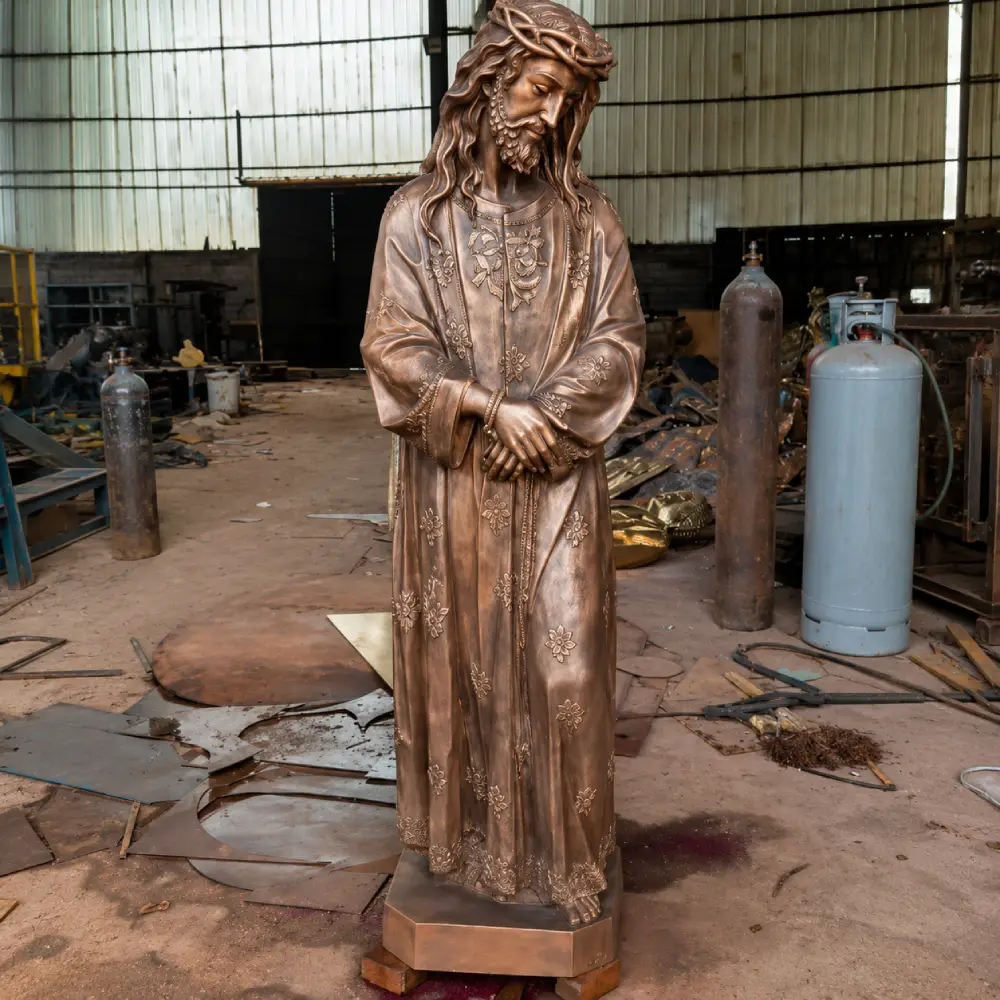
The Sacred Heart of Jesus stands facing forward, one hand raised in blessing, the other pointing to the heart. The gesture is outward, open, and directional — designed to greet people approaching head-on. This makes it most powerful at the entrance of a church, the main axis of an institutional courtyard, or the focal point of a formal garden where visitors walk toward it on a clear sightline. It does not work well tucked beside a path or placed where it cannot be seen from the front.
The Good Shepherd holds a lamb and looks slightly downward — the posture of care rather than proclamation. This is a statue that rewards proximity. It belongs at the end of a garden path, in a seminary garden, at a school entrance, or beside a retreat house door. People should encounter it, not view it from a distance. I have seen Good Shepherd statues placed in large open plazas where their quiet intimacy simply disappears. The figure is not designed to command space. It is designed to inhabit it.
The Risen Christ stands with arms raised or extended — triumph, openness, proclamation. It needs vertical space and open sight lines to work architecturally. Hospital healing gardens, memorial plazas, Easter chapel gardens, and large open courtyards are its natural environments. In enclosed or narrow spaces, the upward gesture has nowhere to go and the composition feels crowded.
The Jesus on Cross is primarily an architectural element — attached to a church facade, a cemetery entrance, or an outdoor Stations of the Cross installation — rather than a freestanding garden figure. Freestanding outdoor crucifixes require substantial engineering and are typically commissioned for specific liturgical environments.
The Jesus Bust is an indoor collector’s piece. It does not belong outdoors.
Sacred Heart of Jesus: The Statue for Formal Outdoor Spaces
For institutional commissions — churches, Catholic schools, hospital campuses, and large estate gardens with formal axes — the Sacred Heart of Jesus outdoor statue is the most commonly commissioned figure, and for good reason.
The welcoming gesture reads clearly from twenty meters. The frontality of the figure suits placement on a central axis. The theological message — divine love offered openly to anyone who approaches — aligns naturally with the entrance experience of any institution whose identity is built around welcome and service.
A parish in Virginia commissioned a life-size Sacred Heart bronze from us two years ago for their newly landscaped courtyard. The director of facilities initially considered a Good Shepherd figure because of its personal associations. After we discussed the courtyard layout — a long approach from the parking area, the statue visible from forty meters — he understood why the Sacred Heart’s outward gesture would work and the Good Shepherd’s downward gaze would not. The finished bronze has become the visual anchor of the entire campus.
For the complete guide to Sacred Heart iconography, material selection, and structural engineering for this commission, our Sacred Heart of Jesus statue custom guide covers every detail.
Good Shepherd: The Statue That Belongs at the End of a Path
The Good Shepherd does not announce itself. It waits to be found.
This is its architectural function — and the reason it works so well in garden settings where discovery, not proclamation, is the devotional intention. A well-placed Good Shepherd statue creates a moment of arrival rather than a moment of declaration. The visitor rounds a curve in the path, or passes through a garden gate, and finds the figure there — calm, present, looking down at the lamb with the same quality of attention that a good shepherd gives to the one sheep that needed finding.
For seminary gardens, monastery grounds, school prayer gardens, and private estate chapels, the Good Shepherd is the figure I recommend most consistently. It communicates spiritual mentorship and pastoral care in a way that no other Jesus statue does. Placed at the end of a path of appropriate length — thirty to fifty feet is ideal — it creates a destination that transforms an ordinary garden walk into something closer to a pilgrimage.
Our Jesus the Good Shepherd custom garden guide covers placement principles, scale considerations, and the specific iconographic details that define a well-executed commission in depth.
Risen Christ: When the Garden Needs to Declare Something
Not every outdoor space calls for intimacy. Some spaces are built for proclamation — for the kind of visual statement that can be seen from across a plaza, that creates an architectural presence large enough to orient an entire landscape around it.
For these spaces, the Risen Christ is the right figure.
Arms raised or extended, the posture communicates triumph over death, openness to humanity, and an authority that reads clearly from a significant distance. This is why Risen Christ statues appear so consistently in hospital healing gardens, where patients and families need a visual declaration of hope rather than a quiet companion. It is also why they work at memorial plazas, Easter garden installations, and the entrances of retreat centers where the first impression of arrival matters.
The engineering requirements for a Risen Christ commission differ significantly from other Jesus statue types because of the raised arms. Extended arms at life-size create substantial leverage stress — in bronze, this is managed through internal armature and careful weight distribution; in marble, extended arm poses require reinforcement and are generally not recommended for fully exposed outdoor environments. For commissions above 8 feet, wind load calculations become essential.
Our Risen Christ custom bronze guide covers these structural considerations alongside the full iconographic tradition.
What Material Survives Your Climate?
The material decision is determined by two factors: installation environment and climate. Neither factor is optional.
Cast bronze is the standard for any large outdoor jesus statue in an exposed garden or courtyard setting. Donghui Zhang, who has directed our foundry for over twenty years, is direct about this for clients in North America and Northern Europe: marble in a fully exposed outdoor environment with freeze-thaw cycles is a long-term structural risk. Water infiltrates micro-fractures in stone, expands on freezing, and widens those fractures progressively over years. In a Jesus statue, the most vulnerable elements are extended hands, tool details, and any projecting element — exactly the details that give the sculpture its expressive quality.
Bronze handles freeze-thaw cycling without structural deterioration. The natural patina that develops over years actually protects the surface rather than degrading it. A bronze Jesus garden statue installed today should look better in fifteen years than on the day of delivery.
Natural white marble is the correct choice for sheltered outdoor spaces — covered cloisters, protected garden niches, church interiors, and outdoor environments in mild climates without significant frost. Marble’s translucency and light-holding quality create a spiritual presence indoors that bronze cannot replicate. For a chapel garden in a mild climate, marble produces a quality of sacred atmosphere that is genuinely different from bronze — quieter, more luminous, more contemplative.
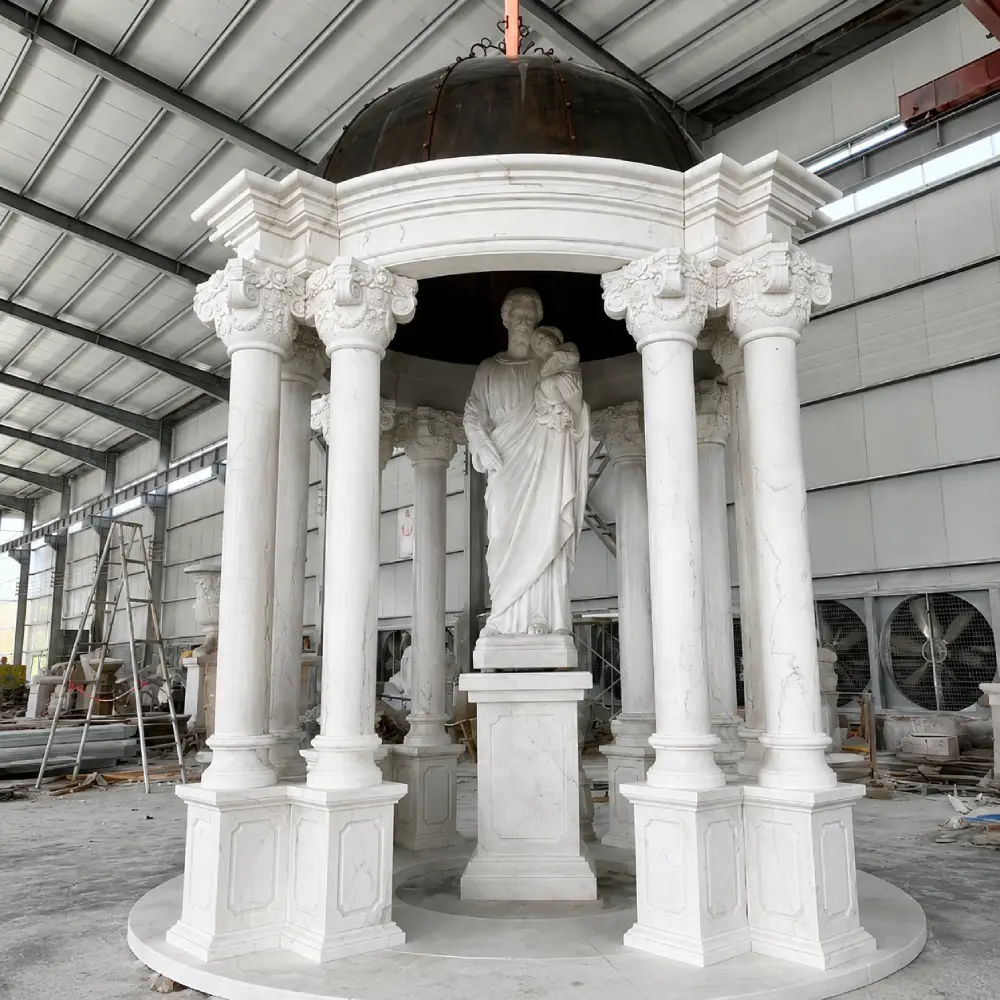
Price context, because most buyers search for it and most suppliers refuse to provide it:
| Size | Material | Price Range |
|---|---|---|
| 24–36 inches | White marble | $1,800–$4,500 |
| Life-size (5–6 ft) | White marble | $4,500–$9,000 |
| Life-size (5–6 ft) | Cast bronze | $6,000–$14,000 |
| 8 ft and above | Cast bronze | $15,000–$35,000+ |
These ranges reflect direct factory pricing. Italian-import pricing from distributors typically adds 40–70% above these figures.
Not sure whether marble or bronze suits your climate and installation setting? Send us your location and a photograph of the space — we will give you a direct recommendation.
FAQ
What does the statue of Jesus symbolize?
A Jesus statue’s specific symbolism depends on which figure is depicted. The Sacred Heart represents Christ’s love for humanity and his invitation to trust — the heart exposed, the gesture outward. The Good Shepherd represents pastoral care, the seeking of the lost, and the protection of those entrusted to his keeping. The Risen Christ represents the triumph over death and the promise of resurrection. The Crucifix represents the sacrifice of the Passion and the redemptive act at the center of Christian faith. Each statue type is a visual theology — a specific claim about who Christ is and what he does — rather than a generic religious decoration.
Is it okay to have a Jesus statue?
Yes. Statues of Jesus have been part of Christian devotional practice since the early centuries of the Church, appearing in catacombs, churches, homes, and public spaces across two millennia. They serve as visual focal points for prayer and meditation — aids to devotion rather than objects of worship. Catholic, Orthodox, Anglican, and many Protestant traditions all use sacred imagery in various forms. A statue in a garden or home functions as a daily visual reminder of faith, creating a space for reflection in ordinary environments. The objection some Christians raise comes from a misreading of the Old Testament prohibition, which forbids worshipping created objects — not creating images for devotional use.
Does the Bible say not to have statues of Jesus?
The relevant passage is Exodus 20:4-5, which prohibits making images for the purpose of worship — bowing down to them as gods. Catholic and Orthodox theology draws a clear distinction between worshipping a statue (which is forbidden) and venerating a sacred image as a focal point for prayer directed toward the person it represents (which is consistent with the broader biblical tradition). Notably, the same God who issued this command also instructed the construction of golden cherubim on the Ark of the Covenant. The Incarnation — God taking visible human form in Jesus Christ — further grounds the legitimacy of depicting Christ in material form. A statue of Jesus is not an idol; it is a representation of the God who chose to become visible.
Can bronze statues be left outside?
Yes. Cast bronze is specifically engineered for outdoor use. It resists corrosion, handles temperature fluctuation, and maintains structural integrity in rain, sun, wind, and freeze-thaw conditions that would damage other materials. The natural patina that develops on the surface over time — the characteristic green or brown coloration — is not damage but a protective oxide layer that actually slows further oxidation. Bronze statues installed outdoors a century ago are typically still structurally sound and visually intact. For garden and courtyard installations, bronze is the professional standard precisely because of this outdoor durability.
How long does bronze last outside?
A properly cast bronze statue installed outdoors has a functional lifespan measured in centuries, not decades. The Statue of Liberty, cast in 1886, remains structurally intact. Numerous Renaissance-era bronze statues installed in European public spaces four and five hundred years ago are still standing. For a garden Jesus statue, a realistic expectation is that a well-executed bronze commission will outlast its original owner by several generations with no structural intervention required. Periodic cleaning — removing bird debris and surface accumulation — and occasional waxing every few years will maintain the appearance. The bronze itself does not degrade under normal outdoor conditions.
How do you protect a bronze statue outside?
Bronze requires minimal maintenance compared to other outdoor materials. The primary care steps are: clean the surface annually with mild soap and water using a soft brush, removing debris accumulation from textured areas; apply a coat of paste wax — Renaissance Wax or carnauba wax — once every one to three years to protect the patina and maintain surface luster; avoid pressure washing, acidic cleaners, or abrasive materials that can strip the patina layer. In coastal environments with salt air exposure, more frequent waxing is recommended. The patina itself is protective — do not attempt to restore a bronze statue to its original bright finish, as this removes the natural protection the patina provides.
How much does a full-size bronze Jesus statue cost?
A life-size bronze Jesus garden statue commissioned directly from a foundry typically falls between $6,000 and $14,000 depending on figure complexity, pose, and base design. Simpler standing figures with contained arm positions fall toward the lower end; figures with extended arms, dynamic poses, or complex drapery fall toward the higher end. Statues above 8 feet begin at approximately $15,000 and can reach $35,000 or above for large-scale institutional commissions. These are factory-direct prices. Purchasing through distributors or Catholic supply retailers typically adds 40–70% above these figures. Mass-produced resin pieces range from $50–$500 and are suitable for home altars but not for institutional outdoor settings where permanence and material authority matter.
How long does it take to create a bronze Jesus statue?
A life-size bronze Jesus statue takes approximately 40–55 working days from approved clay maquette to shipping. The process includes clay modeling and client approval, wax casting, ceramic shell investment, bronze pouring, surface finishing, and patina application — each stage has minimum curing or processing time that cannot be shortened without compromising quality. International shipping to the United States or Europe adds 15–25 days depending on destination port. For institutional commissions with a specific dedication date — a church anniversary, a campus opening, a feast day ceremony — production scheduling should begin at minimum four to five months before the target date.
Commission Your Outdoor Jesus Statue
The right figure in the right space — built in the right material for your climate — will still be standing in your garden in fifty years.
Factory Direct · Quyang, China
Get an Exact Quote for Your Jesus Statue
Tell us the size, pose, and any custom requirements — we respond within 24 hours with a detailed price breakdown, no obligations.