Get in touch with Yun-Sculpture company
Venus de Milo Statue for Sale: A Marble Replica Buyer’s Guide for Garden & Home

Every venus de milo statue for sale claims to reproduce the same image — the armless goddess, the spiral torso, the drapery falling from the hips. The problem is that the image is only half of what the original does. The Venus de Milo at the Louvre is not famous because it looks a certain way from the front. It is famous because it moves — because it turns in space in a way that keeps the eye following it around the figure rather than settling on a single view. Most replicas reproduce the silhouette. Few reproduce the movement. This guide covers what material and scale decisions determine which kind of piece you are actually buying, and why the word “marble” on a product listing tells you almost nothing on its own.
Table of Contents
Table of Contents
What the Original Venus de Milo Actually Is
Most replicas gesture toward the famous silhouette without capturing what makes the original work as sculpture. Understanding the original changes how you evaluate what is on offer — and makes the material and scale decisions that follow considerably clearer.The figure is Aphrodite — the Greek goddess of beauty and desire, known as Venus in Roman tradition. She is one of six female Olympians whose commissions each bring a distinct emotional register to a space, a subject we cover in our Greek goddess statues buyer’s guide.
The Venus de Milo was carved around 100 BC, most likely in the Cyclades, and discovered in 1820 by a Greek farmer named Yorgos Kentrotas, who found fragments buried in a niche in an ancient wall on the island of Melos. The French ambassador acquired the statue, presented it to Louis XVIII, and it was donated to the Louvre, where it has stood in Salle 346 ever since. The original is 2.02 meters tall — 6 feet 7 inches — and is carved from two separate blocks of Parian marble joined at the hips, a technique typical of Cycladic sculpture of that period.
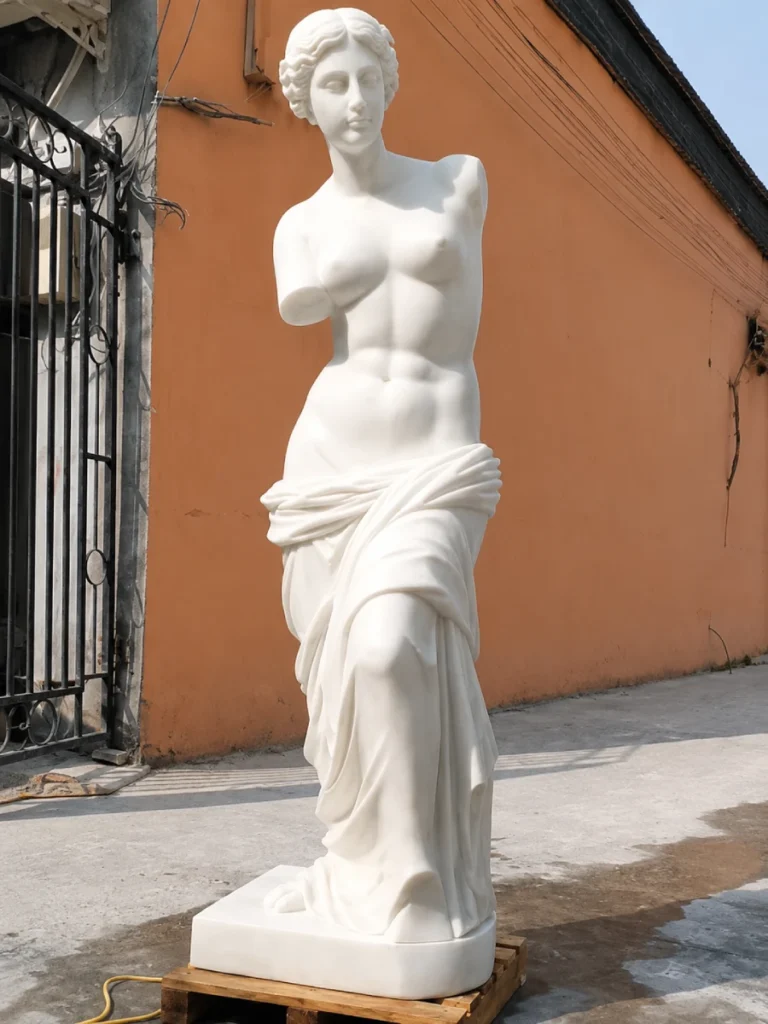
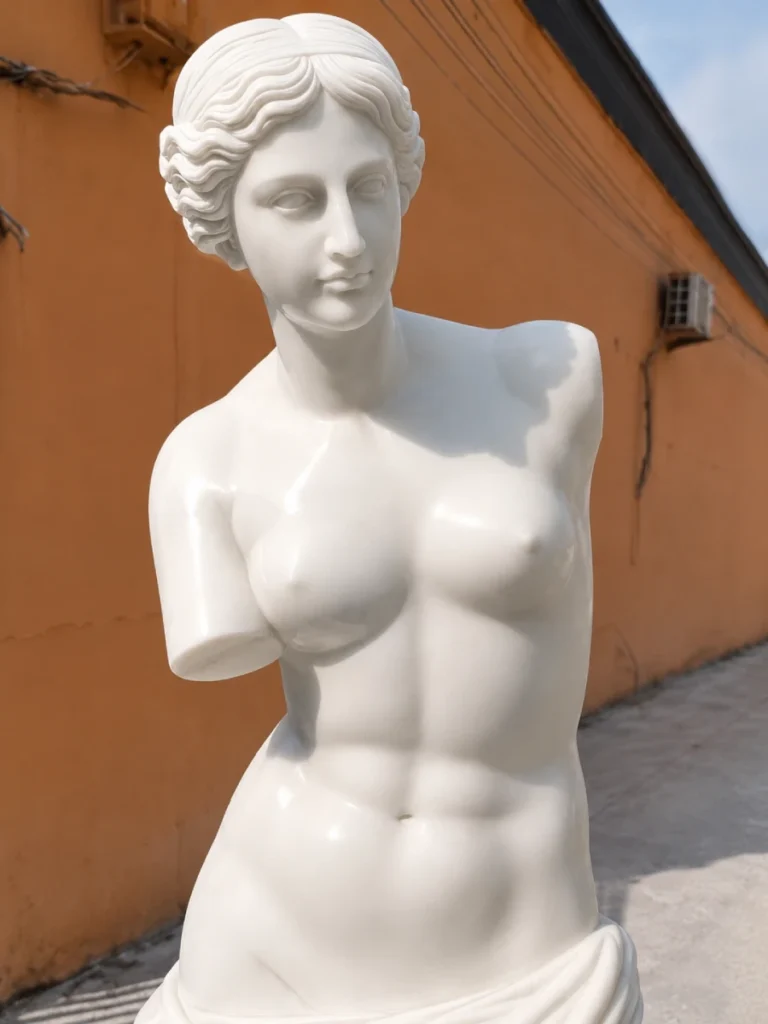
What those two blocks produced is a study in controlled movement. The torso turns in a slow spiral — hips facing one direction, shoulders turning slightly, head turning slightly further still — creating a figure that reads differently from every angle. This is the central achievement of Hellenistic sculpture: a body that inhabits three-dimensional space rather than presenting a single frontal view. Walk around the Venus at the Louvre and it is always mid-turn, always becoming a different statue. That quality — the spiral that keeps the eye moving — is exactly what is lost when a replica is too small, simplified into a frontal pose, or cast from a mold that captures the front view and produces shallow suggestion everywhere else.
The arms deserve a separate note because they are invariably the first question buyers raise. They were not lost gradually. The statue arrived in Paris already armless — damaged at or shortly before discovery — and what the hands held has never been established: an apple, a mirror, a shield, drapery. Several scholarly reconstructions exist. Most replicas omit the arms entirely, which is the correct choice. Speculative arm additions tend to freeze a composition that, without them, remains open.
1
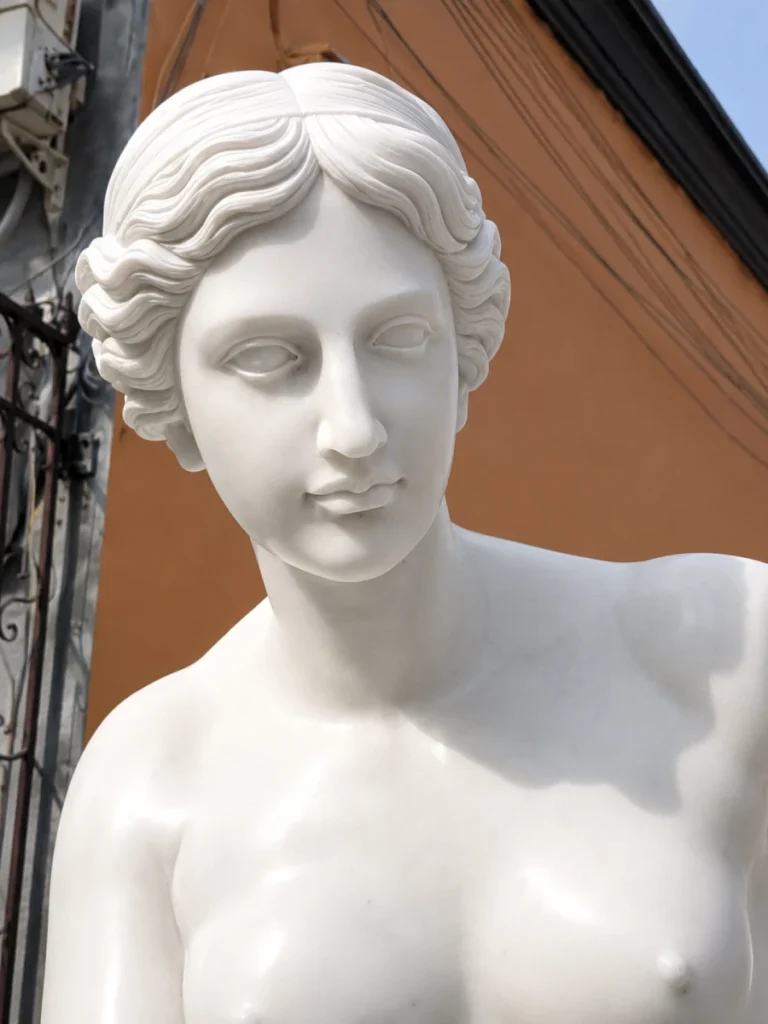
Natural White Marble — Hand Carved
Quarried stone carved by a sculptor. Light-transmitting surface (translucency). Unique per piece. The material the original was made from. Outdoor use requires protected siting in freeze-thaw climates. Price range: $2,000–$50,000+ depending on scale and complexity.
2
Bonded Marble — Marble Powder + Resin Binder
Molded from marble dust combined with resin. Surface color is correct; surface is opaque — no light transmission. Detail is consistent from the mold but not hand-refined. Suitable for indoor or sheltered display; better at smaller scales where the viewer is at distance.
3
Composite Stone / Alabaster Dust Composite
Alabaster or stone dust in a binding compound, molded. Similar optics to bonded marble — surface-dependent, no translucency. Common in the 12–24 inch size range sold by European replica vendors. Appropriate for desk and shelf display; not for outdoor permanent installation.
4
Fiberstone / Cast Stone
Stone aggregate mixed with fiberglass reinforcement. More weather-resistant than resin but visually unrelated to marble — a different material family entirely. Surface finish hand-applied after casting. Common in American garden statue retail; more accurately described as cast stone than marble.
5
Resin with Stone Finish
Polymer base with a surface coating applied to simulate stone. Lightweight, inexpensive, produced by mold. Surface coating deteriorates within 2–5 years outdoors. Correct for small-scale indoor decorative use. Not appropriate for permanent display, garden installation, or any setting where the viewer approaches at close range.
What “Marble” Actually Means in This Market
This is where most buyers go wrong, and where most vendors are deliberately unclear. The word “marble” appears in the description of nearly every Venus de Milo replica available — from a $35 Amazon figurine to a $15,000 life-size commission. It does not mean the same thing across that range, and the differences matter more than the price tag suggests.
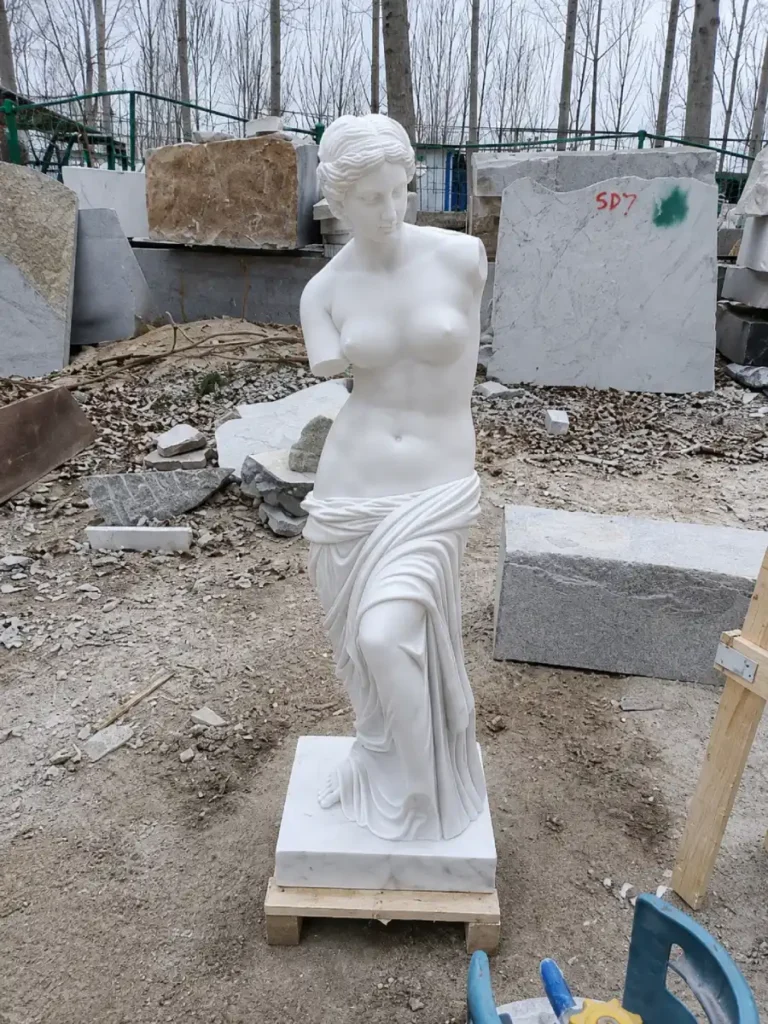
Natural white marble — quarried stone, hand-carved by a sculptor — is the material the original was made from. Light enters the surface slightly before reflecting back, giving the stone a translucency that no composite replicates. The carving is unique: no two hand-carved pieces are identical, and the refinement of surface detail — the way drapery folds resolve at close range, the precise modeling of the torso’s planes — is the work of individual hands over weeks, not of a mold and a pour. Our workshop in Quyang produces natural marble Venus de Milo replicas from 80 centimeters to 300 centimeters, with production running 30 to 60 days depending on scale and the complexity of the surface work requested.
Bonded marble combines marble powder with a resin binder, poured into molds. The surface color is approximately correct, but the material is opaque — light reflects from the surface rather than entering it. Mold production means detail is consistent but not hand-refined. For indoor display at smaller scales, bonded marble is a defensible choice. For life-size or larger commissions where the viewer approaches at close range, the difference from natural stone becomes visible immediately.
Composite stone, alabaster dust composites, fiberstone, and resin with stone finish occupy the remaining tiers — each step further from the material quality of the original, each step more dependent on surface coating for its appearance. A resin piece with marble finish costs $30 to $150 and looks plausible in a product photograph. At three feet, it looks like what it is.
Choosing the Right Scale
The original stands 2.02 meters. At that height, the spiral composition fully develops — the twist from hip to shoulder to head covers enough vertical distance to read as movement rather than as a slight lean. The drapery has room to fall. The torso has room to turn. The figure occupies its space with the authority of a body in motion.
Scale down significantly and the composition compresses. At 80 centimeters, the spiral is still present but simplified — you read armless goddess, not a body mid-turn. At 40 centimeters, the torsion and the drapery folds both reduce to surface suggestion. The figure becomes an icon: recognizable, evocative, but no longer doing what the original does in three dimensions.
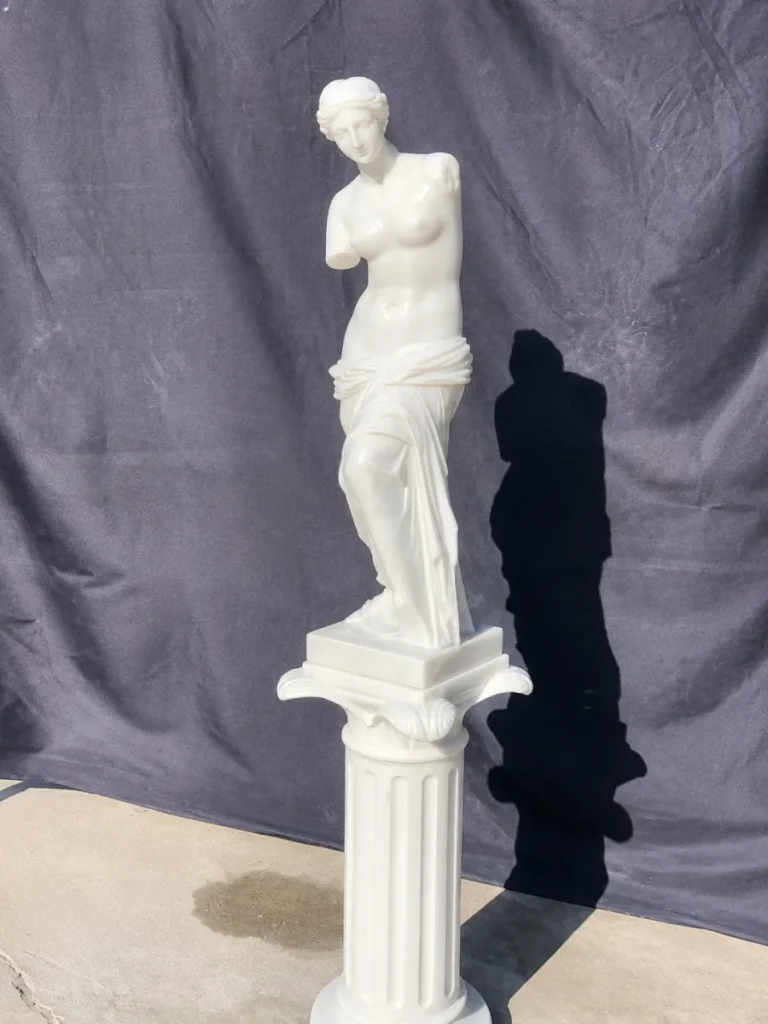
The practical implication: a figure that will be viewed from three meters or more needs to be at or near life-size for the composition to fully resolve. A figure on a library shelf or a mantelpiece operates under different conditions — at close range, even an 80-centimeter piece can carry significant surface detail, and the compression of the spiral matters less when the viewer’s eye is at arm’s length from the stone.
| Height | Setting | Viewing Distance | What the Composition Does |
|---|---|---|---|
| 40–60 cm | Mantelpiece, bookshelf, desk display | 0.5–1.5 m | Silhouette reads clearly; spiral simplifies to a surface lean |
| 80–100 cm | Side table, terrace accent, alcove | 1–3 m | Composition readable; drapery detail present and legible |
| 120–150 cm | Garden niche, covered loggia, corridor | 2–4 m | Full torsion visible; drapery folds resolved from multiple angles |
| ~200 cm (life-size) | Entrance hall, garden focal point, courtyard | 3–6 m | Original spiral composition fully realized; spatial presence complete |
| 250–300 cm | Estate garden, plaza, water feature surround | 5 m+ | Monumental authority; requires engineered base and pedestal |
Where to Place a Venus de Milo Replica
The original has spent two centuries in a controlled interior environment: consistent temperature, diffuse artificial light, no moisture exposure. She has never weathered. This is worth holding in mind when choosing placement for a replica — not because garden installation is wrong, but because the siting decisions for outdoor placement matter more than most buyers anticipate.
Indoors, natural white marble performs at its best. The slight translucency of well-quarried marble under gallery lighting or strong natural light — the way the surface seems to glow rather than simply reflect — is the quality that gives the original its particular presence in Salle 346. An entrance hall with high windows, a gallery-style corridor, a library with a skylight, a covered loggia that receives morning light from one direction: these are the settings where a hand-carved marble Venus performs as the original intends. The figure does not need supplementary lighting to work in these environments. It needs to be positioned where light crosses it at an angle, revealing the surface modeling.
For garden placement, position matters more than material. A Venus de Milo placed against a dark hedge or garden wall, elevated on a stone or marble pedestal, with a clear primary viewing axis: this works. The same figure at grade level in open lawn, surrounded by planting that grows to compete with it: this does not. The figure needs height, contrast — white marble against dark foliage reads cleanly at distance — and a viewing distance appropriate to its scale. Three to four times the figure’s height is a reasonable minimum for the spiral composition to resolve fully.
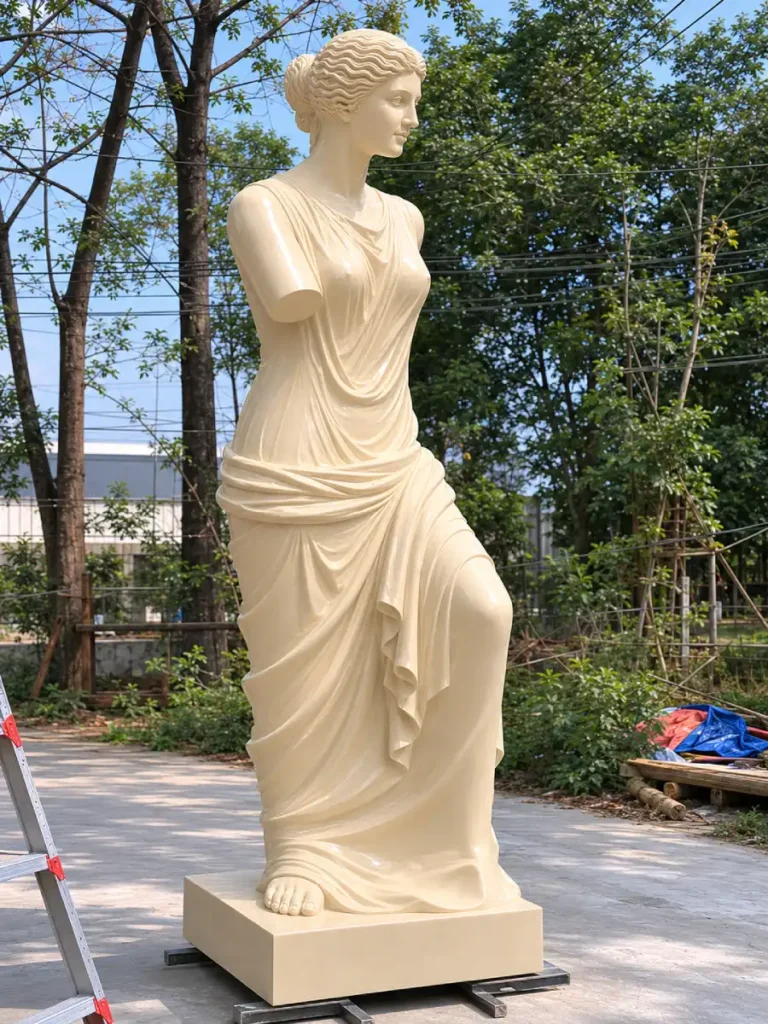
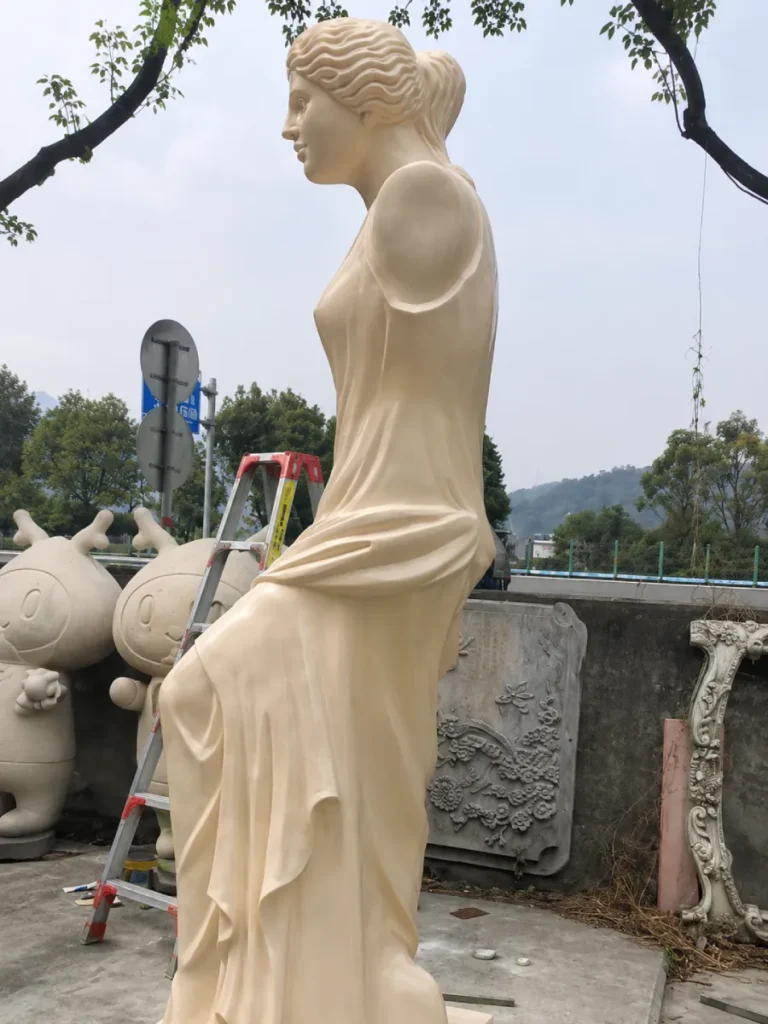
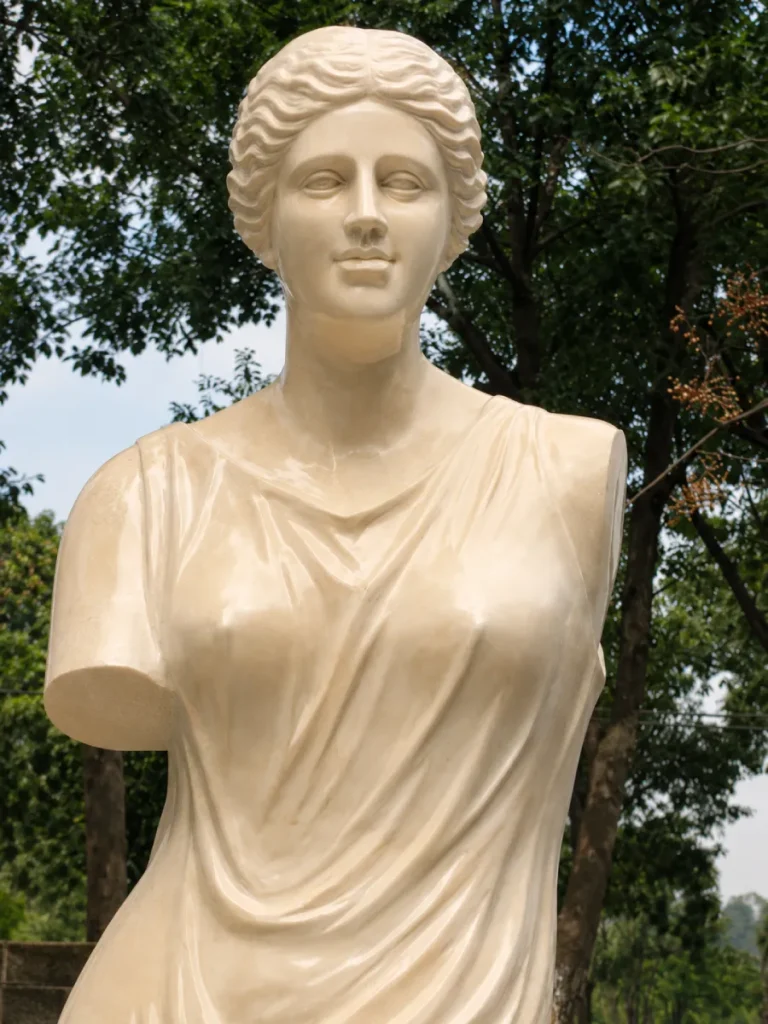
For climates with genuine freeze-thaw cycling, natural marble outdoors requires a protected position — sheltered from direct precipitation where possible, on a base that drains rather than retains moisture, ideally a covered niche or south-facing position that stays relatively dry. In Mediterranean climates and most of the American South and West, outdoor natural marble installation is unproblematic. If your climate is uncertain, raise it at inquiry — the solution is usually a siting adjustment rather than a material change.
Frequently Asked Questions
Why does the Venus de Milo have no arms?
The arms were lost before the statue arrived in France, most likely damaged at or shortly before its discovery on the island of Melos in 1820 — they were not worn away gradually. What the hands held has never been established. Several scholarly reconstructions propose an apple, a mirror, a spear, or drapery, but none has been accepted as definitive. Most modern replicas omit the arms entirely, which is the correct choice: the open composition of the armless figure is more successful sculpturally than any speculative reconstruction has managed to be.
What does the Venus de Milo symbolize?
The statue is generally identified as Aphrodite — Venus in the Roman tradition — based on her partial nudity, her physical idealization, and the context of her discovery on Melos, where Aphrodite was venerated. She symbolizes the Hellenistic ideal of female beauty: not static or frontal, but alive in space, caught mid-turn, simultaneously present and withdrawing. For modern collectors and institutions, she also represents the Western classical tradition at its most formally refined — the point where Greek sculptural ambition reached its highest development before the Roman period.
Where is the original Venus de Milo statue?
The original has been in the Louvre in Paris since 1821, displayed in Salle 346 in the Denon Wing. It was discovered in 1820 on the Greek island of Melos, acquired by the French ambassador, and presented to Louis XVIII, who donated it to the Louvre. The statue has remained there continuously except for removal during the Second World War for safekeeping. It is not on loan and cannot be seen anywhere other than the Louvre.
How much does a Venus de Milo replica cost?
Price depends on material and scale. Resin pieces with stone finish range from $30 to $300 for small decorative sizes. Bonded marble or composite stone replicas at 40–80 cm typically run $200 to $1,500. Natural hand-carved white marble replicas — the same material as the original — start at approximately $1,500 for 80 cm pieces and reach $6,000 or more for life-size and larger commissions. Production time for natural marble is 30 to 60 days depending on scale. Shipping is quoted separately.
Why is Venus de Milo so famous?
The Venus de Milo became famous almost immediately after arriving in Paris in 1821, presented as a recovered masterpiece at a moment when European culture was intensely focused on the classical ideal. Its particular fame rests on three things: the mystery of the missing arms, which creates an open composition and an unresolvable question; the quality of the carving, which achieves the Hellenistic goal of a figure fully alive in three-dimensional space; and the cultural timing of its arrival in Paris, when the ideal of feminine beauty it represented was at its most resonant. Two centuries of reproduction have made the silhouette one of the most universally recognized images in the world.
Factory Direct · Quyang, China
Commission a Natural Marble Venus de Milo
Hand-carved in white marble, 80 cm to 300 cm. Every scale resolved to the original’s spiral composition. Indoor and garden specifications available.