Get in touch with Yun-Sculpture company
Athena Bust Statue: Bronze & Marble for Library, Office & Academic Spaces

A foundry director’s guide to Athena bust statues — historical prototypes, iconographic attributes, material selection, and size guidance for libraries, offices, law firms, and academic institutions.
Table of Contents
Table of Contents
Why Athena for Libraries, Offices, and Academic Spaces
Of all the deities in the Greek and Roman pantheon, Athena — Minerva in the Roman tradition — has the strongest and most enduring institutional association with libraries, universities, law courts, and spaces dedicated to intellectual work. This is not coincidental. Her domain encompasses wisdom, strategic intelligence, the practical arts of civilization, and the disciplined application of knowledge to real-world problems — precisely the values that libraries, universities, law firms, and research institutions exist to embody.
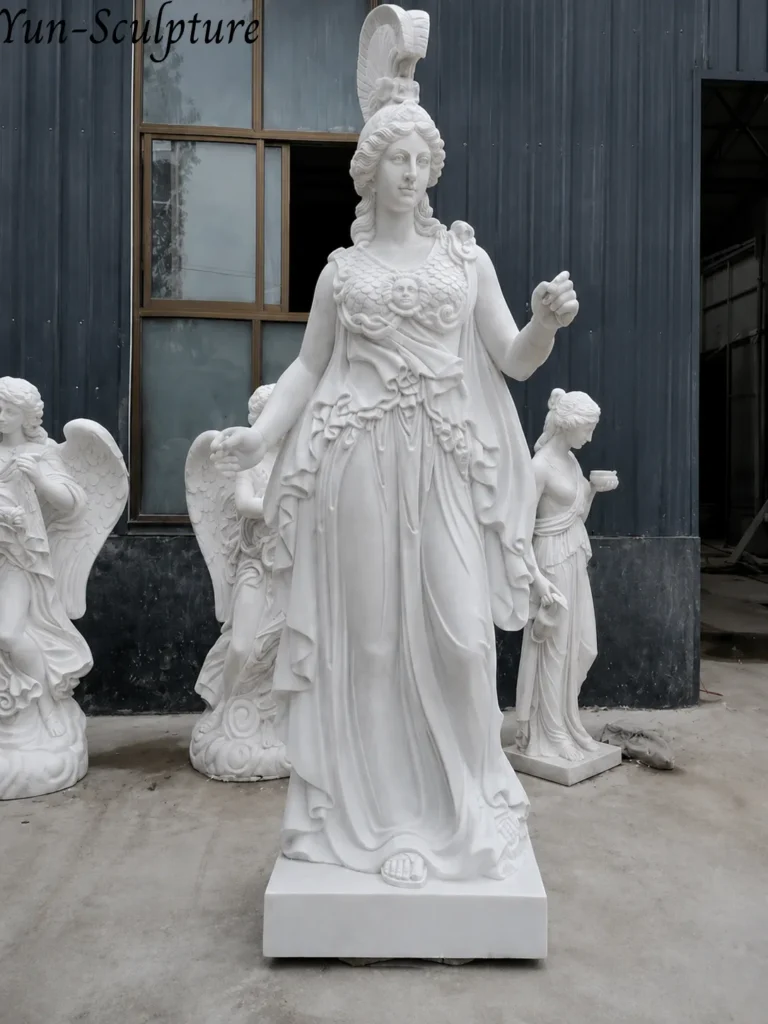
The evidence is in the buildings themselves. The Library of Congress Thomas Jefferson Building features a Minerva mosaic at the entrance to the Main Reading Room — one of the most prominent decorative programs in American institutional architecture. Columbia University’s Low Library has a white marble Pallas Athena bust in its entry hall, modeled on the Minerve du Collier in the Louvre. The Athena Parthenos was the patron deity of Athens’s civic institutions for nearly a millennium. The pattern is consistent across cultures, centuries, and continents: when an institution wants to declare its commitment to knowledge and disciplined intelligence, it turns to Athena.
For contemporary buyers commissioning a bust statue for a library, office, law firm, or academic building, this institutional tradition provides both the justification and the visual vocabulary for the commission. An Athena bust statue in bronze or marble is not simply decoration — it is a deliberate alignment with a 2,500-year tradition of placing wisdom at the center of institutional identity.
The Three Principal Athena Bust Prototypes
Most Athena bust statues in the contemporary market derive from one of three principal ancient prototypes. Understanding which prototype a given piece references tells you a great deal about its visual character, the institutional context it best suits, and the quality of the sculptor’s historical knowledge.
The Athena Velletri Type
The Athena Velletri is a Roman marble copy (1st century BCE) of a lost Greek bronze original attributed to Kresilas, dated to approximately 430 BCE. It is characterized by a full Corinthian helmet with elaborate relief decoration — griffins on the sides of the crest, an owl at the front, and a serpent coiling around the crest — combined with an oval, serene face whose sharpness of brow ridge and precision of facial structure closely parallel the Pericles bust also attributed to Kresilas. The original is in the Glyptothek in Munich; the type has been widely copied.
The Velletri type is the most architecturally formal of the three principal prototypes — its elaborate helmet decoration makes it visually complex and best suited to spaces with sufficient wall or shelf space to read the detail. For large-format library reading rooms, institutional reception areas, and formal office settings where the piece will be viewed from a distance of several feet or more, the Velletri type carries the strongest visual authority.
The Athena Lemnia Type
The Athena Lemnia is a reconstruction of a lost bronze original by Pheidias, commissioned by Athenian colonists for dedication on the Acropolis around 450 BCE. It was described by ancient sources as the most beautiful of Pheidias’s Athena statues — distinguished from his other Athena figures by the absence of a helmet (she is depicted holding it at her side rather than wearing it) and by an expression of unusual gentleness and meditative calm. The reconstruction in the Städel Museum Frankfurt, assembled from fragmentary ancient copies, shows a face of extraordinary refinement.
For buyers seeking an Athena bust that projects intellectual contemplation rather than martial authority — more appropriate for a private library, a university seminar room, or a medical or research institution than for a courthouse or law firm — the Lemnia type is the most suitable choice. Its helmetless variant reads as Athena the thinker rather than Athena the warrior.
The Minerve du Collier Type
The Minerve du Collier (Minerva of the Necklace) is a Roman marble bust in the Louvre, dated to the 1st–2nd century CE, depicting Athena/Minerva with a full helmet and a distinctive necklace — an unusual attribute that gives the piece its name. It is among the most elegant surviving Athena busts in terms of proportion and surface refinement, and is the specific prototype referenced in the Columbia University Low Library installation.
For buyers seeking a bust that balances formal authority with aesthetic refinement — appropriate for law firm reception areas, private libraries, university donor spaces, and high-end office installations — the Minerve du Collier type is consistently the most requested at Yun Sculpture’s foundry. Its combination of helmeted authority and decorative elegance suits spaces where the piece will be encountered at close range and where quality of surface finish is as important as iconographic weight.
Iconographic Attributes: What to Look For
An Athena bust statue is identified by a consistent set of iconographic attributes, all of which communicate specific aspects of her domain and character. Understanding these attributes allows buyers to verify the historical accuracy of a piece they are considering and to specify exactly which attributes they want in a custom commission.
| Attribute | What It Signifies | Presence in Bust Format |
|---|---|---|
| Corinthian helmet | Military strategy and the defense of civilization | Always present in helmeted types; absent in Lemnia type |
| Aegis | The divine breastplate bearing the Gorgon’s head — protective power | Sometimes visible at the base of the bust |
| Owl | Wisdom and night vision — the ability to see what others cannot | Occasionally carved on helmet or pedestal |
| Serpent | Protective guardian of Athens and the Acropolis | Sometimes shown coiling on helmet crest |
| Spear | Active defense of wisdom and just order | Not typically shown in bust format |
| Necklace | Decorative attribute specific to the Minerve du Collier type | Present only in that specific type |
| Gorgoneion | The face of Medusa on the aegis — apotropaic protective symbol | Visible on aegis when aegis is depicted |
For institutional commissions where the piece will be installed in a public or semi-public space, we recommend specifying the helmet variant — either Velletri or Minerve du Collier type — as the helmeted Athena carries stronger visual authority at distance and is more immediately recognizable as Athena rather than a generic female bust. For private library and office installations where close-range viewing is expected, the Lemnia helmetless type is a valid and historically prestigious choice.
Our full Athena statue guide covers her complete iconographic tradition in both bust and full-figure format, with reference images for each major type.
Bronze vs. Marble: Which Material for an Athena Bust
The material choice for an Athena bust statue is consequential in ways that differ slightly from full-figure commissions. Because a bust is viewed primarily at close range — on a desk, a bookshelf, a column pedestal, or a wall-mounted bracket — surface quality and tonal character matter more than they do for a garden figure viewed from fifteen feet.
| Silicon Bronze | White Marble (Sichuan) | White Carrara Marble | |
|---|---|---|---|
| Surface character | Warm, brown or black patina; fine casting detail | Cool, luminous, smooth; slight translucency | Premium luminosity; Michelangelo’s stone |
| Detail resolution | Extremely high — lost-wax captures sub-millimeter detail | High — hand-carving achieves excellent facial detail | High — same carving standard as Sichuan |
| Institutional association | Roman bronze portrait tradition; authority | Greek marble tradition; classical scholarship | Neoclassical European institutional tradition |
| Best setting | Law firms, corporate offices, boardrooms | Libraries, university reading rooms, private studies | Premium academic institutions, donor spaces |
| Indoor/outdoor | Both — bronze suits either | Indoor only | Indoor only |
| Starting price (desk size) | From $1,200 | From $1,600 | From $2,800 |
| Starting price (life-size bust) | From $3,800 | From $4,200 | From $7,500 |
For the majority of library and academic institutional commissions, white marble — either Sichuan or Carrara depending on budget — is the more historically resonant choice. The Columbia University Pallas Athena, the Library of Congress Minerva, and virtually every significant institutional Athena installation from the Neoclassical period onward uses white marble. The visual logic is direct: marble’s cool, luminous whiteness aligns with the clarity and light associated with wisdom in the Western tradition.
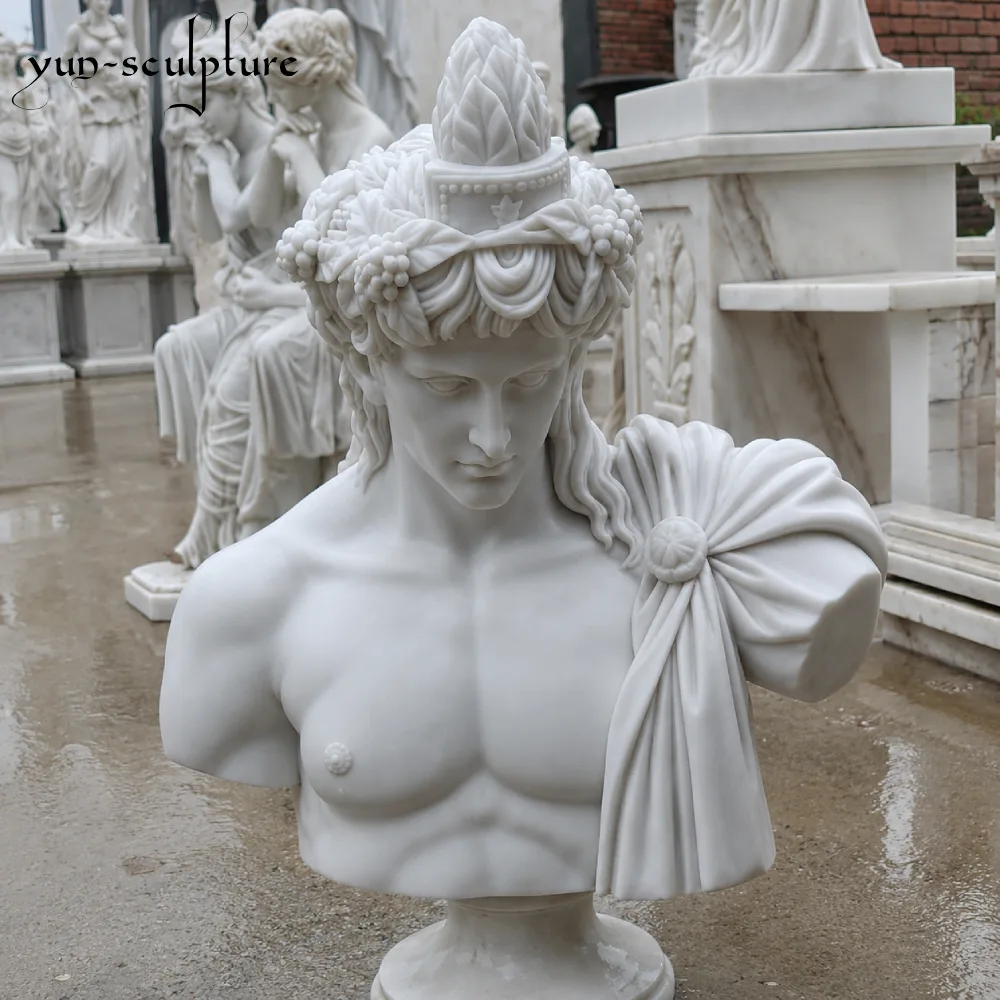
Bronze Athena busts are the correct choice for law firms, corporate settings, and spaces where the Roman portrait tradition is more appropriate than the Greek sculptural tradition — where authority and institutional weight take precedence over classical refinement. A bronze Athena in a dark-paneled law library reads very differently from a white marble Athena in a university reading room, and both are historically valid choices for their respective environments.
Size Selection Guide
Athena bust statues are produced in four practical size ranges, each suited to different display contexts and viewing distances. The sizes below reflect standard production dimensions at Yun Sculpture’s Quyang foundry; custom dimensions are available on request.
| Size Category | Height (bust only) | Total Height (with pedestal) | Best Display Context | Bronze | Marble |
|---|---|---|---|---|---|
| Desk / Bookshelf | 8–12 in (20–30 cm) | 14–20 in (35–50 cm) | Desk, bookshelf, console | From $1,200 | From $1,600 |
| Half Life-Size | 14–18 in (35–45 cm) | 22–30 in (55–75 cm) | Credenza, mantelpiece, side table | From $1,800 | From $2,400 |
| Life-Size | 20–26 in (50–65 cm) | 32–44 in (80–110 cm) | Column pedestal, alcove, reception desk | From $3,800 | From $4,200 |
| Monumental | 28 in+ (70 cm+) | 48 in+ (120 cm+) | Entrance hall, lobby, institutional installation | From $6,500 | From $7,500 |
The most common mistake in Athena bust commissioning is undersizing. A desk-size bust at 8–12 inches reads well on a personal desk or bookshelf but disappears on a credenza, a reception counter, or an institutional reading room shelf. For spaces where the bust will be viewed from across a room — law firm reception areas, university reading rooms, library reference sections — a life-size or larger bust is almost always necessary to achieve the intended visual presence.
For column pedestal installations, the standard proportion is a bust height approximately equal to one-third of the total installation height (bust plus pedestal). A life-size bust at 24 inches on a 48-inch pedestal produces a total installation height of 72 inches — appropriate for a formal reception area or institutional lobby. A half-life-size bust at 16 inches on a 36-inch pedestal at 52 inches total is more suitable for office corridors and seminar room alcoves.
Placement Recommendations by Space Type
| Space Type | Recommended Size | Recommended Material | Recommended Type | Placement |
|---|---|---|---|---|
| Private home library | Desk to half life-size | White marble | Lemnia (helmetless) or Minerve du Collier | Bookshelf, mantelpiece, or desk |
| University reading room | Life-size to monumental | White Carrara or Sichuan marble | Minerve du Collier or Velletri | Column pedestal in alcove or at room terminus |
| Law firm reception | Life-size | Silicon bronze | Velletri (helmeted) | Reception desk surround or column pedestal |
| Corporate boardroom | Half life-size to life-size | Silicon bronze | Minerve du Collier | Credenza, side console, or alcove |
| Home office / executive office | Desk to half life-size | Bronze or marble | Any type | Desk, bookshelf behind desk, or windowsill |
| Academic department entrance | Life-size | White marble | Velletri or Minerve du Collier | Column pedestal flanking entrance |
| Public library | Monumental | White marble | Velletri | Freestanding column pedestal in reading area |
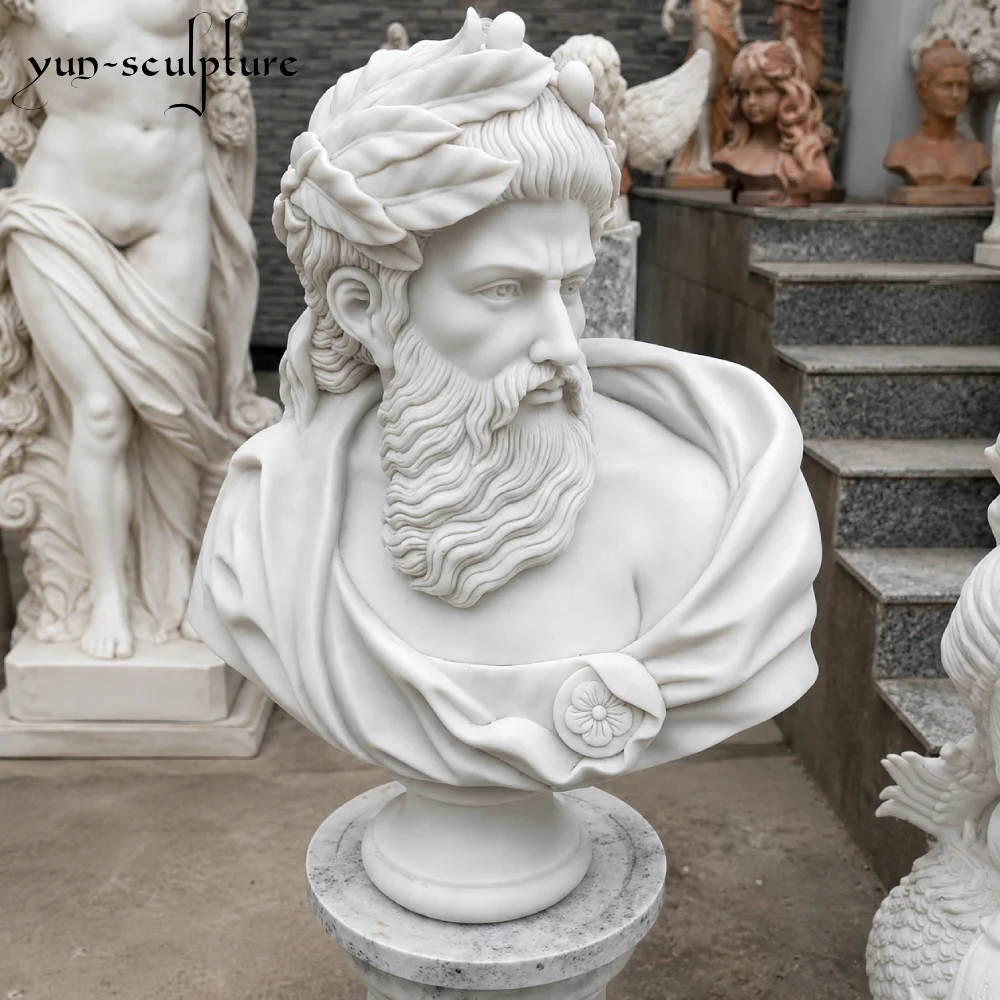
For all indoor installations, the pedestal material should be chosen to complement rather than compete with the bust. White marble busts pair best with black granite, dark verde antique marble, or white marble pedestals — avoid warm-toned stones that reduce the contrast between bust and base. Bronze busts pair well with black granite, dark marble, or polished dark wood pedestals that allow the warm tonal range of the bronze to read against a neutral ground.
For our full range of Greek god statues in bust and full-figure format, including Zeus, Apollo, and Poseidon busts that complement an Athena installation, see our complete Greek mythology collection. For custom portrait busts of specific individuals — for institutional honor walls, retirement gifts, or memorial commissions — our personalized bust guide covers the commission process in detail. A broader overview of the complete Greek mythology statues collection is available for buyers working with multiple deities.
Frequently Asked Questions
What does the bust of Athena represent? +
An Athena bust statue represents wisdom, strategic intelligence, the practical arts of civilization, and the disciplined application of knowledge — the core domains of the Greek goddess Athena (Minerva in the Roman tradition). In institutional contexts, an Athena bust signals a deliberate alignment with the 2,500-year tradition of placing wisdom and intellectual authority at the center of civic and academic life. Libraries, universities, law courts, and research institutions have used Athena imagery continuously from ancient Athens through the present — the Library of Congress Minerva mosaic and the Columbia University Pallas Athena bust being among the most prominent American examples.
What happened to the original statue of Athena? +
The most famous original statue of Athena — the Athena Parthenos by Pheidias, a forty-foot chryselephantine figure that stood inside the Parthenon from approximately 438 BCE — was removed from Athens in late antiquity and has not survived. No ancient chryselephantine statue has survived intact anywhere in the world. What survives of the Athena Parthenos is known through ancient descriptions, coins, and several small-scale marble copies, of which the best is the Varvakeion Athena in the National Archaeological Museum, Athens (2nd century CE).
What is the colossal bust of Athena? +
The term colossal bust of Athena most commonly refers to large-format ancient marble busts derived from the Athena Velletri type — Roman copies of a Greek bronze original attributed to Kresilas, dated to approximately 430 BCE. The Velletri type is characterized by an elaborate Corinthian helmet with griffins, serpent, and owls, and a face of formal severity that conveys institutional authority. In contemporary production, colossal Athena busts (28 inches or taller in bust height, typically mounted on column pedestals for a total installation height of 5–7 feet) are produced for institutional lobbies, university entrance halls, and public library reading rooms.
What is Athena wearing on her chest? +
Athena is typically depicted wearing the aegis on her chest — a divine breastplate or cloak bearing the head of Medusa (the Gorgoneion) at its center. The aegis is fringed with serpents and functions as an apotropaic device: its terrifying appearance protects Athena and, by extension, the city and institutions under her patronage. In bust format, the aegis is sometimes visible at the base of the bust where the figure is cut, and sometimes implied rather than fully depicted. The Gorgoneion on the aegis is one of the most reliable secondary identifying attributes of Athena in sculptural contexts where her helmet or spear is not present.
Which animal is sacred to Athena? +
The owl is Athena’s primary sacred animal — specifically the little owl (Athena noctua), which appears on Athenian coins alongside Athena’s helmeted portrait from the 5th century BCE onward. The owl’s associations with night vision and the ability to see clearly in darkness made it a natural symbol of wisdom and penetrating intelligence. The serpent is Athena’s secondary sacred animal — the guardian snake Erichthonius who lived in the Parthenon. In Athena bust sculpture, owls appear most commonly carved on the helmet in the Velletri type or on the pedestal base as an identifying attribute.
What size Athena bust statue is best for a desk or bookshelf? +
For desk display, an Athena bust statue in the 8–12 inch range (bust height, excluding pedestal) is the most practical size — large enough to read clearly on a standard desk or bookshelf without dominating the space. For a credenza, console, or mantelpiece, a half life-size bust at 14–18 inches provides more visual presence appropriate for the larger surface. For column pedestal installations in office alcoves or reception areas, a life-size bust at 20–26 inches is standard. The most common sizing mistake is commissioning a desk-size bust for a space that requires a life-size piece — a 10-inch bust disappears on a reception counter or library reading room shelf viewed from across the room.
Commission an Athena Bust Statue from Quyang
Velletri, Lemnia, or Minerve du Collier — bronze or marble, desk size to monumental. Share your space dimensions and intended placement and we’ll respond within 2 business days with a detailed factory-direct quote.
Commission an Athena Bust Statue from Quyang
Velletri, Lemnia, or Minerve du Collier — bronze or marble, desk size to monumental. Share your space dimensions and intended placement and we’ll respond within 2 business days with a detailed factory-direct quote.