Get in touch with Yun-Sculpture company
Pregnant Mother Mary Statue: The Complete Art History, Theology & Custom Commission Guide to the Expectant Madonna

The first time a pilgrim encounters a pregnant mother mary statue, the reaction is rarely casual.
There is usually silence. Then reflection. Then something deeper—recognition.
Because this image does not present Mary as Queen of Heaven or Sorrowful Mother. It presents her in the most fragile and sacred moment of human history: the quiet months before Bethlehem, when the Incarnation was still hidden beneath her heart.
As religious art historians, we refer to this form as the expectant mary statue, or more precisely, Maria Gravida—Mary in the state of pregnancy. It is one of the most ancient Marian traditions in Christian visual culture, yet it remains one of the least understood.
Many collectors, clergy, and institutions assume that a statue of pregnant virgin mary is a modern artistic invention.
It is not.

The truth is far more profound.
For over fifteen centuries, artists across Byzantium, Germany, Italy, Spain, and Portugal carved, painted, and cast the image of the pregnant blessed virgin mary statue as a theological declaration: God truly entered human history through the womb of a woman.
This pillar page is not simply about sculpture.
It is about restoring a forgotten tradition, understanding its theology, and guiding those who feel called to commission a statue of pregnant madonna that speaks with historical authority and spiritual depth.
Table of Contents
Table of Contents
The Statue Most Art History Books Ignore: An Introduction to Maria Gravida
The Reality
In academic art history, the term Maria Gravida refers to representations of the Virgin Mary visibly pregnant with Christ.
The tradition stretches back more than 1,500 years, beginning in early Byzantine Christianity and continuing through medieval and Renaissance Europe.
Yet most modern art history textbooks barely mention it.
The reason is not the absence of historical evidence.
The reason is suppression.
After the Council of Trent in the 16th century, religious imagery across Catholic Europe was subjected to strict theological and visual regulations. The Church sought clarity, emotional restraint, and doctrinal precision in sacred art. Images considered ambiguous, overly symbolic, or potentially misunderstood were gradually removed from mainstream devotional practice.
The pregnant Virgin fell into this category.
Not because the theology was incorrect.
But because the image was considered too intimate, too human, and too vulnerable for widespread liturgical display.
In many regions, Maria Gravida statues disappeared from churches, replaced by more standardized Marian forms such as the Immaculate Conception or Madonna and Child.
Still, the tradition never completely died.
In isolated monasteries, rural chapels, and Iberian devotional centers, the statue of pregnant virgin mary quietly survived, preserved by communities who understood its theological meaning: the Incarnation begins in hiddenness, not in glory.
In the 20th and 21st centuries, this ancient image began to re-emerge.
Two forces contributed to this revival.
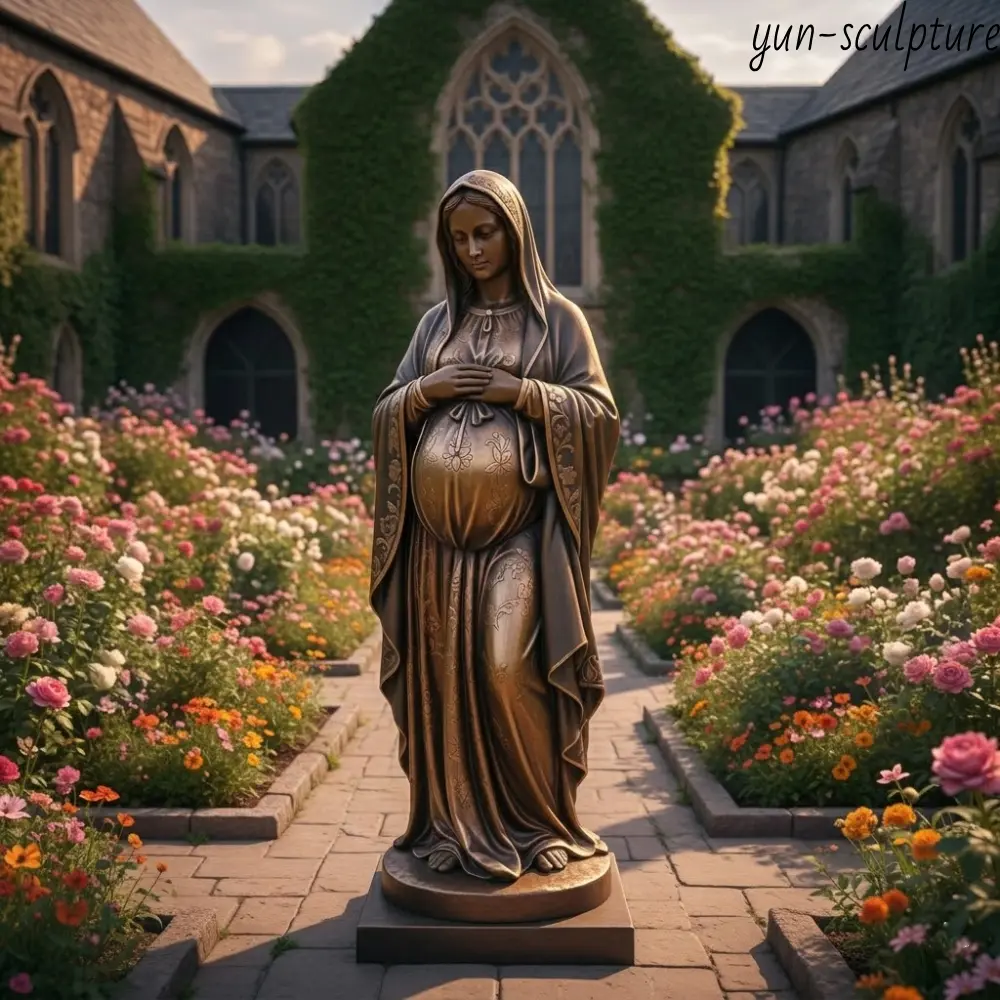
First, the global Pro-Life movement rediscovered Maria Gravida as a powerful visual affirmation of the sanctity of unborn life.
Second, Advent liturgical renewal encouraged a return to earlier Marian imagery that emphasizes waiting, expectation, and the mystery of Christ’s coming.
Today, the pregnant blessed virgin mary statue is no longer seen as unusual.
It is increasingly recognized as one of the most spiritually resonant Marian forms in contemporary Catholic art.
It reminds believers that before Christmas, before the Nativity, before the Cross, there was a quiet moment of waiting.
A moment when God was carried in silence.
1,500 Years of Maria Gravida
The Byzantine Origin — Theotokos Platytera (6th Century)
The earliest visual foundation of Maria Gravida appears in Byzantine iconography.
The image is known as Theotokos Platytera, meaning She Who Is More Spacious Than the Heavens.
It typically appears in the apse of Eastern Christian churches, positioned above the altar.
Mary stands in the Orans posture, arms raised in prayer, facing the faithful.
At the center of her body, within a circular medallion, appears the Christ Child.
This circular halo is not decorative.
It represents the womb.
The theological message is unmistakable: Mary is the living tabernacle, the vessel of the Incarnation.
The universe cannot contain God, yet He is contained within her.
This is the earliest visual language of the expectant mary statue.
Although rendered in mosaic and icon rather than sculpture, the concept is identical to later Western pregnant mother mary statue forms—Mary presented not as mother holding a child, but as mother carrying God within her.
The emphasis is theological, not emotional.
Mary is not portrayed as fragile.
She is portrayed as cosmic.
A sacred space where heaven and earth meet.
This Byzantine foundation shaped every Maria Gravida representation that followed.
The Medieval German Tradition — Aehrenkleid Madonna (15th Century)
By the 15th century, Maria Gravida took on a new symbolic language in Germany and Central Europe.
The Aehrenkleid Madonna, or Madonna of the Wheat Garment, depicted Mary wearing a midnight blue robe covered with golden wheat stalks.
The wheat symbolized the Eucharist—Christ as the Bread of Life growing within her.
The message was both agricultural and theological.
Just as wheat grows in hidden fields before harvest, Christ grows in Mary’s womb before His revelation to the world.
Among these works emerged one of the most extraordinary forms in Marian sculpture: the Öffnungsmadonna, or Opening Madonna.
These were wooden statues constructed with hinged doors on Mary’s abdomen.
When opened, the interior revealed sacred imagery—Christ, the Trinity, or scenes of salvation history.
It was not theatrical.
It was theological engineering.
The exterior represented the visible world.
The interior revealed the divine mystery hidden within Mary.
This level of structural and symbolic complexity required exceptional craftsmanship.
Today, very few workshops in the world possess the engineering and sculptural capability to recreate such a structure with modern durability standards. Yun Sculpture’s structural team has the technical capacity to reproduce a historically accurate statue of pregnant virgin mary with concealed hinges, internal support systems, and museum-grade structural stability while maintaining the sacred aesthetic of medieval craftsmanship.
It is a rare intersection of art history and engineering precision.
And it proves that Maria Gravida was never a marginal tradition—it was one of the most intellectually sophisticated forms of Marian sculpture in medieval Europe.
The Italian Renaissance Peak — Madonna del Parto (14th–15th Century)
In Italy, Maria Gravida reached its artistic peak through one of the most revered Renaissance works: Madonna del Parto.
Painted by Piero della Francesca in Tuscany, the fresco presents Mary standing calmly, one hand resting on her abdomen, the other gently opening her garment.
Two angels pull back a tent-like curtain behind her, framing the moment like a sacred revelation.
Mary is visibly pregnant.
Yet there is no dramatic gesture.
No emotional exaggeration.
Only stillness.
The Renaissance transformed Maria Gravida into a meditation on human dignity and divine incarnation.
Mary is not symbolic alone—she is human, serene, and quietly aware of the miracle she carries.
This is the moment between prophecy and birth.
The calm before Bethlehem.
The image became one of the most important representations of the statue of pregnant madonna concept in Western art history, influencing later sculptural interpretations across Europe.
It established a visual language still used today: gentle posture, subtle abdominal form, peaceful expression, and architectural framing that elevates the spiritual presence of the pregnant blessed virgin mary statue.
The Iberian Survival — Spain & Portugal After Trent (16th–18th Century)
While much of Europe abandoned Maria Gravida after the Council of Trent, the Iberian Peninsula preserved it.
Spain and Portugal maintained strong traditions of polychrome religious sculpture, particularly in rural churches and cathedral devotional spaces.
In Portugal, Évora Cathedral preserved representations of the pregnant Virgin in devotional art, continuing the theological emphasis on Mary as the vessel of the Incarnation.
In Spain, the tradition became even more localized.
The Andalusian region developed small-scale polychrome wooden sculptures used in private chapels and church interiors. These works often showed Mary standing with hands resting gently on her abdomen, dressed in richly painted garments with deep reds and blues.
This is where art history pregnant maria statue spain becomes particularly significant.
In Cádiz, surviving devotional objects and church sculptures demonstrate the quiet persistence of Maria Gravida imagery. The art history pregnant maria statue cadiz tradition includes small devotional statues placed in church niches and side altars.

Pilgrims occasionally describe encountering a cadiz spain maria pregnant small statue in church, a humble yet powerful representation of the expectant Virgin preserved through centuries of local devotion.
These were not monumental works.
They were intimate.
Quiet.
Human.
The statue of pregnant madonna survived not through royal commissions, but through community faith.
Spain and Portugal became the guardians of Maria Gravida during a time when the rest of Europe had forgotten it.
The Contemporary Renaissance — Timothy Schmalz’s “Advent” (2023)
In the modern era, Maria Gravida has returned to global attention.
One of the most powerful contemporary examples is “Advent” (2023), a monumental bronze sculpture by Timothy Schmalz, unveiled at The Catholic University of America.
The sculpture depicts a homeless pregnant Mary seated on a bench.
She is wrapped in simple garments.
Her head is lowered.
Her pregnancy is visible.
There is no crown.
No throne.
No royal symbolism.
Only vulnerability.
The sculpture transforms the ancient Maria Gravida tradition into a modern theological statement: Christ still enters the world through the poor, the hidden, and the overlooked.
This contemporary pregnant blessed mother statue reconnects modern believers with a tradition that spans fifteen centuries.
It shows that the statue of pregnant blessed mother is not a relic of the past.
It is a living theological image.
An image that continues to speak across cultures, centuries, and artistic mediums.
And it reminds us of a timeless truth:
Before the Nativity, before the Cross, before the Resurrection—there was a woman waiting in silence, carrying the hope of the world.
Our Lady of Guadalupe: The World’s Most Viewed Pregnant Mary Image
The most widely seen image of a pregnant Virgin Mary is not a sculpture.
It is a tilma.
For nearly five centuries, millions of pilgrims have stood before the image of Our Lady of Guadalupe in Mexico City, often without realizing that they are looking at one of the most powerful Maria Gravida representations in Christian history.
This is not an artistic interpretation created in a studio.
It is an apparition image that reshaped Marian devotion across the Americas.
And at its core lies a quiet but unmistakable truth: Mary is visibly pregnant.
The Hidden Pregnancy in Guadalupe’s Tilma
In 1531, according to Catholic tradition, the Virgin Mary appeared to Juan Diego on Tepeyac Hill in present-day Mexico.
She instructed him to gather roses in his tilma and present them to the bishop as proof of her apparition.
When the tilma was opened, the image of Mary appeared.
At first glance, she looks like the familiar Guadalupe figure: hands folded in prayer, head slightly bowed, surrounded by radiant light.
Yet within the image are unmistakable maternity symbols deeply rooted in Aztec and Spanish visual language.
At the center of her body lies a small but critical detail—the four-petal jasmine flower.
In Nahuatl symbolism, this flower represented the presence of the divine and the center of the universe.
Placed directly over Mary’s womb, it indicates that the divine child is within her.
Her abdomen is gently curved.
Her posture is modest and maternal.
Around her waist is a black ribbon—the maternity sash traditionally worn by pregnant Indigenous women in 16th-century Mexico.
To the Spanish missionaries, this sash signified pregnancy.
To the Indigenous population, it was a culturally recognized sign of motherhood.
The tilma therefore communicates a clear message across two civilizations:
Mary is carrying God.
This makes Guadalupe one of the most powerful visual expressions of the pregnant mary mother of jesus statue concept in global Catholic culture, even though it exists in painted form rather than sculpture.
It is Maria Gravida presented not through European symbolism, but through indigenous cultural language.
A universal theological image translated into a local visual vocabulary.
For this reason, many theologians consider Guadalupe the most influential mary pregnant with jesus statue prototype ever created in Marian devotion.
It speaks across continents, languages, and cultures with a single message: life in the womb is sacred because Christ Himself entered the world this way.
The Guadalupe Connection for Institutional Commissions
In modern religious art commissions, the Guadalupe model has become especially significant.
Catholic hospitals, maternity centers, and crisis pregnancy ministries frequently request Maria Gravida statues inspired by Guadalupe iconography.
The reason is pastoral, not decorative.
Guadalupe represents protection of life before birth.
Her image carries deep emotional resonance among Hispanic Catholic communities, particularly in the United States and Latin America, where Marian devotion is closely tied to family, motherhood, and the sanctity of unborn children.
For institutional spaces such as:
- Catholic medical centers
- pregnancy resource clinics
- pro-life advocacy organizations
- diocesan family life ministries
- Hispanic parish communities
a pregnant mary mother of jesus statue inspired by Guadalupe communicates compassion rather than argument.
It does not confront.
It comforts.
Patients entering a maternity clinic see a mother who understands their fear.
Families see hope.
Staff see a reminder of their mission.
This is why the mary pregnant with jesus statue model based on Guadalupe has become one of the most requested forms in contemporary commissions.
The image carries both historical legitimacy and pastoral power.
It is not simply art.
It is a visual theology of protection, motherhood, and divine presence in the womb.
And for institutions seeking a sacred image that speaks gently yet clearly, Guadalupe remains the most universally recognized Maria Gravida form in the world.
Five Narrative Scenes: Choosing the Story Your Statue Will Tell
Every Maria Gravida commission begins with a theological question:
What moment of the Incarnation should the statue represent?
Mary’s pregnancy is not a single image.
It is a narrative journey filled with spiritual milestones.
Different clients choose different scenes depending on their mission, location, and devotional focus.
Some seek quiet contemplation.
Others seek historical storytelling.
Others seek pastoral symbolism.
Each narrative transforms the meaning of the statue.
Below are the five most historically grounded and spiritually significant Maria Gravida compositions.
1. The Solitary Expectant Mary — Magnificat in Stone
The most common and timeless form is the solitary expectant Virgin.
Mary stands alone.
Her hands rest gently on her abdomen or fold in prayer.
Her head tilts slightly downward in contemplation.
This form reflects the moment after the Annunciation and before the Visitation—the interior prayer of the Magnificat.
It is not dramatic.
It is meditative.

The expectant mary statue in this form emphasizes stillness and spiritual surrender.
The expecting mary statue becomes a visual prayer rather than a narrative scene.
Churches often place this type of sculpture in:
- Advent devotional spaces
- Marian gardens
- hospital chapels
- quiet prayer areas
- monastery courtyards
The solitary figure invites reflection rather than observation.
It speaks of waiting.
Waiting for Christ.
Waiting for hope.
Waiting for salvation.
From an artistic perspective, this form requires perfect balance in posture and abdominal proportion.
Too much curvature becomes theatrical.
Too little becomes invisible.
The sculptor must create presence without exaggeration.
A calm face.
A gentle stance.
A quiet womb.
Magnificat in stone.
2. The Visitation Scene — Two Pregnant Women, One Theological Miracle
The Visitation is one of the most powerful narrative commissions in Maria Gravida sculpture.
Mary visits Elizabeth.
Both women are pregnant.
Both carry miraculous children.
And when they meet, John the Baptist leaps in Elizabeth’s womb.
This moment is deeply theological because it represents the first recognition of Christ by another human being.
Before birth.
Before Bethlehem.
Before the Nativity.
The Visitation scene transforms the pregnant mary mother of jesus statue into a relational sculpture.
It is no longer a solitary figure.
It becomes a dialogue in bronze or marble.
From an engineering perspective, this composition requires precise proportional harmony.
Mary and Elizabeth must appear naturally pregnant without visual imbalance.
Their abdominal curvature must align with realistic anatomical posture.
Their eye lines must intersect at a believable angle.
The hands often meet in gentle contact, forming a visual bridge between the two figures.
The sculptural challenge lies in emotional balance.
Joy without exaggeration.
Reverence without stiffness.
Two mothers recognizing the presence of God.
This scene is especially requested by theological institutions and Marian shrines because it emphasizes community, prophecy, and recognition of life in the womb.
3. The Journey to Bethlehem — Mary on the Donkey
Few scenes carry as much emotional tension as the journey to Bethlehem.
Mary is pregnant.
The road is long.
The future is uncertain.
Yet she continues forward in faith.
The pregnant mary on donkey statue captures this moment of endurance and trust.
It is one of the most narrative-driven Maria Gravida compositions.
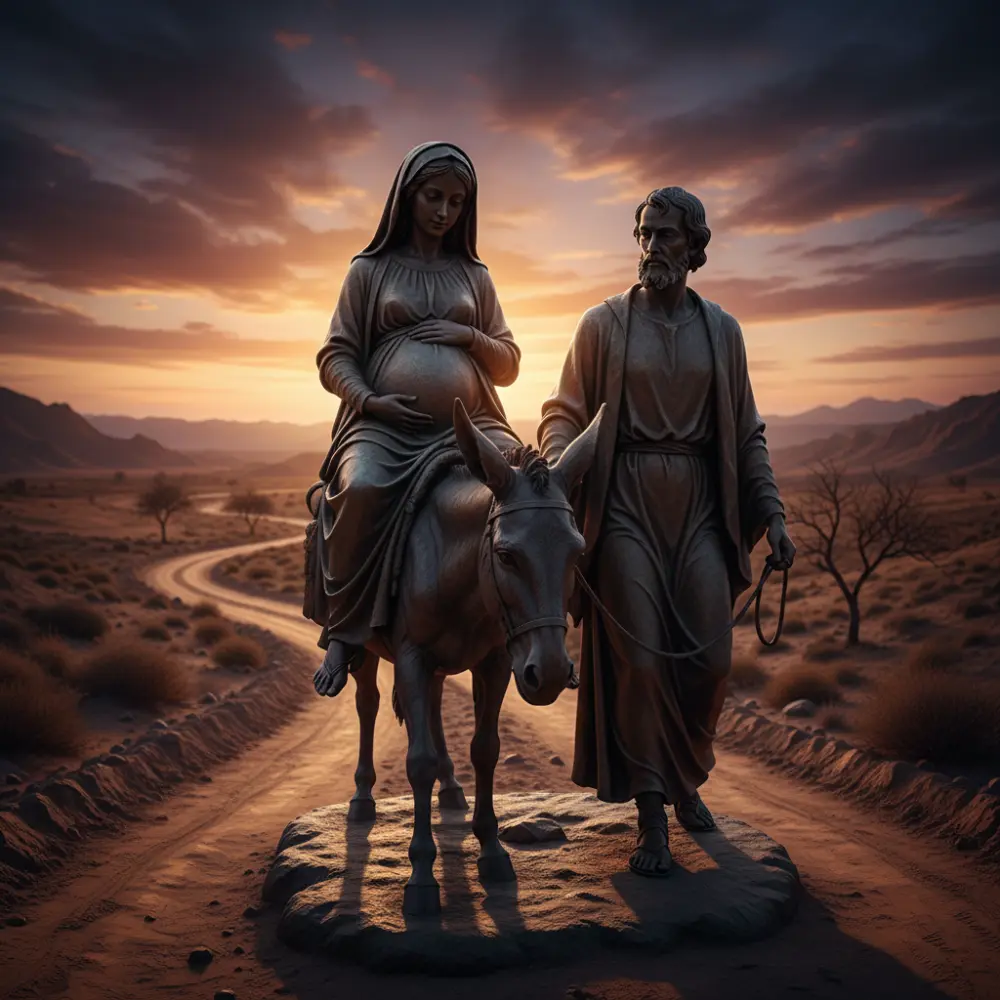
In this scene, Mary rides a donkey while Joseph walks beside her, guiding the animal and protecting his family.
The mary on donkey statue introduces movement into the sculpture.
Unlike static Marian figures, this composition requires dynamic balance.
The donkey must support Mary’s weight naturally.
Joseph must appear stable and protective.
Mary must remain serene despite the journey.
When Joseph is included, the sculpture becomes a pregnant mary and joseph statue, emphasizing the Holy Family as a unit of faith and responsibility.
Engineering considerations become critical.
The donkey’s legs must support structural weight without appearing rigid.
Joseph’s staff often acts as a hidden support element.
Mary’s seated posture must maintain anatomical realism.
This is not just a sculpture.
It is a story in motion.
A pilgrimage cast in metal or carved in stone.
It reminds viewers that the Incarnation was not comfortable—it was a journey filled with uncertainty, endurance, and trust in God.
4. The Holding-a-Bird Madonna — A Forgotten Medieval Gesture
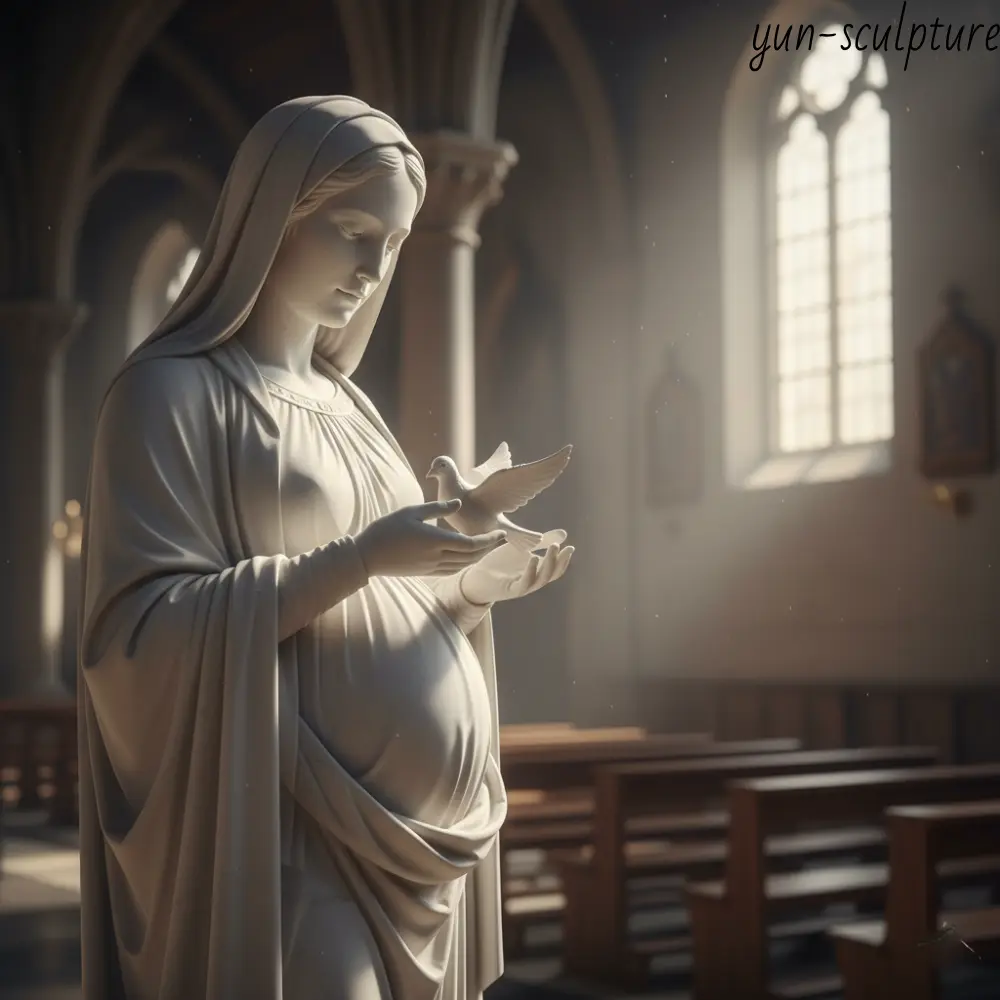
Among the rarest Maria Gravida forms is the Madonna holding a bird.
In medieval symbolism, birds carried deep theological meaning.
The statue of mary pregnant holding a bird draws from early European devotional art where small symbolic objects communicated spiritual truths.
The most common bird is the goldfinch.
In Christian iconography, the goldfinch symbolizes the Passion of Christ because it feeds on thorns, linking it to the Crown of Thorns.
When Mary holds a goldfinch while pregnant, the symbolism becomes profound.
She carries the unborn Christ.
And in her hands rests the sign of His future sacrifice.
Birth and crucifixion connected in a single image.
In some interpretations, the bird is a dove.
The dove represents the Holy Spirit.
This creates a theological triangle:
Mary carries Christ.
The Spirit rests in her hands.
The Father sends salvation into the world.
From a sculptural perspective, the bird must be carefully integrated into Mary’s hand to avoid fragility.
It often connects to the garment or sleeve to maintain structural strength.
This form is rarely commissioned, but when executed properly, it becomes one of the most intellectually and spiritually rich Maria Gravida sculptures.
A quiet medieval theology reborn in modern craftsmanship.
5. The Birth of Christ Scene — The Most Rarely Commissioned
The most sensitive and rare Maria Gravida representation is the birth itself.
A virgin mary giving birth statue or statue of mary giving birth is almost never commissioned in traditional Catholic sculpture.
Not because the event lacks importance.
But because it requires extraordinary theological and artistic care.
The Church traditionally emphasizes reverence and modesty in Nativity imagery.
Most sculptures depict Mary after the birth, kneeling beside the Child.
Depicting the actual moment of childbirth enters deeply sacred territory.
It must avoid realism that could distract from the spiritual meaning.
It must preserve dignity and theological reverence.
When commissioned, these works are typically intended for theological institutions, academic settings, or specialized devotional spaces rather than parish display.
The goal is not dramatic realism.
The goal is incarnation theology.
God truly became human.
Christ truly entered the world through birth.
Mary truly became Mother.
This type of Maria Gravida sculpture requires collaboration between theologians, artists, and structural engineers to ensure that every detail communicates reverence, not spectacle.
It is the rarest form of the tradition.
And perhaps the most profound.
Because it confronts the viewer with the ultimate mystery of Christianity:
God entered the world not in power, but in vulnerability.
The Patroness of Pregnancy: Building a Complete Childbirth Shrine
The Maria Gravida tradition does not exist in isolation.
Across Christian history, the expectant Virgin was often placed within a wider devotional structure—a shrine dedicated to childbirth, motherhood, and the protection of life.
This transforms the pregnant blessed mother statue from a single sculpture into the spiritual center of a prayer environment.
Such shrines were once common in Europe, especially in Italy and Spain, where women prayed for safe delivery, healthy children, and strength during pregnancy.
Today, this tradition is quietly returning in hospitals, maternity clinics, and parish prayer gardens.
The goal is not decoration.
The goal is intercession.
A sacred space where mothers, families, and caregivers place their fears, hopes, and prayers before God through Mary.
Our Lady of Childbirth — A Forgotten Marian Title
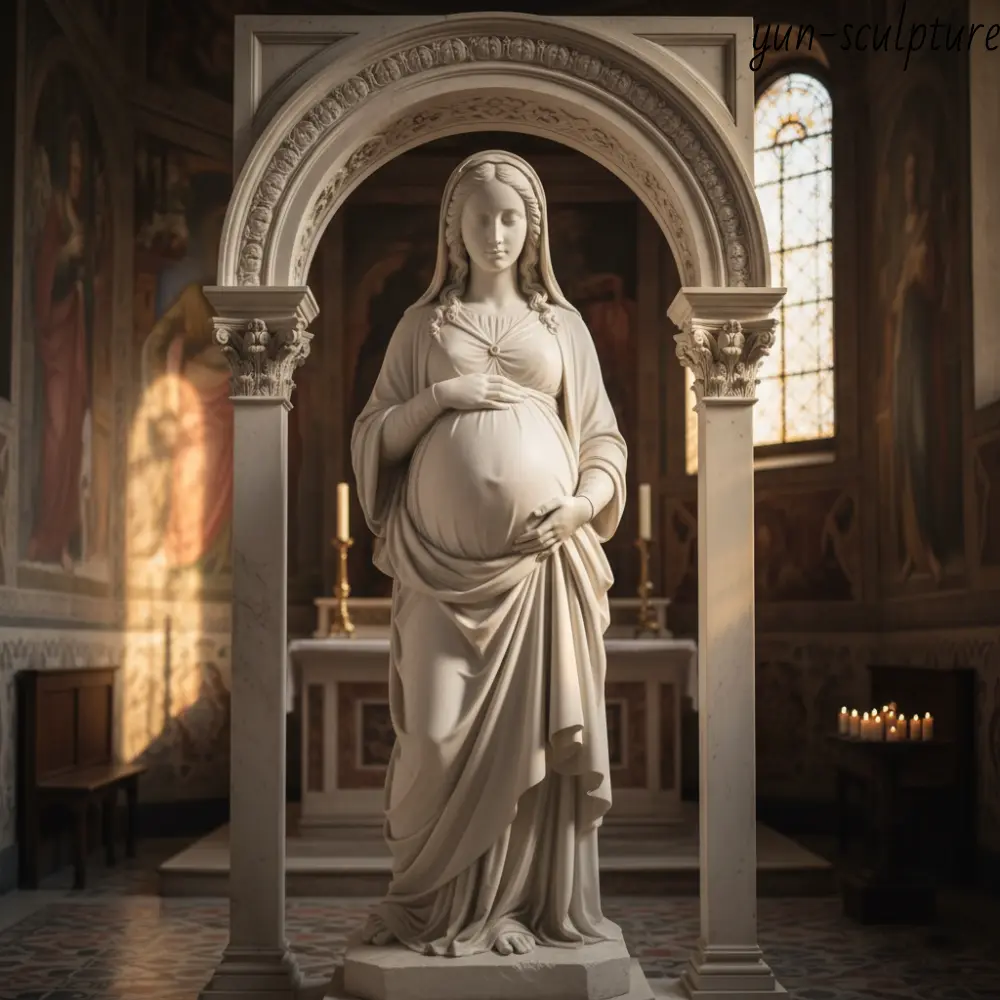
One of the most ancient Marian titles connected to Maria Gravida is Our Lady of Childbirth, often associated with the Madonna del Parto tradition.
In Rome, devotion to Mary as protector of pregnant women developed around churches such as the Basilica of Sant’Agostino, where expectant mothers would pray before Marian images for safe delivery.
Women left offerings, letters, and small tokens asking for protection during labor.
The theology was simple and deeply human.
Mary gave birth to Christ.
Therefore, she understands the fear and vulnerability of childbirth.
This title emphasizes Mary not only as Queen of Heaven, but as a mother who walked the same physical and emotional path as every woman who carries a child.
The pregnant blessed mother statue in this context becomes a living presence within the shrine.
It represents protection, comfort, and companionship.
Not distant holiness.
But maternal closeness.
For modern churches and maternity centers, restoring this title through sculpture reconnects believers with a forgotten dimension of Marian devotion—Mary as guardian of mothers and unborn life.
The Four Saints of Childbirth — Building the Complete Shrine
Historically, Maria Gravida shrines often included a small community of intercessory saints surrounding the Virgin.
This created a theological structure of protection and prayer.
Four saints commonly appear in childbirth devotion:
St. Gerard Majella — Patron saint of expectant mothers and safe delivery.
St. Raymond Nonnatus — Patron of childbirth and midwives.
St. Anne — Mother of the Virgin Mary, representing maternal lineage and generational blessing.
St. Elizabeth — Mother of John the Baptist, representing miraculous pregnancy and faith.
When placed around the expectant Virgin, these figures form a spiritual network of intercession.
Mary stands at the center.
The saints surround her.
Together, they create a complete shrine dedicated to the protection of life.
From a design perspective, this arrangement often follows a semicircle or garden layout, with the pregnant blessed mother statue positioned as the focal point.
Hospitals sometimes place the Virgin at the entrance of maternity wards.
Parishes create prayer gardens for families.
Catholic clinics build quiet courtyards for reflection and prayer.
The structure communicates a clear message:
No mother walks alone.
Mary stands with her.
And the communion of saints surrounds her.
The Grief Commission — For Miscarriage and Stillbirth Memorial
Some commissions begin not with celebration, but with loss.
Families who have experienced miscarriage or stillbirth often struggle to find a way to remember their child within the language of faith.
There is grief, silence, and an absence that words cannot fill.
In these moments, the Maria Gravida tradition offers a deeply compassionate form of memorial.
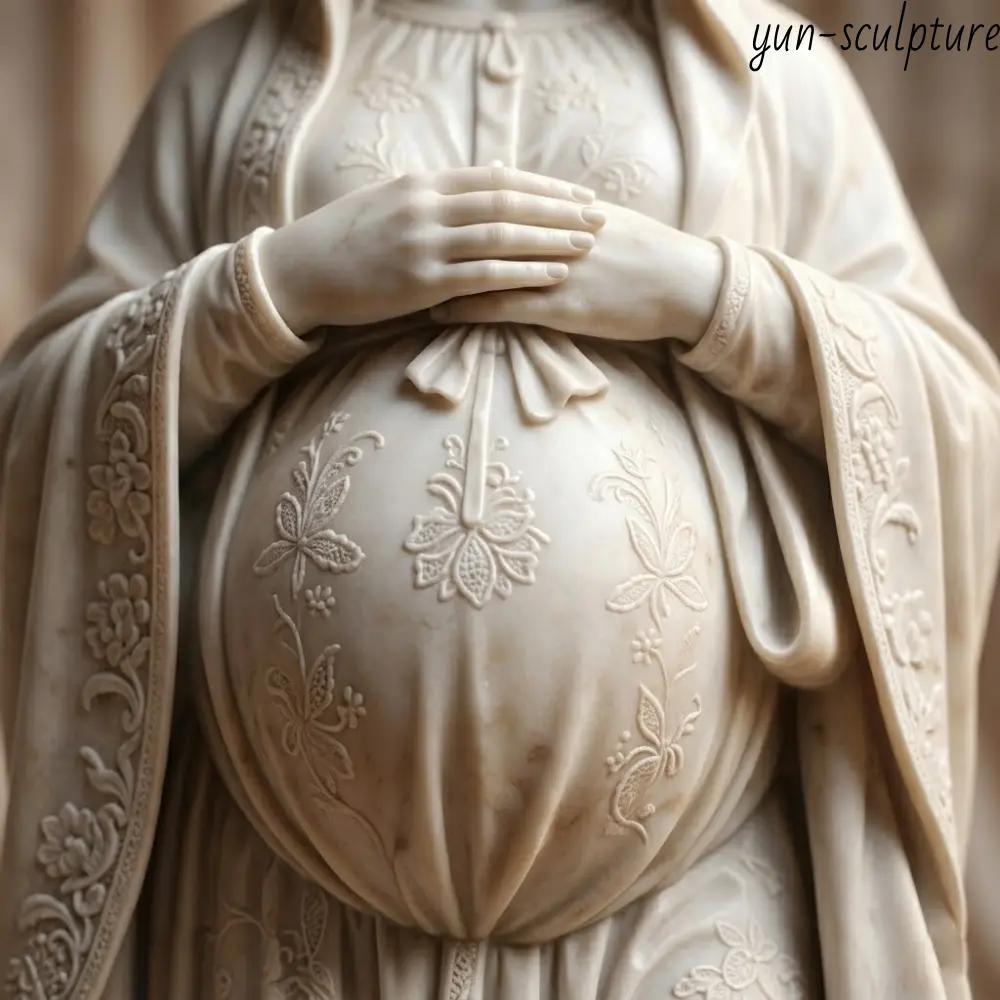
A pregnant blessed mother statue becomes a symbol of the child who was carried but never held.
Mary herself carries the unborn Christ.
She becomes the mother who understands unseen life and unspoken sorrow.
Parents who commission such a statue are not seeking artistic grandeur.
They are seeking presence.
A quiet place to pray.
A sacred image that acknowledges the reality of their child.
A reminder that life in the womb is known and loved by God.
These memorial statues are often placed in:
- cemetery prayer gardens
- church remembrance spaces
- private family chapels
- hospital memorial courtyards
- pro-life ministry centers
The statue does not display grief openly.
Mary stands in peace, gently holding the unborn Christ.
This communicates hope rather than despair.
The child is not forgotten.
The child is held in the mystery of God.
Families sometimes begin their search with a simple question:
where can i buy a pregnant blessed mother statue
Behind this question is often a deeper need.
Not commerce.
Comfort.
They are looking for a sacred object that speaks when words fail.
For these commissions, sensitivity is essential.
The sculpture must be gentle in expression, calm in posture, and quiet in presence.
It becomes not just a religious artwork, but a place of healing.
A place where grief and faith meet.
And where Mary stands beside those who mourn, carrying hope in her womb.
The Liturgical Calendar Logic: When to Display and When to Commission
Maria Gravida sculptures follow a natural rhythm within the liturgical year.
They are not meant to be displayed randomly.
Their presence aligns with specific seasons and feasts that emphasize the mystery of the Incarnation and the anticipation of Christ’s birth.
Understanding this liturgical logic helps churches, institutions, and collectors determine the best time to install or unveil a pregnant blessed mother statue.
The statue becomes part of the Church’s calendar, not just its architecture.
It enters the rhythm of sacred time.
Advent — The Primary Season for the Expectant Madonna
Advent is the natural home of the expectant Virgin.
The Church enters a period of waiting, preparation, and hope.
Scripture readings focus on prophecy, anticipation, and the coming of Christ.
Mary’s pregnancy becomes the central spiritual symbol of this season.
She carries the Savior while the world waits in darkness.
Displaying the pregnant blessed mother statue during Advent creates a powerful theological alignment.
The statue visually expresses what the liturgy proclaims:
God is coming.
Quietly.
Humbly.
In the womb of a mother.
Many churches install the expectant Virgin near the altar or in Marian chapels during Advent, sometimes replacing traditional Marian statues temporarily to emphasize the season’s focus.
The sculpture becomes a visual homily.
A silent proclamation of hope.
Advent without Maria Gravida loses one of its most intimate theological images.
The Feast of the Visitation — May 31st
The Feast of the Visitation celebrates the meeting of Mary and Elizabeth.
Two pregnancies.
Two miracles.
One moment of recognition.
This feast naturally connects to the dual-figure Maria Gravida sculpture discussed earlier.
Churches that commission a Visitation statue often unveil or bless it on May 31st, aligning the sculpture with the liturgical celebration of life in the womb and prophetic recognition of Christ.
The statue becomes a permanent reminder of this feast.
Each year, the community gathers around it again, renewing the connection between art, theology, and liturgy.
It transforms sculpture into an annual devotional focal point.
The Annunciation — March 25th
The Annunciation marks the moment of conception.
The angel speaks.
Mary consents.
Christ enters the world.
This is the beginning of Maria Gravida.
For many institutions, March 25th becomes the ideal commissioning or installation date for a pregnant blessed mother statue, especially in pro-life centers and Marian shrines.
The symbolism is profound.
On the day Christ was conceived, a statue of the expectant Virgin is unveiled.
The sculpture becomes a visual proclamation of the Incarnation.
Life begins in the womb.
God became human at conception.
Theological truth expressed through sacred art.
Material Intelligence: What Makes a Pregnant Mary Statue Different to Commission
Creating a Maria Gravida sculpture is not the same as creating a standard Marian statue.
The emotional meaning is deeper.
The anatomical precision is more demanding.
The material choice carries theological weight.
Every decision—from the curvature of the abdomen to the type of stone or metal—affects how the statue communicates the mystery of the Incarnation.
This is where art history meets engineering and material science.
The Abdomen Curve — The Supreme Test of the Carver’s Hand
The most difficult element of a Maria Gravida sculpture is the abdomen.
It must look natural.
Not exaggerated.
Not perfectly spherical.
Not artificially smooth.
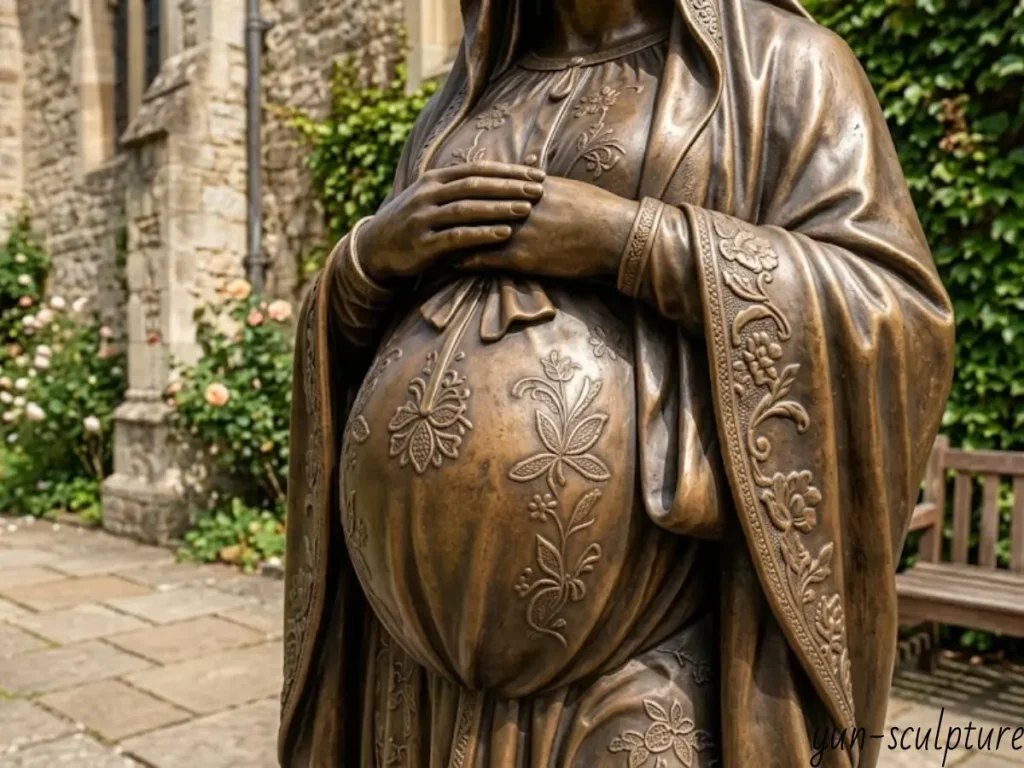
A pregnant abdomen has subtle asymmetry and gentle tension in the fabric and posture of the body.
The sculptor must understand human anatomy, maternal posture, and balance.
If the curve is too pronounced, the statue appears theatrical.
If too subtle, the pregnancy disappears visually.
The entire theological message depends on this delicate balance.
It is the supreme test of craftsmanship.
The womb must feel real.
Because it represents the Incarnation itself.
White Marble — Skin Warmth for the Mother of God
White marble remains one of the most revered materials for Marian sculpture.
A marble virgin mary statue possesses a unique visual quality: translucency.
Light penetrates slightly into the stone and reflects back, creating the illusion of soft skin and living presence.


This effect is especially powerful in Maria Gravida sculptures.
The abdomen appears gentle and warm.
The face appears calm and human.
The entire statue radiates quiet dignity.
Marble communicates purity, serenity, and timelessness.
It transforms the expectant Virgin into a sacred presence rather than a decorative object.
For indoor chapels and prayer spaces, marble remains one of the most spiritually resonant material choices.
Bronze — For Outdoor Shrines and Pro-Life Institutions
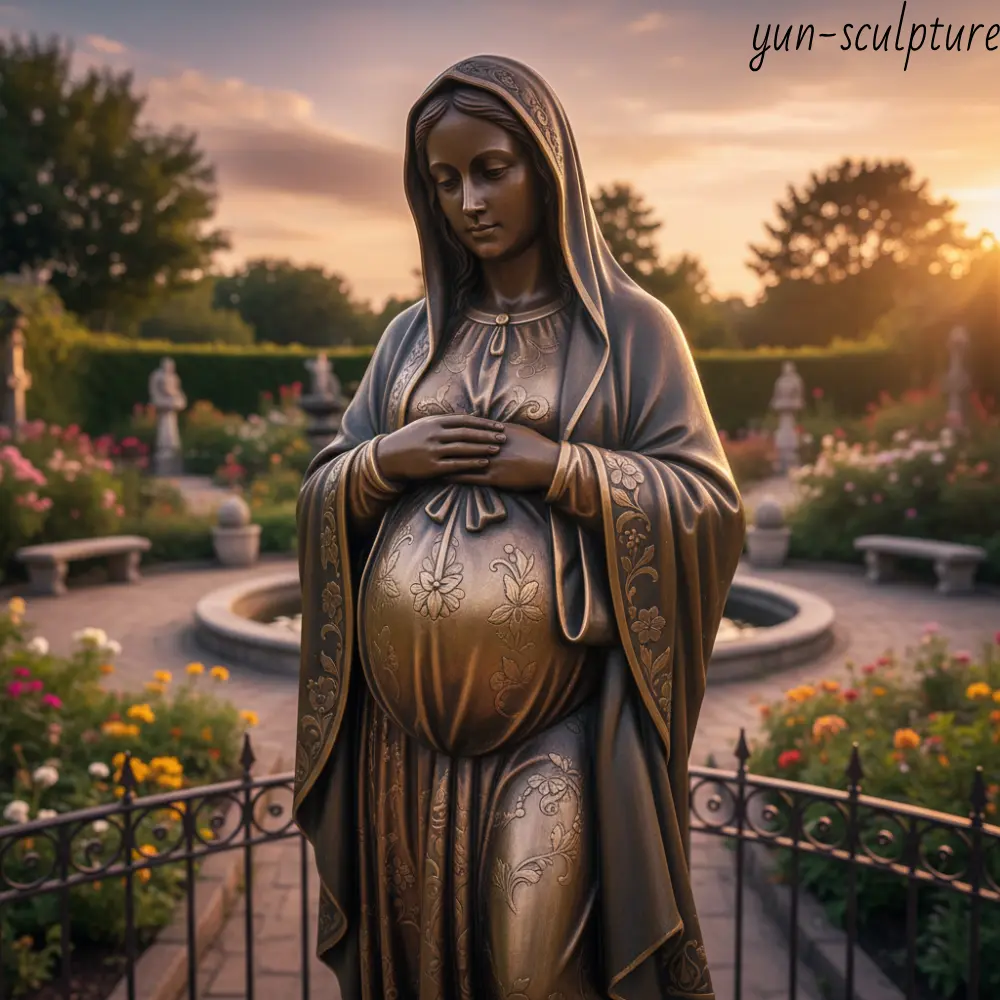
Bronze is the preferred material for outdoor Maria Gravida monuments.
It withstands weather, temperature changes, and long-term exposure without losing structural integrity.
This makes it ideal for:
- hospital courtyards
- church gardens
- pro-life memorial parks
- public religious spaces
- institutional campuses
Bronze also carries symbolic strength.
It communicates permanence and endurance.
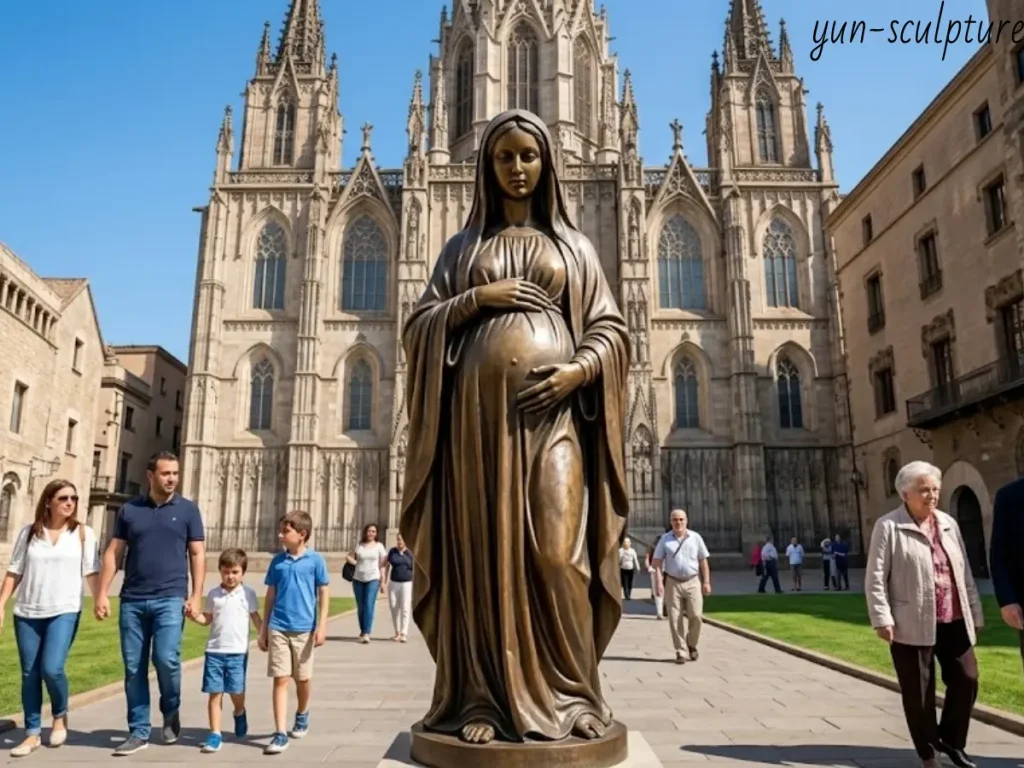
A bronze pregnant blessed mother statue in a public space becomes a lasting witness to the sanctity of life.
It speaks to generations.
Rain, sun, and time do not erase its message.
The Incarnation remains visible.
The Polychrome Tradition — When Color Completes the Theology
In Spain and Portugal, color plays a central role in Marian sculpture.
Polychrome statues are carefully painted using traditional pigments and gilding techniques.
Blue represents heaven and purity.
Red represents sacrifice and love.
Gold represents divine glory.
When applied to Maria Gravida sculptures, these colors deepen theological meaning.
The blue cloak protects the unborn Christ.
The red garment anticipates the Passion.
The gold highlights divine presence.
Color completes the message.
It transforms the sculpture into a living devotional image.
This tradition is especially powerful for churches seeking historical authenticity and emotional warmth.
Olive Wood — The Most Theologically Charged Material
Among all materials, olive wood carries the deepest symbolic meaning.
It comes from the land of Christ.
From the region of Bethlehem and Jerusalem.
From the trees that witnessed biblical history.
Olive wood connects Maria Gravida directly to the Holy Land.
Bethlehem, where Christ was born.
Gethsemane, where Christ prayed before His Passion.
The material itself becomes part of the theology.
A pregnant blessed mother statue carved in olive wood does not only represent Mary.
It carries the physical memory of the land where salvation history unfolded.
The grain of the wood moves naturally, creating a warm and organic appearance.
Each sculpture becomes unique, shaped by the natural patterns of the tree.
It feels alive.
Human.
Sacred.
For private chapels and devotional spaces, olive wood creates an intimate connection between the believer and the mystery of the Incarnation.
A quiet material for a quiet miracle.
And a powerful reminder that the story of Christ began not in stone or metal, but in the living body of a mother.
Scale & Placement: From Nursery to National Monument
The meaning of a Maria Gravida sculpture is shaped not only by its design, but by its scale.
Size determines how people interact with the statue, how close they stand, and how deeply they feel its presence.
A small expectant Virgin invites quiet prayer.
A life-size figure invites encounter.
A monumental sculpture invites public reflection.
Choosing the right scale is therefore not a technical decision—it is a theological and pastoral one.
Some families begin their search with a simple intention: pregnant mary statue buy for a home altar or private chapel.
Institutions often explore pregnant mary statue buy online options before moving into custom commissions.
Understanding scale helps transform that search into a clear commissioning strategy.
Size Guide
| Size Range | Typical Placement | Recommended Materials | Spiritual Function |
|---|---|---|---|
| 4–8 inches | Nursery, personal prayer desk, bedside altar | Olive Wood, Small Bronze | Personal devotion, protection of unborn life |
| 8–18 inches | Home altar, Advent display, parish Marian corner | Marble, Polychrome Wood | Seasonal devotion and family prayer |
| 18–36 inches | Hospital chapel, crisis pregnancy center, prayer garden | Bronze, Stone | Pastoral presence and institutional intercession |
| Life-size (5–6 ft) | Church courtyard, university campus, monastery grounds | Bronze | Public encounter and theological witness |
| 8 ft and above | National pro-life monument, cathedral plaza, pilgrimage shrine | Bronze, Granite | Monumental testimony to the Incarnation and sanctity of life |
Each size creates a different emotional distance.
A small olive wood statue sits close to the heart.
A marble chapel statue stands at eye level with the faithful.
A monumental bronze figure speaks to an entire community.
The scale should always match the mission of the space.
A nursery requires tenderness.
A hospital requires comfort.
A university requires intellectual and theological presence.
A national monument requires permanence and authority.
The statue becomes part of the environment it inhabits.
And in every size, Mary remains the same—quietly carrying Christ.
The Custom Commission: Questions Only This Subject Requires
Designing a Maria Gravida sculpture requires decisions that do not appear in standard Marian commissions.
A traditional Madonna and Child follows established iconographic patterns.
An expectant Virgin requires deeper narrative and emotional clarity.
Every detail communicates a specific moment in salvation history.
The gestational stage, the hands, and the facial expression all shape how the viewer understands the Incarnation.
These decisions are not aesthetic alone.
They are theological.
The Gestational Stage Decision — A Question of Narrative
The first and most important decision is gestational stage.
Early pregnancy represents the Annunciation.
Mary has just said yes.
The Incarnation has begun, but the physical pregnancy is subtle.
This form emphasizes faith and obedience.
Mary becomes the model of spiritual surrender.
The abdomen is gentle and restrained, almost hidden beneath the garment.
The statue communicates quiet acceptance of God’s will.
Late pregnancy represents the Journey to Bethlehem or the final days before the Nativity.
The abdomen is more visible.
The physical reality of motherhood becomes clear.
This form emphasizes endurance and hope.
Mary carries the weight of the world—literally and spiritually.
Churches focused on Advent often choose late pregnancy to emphasize waiting and expectation.
Theological institutions sometimes prefer early pregnancy to highlight the Incarnation at conception.
Both are historically valid.
The choice depends on the story the statue is meant to tell.
The Hand Position — The Most Expressive Choice
Hands communicate emotion more clearly than any other element.
In Maria Gravida sculpture, hand position becomes the emotional language of the statue.
Hands folded on the abdomen express protection and maternal care.
Mary becomes guardian of the unborn Christ.
This is the most common and comforting form, often chosen for hospitals and pregnancy centers.
One hand raised and one hand resting on the belly expresses receiving and giving.
Mary receives God’s grace and offers Christ to the world.
This form is often used in theological or academic settings because it emphasizes the Incarnation as a gift to humanity.
Hands folded in prayer express submission and contemplation.
Mary becomes the silent servant of God’s will.
This form is particularly powerful in monasteries and chapels, where the focus is prayer and meditation.
Each gesture changes the emotional impact of the sculpture.
The hands tell the story before the viewer even looks at the face.
The Face of an Expectant Mother — A Different Expression Brief
The face of Maria Gravida is unlike any other Marian sculpture.
It cannot be triumphant like the Immaculate Conception.
It cannot be sorrowful like the Pietà.
It cannot be maternal like Madonna and Child.
It must reflect anticipation.
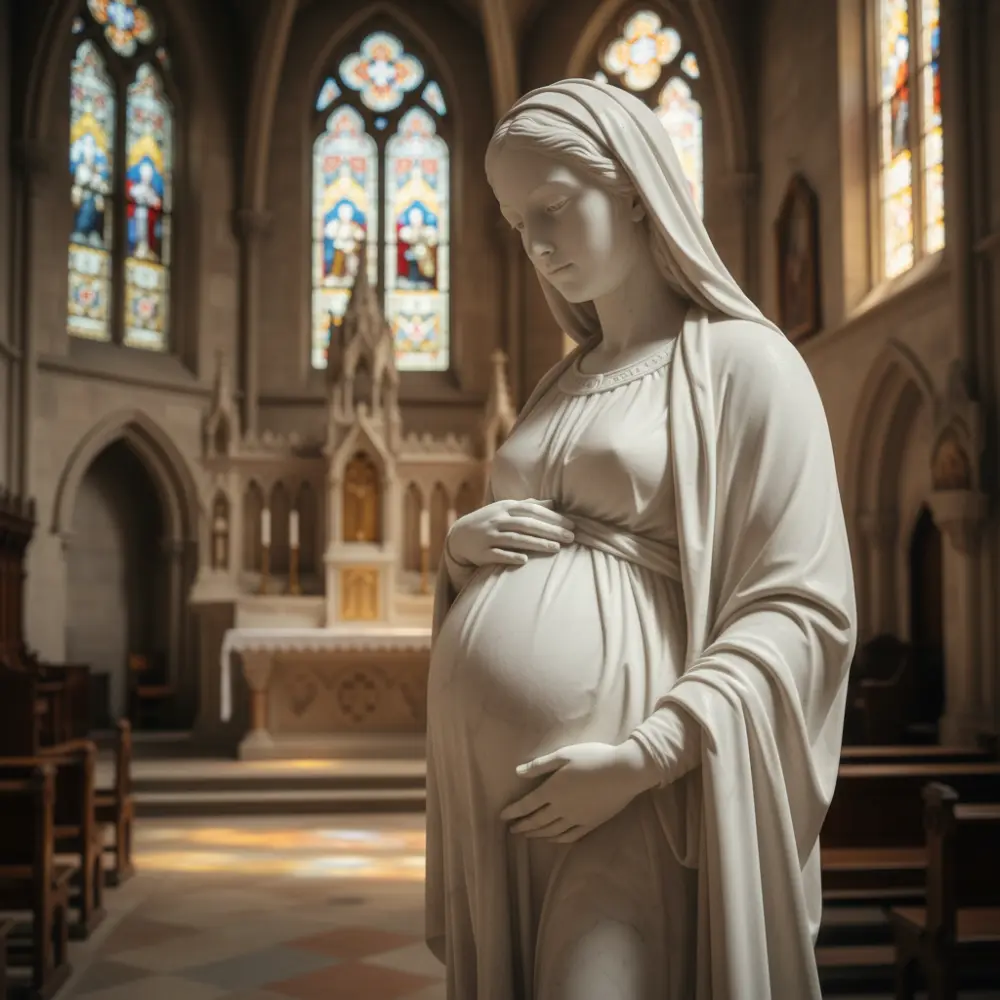
Three expressions are most commonly used.
Joy expresses confidence in God’s promise.
Mary becomes a radiant mother awaiting Christ.
Contemplation expresses interior prayer and reflection.
Mary becomes a quiet witness to the mystery she carries.
Maternal tenderness expresses emotional warmth and protection.
Mary becomes a gentle presence for mothers and families.
The sculptor must balance serenity and humanity.
Too much emotion feels theatrical.
Too little emotion feels distant.
The goal is peaceful expectation.
A mother waiting for her child.
A woman carrying God.
FAQ: Pregnant Mother Mary Statue
What does a pregnant Virgin Mary statue mean theologically?
Many people ask a simple but profound question:
what does the pregnant mary statue mean
The answer lies at the heart of Christianity.
A pregnant Virgin Mary statue is the most direct visual expression of the Incarnation—the belief that God became human in the womb of Mary.
It emphasizes that Christ did not appear suddenly at birth but entered human existence through conception and gestation like every human being.
This gives the statue deep theological meaning.
It represents the sanctity of unborn life.
It represents Mary’s faithful acceptance of God’s will.
It represents the hidden period of waiting before salvation was revealed to the world.
The statue therefore communicates three core truths:
God became human in the womb.
Mary actively carried the Savior in faith.
Life before birth is sacred and known by God.
Rather than being a symbolic variation of Marian art, Maria Gravida is one of the most powerful visual declarations of Christian theology.
It shows the Incarnation in its earliest and most vulnerable moment.
God as an unborn child.
What is the “Expectant Mary” or “Expecting Mary” statue?
The Expectant Mary or Expecting Mary statue refers to a specific Marian devotional tradition rooted in Spain and Latin Catholic spirituality.
In Spanish, this tradition is often called Nuestra Señora de la Esperanza—Our Lady of Hope or Our Lady of Expectation.
The statue typically depicts Mary alone, standing quietly in contemplation of her pregnancy.
Her posture is calm.
Her hands rest gently on her abdomen or fold in prayer.
Her expression reflects peaceful anticipation.
This form emphasizes Advent spirituality.
Mary becomes the symbol of hope waiting for Christ.
Churches often display this type of sculpture during Advent to remind the faithful that salvation entered the world through quiet waiting and trust in God’s promise.
It is one of the most serene and spiritually focused forms of Maria Gravida imagery.
What is the history of the pregnant Mary statue in Spain and Cádiz?
The Iberian Peninsula played a crucial role in preserving Maria Gravida after much of Europe abandoned the tradition.
Between the 14th and 16th centuries, Spain developed a strong tradition of expectant Virgin imagery, particularly in Andalusia.
Cádiz became one of the regional centers for polychrome religious sculpture, where artisans created wooden statues of the expectant Madonna for churches and private devotion.
These sculptures were known for their vivid colors, natural posture, and emotional warmth.
Blue cloaks, red garments, and gold detailing created a living devotional image that connected believers to the mystery of the Incarnation.
Unlike monumental Renaissance works, many Cádiz statues were small and intimate, placed in church niches or side chapels.
This allowed the tradition to survive quietly through local devotion even after the Council of Trent discouraged widespread use of Maria Gravida imagery.
Today, the Cádiz and Andalusian tradition remains one of the most important historical foundations for the modern expectant Virgin statue.
It represents continuity, resilience, and deep Marian devotion preserved through centuries of faith.
What is the pregnant Mary statue with an opening door?
The pregnant Mary statue with an opening door is known as the Öffnungsmadonna, or Shrine Madonna, a medieval German masterpiece of theological sculpture.
This form of statue of pregnant virgin mary features carefully constructed hinged doors on Mary’s abdomen.
When opened, the interior reveals sacred imagery—often the Christ Child, the Holy Trinity, or scenes of salvation history.
The exterior represents the visible world.
The interior reveals the divine mystery hidden within Mary.
It is not a mechanical novelty.
It is a theological statement carved in wood and engineered with extraordinary precision.
The Öffnungsmadonna expresses one central truth: the womb of Mary is the place where heaven enters the world.
Recreating this form today requires advanced structural engineering, hidden hinge systems, and historically accurate craftsmanship.
It remains one of the most intellectually sophisticated forms of Maria Gravida sculpture ever created.
Is the Our Lady of Guadalupe image a pregnant Mary?
Yes. Many scholars and theologians interpret the image of Our Lady of Guadalupe as a pregnant Virgin Mary.
The symbolism is precise and intentional.
The four-petal flower placed over her womb represents the divine center of the universe in Nahuatl symbolism.
The black maternity sash indicates pregnancy in 16th-century Indigenous culture.
The slight curvature of her abdomen reinforces the maternal form.
These elements strongly suggest that Mary is depicted as carrying Christ.
This makes Guadalupe one of the most widely recognized visual representations of Maria Gravida in the world.
The image communicates the Incarnation through cultural symbolism rather than European artistic conventions.
Mary is not shown holding the Child.
She carries Him.
A quiet but powerful expression of divine presence in the womb.
What is the difference between the “Expectant Mary” and the “Pregnant Mary on a Donkey” statue?
The difference lies in narrative and emotional focus.
The expectant mary statue presents Mary as a solitary and contemplative figure.
She stands quietly, hands resting on her abdomen or folded in prayer, reflecting the interior moment of waiting for Christ.
This form emphasizes stillness, faith, and spiritual anticipation.
The pregnant mary on donkey statue, by contrast, tells a journey story.
Mary travels toward Bethlehem, often accompanied by Joseph.
The donkey introduces movement, physical hardship, and narrative tension.
This composition highlights endurance and trust in God during uncertainty.
In simple terms:
The expectant mary statue is about prayer and waiting.
The pregnant mary on donkey statue is about faith in motion and the journey toward the Nativity.
Both are historically grounded.
Both communicate the Incarnation.
They simply tell different chapters of the same sacred story.
What does the pregnant Mary statue holding a bird symbolize?
The statue of mary pregnant holding a bird comes from medieval European devotional symbolism.
The bird represents a theological message connected to Christ’s identity and mission.
If the bird is a dove, it symbolizes the Holy Spirit.
This emphasizes divine conception and the presence of God within Mary.
If the bird is a goldfinch, the symbolism becomes more profound.
The goldfinch feeds on thorns and carries red markings on its head and wings.
In Christian iconography, this foreshadows Christ’s Passion and the Crown of Thorns.
Mary holds the unborn Christ.
And in her hand rests the sign of His future sacrifice.
Birth and crucifixion connected in a single image.
This makes the statue one of the most intellectually rich Maria Gravida forms ever developed in medieval art.
Can a pregnant Virgin Mary statue be commissioned as a miscarriage memorial?
Yes.
Many families commission a Maria Gravida sculpture as a memorial for a child lost through miscarriage or stillbirth.
The virgin mary giving birth statue or statue of mary giving birth is rarely used in this context.
Instead, families usually choose a peaceful statue of pregnant blessed mother holding the unborn Christ in quiet serenity.
The meaning is deeply comforting.
Mary carries life that is not yet visible to the world.
She becomes the spiritual guardian of children who were carried but never held.
These memorial statues are often placed in cemetery gardens, church remembrance spaces, hospital courtyards, or private family chapels.
They do not display grief openly.
They express hope.
The message is gentle and powerful: every unborn life is known and loved by God.
For many parents, this becomes a place of prayer, remembrance, and healing.
What season is best to display a pregnant Mary statue?
Advent is the most theologically appropriate season.
The four weeks before Christmas mirror Mary’s period of waiting for Christ.
Scripture readings focus on prophecy, expectation, and preparation for the Incarnation.
Displaying a statue of pregnant virgin mary during Advent visually reinforces this spiritual journey.
The Church waits.
Mary waits.
The world waits.
The sculpture becomes a silent reflection of the liturgical season.
Some churches display the expectant Virgin only during Advent, while others keep it permanently in Marian chapels and highlight it during this season with special lighting, prayer services, or processions.
Advent remains the natural home of Maria Gravida.
It is the season of hope carried in the womb.
What is the best material for a pregnant Mary statue?
Material choice depends on placement and mission.
White marble is ideal for indoor chapels and devotional spaces.
It captures the warmth of skin, softness of expression, and serenity of the expectant Virgin.
A marble Maria Gravida sculpture creates an intimate and prayerful atmosphere.
Foundry bronze is best for outdoor installations.
Hospital courtyards, pro-life monuments, and church gardens require durability and permanence.
Bronze withstands weather, temperature changes, and long-term exposure while maintaining structural integrity.
In simple terms:
Marble creates closeness and quiet prayer.
Bronze creates permanence and public witness.
Both materials honor the sacred meaning of Maria Gravida.
The choice depends on where Mary will stand and whom she will serve.
Where can I buy a pregnant Blessed Mother statue?
Many people begin their journey with a practical question:
where can i buy a pregnant blessed mother statue
The answer depends on the level of theological accuracy and material quality desired.
Mass-produced resin statues are widely available through online religious stores.
However, these often lack historical accuracy, structural durability, and proper anatomical proportions.
For those searching pregnant mary statue buy online or pregnant mary statue buy, the most important consideration is craftsmanship and material permanence.
A statue of pregnant blessed mother is not simply a decorative religious item.
It represents the Incarnation.
It carries deep theological meaning and emotional significance.
For churches, institutions, memorial projects, and serious collectors, commissioning directly from a professional sculpture foundry ensures:historically accurate Maria Gravida design
correct anatomical proportions
durable marble, bronze, or wood materials
structural integrity for long-term installation
theological consultation during the design process
This approach transforms a purchase into a sacred commission.
The statue becomes part of a spiritual legacy rather than a temporary object.
Commission a Statue That Honors the Beginning of Everything
The Maria Gravida tradition is not only art history.
It is a living theological language.
It speaks of the Incarnation, the sanctity of life, the dignity of motherhood, and the quiet courage of Mary who carried Christ into the world.
Every expectant mary statue tells a story.
A hospital seeking comfort for mothers.
A church preparing for Advent.
A university building a pro-life landmark.
A family honoring a child lost in pregnancy.
Each commission carries a sacred purpose.
Planning a pro-life landmark, hospital chapel, or crisis pregnancy center installation?
Our sacred art team will guide you through every theological decision, from historical iconography to structural engineering and material selection.
Commissioning a memorial for a child lost in pregnancy?
Our team handles these commissions with the utmost care, empathy, and confidentiality, ensuring the final sculpture becomes a place of healing and prayer.
Ready to commission your pregnant Blessed Mother statue for Advent or year-round devotion?
Tell us your vision, size, and material preference — receive a free quote within 24 hours.
The tradition of Maria Gravida continues through those who choose to preserve it.
Through those who build shrines.
Through those who honor life.
Through those who believe that sacred art still has the power to speak to the world.
– Elena Zhang & Donghui Zhang, Yun Sculpture