Get in touch with Yun-Sculpture company
The Ultimate Guide to Foo Dogs: Meaning, Placement, and Top 9 Iconic Chinese Guardian Lions

Across the entrances of imperial palaces, Buddhist temples, and the estates of powerful families, a pair of powerful figures often stands watch. Carved in marble, cast in bronze, or forged from iron, these creatures crouch with intense awareness—muscles coiled, mouths open in silent vigilance. They are not merely sculptures. They are guardians.
In Western architecture and garden design, these statues are widely known as Foo Dogs. Yet their presence carries far deeper meaning than decoration. For more than a thousand years, these figures have represented imperial authority, spiritual protection, and the invisible boundary between chaos and order.
Historically, placing a pair of Foo Dogs at the entrance of a home or institution signaled status and power. Only the most prestigious buildings—government halls, temples, and the estates of elite officials—were permitted to display them. Their presence declared that the space beyond the gate was protected, prosperous, and under powerful spiritual watch.
Today, these sculptures continue to appear in luxury estates, classical gardens, and cultural landmarks around the world. Designers and collectors are drawn not only to their dramatic presence but also to the ancient philosophy they embody: protection, balance, and enduring strength.
Understanding these statues requires looking beyond the surface. Their posture, pairing, and symbolic details all carry meaning. To appreciate them fully, we must first decode the powerful symbolism behind the Foo dogs guardian lion tradition.
Table of Contents
Table of Contents
What is a Foo Dog? Decoding the Symbolism of Guardian Lions
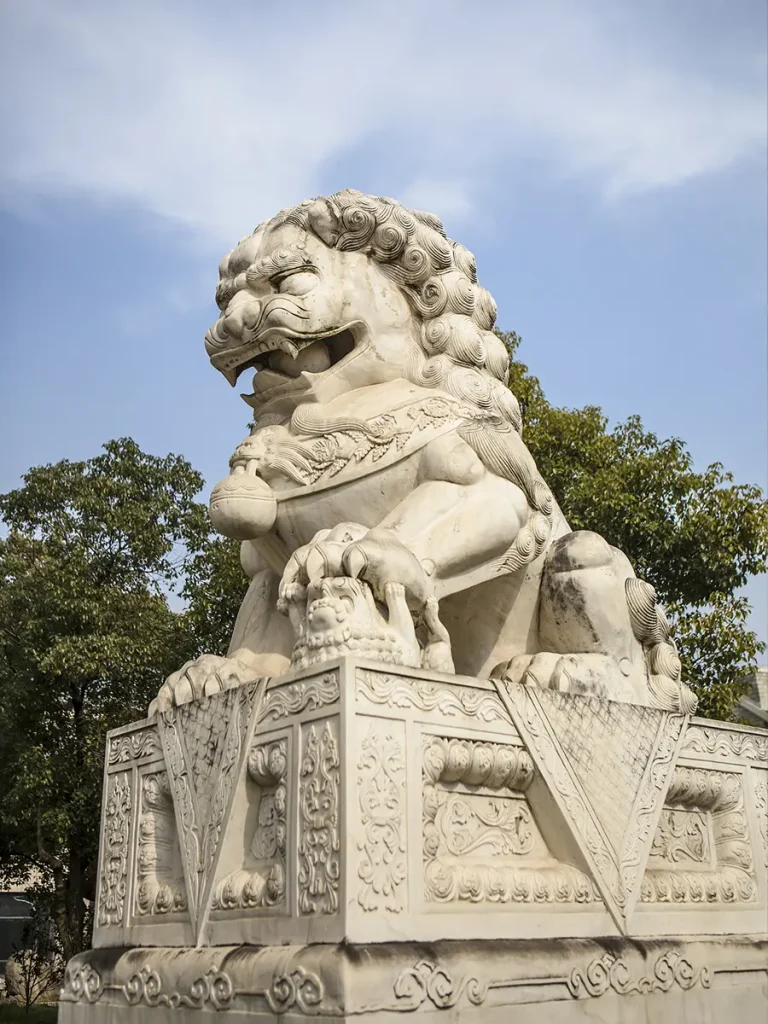

At their core, Foo Dogs are spiritual sentinels. In traditional Chinese architecture and Feng Shui philosophy, they serve as a Guardian protector, positioned at entrances to prevent harmful energy from entering a space.
The Symbolism of fu dog statues revolves around protection, authority, and prosperity. Their fierce expressions and powerful stance are designed to repel negative forces—whether those forces are understood as spiritual entities, misfortune, or hostile intent.
Unlike decorative sculptures meant purely for beauty, Foo Dogs carry an active purpose. Their role is to guard the threshold between the outside world and the protected domain within. The doorway they flank represents a transition point, and the statues act as watchful gatekeepers.
Traditionally, Foo Dogs appear in pairs. The male guardian typically rests one paw upon a carved sphere representing the world, symbolizing dominion and protection of the external realm. The female guardian restrains a playful cub beneath her paw, representing the safeguarding of family, lineage, and the continuity of life.
Together, the pair forms a symbolic balance between power and nurture. One guards authority and territory; the other protects home and legacy.
Their exaggerated features—curled manes, wide eyes, muscular limbs—are not accidental artistic flourishes. These elements were intentionally designed to amplify their presence. The statues project vigilance and power, reinforcing the idea that unseen forces stand guard.
This is why the Foo dogs guardian lion remains one of the most recognizable protective symbols in East Asian architecture. Whether carved from white marble in a temple courtyard or cast in bronze outside a private residence, the message is clear: this space is defended.
Yet despite their common name, these figures are not dogs at all.
Lion or Dog? The Evolution of the Foo Dog Legend
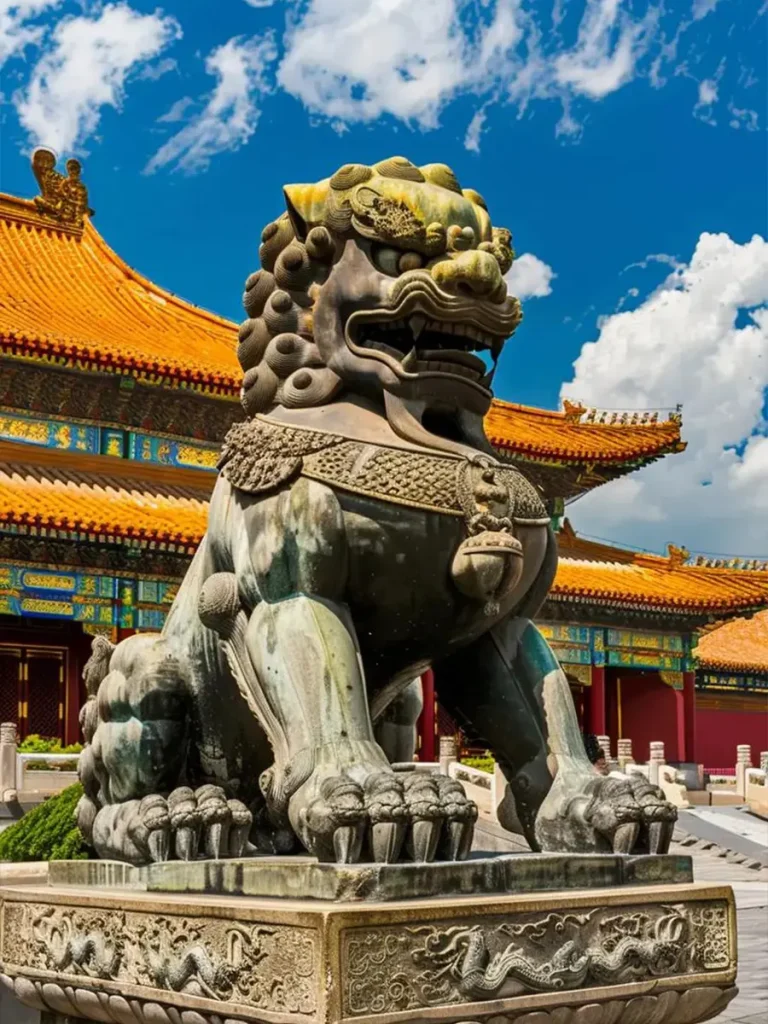
One of the most persistent misunderstandings surrounding these sculptures is the belief that they represent dogs. In reality, they are stylized lions—specifically mythical interpretations of Asiatic lions known in Chinese tradition as Shishi, or guardian lions.
The confusion largely emerged when Western travelers encountered the statues centuries ago. To unfamiliar eyes, their curled manes, compact bodies, and expressive faces resembled certain Chinese dog breeds such as Chow Chows or Pekingese. As a result, the term “Foo Dogs” entered Western vocabulary and remained widely used.
Historically, however, lions were not native to most regions of China. Knowledge of the animal arrived through trade routes during the Han dynasty, when emissaries and merchants traveling along the Silk Road introduced exotic animals and cultural ideas from Central Asia and Persia.
These early descriptions of lions inspired Chinese artists to create mythical interpretations of the creature. The result was not a naturalistic animal but a symbolic hybrid—part lion, part dragon, part celestial beast.
This transformation lies at the heart of the Legend of the fu dog. Over time, the lion evolved into a supernatural guardian associated with Buddhism, imperial authority, and sacred architecture.
During the Han dynasty, early guardian lions appeared relatively simple in form. By the Tang dynasty, the sculptures became more expressive and powerful, reflecting the cosmopolitan culture and artistic confidence of the era.
The Qing dynasty refined the style even further. Sculptors developed the elaborate curled manes, muscular forms, and dramatic facial expressions that modern audiences recognize today.
Through these centuries of artistic evolution, the chinese guardian lion dogs gradually shifted from mythological creatures into highly stylized architectural guardians. Their purpose, however, remained unchanged: to stand watch at the threshold, defending the realm beyond the gate.
And it is precisely this blend of myth, symbolism, and architectural power that continues to make Foo Dogs one of the most iconic protective sculptures in the world.
Feng Shui Rules: Where to Place Fu Dogs for Maximum Protection
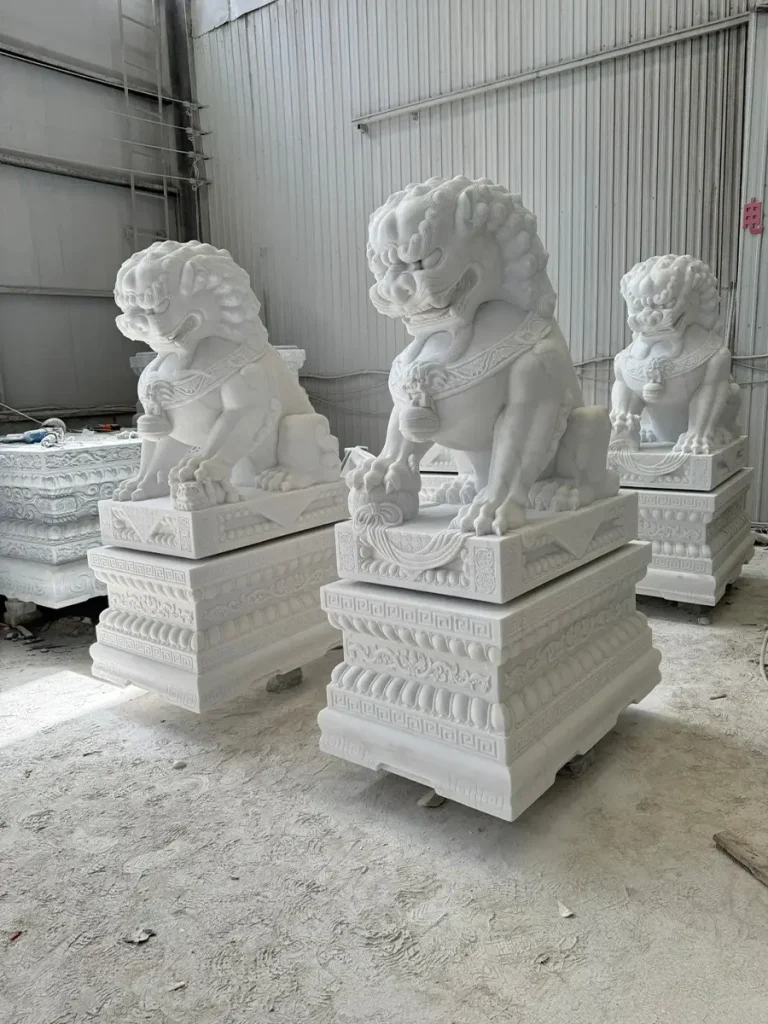
Placing guardian lions is not a casual decorative choice. In traditional Feng Shui practice, positioning a foo dogs pair follows precise rules developed over centuries of architectural tradition. When placed correctly, the statues form a symbolic shield that protects a home, estate, or temple from disruptive external forces.
One of the most common questions people ask is is one foo dog bad luck. According to classical Feng Shui philosophy, the answer is yes. A single statue disrupts the balance of Yin and Yang energies. Guardian lions must always appear as a pair to create harmony between protective strength and nurturing stability.
Understanding Where to place fu dogs in home begins with recognizing their role as threshold guardians. These statues should stand at the main entrance—the symbolic gateway where energy flows into the property. Their purpose is to intercept harmful influences before they cross the boundary into the protected space.
Equally important is Which direction should fu dogs face. The statues should always face outward, toward the street, driveway, or approaching pathway. This outward orientation ensures that the guardians confront negative energy before it enters the home.
To achieve proper placement, follow these traditional guidelines:
- Always place them at the main entrance. The front gate, driveway entrance, or primary doorway is ideal.
- Ensure they face outward. Their gaze should look toward approaching visitors or the street.
- Keep the statues elevated. Pedestals or steps reinforce their authority as protectors.
- Maintain symmetry. Both statues should be positioned evenly on either side of the entrance.
- Never separate the pair. Dividing the guardians weakens their symbolic protection.
In classical Chinese estates, guardian lions often stood on raised plinths carved from stone. This elevated position symbolized authority while ensuring the statues visually dominated the entrance. Even in modern architectural settings, maintaining this sense of presence is important.
Proper placement transforms the statues from simple sculptures into active guardians. With the correct positioning and orientation, the pair establishes a protective barrier that reflects centuries of spiritual and architectural wisdom.
The Right Side vs. Left Side: How to Align Your Fu Dogs Pair
Another frequent question concerns Fu dogs left or right. This rule is often misunderstood, especially when installing statues in Western homes. Fortunately, the principle itself is straightforward.
To determine correct placement, stand inside the doorway and look outward toward the entrance.


From this perspective:
- The Male guardian stands on the left side of the doorway.
- The Female guardian stands on the right side of the doorway.
This arrangement has been used in temples, palaces, and government buildings for centuries. The pairing creates a balanced flow of masculine and feminine energies, reinforcing harmony within the property.
Maintaining proper Feng Shui alignment is essential. When the statues are reversed, their symbolic roles are disrupted. Instead of creating balance, the guardians may unintentionally weaken the protective symbolism they represent.
Architecturally, this alignment also reinforces the ceremonial power of an entrance. Visitors approaching the doorway encounter two watchful figures positioned with deliberate authority. Their presence signals that the space beyond the threshold is secure, respected, and protected.
In grand estates and historic compounds, this careful arrangement forms part of a larger spatial hierarchy. Gates, courtyards, and halls align in precise symmetry, and the guardian lions mark the boundary between public and protected realms.
Even in modern homes, preserving this alignment maintains the cultural integrity of the tradition.
Paw Power: What the Ball and Cub Symbols Mean
Beyond their placement, the details of each statue carry profound symbolic meaning. The most recognizable elements are the objects beneath the guardians’ paws: a carved ball beneath the male and a playful cub beneath the female.
These elements represent the complementary forces of Yin and Yang.


The Male guardian (Yang) represents strength, authority, and control. His right paw rests upon an ornate ball known as the xiù qiú, often carved with intricate patterns resembling embroidered fabric.
This sphere symbolizes dominance over the material world. It represents imperial authority, territorial protection, and the guardian’s command over external forces. In many interpretations, the ball also represents the world itself, reinforcing the male lion’s role as protector of the domain.
The Female guardian (Yin) embodies nurturing energy and continuity. Her left paw gently restrains a playful cub beneath her.
This cub symbolizes family, inheritance, and the cycle of life within the home. While the male protects territory and power, the female safeguards lineage and the well-being of those inside the walls.
Together, these symbols reinforce the deeper philosophy behind the guardian lions. Protection is not only about strength—it is also about preservation.
One guards the world outside the gate. The other protects the life unfolding within it.
The Hall of Fame: Top 9 Most Iconic Chinese Guardian Lions
Across China’s imperial capitals, temple courtyards, and ancient bridges, guardian lions have stood watch for centuries. These sculptures are not simply artistic creations—they are cultural landmarks that reflect the political power, craftsmanship, and spiritual beliefs of their eras.
Many of the world’s most recognizable lion statues were commissioned by emperors, dynasties, and major institutions. Their scale, posture, and intricate detailing established design standards that sculptors still study today.
For modern artisans and collectors, these historical examples form the blueprint for contemporary guardian lion design. The following masterpieces represent the most influential Chinese guardian lions ever created.
1. The Bronze Lions of the Forbidden City (Gate of Supreme Harmony)


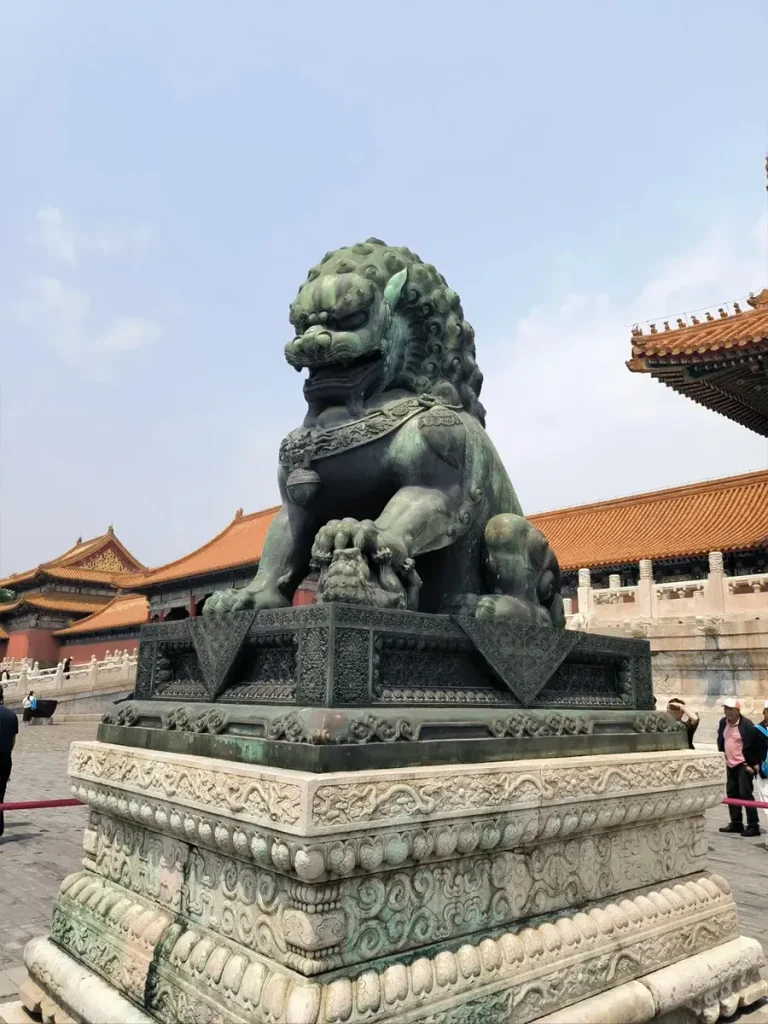

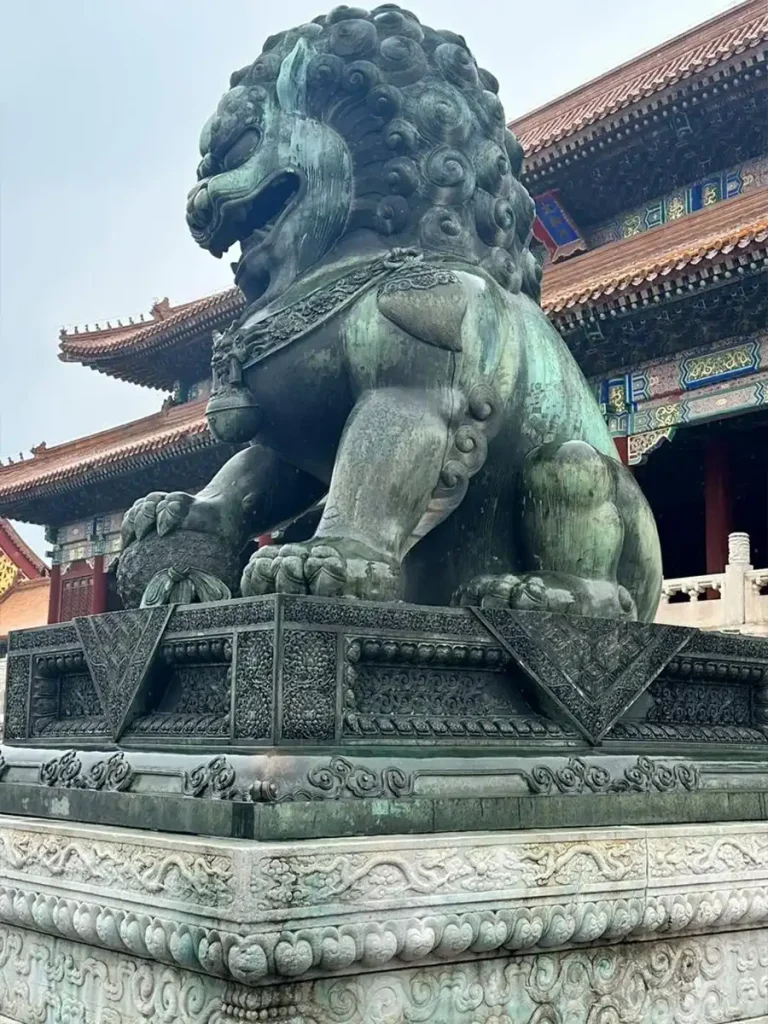

Within the Forbidden City, there are six or seven distinct pairs of lions, yet the lions at Taihe Gate stand apart for their lack of gilding. This deliberate choice highlights the raw, majestic power inherent in bronze. The placement of the lions follows strict rules of gender and orientation: viewed from inside the hall looking outward, the male lion stands on the left and the female on the right. A visitor facing the hall sees the female on the left and the male on the right. The male lion rests its right paw upon a brocade ball, a geometric sphere symbolizing the emperor’s dominion over the material world and global unity. Conversely, the female lion—more accurately termed the lioness—holds a cub beneath her left paw, representing the “spiritual” element, guardianship of the inner palace, and the continuity of the imperial bloodline.
Cast during the Ming dynasty and refined through Qing restorations, they guard the ceremonial heart of China’s imperial government. Their powerful stance, layered manes, and commanding expressions embody absolute sovereignty.
The curls of a lion’s mane serve as a crucial indicator of imperial rank. During the Ming and Qing dynasties, the number of curls guarding the lion’s mane was strictly regulated to reflect the status of the building’s occupant. The lions at the Gate of Supreme Harmony bear forty-five curls, a number derived from the “nine-five” principle in the Book of Changes, symbolizing the supreme authority of the Son of Heaven.
These lions are widely considered the definitive model for traditional palace guardians.
2. The Iron Lion of Cangzhou
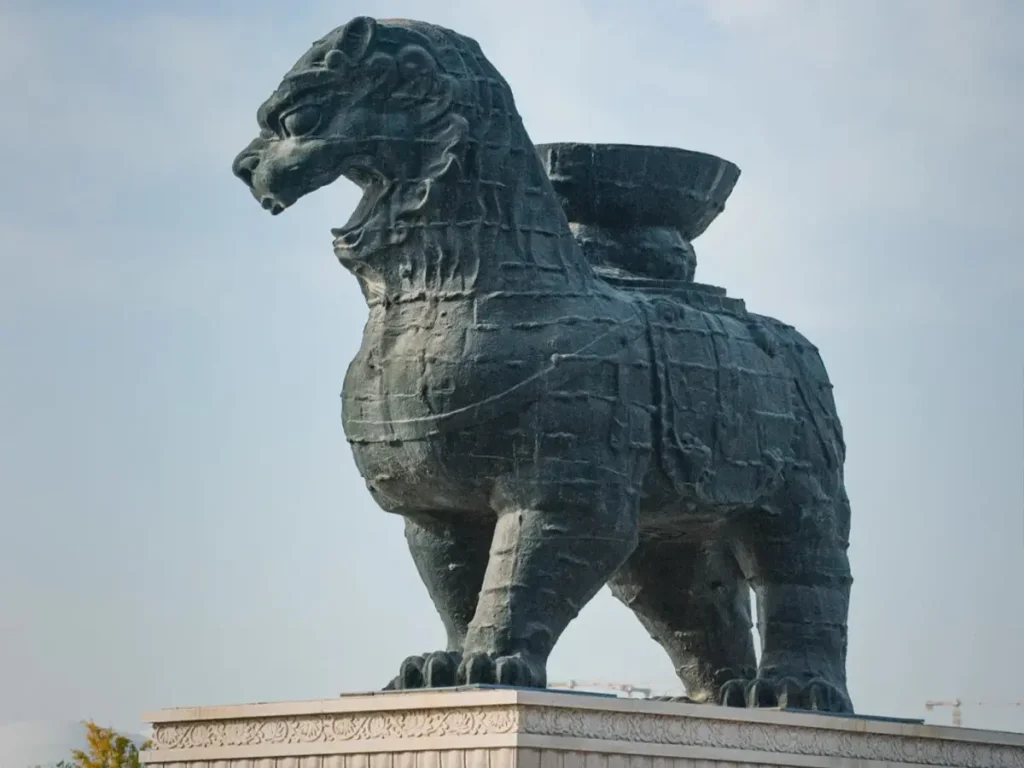
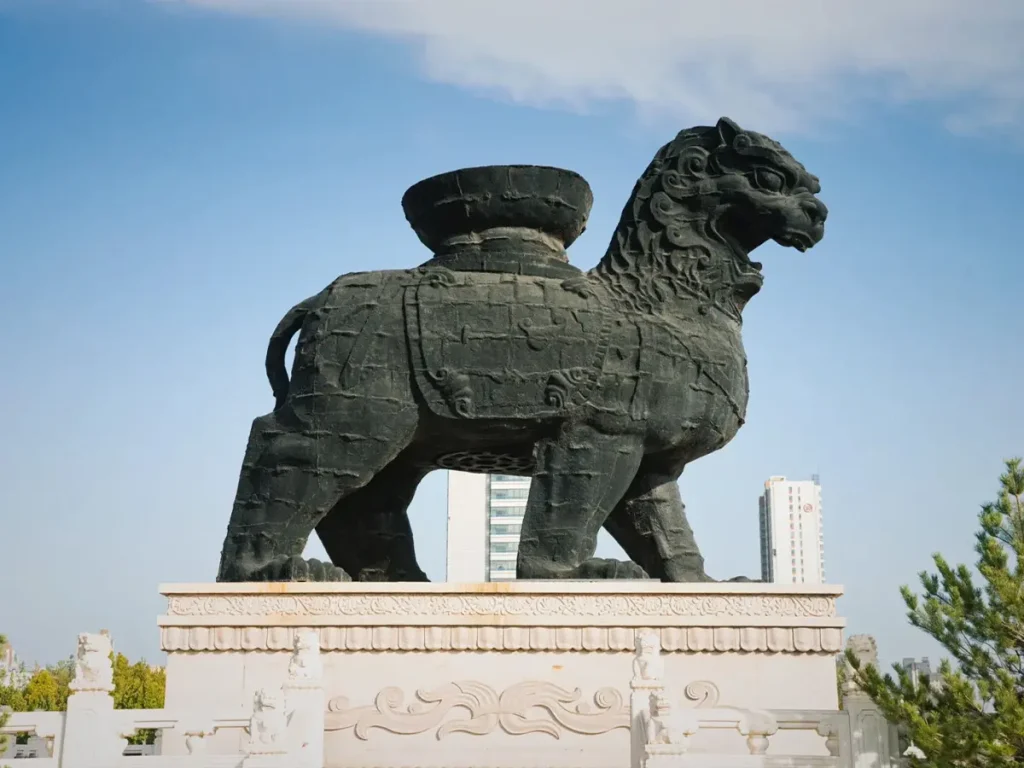

Located in Hebei Province, the Iron Lion of Cangzhou is one of the largest and oldest surviving iron sculptures in the world.
Cast in 953 AD during the Later Zhou dynasty, the statue weighs more than 30 tons. Its construction demonstrates extraordinary ancient casting technology, proving that large-scale metal sculpture was already highly advanced over a thousand years ago.
This iron lion is a masterpiece of the “segmented casting” technique, which originated from ancient bronze casting methods and was scaled up for industrial iron production. Research indicates the statue was formed by stacking 409 to 600 individual clay molds, with each layer cast sequentially. This multi-stage casting process is clearly visible in the “cold seams”—horizontal joints formed where newly poured molten iron met previously cast, partially cooled metal. While these seams create a distinctive grid-like aesthetic, they also represent structural vulnerabilities that have challenged the statue’s preservation efforts for over a millennium.
Despite centuries of weathering, the lion still projects remarkable strength and presence.
Caption: This lion statue originally served a religious purpose, bearing a bronze statue of Manjusri Bodhisattva seated on a lotus pedestal upon its back. Over the centuries, the statue suffered significant damage; its tail was lost as early as 1603, and its lower jaw disappeared after collapsing during a storm in 1803. Modern conservation efforts have proven exceptionally challenging. A protective pavilion built in 1957 accelerated corrosion due to trapped condensation; a 1984 attempt to fill the lion’s legs with sulfate compounds caused internal cracking. In 2007, the Chinese Academy of Cultural Heritage employed FARO 3D laser scanning technology to create a finite element analysis (FEA) model for structural reinforcement. The statue is currently supported by over 20 steel tubes.
3. The Lions of Lugou Bridge (Marco Polo Bridge)

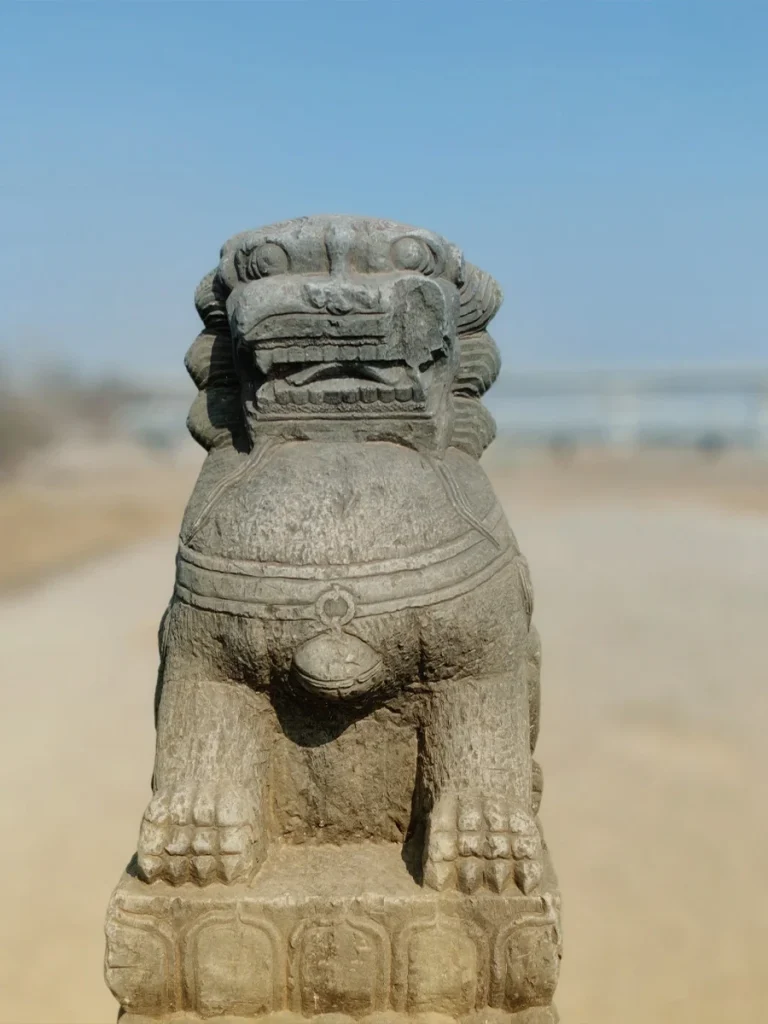
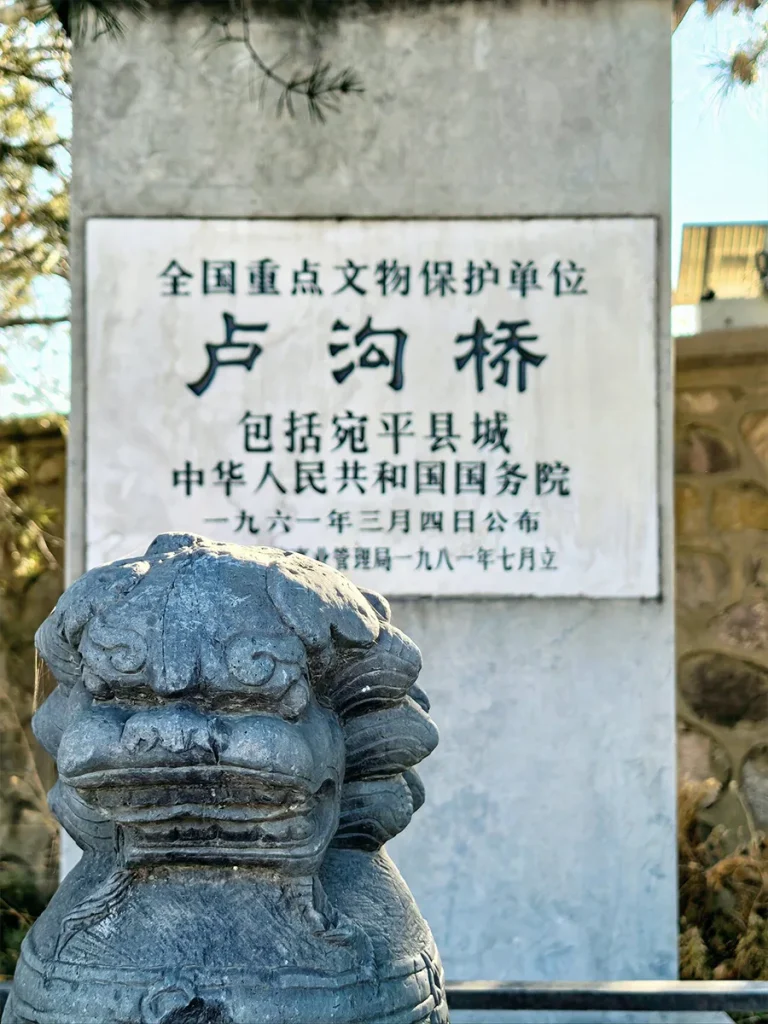


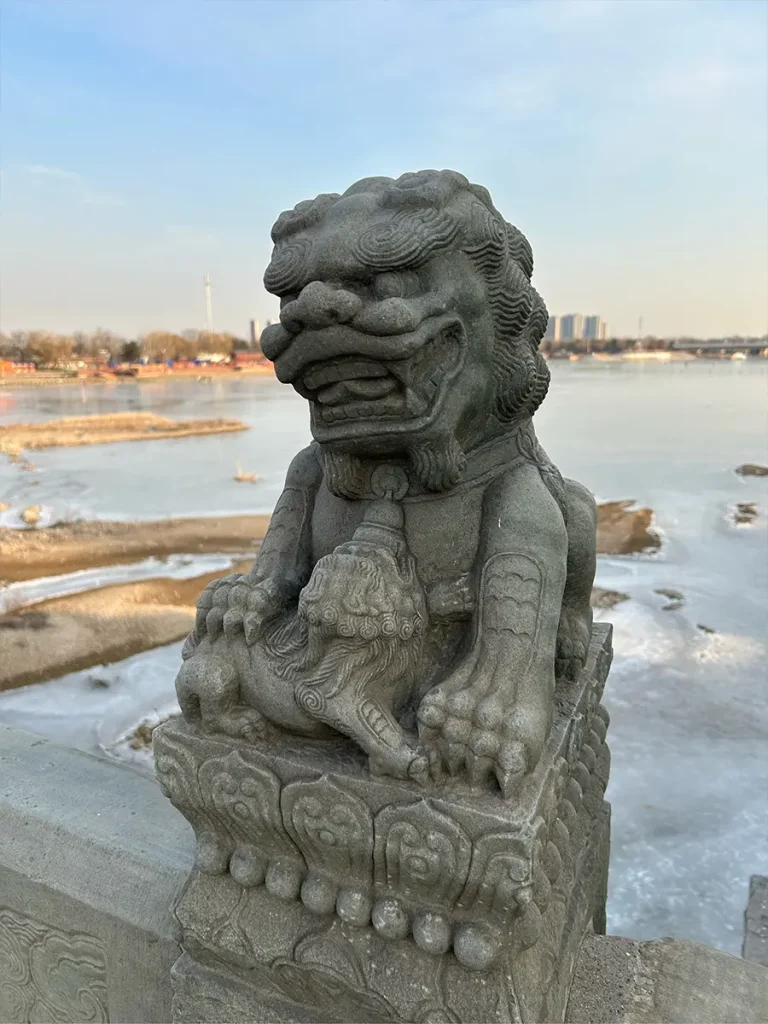
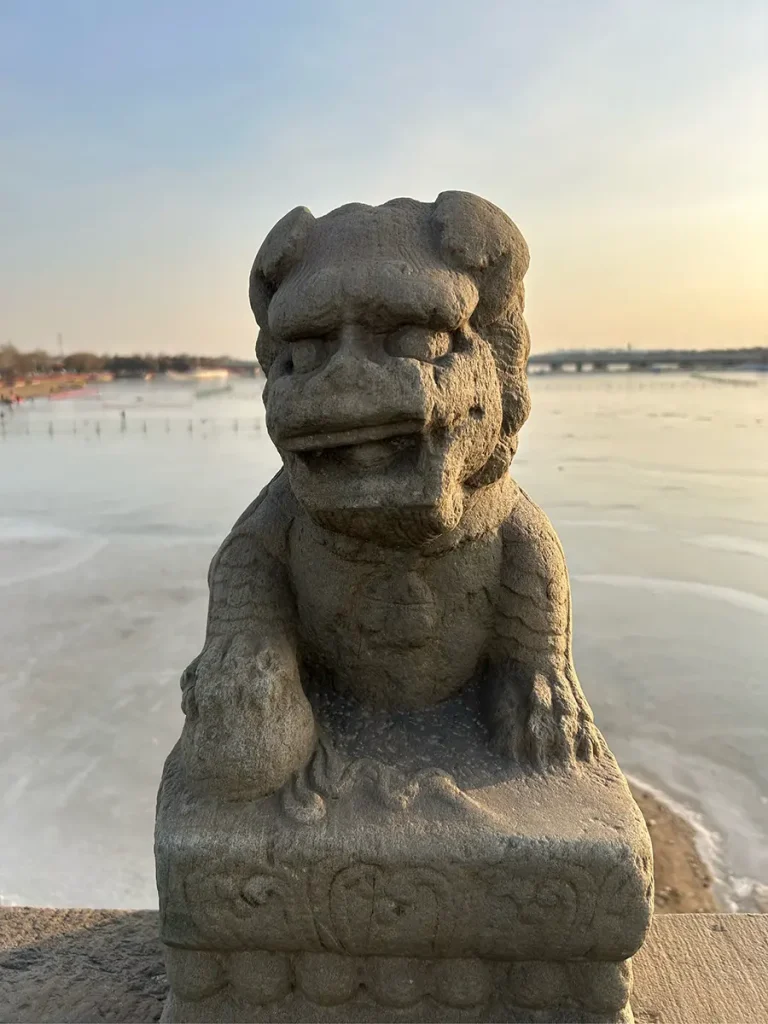


This bridge was originally constructed during the Jin Dynasty (1189–1192) and later rebuilt in the Qing Dynasty (1698), featuring a total of 281 balustrades. Each railing is topped with a stone lion, representing the cumulative development of Chinese sculptural art. Some of these lions date back to the Jin, Yuan, Ming, and Qing dynasties.
The stone bridge is famous for the hundreds of small lions carved along its balustrades. Each lion features unique posture, facial expression, and decorative elements, showcasing astonishing intricate detailing.
For decades, official counts of the lion population have been inconsistent. A 1962 census recorded 485 lions; by 1979, another survey found 17 more, bringing the total to 502. Earlier records suggest the original lion population may have reached 627. Beyond its aesthetic reputation, the bridge also stands as a symbol of national memory, marking the July 7, 1937 Marco Polo Bridge Incident that triggered the full-scale outbreak of the Second Sino-Japanese War. Bullet holes remain visible on the nearby Wanping City Wall, bearing witness to that conflict.
4. The Stone Lions of the Ming Dynasty Tombs

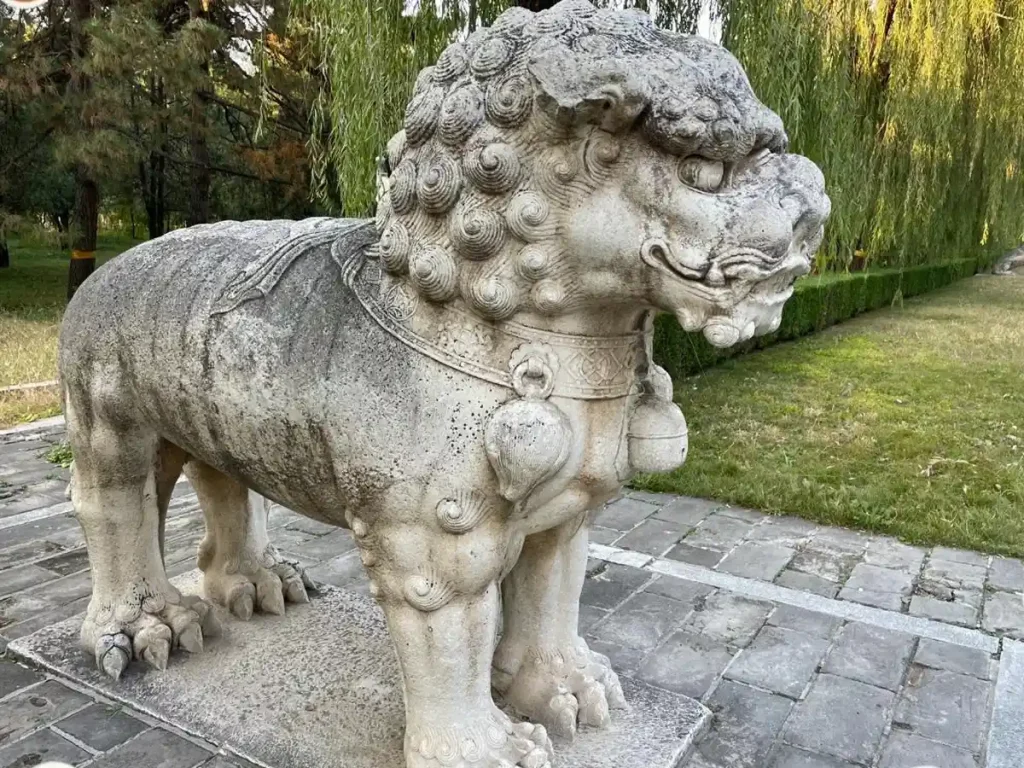

Among the Ming Dynasty tombs near Beijing lies a “Sacred Way,” the final ceremonial passage for thirteen emperors. Flanking this path stand 24 stone animal sculptures and 12 stone human figures, with lions occupying positions of “solemn majesty.”
Monumentalism and the Sacred Way Protocol
Carved from massive limestone blocks, the Spirit Way lions far exceed life-size, emphasizing solemn grandeur over intricate detail. The procession includes four lion statues: two standing and two crouching. The standing lions symbolize the eternal presence of imperial power, while the crouching lions represent the repose of the deceased and eternal peace.
The lions’ forms are “majestic and unadorned,” an aesthetic choice reflecting the Ming dynasty’s fixation on national perpetuity. Unlike playful lions found in imperial courts, these tomb guardians were intended to “endow the deceased with their former strength” to protect the mausoleum from malevolent spirits. The spirit path itself begins with China’s earliest and largest stone-carved archway, constructed in 1540. Beside it stands a 50-ton tortoise-bearer (pi xiu) carrying a stele inscribed with the deceased’s achievements.
5. The Southern Style Lions of Hui’an (Fujian)
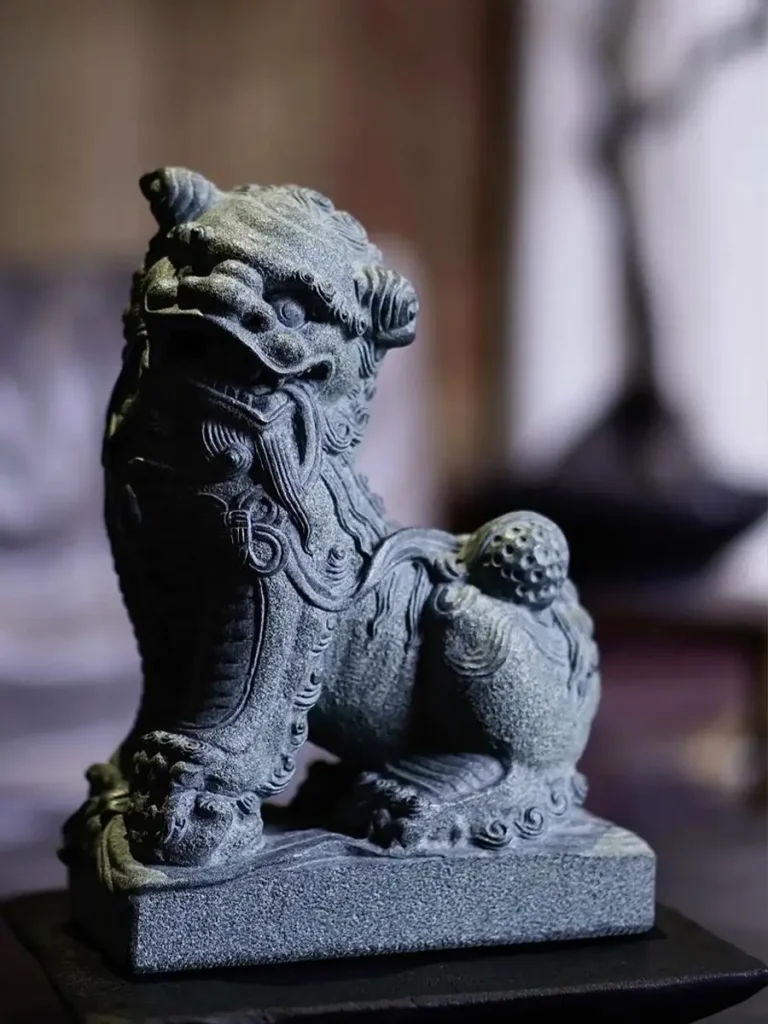

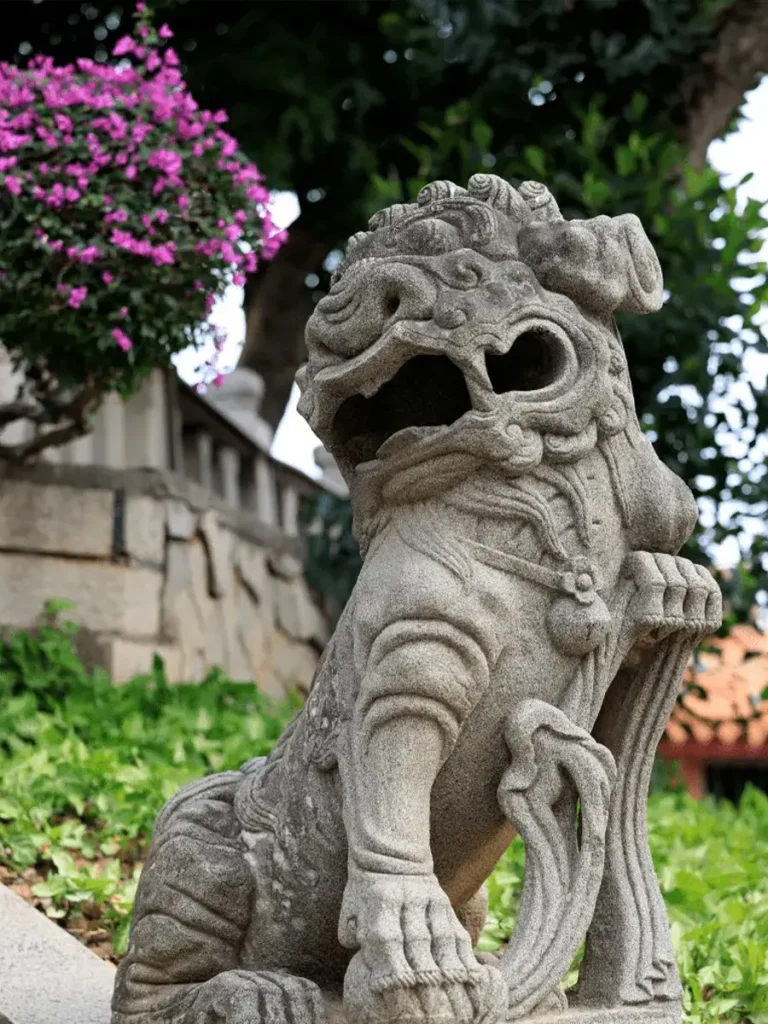


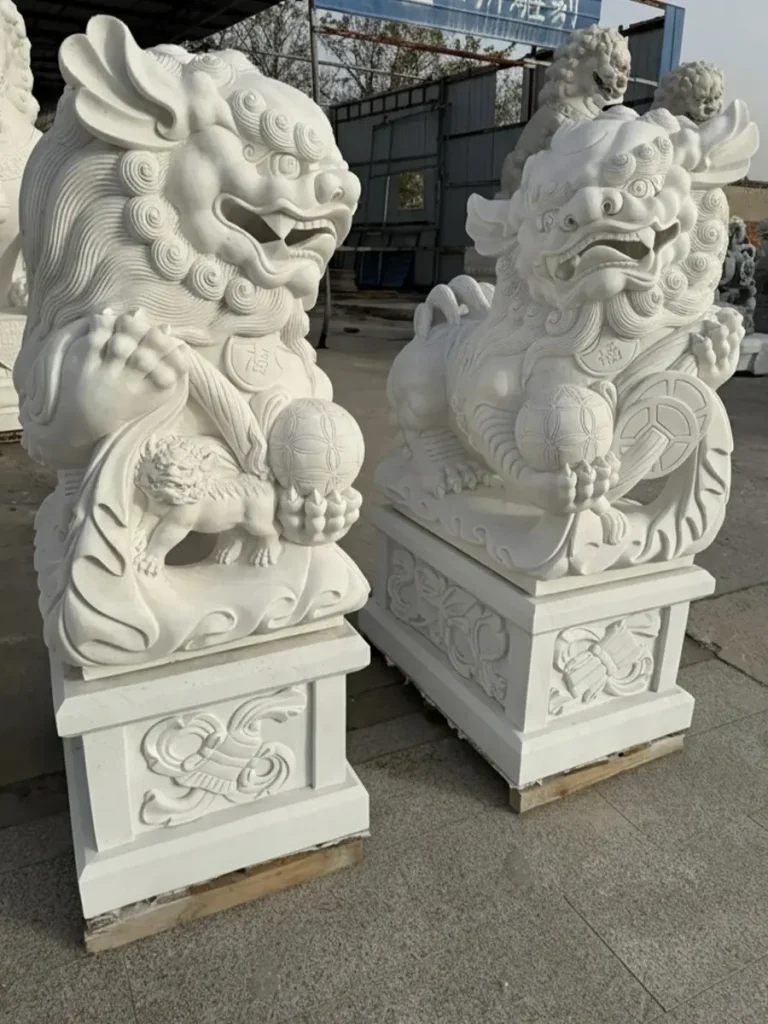


The imperial style of the north emphasizes strict symmetry and solemnity, while the stone carving town of Huian in Fujian Province has developed a distinctive “southern style.” This tradition has been recognized as a national intangible cultural heritage, representing the outstanding stone carving craftsmanship of southern China.
Hui’an lions are characterized by their “lively and vivid” nature. They typically abandon the solemn, angular forms of northern lions in favor of slender, agile postures adorned with colorful ribbons, bells, and flowing sashes. Their bodies are often depicted in motion—manes tousled, eyes wide, mouths agape—embodying the playful spirit of Fujian’s vibrant coastal folk culture.
Hui’an’s production process follows four key steps:
Kneading: Material preparation and selection of premium granite.
Hollowing: Carving out the stone to create intricate, lightweight details.
Extraction: Roughly shaping the lion’s form.
Fine Carving: Detailed rendering of the mane, ornaments, and facial expressions.
This style blends indigenous Min-Yue culture with exotic influences introduced via the Maritime Silk Road, earning international recognition for its works in Southeast Asia.
6. Commercial Sentinels: HSBC Lions (Hong Kong)


The lions of the Bank of China represent the struggle between modernism and tradition, while HSBC’s lions—Stephen and Stitt—embody the ultimate fusion of Western naturalism and Chinese feng shui.
Stephen and Stitt: History and Namesakes
Commissioned in 1935 for HSBC’s third headquarters in Hong Kong, these bronze lions were modeled after an earlier pair in Shanghai. Unlike traditional Chinese bronze lions, both HSBC lions are male. The roaring lion on the left is named “Stephen” (after Alexander Stephen, the General Manager who first proposed the commission), while the serene lion on the right is named “Stitt” (after Gordon Stitt, the Shanghai Manager).
Interpretation of the Lions’ Names, Postures, and Roles
Stephen roars (mouth open), symbolizing proactive strength and vigilance.
Stitt remains still (mouth closed), representing inner strength and tranquil prosperity.
These lions are iconic landmarks in Hong Kong, often playfully referred to by locals as the “Lion Bank.” During the 1941 Battle of Hong Kong, the lions sustained damage from shrapnel, scars of which remain visible today. Similar to the lions in Shanghai, passersby frequently touch them, believing that doing so will “rub off power and wealth.”
From Imperial Palaces to Modern Gardens: Yun Sculpture’s Interpretation
While the historic lions of China stand in palaces, temples, and monuments, their legacy continues in modern architectural design. Today, estates, luxury gardens, hotels, and cultural spaces often incorporate guardian lions as dramatic focal points and protective symbols.
At Yun Sculpture, we study the exact proportions and stylistic principles of these historical masterpieces. By adapting them for modern settings, we help clients bring imperial symbolism into contemporary landscapes.
7. The Classic Imperial Replica


Inspired directly by the Forbidden City guardians, this design faithfully reproduces the commanding proportions of the imperial lions.
Scaled appropriately for private estates, these sculptures preserve the same authoritative posture and layered mane structure that defined palace entrances. The result is a guardian pair that radiates historic power and authenticity.
8. The Modern Minimalist Guardian


Some contemporary architectural spaces require a cleaner aesthetic. For these environments, sculptors reinterpret the lion using simplified forms and smooth surfaces.
The result is a sleek guardian figure that functions as a powerful architectural accent while maintaining the symbolic role of protection.
This approach allows traditional symbolism to coexist with modern design language.
9. The Custom Bronze Estate Lion
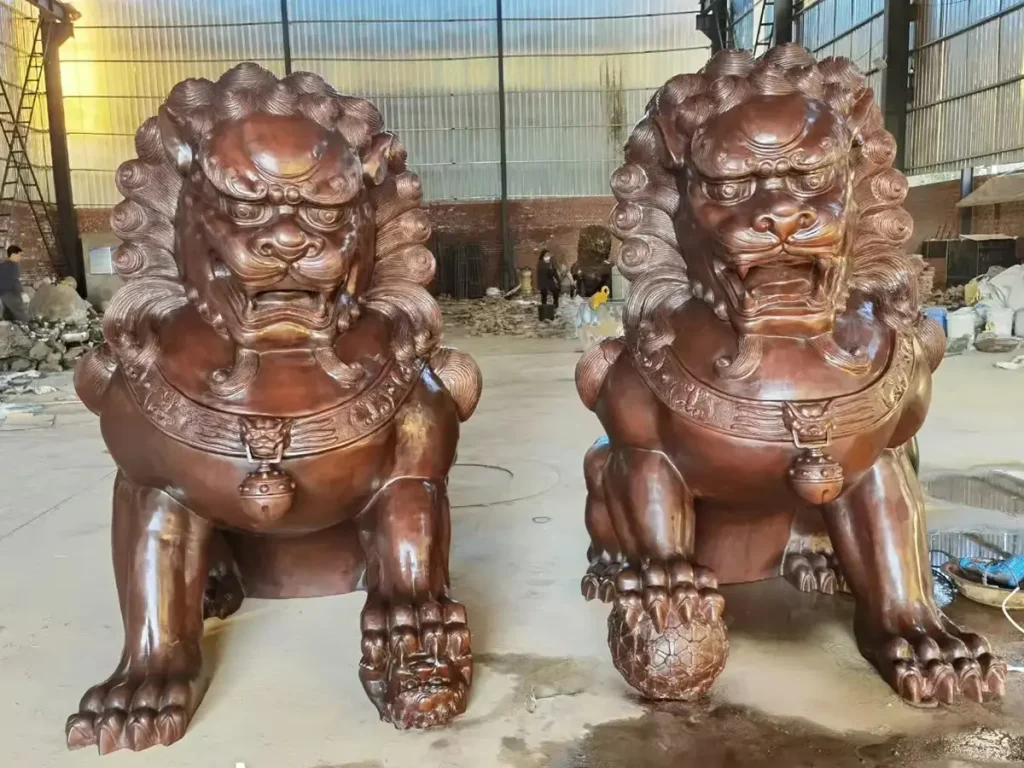
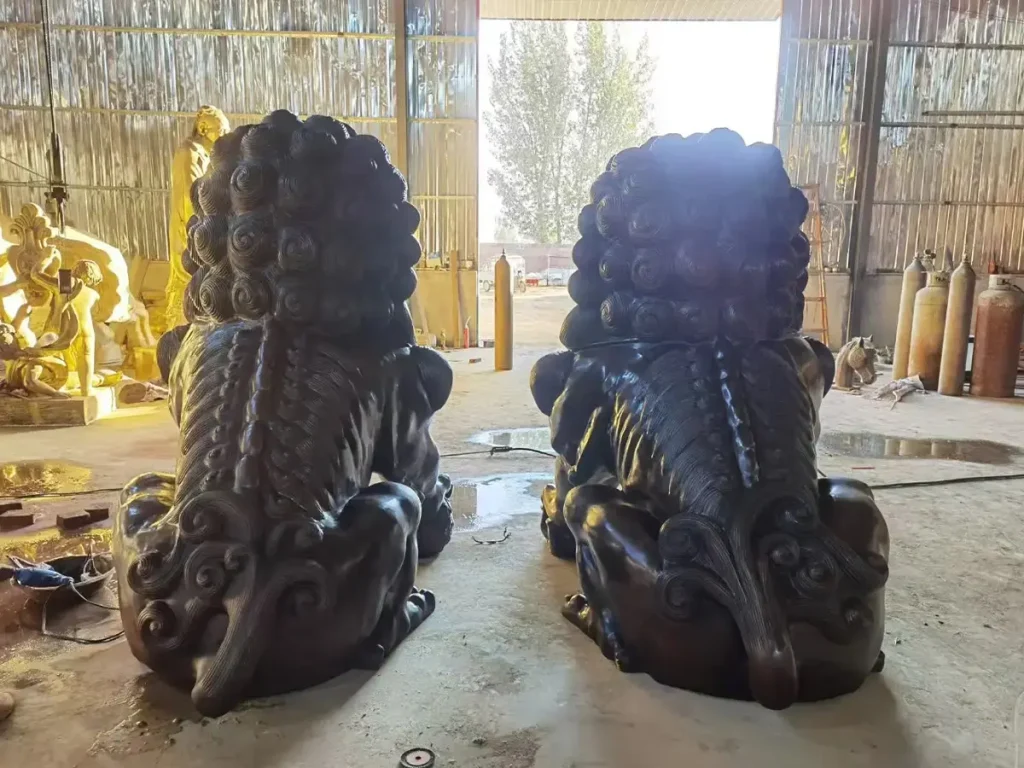
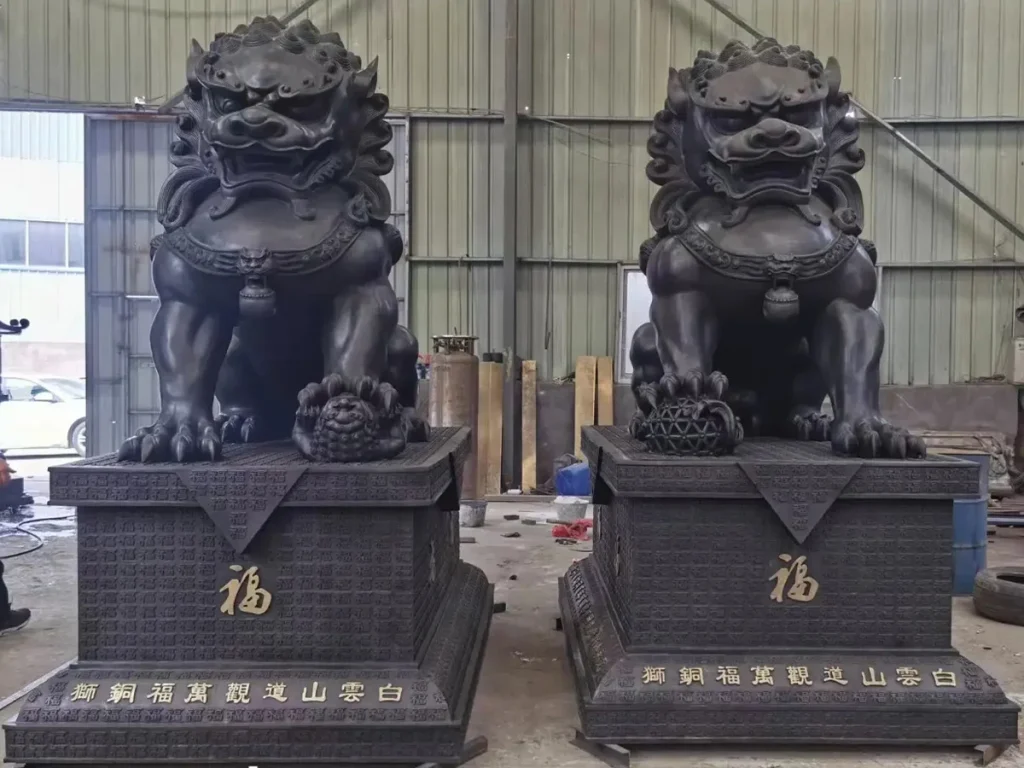
For large estates and luxury properties, custom-cast bronze lions offer the most dramatic presence.
These statues are individually designed and cast in our foundry, allowing full customization of size, posture, and detailing. From powerful imperial styles to modern interpretations, each pair is created specifically for the property it will guard.
At Yun Sculpture, we borrow the exact proportions of these historical masterpieces to craft large outdoor stone and bronze lions with royal aura for your property.
Choosing Your Guardian: Large Outdoor Foo Dog Statues & Materials
Selecting the right guardian lions is both an artistic and architectural decision. When commissioning Large foo dog statues for a grand residence, hotel entrance, or corporate plaza, the material used will determine not only appearance but also durability for decades to come.
An Outdoor guardian lion must withstand wind, rain, sunlight, and seasonal temperature changes. At the same time, it must retain the powerful visual authority that makes these statues effective architectural guardians.
Today, property owners increasingly request custom outdoor foo dogs designed specifically for their entrance scale and architectural style. A villa gate may require statues over six feet tall, while a landscaped courtyard may call for more refined proportions.
Material choice is therefore critical. It affects carving methods, installation requirements, weather resistance, and the overall artistic expression of the sculpture.
Among the many materials available, two remain the undisputed standards for large outdoor installations: stone and bronze.
Bronze vs. Stone: Selecting the Best Material for Your Entryway
Both stone and bronze have been used for guardian lions for more than a thousand years. Each material carries its own aesthetic character, manufacturing process, and structural advantages.
The best choice depends on the architectural language of the property and the atmosphere the owner wishes to create.
Stone: Timeless Monumental Presence
Stone remains the most traditional material for guardian lions. The vast majority of historic temple and palace lions were created through hand-carved stone, a method that requires exceptional skill and patience.
Master stone carvers begin with massive blocks of granite, marble, or limestone. Using chisels and pneumatic tools, they gradually reveal the lion’s posture, mane, and facial features. The process can take weeks or even months depending on size and complexity.
This carving technique produces sculptures with a powerful sense of permanence. Their surfaces carry subtle tool marks and natural textures that evoke the appearance of antique foo dogs found in ancient temple courtyards.
For large installations, stone also provides outstanding structural integrity. A properly carved stone guardian can weigh several tons, giving the statue immense stability against wind and impact.
In modern landscaping, some designers also choose weather-resistant concrete for large guardian lions. High-grade architectural concrete can replicate the look of carved stone while allowing greater flexibility in scale and production speed.
The result is a statue that feels grounded, monumental, and deeply connected to historic tradition.
Bronze: Prestige and Sculptural Detail
While stone offers timeless solidity, Bronze foo dog statues represent the highest level of sculptural craftsmanship.
Bronze lions are created through the ancient lost-wax casting method, a process that allows extremely precise detail and dramatic sculptural depth.
The procedure begins with a full clay model sculpted by an artist. A mold is then created, and a wax replica is produced. After layers of refractory material are applied, the wax is melted away, leaving a cavity into which molten bronze is poured.
Once cooled, the bronze casting is removed, refined, and welded if necessary. Sculptors then add final details by hand before applying surface treatments.
The final stage is patina finishing, where chemical solutions are applied to the metal surface to create rich tones ranging from deep brown and antique green to dark chocolate bronze. This patina not only enhances visual depth but also protects the metal from corrosion.
Bronze lions possess remarkable presence. Their surfaces capture light beautifully, highlighting every curl of the mane and every fold of the muscles.
For luxury estates, hotels, and civic plazas, bronze guardians are often considered heirloom sculptures—artworks designed to last for generations while gradually developing even richer patina with age.
Frequently Asked Questions About Foo Dogs
1. Are they lions or dogs?
Despite the popular Western name, Foo Dogs are not dogs at all. In Chinese culture, they are always called Shishi, which translates directly to “stone lions.” Ancient sculptors based these guardians on Asiatic lions, animals that became known in China through early trade routes.
The name “Foo Dogs” emerged when Western travelers first encountered the statues and noticed their resemblance to Chinese dog breeds such as Chow Chows or Pekingese. Over time, the nickname remained in English, even though historically and culturally they are stylized lions created by ancient artists.
2. How can I quickly tell the male from the female?
The easiest way to distinguish the guardians is by observing their paws. The male lion places his right paw on a decorative ball, symbolizing power and dominion over the external world.
The female lion places her left paw on a cub, representing nurturing energy and protection of the family. Together, the pair symbolizes balance between authority and care, a classic Yin and Yang relationship.
3. What are the correct Feng Shui placement rules?
Traditional Feng Shui follows a very specific rule for positioning guardian lions. When standing inside a building and looking outward through the entrance, the male lion must stand on the left side and the female lion on the right.
Both statues should always face outward toward the street or entrance path. This orientation ensures the guardians confront negative energy before it can enter the home or property.
4. What do the lumps or curls on the lion’s head represent?
The decorative curls on a guardian lion’s mane were once more than simple ornamentation. In ancient China, the number of curls represented the rank of the official or institution that owned the statue.
For example, a first-grade imperial official could display lions with 13 curls on the head. As rank decreased, the permitted number of curls also declined. Today this strict rule is no longer enforced, and sculptors freely use elaborate curling manes for aesthetic purposes.
5. Why is one mouth open and the other closed?
The open and closed mouths of guardian lions symbolize a sacred philosophical concept tied to the cycle of existence. The open mouth forms the sound “A,” representing the beginning of all things.
The closed mouth forms the sound “Un,” representing the end. Together they create the sacred sound “Om,” symbolizing the origin and completion of the universe.
6. If lions are not native to China, why are they guardian beasts?
Lions originally entered Chinese cultural awareness through diplomatic gifts and trade along the Silk Road. These exotic animals impressed early Chinese observers with their strength and commanding presence.
Buddhist symbolism soon elevated lions into sacred guardians. They became associated with divine protectors such as the bodhisattva Manjushri, who is traditionally depicted riding a lion. From temples, the symbol spread to imperial palaces and eventually private homes.
7. What does the “unremovable ball” in the lion’s mouth mean?
Some guardian lion sculptures feature a mysterious ball carved inside the creature’s open mouth. This sphere represents the “Pearl of Wisdom.”
It also demonstrates the remarkable craftsmanship of ancient stone carvers. The ball is carved directly from the same block of stone as the lion’s head, yet it is larger than the opening between the teeth, making it impossible to remove without breaking the sculpture.
8. What is the aesthetic difference between Northern and Southern Chinese stone lions?
Chinese guardian lions evolved into two major stylistic traditions. Northern lions, such as those seen in the Forbidden City, appear majestic, solemn, and disciplined. Their design reflects imperial authority and architectural order.
Southern lions, particularly those carved in places like Hui’an in Fujian Province, are more lively and decorative. They often feature ribbons, bells, and expressive poses, reflecting a vibrant regional artistic culture.
9. Why did the Yuan Dynasty sometimes reverse the left/right placement?
During the Yuan dynasty, which was ruled by Mongol emperors, a unique cultural variation appeared in guardian lion placement. The Yuan court traditionally viewed the right side as the superior position, unlike earlier Chinese traditions.
Because of this belief, some Yuan-era entrances placed the male lion on the right and the female on the left. This arrangement differs from the Ming and Qing dynasty rules that later became the widely accepted standard used today.
10. Can stone lions really “predict disasters”?
A fascinating folk legend suggests that guardian lions can warn people of approaching disasters. According to traditional stories, the statues’ eyes would supposedly turn red before floods, earthquakes, or other calamities.
While there is no scientific evidence supporting this idea, the belief reflects the deep trust and psychological comfort people placed in these protective symbols. For centuries, guardian lions represented security, vigilance, and the hope that powerful forces stood watch over the community.