Get in touch with Yun-Sculpture company
Golfer Statue: How to Choose the Right One for Home, Office & Golf Course

A golfer statue means something different depending on where it lives. On a desk in a home office, it is a personal statement — a small permanent reminder of something that matters. At the entrance of a country club, it is an institutional declaration, a landmark that defines the character of the space for everyone who passes through. On the fairway of a private course, it becomes part of the landscape itself, something that will still be standing when the person who commissioned it is long gone. The choice between these contexts is not just a question of size. It is a question of what you want the object to do, and how long you want it to do it.
Table of Contents
Table of Contents
The Three Lives of a Golfer Statue
Most buyers approaching a golfer statue for the first time are thinking about one specific context — a desk, a garden, a clubhouse. But it is worth stepping back to see how differently the same subject can function across settings, because the setting determines almost everything: material, scale, permanence, and what the object is actually communicating.
In the home, a golfer statue is intimate. It sits at desk height, at eye level when you are seated, and it speaks to one person — the person who placed it there. It does not need to communicate across a distance. It does not need to withstand freeze-thaw cycles or anchor bolts. It needs to be beautiful at close range, to hold its detail when someone reaches over and picks it up, to feel like the right weight in the hand. These are the qualities that matter at this scale, and they are entirely different from the qualities that matter at life-size.
In the office — particularly the professional office of a serious golfer, a club president, or a corporate executive whose identity is partly built around the game — a golfer statue becomes a conversation piece. It signals something about the person who placed it there: their relationship to the game, their aesthetic sensibility, the level of seriousness with which they approach things they care about. A resin figurine from a golf pro shop communicates something. A bronze sculpture on a marble base communicates something else entirely. Both are golfer statues. The difference in what they say is significant.
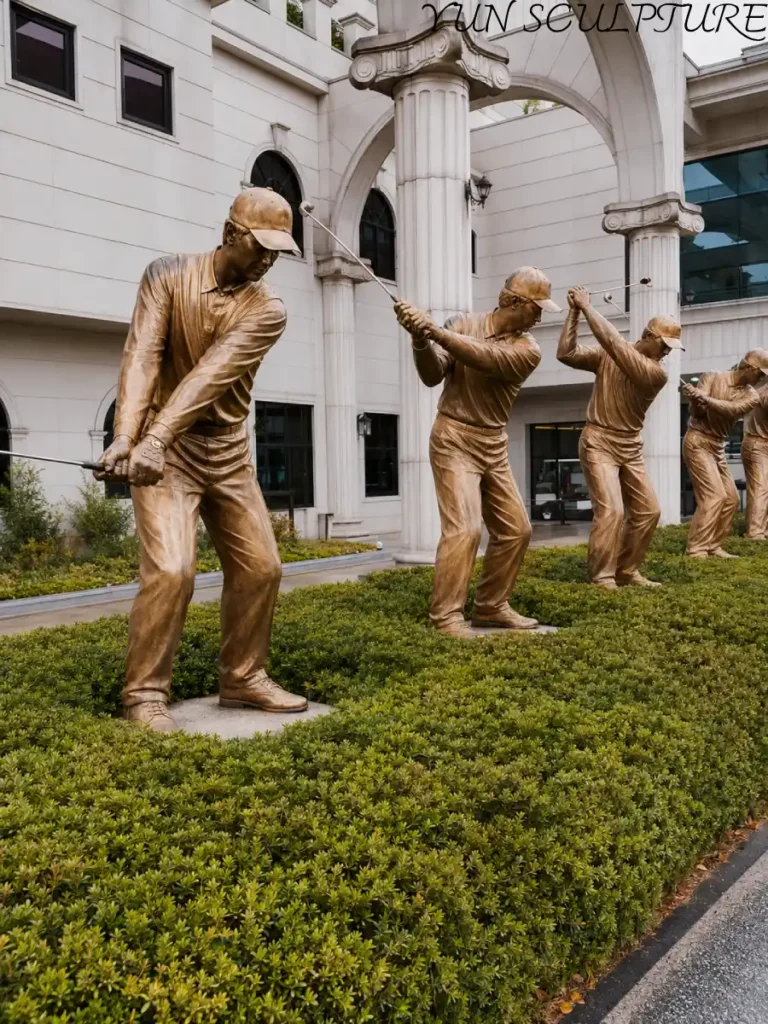
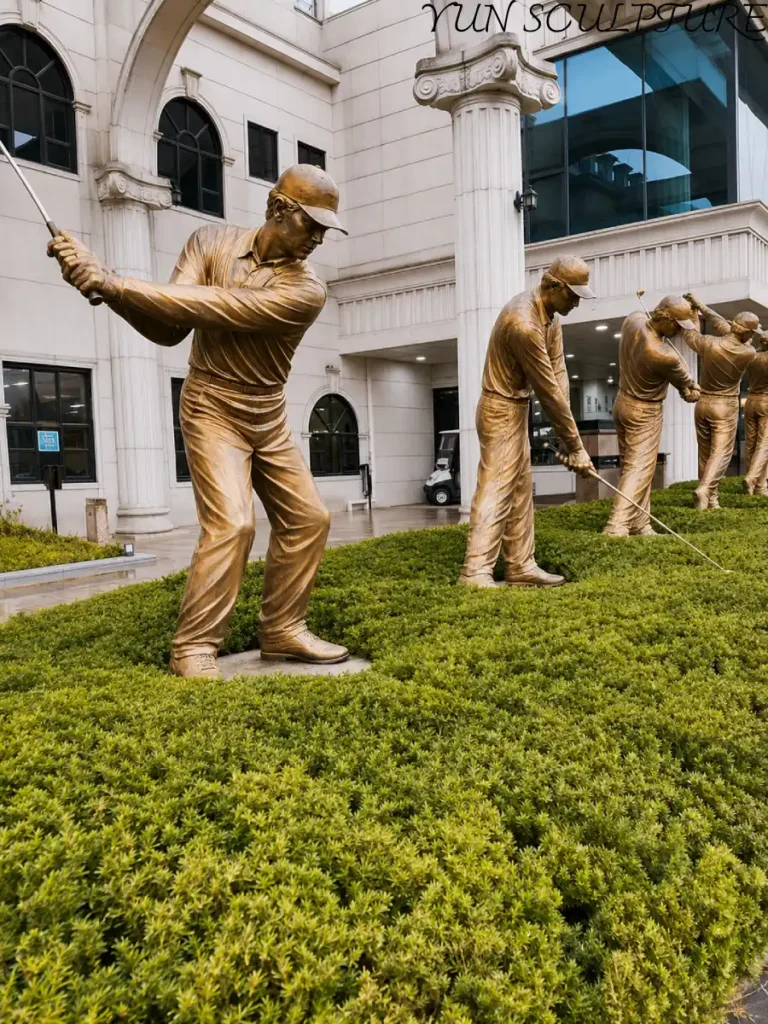
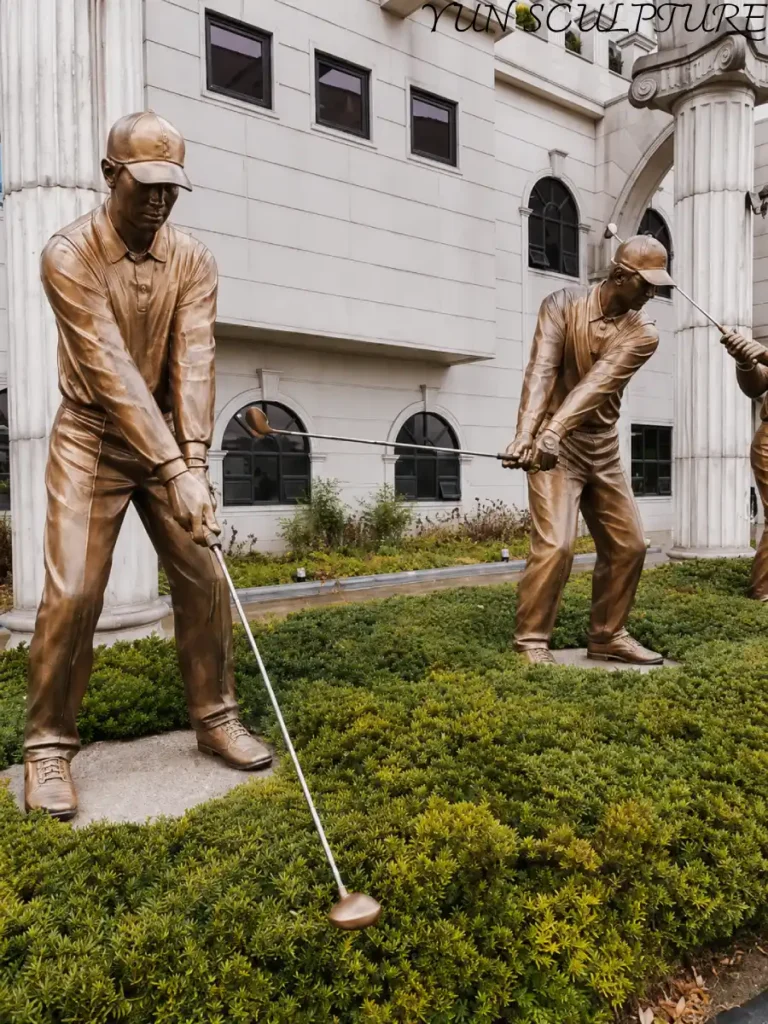
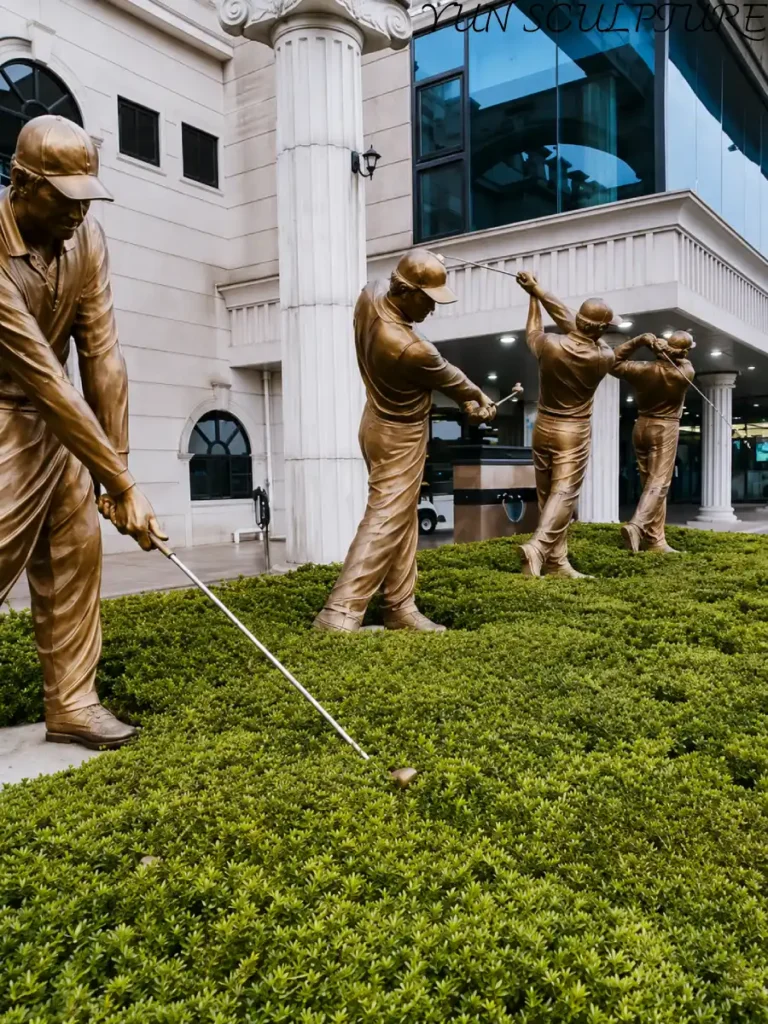
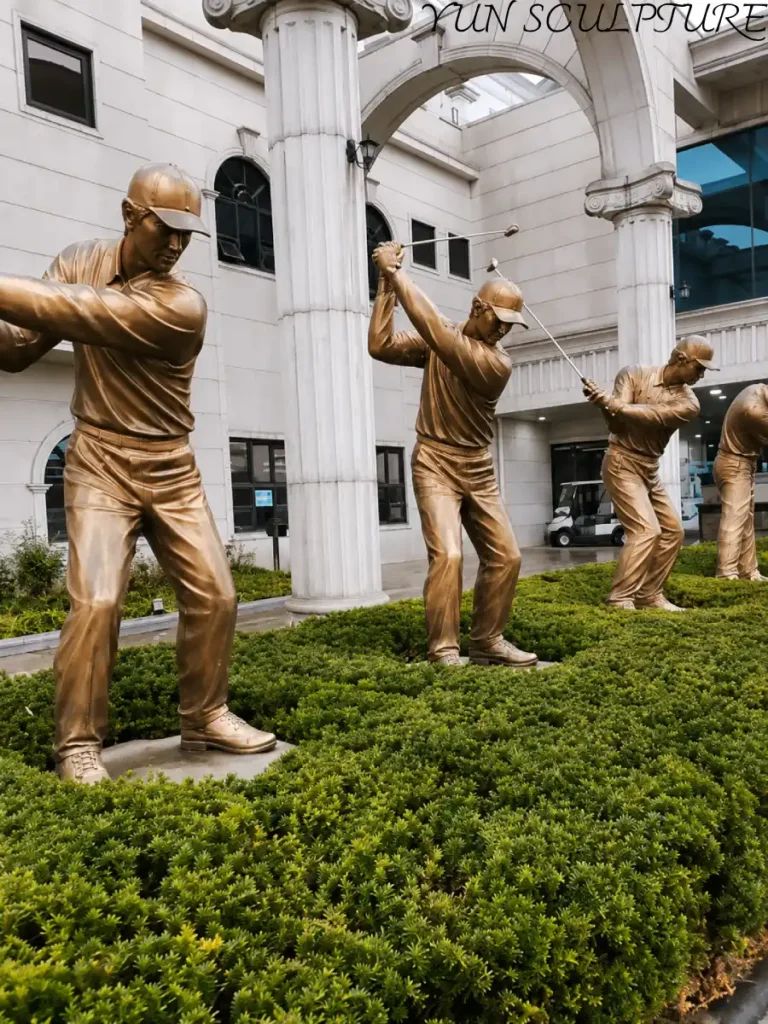
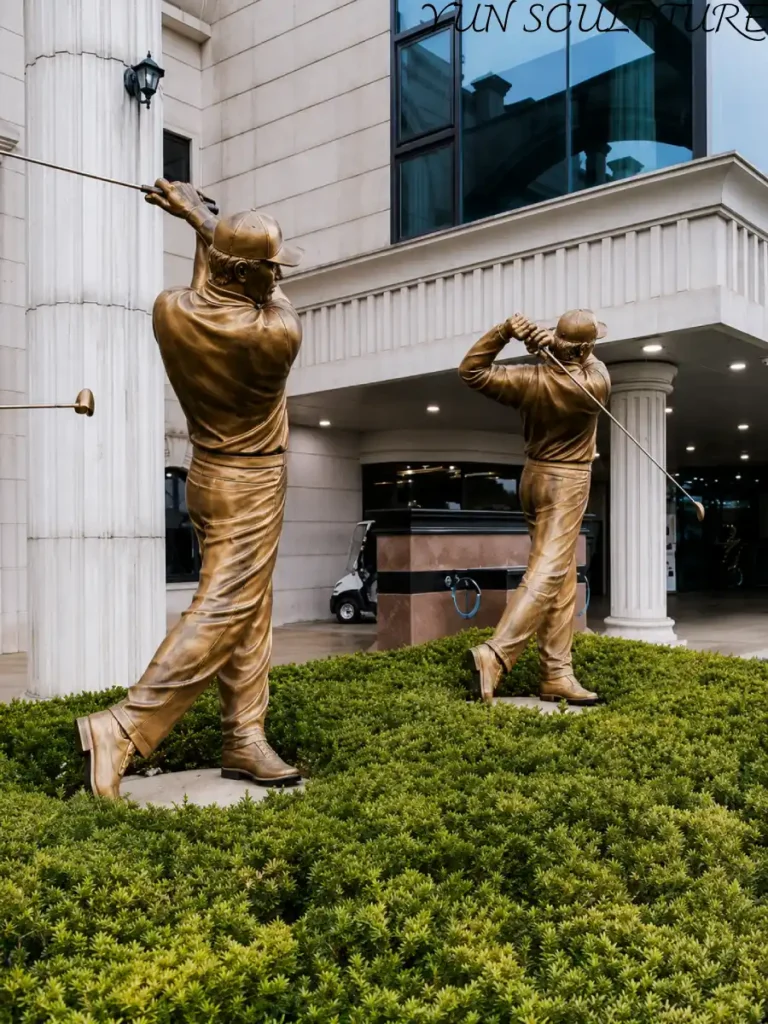
At the golf course itself — at the entrance, on the fairway, in the clubhouse garden — a golfer statue becomes part of the institution’s identity. The most famous example most golfers know without knowing they know it: the Payne Stewart statue at TPC Sawgrass, commissioned after his death in 1999, which captures him in his iconic fist-pump pose at the 17th hole. That statue is not decoration. It is memory made permanent. Every serious golf club installation aspires, consciously or not, to that standard — the sense that this figure belongs here, that it has always belonged here, that the space would be incomplete without it.
Setting 01
Home Office & Study
- Scale: tabletop to half life-size
- Material: bronze or quality resin
- Pose: putting or at-rest
- Priority: detail fidelity at close range
- Budget: $800 – $3,000
Setting 02
Professional Office & Reception
- Scale: half to three-quarter life-size
- Material: foundry bronze only
- Pose: at-rest or swing
- Priority: material presence, visual authority
- Budget: $2,000 – $6,000
Setting 03
Golf Club & Course
- Scale: life-size to heroic
- Material: foundry bronze, outdoor spec
- Pose: custom to site and institution
- Priority: permanence, institutional identity
- Budget: $3,500 – $40,000+
Choosing by Setting: What Each Space Actually Needs
The home office or study is the most personal setting and the one where the widest range of materials is appropriate. A bronze desktop figure on a marble base is the most enduring choice — bronze ages beautifully indoors, requires no maintenance, and develops a stable, deep surface character over years. But a well-cast resin piece at this scale is also defensible: indoors, protected from UV and freeze-thaw, a quality resin figure can hold its surface for decades. The key distinction is in the detail. A high-quality bronze casting can hold surface texture — fabric weave, grass texture underfoot, the specific geometry of a club grip — that resin simply cannot reproduce with the same fidelity. If the piece is going to live at arm’s reach, that detail fidelity matters.
The professional office — conference room, reception area, executive suite — calls for a different scale and a more considered material choice. At this setting, the statue will be seen by clients, colleagues, and guests. It is part of the visual environment of the business, and it reflects on the taste and judgment of the person responsible for the space. Bronze is the right material here, unambiguously. The weight and color of genuine bronze reads as serious in a way that resin, however well-finished, does not. A bronze golfer on a substantial base, positioned where it catches natural light, does something a plastic figurine simply cannot: it makes the space feel considered.
The golf course installation is a category of its own. Here, the questions are entirely different: what is the primary viewing distance? What is the wind exposure? What kind of foundation is the site prepared for? What does the club’s existing architectural language call for — classical figuration or something more contemporary? These are questions for a longer conversation, and they almost always lead to a custom commission rather than a catalog selection. The pose, the scale, the patina color, the base design — all of these need to be resolved in relation to the specific site and the specific institution. A statue placed at a club entrance will be seen by tens of thousands of people over its lifetime. That is a different kind of responsibility than a desktop figure, and it deserves a different kind of process.
Pose and What It Communicates
The pose of a golfer statue is not a neutral choice. Each moment in the golf swing carries its own energy, and that energy is what the space around the statue will absorb.
The full swing — club at the top of the backswing or extended through impact — is the most dynamic pose and the one that reads best at distance. It captures the sport at its most athletic, its most concentrated. For outdoor installations visible from across a fairway or at the end of a long drive, the swing pose has visual authority that a standing figure cannot match. The extended club creates a strong diagonal line that draws the eye and announces itself across space.
The putting stance — figure bent slightly forward, club held lightly, eyes down — is more contemplative. It suits enclosed settings: a garden courtyard, a terrace, an indoor lobby where viewers will approach at close range. The quiet intensity of the putting stance invites the viewer to step closer, to look at the detail, to feel the concentration of the moment. It is not a pose that announces itself across a distance, but at five meters it is more compelling than any swing.
The at-rest figure — standing with club at side, looking toward the horizon or slightly downward — is the most versatile and, in many ways, the most enduring. It does not depend on the energy of movement; it depends on the quality of the figure itself — the weight of the posture, the character of the face, the sense that this person has just finished something and is thinking about what comes next. The great portrait statues of golf history tend toward this pose: Payne Stewart’s fist-pump is an exception, not the rule. The at-rest figure works at any viewing distance and ages better than dynamic poses because it does not become dated the way that captured movement sometimes can.
| Pose | Energy | Best Viewing Distance | Best Setting | Versatility |
|---|---|---|---|---|
| Full Swing | Dynamic, athletic, powerful | 10 m and beyond | Club entrance, fairway landmark, wide outdoor space | Moderate — strong at distance, less intimate up close |
| Putting Stance | Concentrated, contemplative, quiet | 2–8 m | Garden courtyard, terrace, indoor lobby, study | Moderate — excellent at close range, weak at distance |
| At Rest | Reflective, authoritative, timeless | Any distance | All settings — home, office, club, garden | High — the most versatile pose across contexts |
| Address Position | Focused, precise, poised | 3–10 m | Medium-scale outdoor or large interior settings | Moderate — reads well at mid-range |
Material by Setting: The Honest Guide
The material question for golfer statues is often confused by marketing language — “bronze finish,” “antique bronze,” “cold-cast bronze” — that describes appearances rather than materials. Here is the straightforward version.
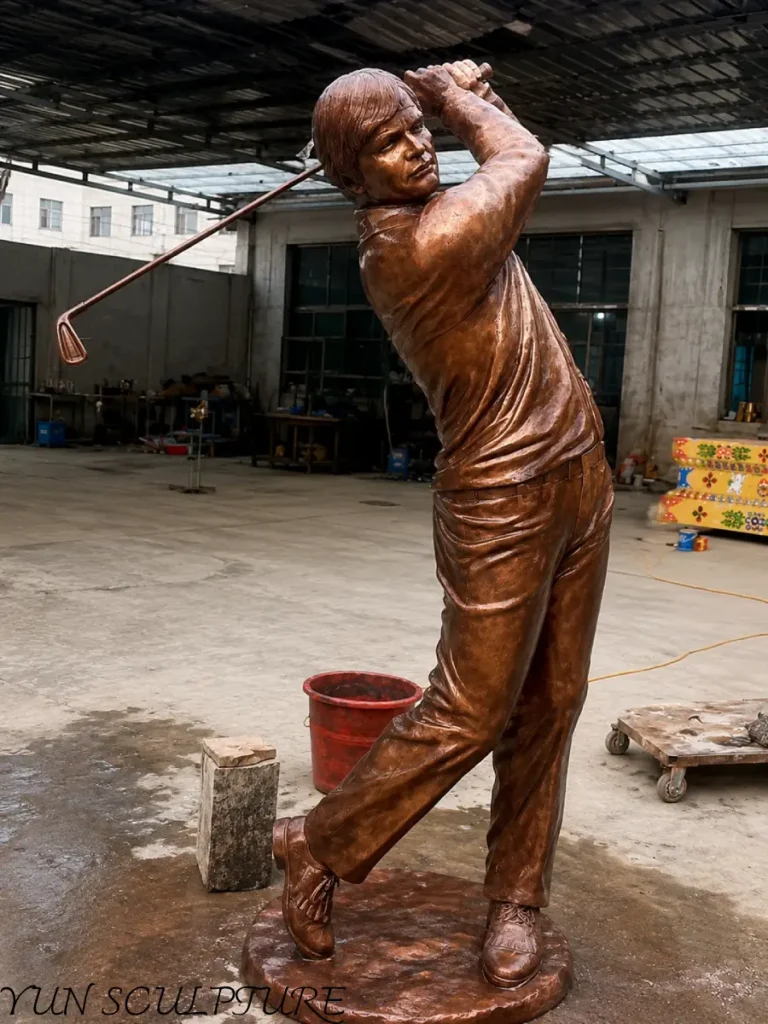
For any outdoor installation intended to be permanent, genuine foundry bronze is the only material that performs without qualification. Bronze forms a protective patina outdoors that stabilizes the surface and actually improves with age. Resin and zinc alloy degrade under UV, moisture, and freeze-thaw cycling on timelines measured in years rather than decades. If the statue is going outside and you want it to still look right in fifteen years, the material choice is not complicated.
For indoor installations — home office, executive suite, clubhouse interior — the material calculus is different. Bronze remains the superior choice for detail fidelity and long-term surface character, but a high-quality resin figure protected from UV and physical stress can serve well for many years. The tell is in the weight: a bronze desktop figure has a heft that grounds it, that makes it feel permanent. Resin figures feel lighter than they look. For a piece that will sit on a desk for decades, the weight matters more than you might expect.
Natural marble and carved stone occupy a different space in this category. A marble golfer figure — carved rather than cast — is rarer, more labor-intensive, and suited to specific aesthetic contexts: the classical-style club library, the estate with a European architectural sensibility, settings where the warmth of white stone suits the surrounding materials. Marble does not suit every context, but in the contexts where it does, nothing else compares.
Frequently Asked Questions
What golfer statues are famous in the world?
The most recognized golfer statue in the world is the Payne Stewart memorial at TPC Sawgrass in Florida, depicting him in his iconic fist-pump pose at the 17th hole. Other well-known examples include the Old Tom Morris statue at St. Andrews near the 18th hole of the Old Course, the Arnold Palmer statue at Bay Hill Club in Orlando, and the Seve Ballesteros statue at Valderrama Golf Club in Spain.
What is a good golfer statue gift?
For a golf enthusiast who values their home or office space, a bronze desktop figure on a marble base — typically 30 to 60 cm — makes a far more meaningful gift than a resin figurine. Bronze holds its surface and detail indefinitely indoors, develops a rich character over years, and communicates a level of care that an off-the-shelf piece does not. For a more personal gift, a custom commission referencing the recipient’s swing or a significant moment in their golf history is an option no catalog piece can match.
Where should I place a golfer statue at home?
The most effective home placements are the desk or study shelf at eye level when seated, the home library or reading room, and the mantelpiece. For outdoor home settings — garden terrace, putting green, estate entrance — scale up to at least half life-size to maintain visual presence in the open landscape. A figure that reads well indoors at close range can disappear entirely in an outdoor setting.
What size golfer statue is best for a home office?
For a desk or shelf, a figure between 30 and 60 cm is appropriate for most settings. For a larger study or library, a half life-size figure at 80 to 100 cm on a plinth can anchor the room effectively. The key measure is that the figure should be at approximately eye level when seated at your primary position in the room — a figure placed too high or too low loses its presence.
What material is best for a golfer statue indoors?
Foundry bronze is the superior material for indoor display — it holds its surface indefinitely, requires no maintenance, and develops a deep stable patina over years. A quality resin figure is a defensible second choice for indoor use since it is not exposed to the UV and freeze-thaw conditions that cause resin to fail outdoors. The practical distinction is in the detail: at close range, bronze casting holds surface texture that resin cannot replicate, and the weight of a bronze figure communicates permanence in a way resin does not.
Factory Direct · Quyang, China
Find the Right Golfer Statue for Your Space
Desktop figures, half life-size, life-size, and heroic scale — all cast in foundry bronze, factory-direct. Tell us your setting and we will recommend the right piece.