Get in touch with Yun-Sculpture company
Poseidon Statue: The Ultimate Guide for Pool, Fountain & Coastal Gardens

Every great maritime civilization placed Poseidon at the threshold between land and sea. The ancient Athenians built his temple at Cape Sounion — on the southernmost point of Attica, where the land ends and the Aegean begins — precisely so that sailors approaching Athens from the sea would see it first. The city of Poseidonia, now Paestum in southern Italy, was literally named for him. His sanctuaries marked headlands, harbor entrances, the places where human territory ended and the sea’s authority began. A poseidon statue at the edge of a coastal garden, at the surround of a pool, or at the center of a fountain is not a garden decoration decision. It is the same decision those civilizations made: this property acknowledges the water beside it, and the god of that water has been invited to preside over the threshold.
Table of Contents
Table of Contents
Why Poseidon — and Not Another God — Belongs at the Water’s Edge
The question of which god belongs at a water feature is one I am frequently asked, and the answer is almost always the same: Poseidon, for a pool or coastal setting, is not simply a convenient choice because he is the god of the sea. He is the specific god whose iconographic tradition — trident, dominion, the posture of command — was developed precisely for these threshold situations. Zeus governs the sky from above; Poseidon governs the water from within it and from its edge. The distinction is not mythological pedantry. It is visible in the figure: Poseidon leans toward the water rather than standing above it. He is the god of this specific relationship between land and sea, and no other Olympian quite occupies that position.
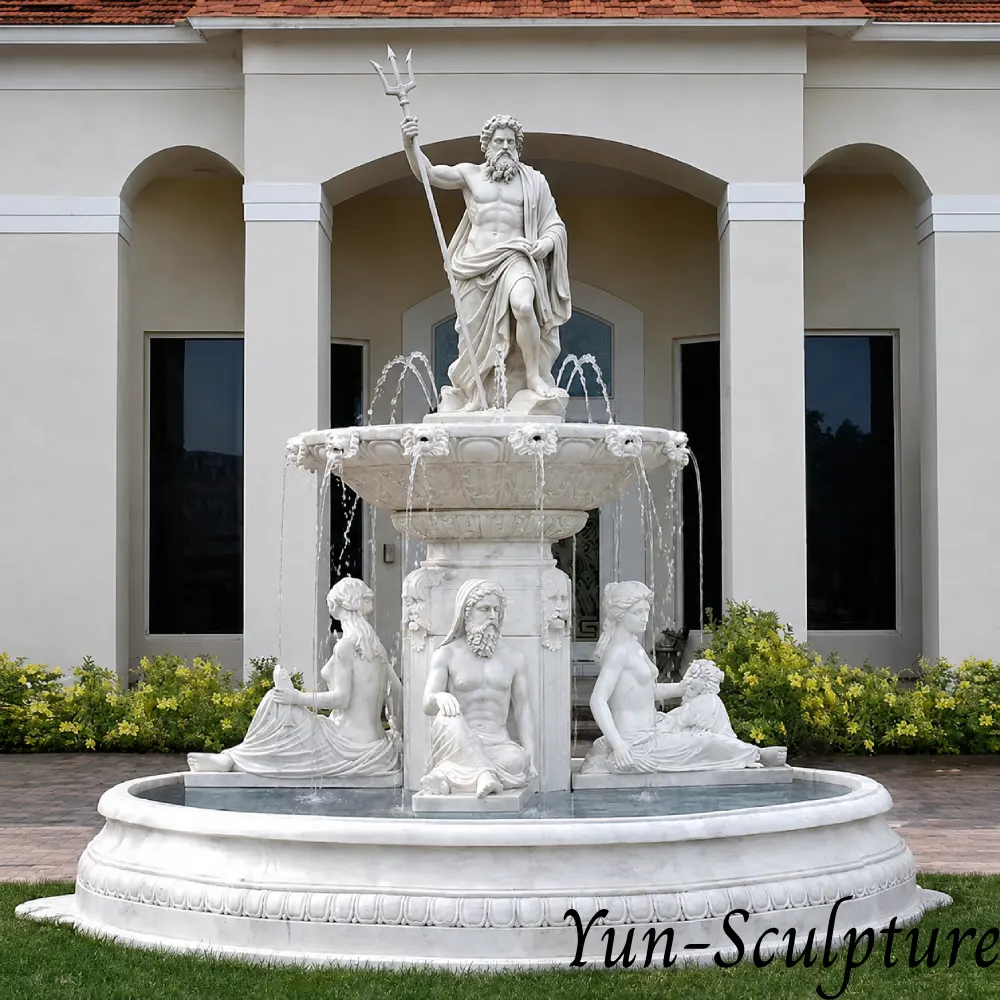
Poseidon is also one of the three most powerful Olympians — co-equal with Zeus and Hades in the ancient division of the world. Zeus took the sky, Hades took the underworld, and Poseidon took the sea and everything it touched: the coastlines, the islands, the harbors, the rivers that ran to it, the earthquakes that originated beneath it. His dominion was not decorative. It was the force that could swallow ships, shake cities, and make the earth itself move. A Poseidon figure at a property’s water edge communicates this ancient category of power — not beauty, not wisdom, not commerce, but the sovereign force of the natural world over which the property sits.
This is why the choice of Poseidon over other water-adjacent gods — Dionysus near a pool terrace, Hermes at a garden path, Apollo in a south-facing courtyard — carries a specific emotional register. Dionysus would make the pool area festive. Hermes would make the path a threshold of commerce and travel. Apollo would make a south garden luminous. But Poseidon makes the entire water feature feel like something that matters — like the property is in dialogue with a force larger than itself, and has chosen to acknowledge that force rather than simply decorate around it.
1
Inland Estate Pool
Poseidon Commands His Own Domain
No sea view. The pool itself is the water domain Poseidon presides over. Position him at the far end of the pool, elevated on a pedestal, facing the primary seating or entertaining area — the god facing the people, the pool between them. He is the authority over this water, even if the sea is fifty miles away. Life-size (180 cm) on a 60 cm pedestal at the pool end reads correctly from the main seating position.
2
Garden with Sea or Lake View
Poseidon at the Transition Point
Pool or garden with a water view beyond the property boundary. Poseidon occupies the threshold — positioned between the domestic space and the view, facing outward toward the distant water. He is the figure who stands between the cultivated and the wild. The viewing logic: from inside the house or the main terrace, Poseidon should be framed against the view, not the garden. He belongs to the water beyond, not the water nearby.
3
Coastal Property
Poseidon at the Land’s End
The property meets the sea directly. Poseidon belongs at the furthest seaward point of the property — at the edge of the bluff, the top of the sea stairs, the boundary where the garden ends and the sea begins. This is the position Cape Sounion established and every maritime civilization understood instinctively. Facing landward, with the sea behind him: he arrives from his domain. Heroic scale (200 cm or above) is correct here — open sky and open water demand it.
Poseidon or Neptune — Choosing Your Aesthetic Register
Poseidon and Neptune are the same divine entity — the Greek original and his Roman successor. But in sculptural tradition, they have developed distinct aesthetic registers, and the choice between them is a meaningful one for a commission.
The Poseidon of the Greek sculptural tradition is severe, physically powerful, and iconographically austere. The Cape Artemision Bronze — the greatest surviving ancient figure of either Poseidon or Zeus, now in the National Archaeological Museum in Athens — shows the god in a throwing stance, arm raised, every muscle engaged, the face intent and entirely without decorative softness. This is the Poseidon of Homer’s Iliad and Odyssey: the god who shook the earth to punish Odysseus, who drove the sea against Troy, who was capable of genuine anger. His modern descendants in sculpture carry that same quality of power without ornament.
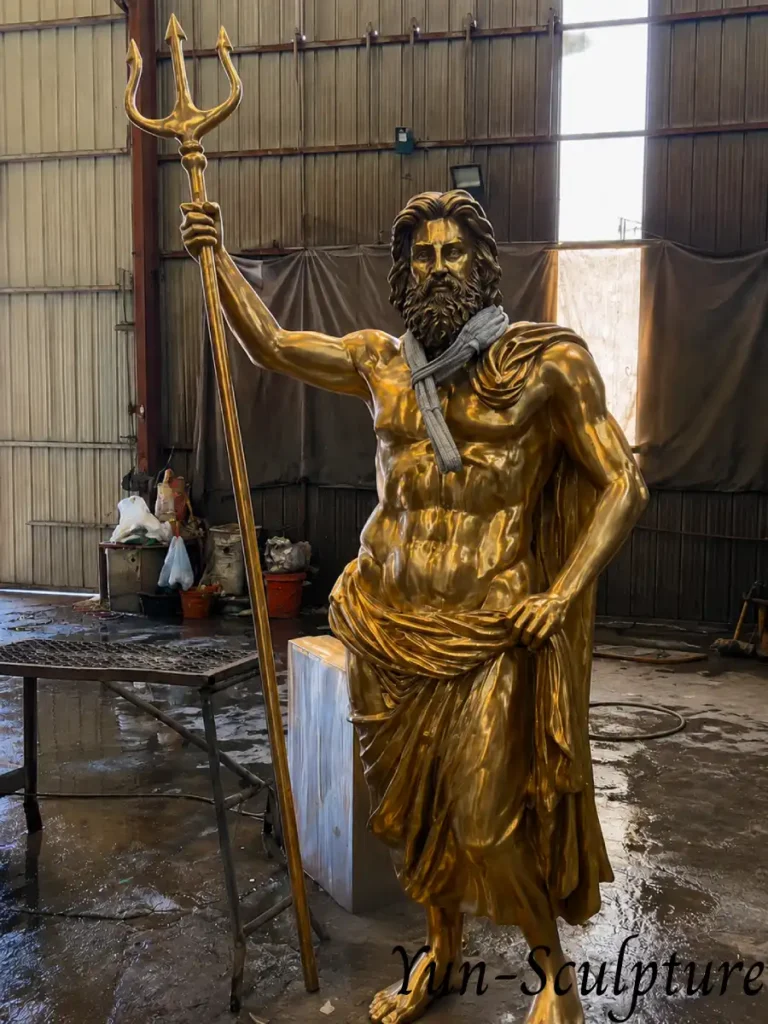
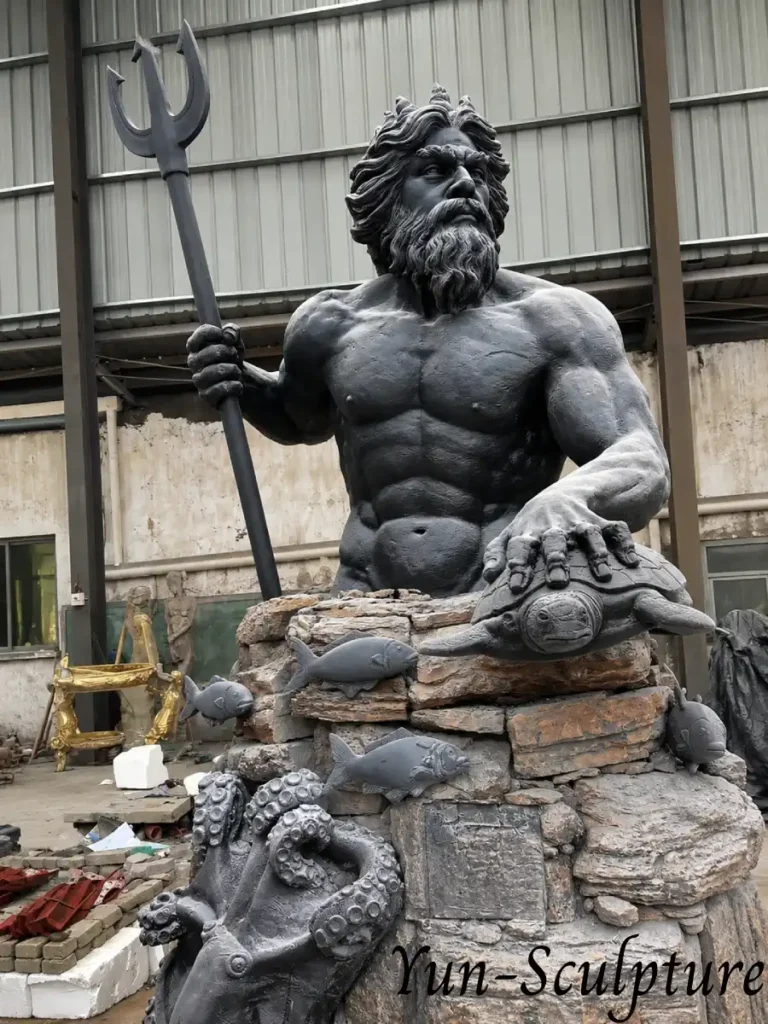
The Neptune of the Roman and Renaissance tradition is more accommodating to decorative settings. Giambologna’s Bologna Neptune, Ammannati’s Florence Neptune, the countless European fountain Neptunes of the 17th and 18th centuries: these figures carry the same trident and the same authority, but with a degree of theatrical elegance that the Greek Poseidon does not have. They are god-as-monument rather than god-as-force. For a formal garden fountain in the European tradition — a walled Italian garden, a French formal parterre, an estate with overtly classical architectural references — this Neptune register is the correct aesthetic choice.
For a contemporary coastal property, a modern pool estate, or any setting where the preference is for classical authority without theatrical flourish, the Greek Poseidon register is the more powerful choice. For the technical specifications — material by environment, structural requirements of the trident, fountain integration engineering — our dedicated marble statue of Poseidon guide covers every production detail.
Greek Tradition
Poseidon
- Severe, physically powerful, iconographically austere
- Draws on the Cape Artemision Bronze tradition — pure force
- No decorative softness; the god of earthquakes as well as the sea
- Correct for contemporary coastal properties, modern pool estates
- Classical authority without theatrical flourish
- The choice when power matters more than elegance
Roman / Renaissance Tradition
Neptune
- More decorative, more accommodating to formal garden settings
- Draws on Giambologna’s Bologna and Ammannati’s Florence fountains
- Often accompanied by seahorses, dolphins, Triton — more theatrical
- Correct for formal European garden fountains, Italian-style gardens
- God-as-monument rather than god-as-force
- The choice when the setting has overtly classical architectural references
Scale, Placement and What the Water Demands
A Poseidon figure at a pool or coastal setting must hold its own against two things simultaneously: the horizontal expanse of the water surface and the vertical scale of any sky above it. Both are more demanding than the enclosed settings where most garden statues are placed, and both push scale decisions in the same direction: larger than you think.
For a residential pool of standard proportions — 10 to 15 meters in length — a Poseidon figure at life-size (approximately 180 centimeters) elevated on a 60-centimeter pedestal at the pool’s end reads correctly from the far end. The figure and the water are in proportion. A figure at 120 centimeters at the same position reads as a garden accent rather than a presiding presence. For larger estate pools or commercial installations, scale up proportionally — the figure should feel as though it belongs to the pool, not as though it has been placed beside it.
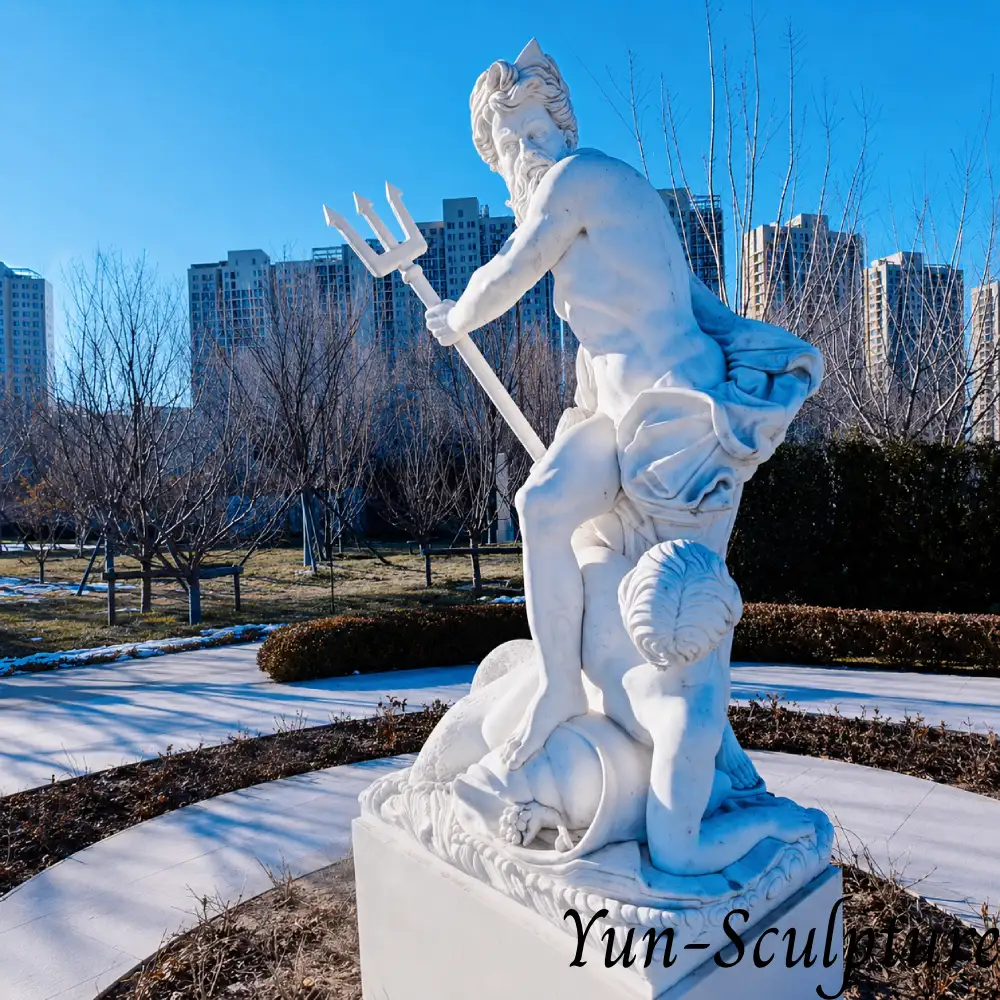
For coastal settings where the figure stands against an open sea view, scale authority becomes even more critical. Open sky and open water have no ceiling, no wall, no enclosure to contain a statue’s presence. Heroic scale — 200 centimeters and above — is appropriate for coastal installations where the figure must compete with an unframed horizon. A life-size Poseidon on a coastal headland can look correct; a smaller figure will disappear into the view rather than holding its position within it.
The one placement rule that applies without exception: Poseidon should face the primary viewing axis — the direction from which the property owner or their guests most often approach the water. He is arriving, or presiding, or about to speak. A Poseidon with his back to the water, or placed in a position where the primary view is his profile, has broken the logic of the figure. Position him so that the water is behind him and the house or the gathering space is in front — so that the god faces inward toward the people, and the sea faces outward behind him.
Frequently Asked Questions
What does the Poseidon statue symbolize?
The Poseidon statue symbolizes sovereign authority over water and the natural forces associated with it. More broadly, it symbolizes the acknowledgment of a power larger than the domestic: a Poseidon at a coastal property or pool edge declares that the property recognizes its relationship to the water beside it and has chosen to mark that relationship with the god who governs it. Ancient harbor cities communicated the same thing when they placed his temple at the water’s edge: this place knows the sea, and the sea god presides here.
What does Poseidon represent spiritually?
Poseidon represents the spiritual principle of sovereign natural force — the power that moves beneath the surface of the visible world and can make the earth itself shake. Spiritually, his presence at a water feature or coastal setting invokes that governing principle — an acknowledgment that the water near the property is not simply a landscape feature but belongs to a force with its own ancient authority. Placing a Poseidon figure is a form of respect toward the natural world: the property declares itself aware of what it sits beside.
Where is the statue of Poseidon in water?
The most significant surviving ancient figure believed to depict Poseidon is the Cape Artemision Bronze, recovered from the sea off Cape Artemision in Greece in 1926 and now in the National Archaeological Museum in Athens — a figure of extraordinary power and technical quality, found in the sea itself. For Neptune specifically, the most famous installed figures are the Fountain of Neptune in Bologna (Giambologna, 1566) and the Neptune Fountain in Florence’s Piazza della Signoria (Ammannati, 1565), both still in their original outdoor positions.
What are the three powers of Poseidon?
Poseidon’s three primary domains are the sea and all water, earthquakes (he was called the “Earth-Shaker”), and horses (credited with creating the first horse by striking the earth with his trident). These powers are reflected in his iconographic attributes: the trident (command over water and earth), the horse (his creative act and the sea’s wildness), and the dolphin (a divine messenger of his realm). In a sculpture commission, the trident is the primary attribute; the dolphin at the figure’s base is the most common secondary element.
Is Poseidon still worshipped today?
Formal religious worship of Poseidon ended with the Christianization of the Roman Empire in the 4th century CE. However, the practice of honoring Poseidon through his image at water’s edge has continued unbroken through Western sculptural tradition. The Renaissance Neptune fountains in Bologna and Florence were civic acts of honoring the sea god’s maritime associations; the private Poseidon commissions placed at estate pools and coastal properties today participate in the same tradition. In this sense, the placement of a Poseidon statue remains a living practice of acknowledgment toward the god of the sea.
Factory Direct · Quyang, China
Commission a Poseidon for Your Pool, Fountain or Coast
Greek severity or Roman elegance. Bronze for water contact, marble for elevated positions, or the hybrid commission that handles both. Every scale from life-size to heroic.