Get in touch with Yun-Sculpture company
Virgin Mary Statue for Outdoor Garden: Which Type, Which Material, and What Will Last

A virgin mary statue placed in the wrong environment loses most of its meaning. Our Lady of Lourdes standing at the end of a grand institutional approach looks timid. Our Lady of Grace tucked into a grotto feels architecturally confused. The figure you choose and the space it inhabits need to speak the same spatial language. This guide maps that language clearly — and explains why the material recommendation you will find on most retail sites is wrong for half the country.
Table of Contents
Table of Contents
Which Virgin Mary Statue Type Fits Your Outdoor Space?
Five Mary statue types appear most often in outdoor garden and institutional commissions. Each has a spatial personality that makes it right for certain environments and wrong for others.
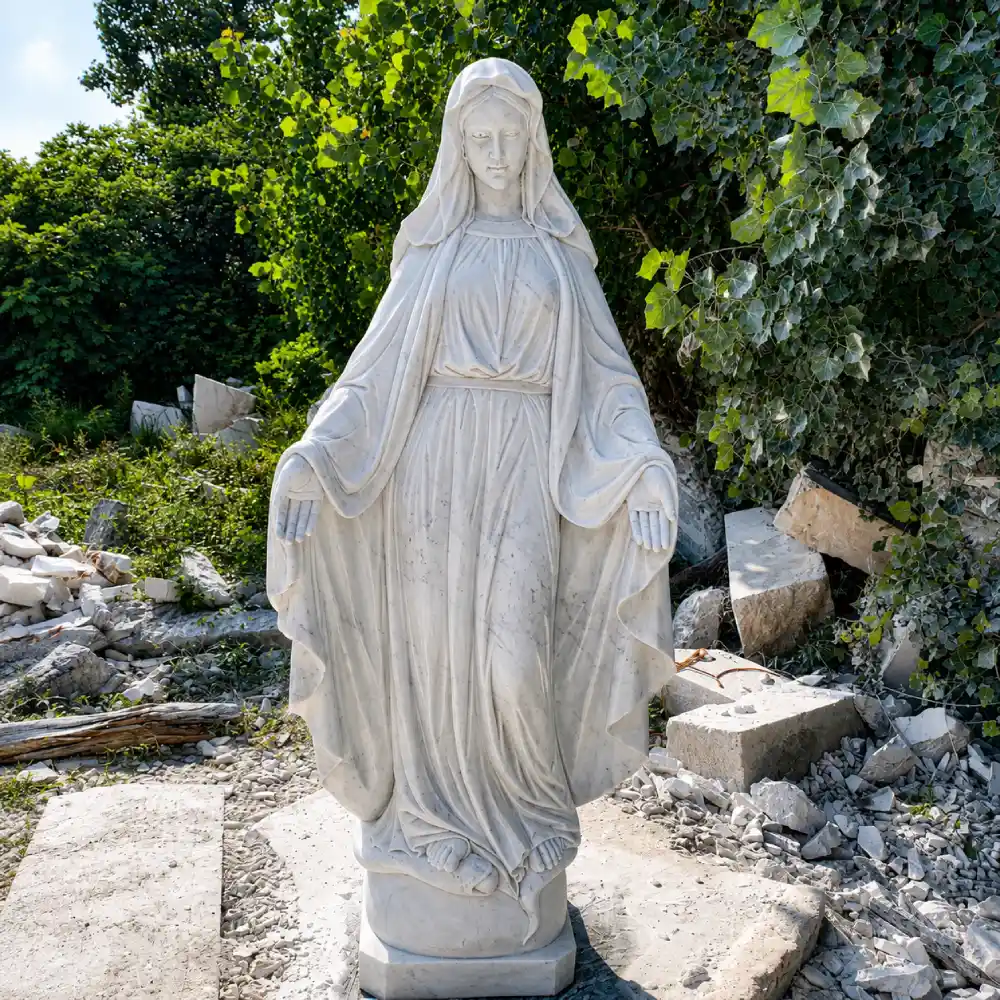
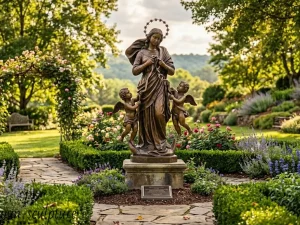
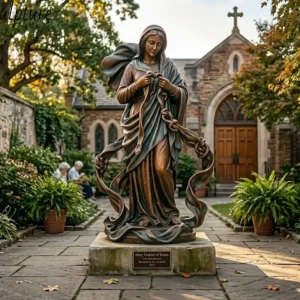
Our Lady of Grace stands with arms open and slightly extended, robes flowing, often positioned atop a globe with the serpent beneath her feet. This posture is outward and welcoming — designed to greet people approaching head-on. It belongs at church entrances, at the central axis of formal institutional gardens, or at a residential garden’s focal point where Mary is the first thing visitors see. It requires open space and clear sightlines.
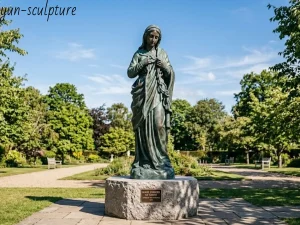
Our Lady of Lourdes stands in contemplative prayer — hands clasped, gaze slightly downward. This is not a statue that commands open space; it inhabits enclosed or sheltered settings with quiet authority. Grottos, alcoves, sheltered garden corners, and chapel garden niches suit it well. In a large open plaza, the intimacy of the pose disappears entirely.
Our Lady of Guadalupe presents a bold, frontal, symmetrical image — the tilma rendered in three dimensions, surrounded by a sunburst mandorla. The composition is designed for visual impact at a distance and carries cultural identity alongside devotional meaning for Hispanic and Latin American communities. It belongs at institutional entrances and large parish courtyards.
The Immaculate Conception — hands at her sides or crossed at her chest, twelve stars above — suits formal memorial gardens and seminary grounds where the theological emphasis is on Mary’s unique holiness rather than a specific apparition.
Mary and Child Jesus, the Madonna, is the most spatially flexible of all Mary statue types. It works at a church side entrance, in a family garden, at a school, or in a hospital healing space. The presence of the child creates a warmth that reads well across very different environments.
Why Do Catholics Put Mary in Their Yard?
The tradition of placing a Mary statue outdoors predates modern suburban garden culture by several centuries.
Mary gardens — small enclosed spaces built around a Marian statue, planted with flowers selected for their association with Mary’s virtues — originated in medieval European monasteries. White lilies for purity, roses for love, violets for humility. The enclosure itself referenced Mary’s virginity. That monastic tradition translated into the American Catholic front-yard shrine: the bathtub Madonna, the grotto set into the garden slope, the statue at the end of the driveway.
These installations represent something specific: a visible, public declaration of faith. Unlike a devotional image inside a home, an outdoor Mary statue speaks to the neighborhood as much as to the household. For many Catholic families, it also functions as a daily focal point — children pass it on the way to school, parents stop at it in the evening. The statue organizes devotional life around a physical place, which is more sustainable than devotion without a spatial anchor.
For institutions — schools, hospitals, retreat centers — the outdoor Mary statue does something a mission statement cannot: it establishes spiritual identity in permanent, architectural form. A hospital healing garden with a quality Mary statue communicates care, protection, and hope to patients and families simply through its presence.
Planning a Mary garden or courtyard installation? Tell us your space and the devotional atmosphere you want to create — we will recommend the right figure and scale.
Our Lady of Grace, Lourdes, and Guadalupe: Which Title for Which Setting?
These three are the most commissioned outdoor Mary statues in North America, and each has specific spatial logic that most buyers never hear explained.
Our Lady of Grace works wherever Mary needs to welcome. Her outstretched arms read clearly from twenty meters. For a parish garden where people gather for outdoor Masses, rosary walks, or Marian celebrations in May and October, Our Lady of Grace is almost always the right choice. The gesture communicates openness to everyone entering the space regardless of where they stand.
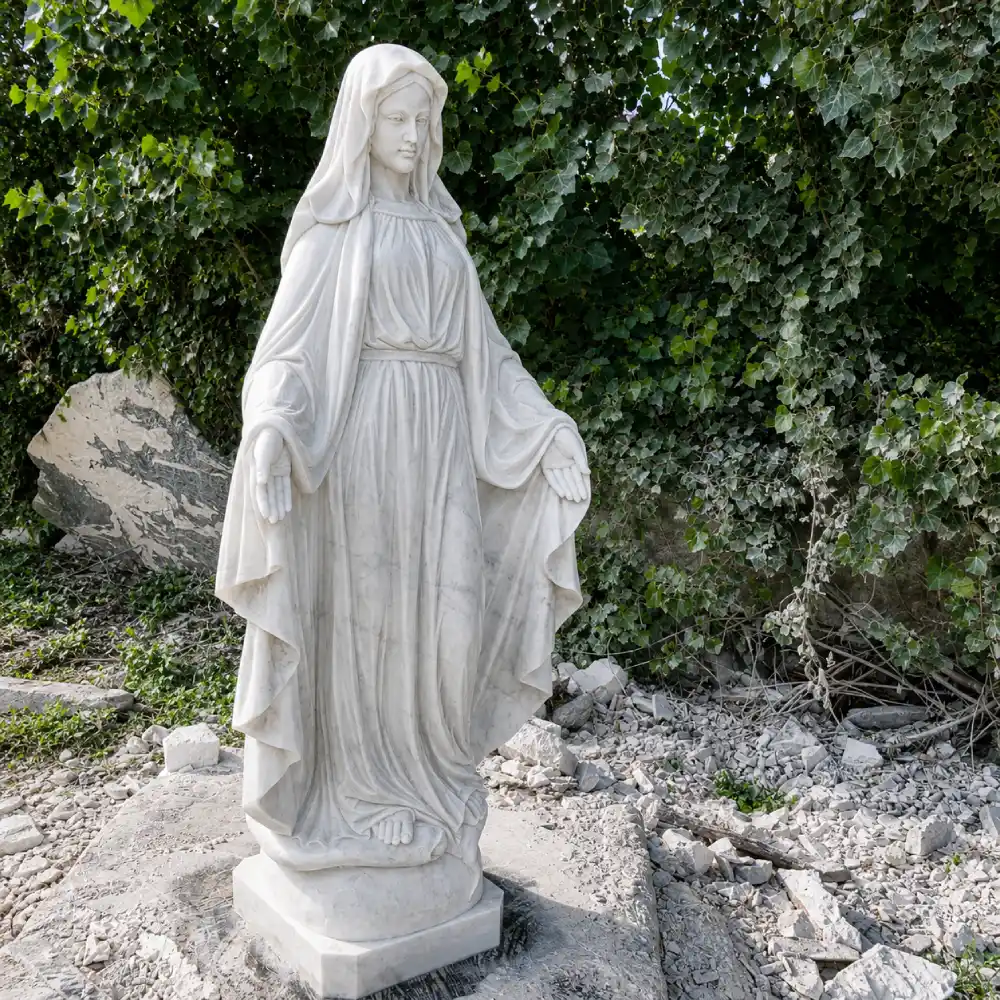
Our Lady of Lourdes belongs in a grotto. The apparitions at Lourdes took place in the Grotte de Massabielle — a cave — and the iconography reflects that environment. Our Lady of Lourdes placed in open air without a grotto surround loses its contextual logic. When integrated into a grotto with stone backing, a water feature referencing the spring, and kneelers for prayer, it creates the most complete Marian devotional environment possible in a garden setting. Our Our Lady of Lourdes grotto and landscape guide covers the full design and engineering requirements for this installation.
Our Lady of Guadalupe carries cultural weight that goes beyond devotion in the conventional sense. For a parish serving a Hispanic or Mexican-American community, the Guadalupe image is a communal identity marker recognized instantly and carrying historical meaning that other Marian titles do not. Placement should honor this: a central courtyard position, a dedicated raised platform, or a primary entrance location. Our Our Lady of Guadalupe outdoor statue guide covers scale, material, and community commission considerations in depth.
For families commissioning a Mary statue for a home garden, the Madonna is often the most natural choice for its warmth and accessibility in domestic settings. Our Mary and Baby Jesus statue guide covers this commission in detail.
Garden Statue or Grotto: Two Installations, Two Spatial Languages
The most consequential outdoor Mary installation decision is not which figure to choose. It is whether to install a freestanding garden statue or to build a grotto.
A freestanding mary garden statue is spatially independent. It can be repositioned. It requires only a stable base and appropriate anchoring. Its presence is defined by the figure itself rather than surrounding architecture. For residential gardens, this is typically the practical choice: a 24–36 inch marble or bronze Mary statue on a stone base, placed along a garden path or at the garden’s focal point, creates a devotional space without significant landscape construction.
A grotto installation transforms the statue into a permanent architectural feature. The stone surround creates enclosure — a sense of entering a sacred space rather than simply encountering a figure. Grottos amplify the devotional atmosphere considerably. They also amplify the engineering commitment.
Donghui Zhang identifies the most common grotto mistake immediately: placing the statue before the drainage is confirmed. Water drainage from the back of the grotto cavity is critical — a statue placed in a grotto that retains water behind it will show accelerated weathering at its base regardless of material. The grotto surround must be completed and drainage verified before the statue is installed.
For outdoor grotto installations in North America, Donghui recommends bronze over marble specifically because of water exposure. Marble in a grotto environment still faces freeze-thaw cycling and moisture at the base. Bronze’s non-porous surface handles these conditions without structural risk over decades.
What Material Survives Your Climate?
One major online retailer recommends UV-resistant resin or stone composite as the best outdoor Mary statue material. That recommendation is reasonable for one climate and wrong for another — and the line between them runs roughly across the middle of the United States.
In year-round mild climates — Southern California, Florida, the Gulf Coast, and the American Southwest — sealed resin and stone composite can perform acceptably for a decade outdoors. The absence of freeze-thaw cycling removes the primary structural failure mode for these materials.
In climates with cold winters — the northern United States, Canada, the United Kingdom, and Northern Europe — resin and stone composite fail over time. Water infiltrates micro-pores, freezes, expands, and progressively widens those pores. After several cycles, cracking and spalling begin. Donghui has seen resin outdoor Mary statues from North American parishes arrive for replacement commissions within five to seven years of installation.
White marble works well in protected outdoor positions: a covered courtyard, a sheltered niche, a grotto with roof overhang. In fully exposed positions in freeze-thaw climates, factory sealing improves performance but must be renewed periodically.
Cast bronze requires no climate caveat. It weathers freeze-thaw cycling, UV exposure, rain, and salt air without structural deterioration. The natural patina deepens over years, giving the sculpture a historical presence that new resin cannot achieve.
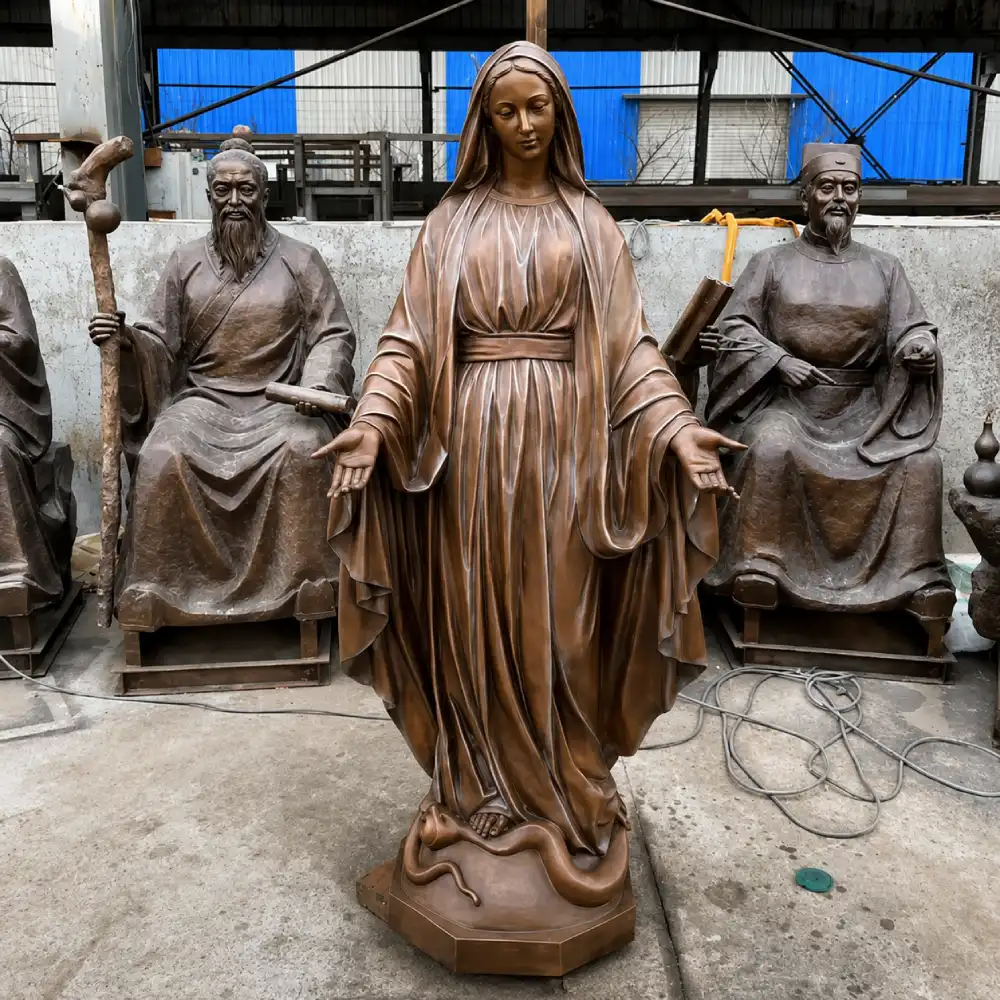
A client in Minnesota commissioned a life-size Our Lady of Grace in bronze for her parish courtyard three years ago. She had initially wanted marble for its warmth. After discussing Minnesota’s conditions — temperatures reaching -25°F, the courtyard’s fully exposed position — she chose bronze. Last spring she sent photographs of the statue after its third winter. The patina had deepened exactly as expected. She described it as looking more rooted in the space than on installation day.
Price context, because most suppliers won’t provide it:
| Size | Material | Price Range |
|---|---|---|
| 24–36 inches | White marble | $1,500–$4,000 |
| Life-size (5–6 ft) | White marble | $4,000–$8,500 |
| Life-size (5–6 ft) | Cast bronze | $5,500–$13,000 |
| 8 ft and above | Cast bronze | $14,000–$32,000+ |
FAQ
Why do people have statues of Mary?
Catholic tradition places Mary in a unique intercessory role — mother of Christ and advocate for the faithful. Outdoor statues serve three overlapping functions: creating a daily focal point for prayer; establishing a household or institution’s spiritual identity in visible, architectural form; and connecting the present-day faithful to a devotional tradition stretching back through medieval Europe to the earliest centuries of the Church. The spatial dimension matters — a statue in a garden creates a place for prayer, not merely an object of devotion. Which Mary statue type creates which kind of devotional space is covered in the selection guide above.
Why do Catholics put Mary in their yard?
The front-yard or garden Mary statue is a distinctly Catholic form of public witness — a visible declaration of faith made to the neighborhood as much as to the household itself. The tradition descends from medieval Mary gardens, where enclosed garden spaces built around a Marian statue served as places of contemplation and prayer. In American Catholic culture, this translated into the residential garden shrine: a small sacred space within domestic life, organized around Mary’s presence. For the spatial design logic of yard and garden installations, the first section of this guide covers the key decisions.
Why are there 12 stars around Mary’s head?
The twelve stars come from Revelation 12:1 — a vision of a woman clothed with the sun, standing on the moon, crowned with twelve stars. Catholic tradition interprets this woman as Mary in her role as Queen of Heaven. The twelve stars represent both the twelve tribes of Israel and the twelve apostles — the full span of salvation history bridging the Old and New Covenants. In outdoor Mary statues, the stars appear as a halo or crown above her head. In marble, individually projecting stars create potential fracture points at their bases; in bronze, they can be cast as fully three-dimensional elements without structural risk.
Why does Mary wear red over blue?
In most Marian iconography, Mary wears a red dress beneath a blue mantle. Red represents her humanity — the blood and flesh of her earthly life. Blue represents her queenship and connection to the divine — in the ancient world, blue was among the most precious pigments, reserved for royalty and the heavens. Together the colors communicate the theological paradox at the center of Marian devotion: a fully human woman elevated to a unique position in salvation history. In sacred sculpture, this color tradition informs polychrome finishing decisions for painted processional statues, particularly in Philippine and Latin American devotional contexts where color carries significant devotional weight.
Which flower symbolizes Mary?
The white lily is Mary’s primary flower in Catholic iconography, representing her Immaculate Conception and perpetual virginity. The rose is the second major Marian flower — Mary is called Rosa Mystica, and the Rosary takes its name from the Latin for rose garland. In medieval Mary gardens, each flower was chosen for its association with one of Mary’s virtues: white lilies for purity, violets for humility, marigolds for her gold, lavender for her dignity. For a contemporary Mary garden surrounding an outdoor statue, white roses, lavender, and white lilies create the most traditionally grounded planting scheme.
What is the oldest image of Mary?
The oldest known image of the Virgin Mary is a fresco in the Priscilla Catacomb in Rome, dated to approximately the late second or early third century AD. It depicts a woman nursing an infant with a male figure pointing to a star above — widely interpreted as Mary nursing the infant Jesus, with the prophet Isaiah indicating the fulfillment of his prophecy. The image establishes that Marian devotion expressed in visual form is as old as the earliest surviving Christian art, predating the Council of Ephesus in 431 AD — which formally defined Mary as Theotokos, Mother of God — by at least two centuries.
Commission Your Outdoor Virgin Mary Statue
The right Mary figure in the right space — in the right material for your climate — will anchor your garden, courtyard, or campus for generations.
Factory Direct · Quyang, China
Get an Exact Quote for Your Mary Statue
Tell us the size, pose, and any custom requirements — we respond within 24 hours with a detailed price breakdown, no obligations.