Get in touch with Yun-Sculpture company
Engineering the “Liquid Silver” Effect: The Ultimate Guide to Custom Stainless Steel Water Fountain Sculptures

Table of Contents
Table of Contents
The Soul of Modern Landscape: Introducing the Liquid Silver Effect
Water has always been the emotional center of landscape architecture.
Long before stainless steel existed, fountains were already performing the same quiet magic: introducing movement into static environments. A garden without water can feel composed but lifeless. Add flowing water, and suddenly the space breathes.
Today, the stainless steel water fountain sculpture has become the most powerful contemporary expression of that tradition.
Why stainless steel? Because no other sculptural material interacts with light the same way. Stone absorbs it. Bronze softens it. But polished steel reflects it—sometimes with startling intensity.

A stainless steel water sculpture acts like a mirror that happens to be alive.
Sky, trees, surrounding buildings, even passing pedestrians—all of it moves across the surface. Add flowing water and the reflections break into shimmering fragments. Light starts behaving like liquid.
Designers often describe this phenomenon as the “Liquid Silver” effect, though the name almost undersells it.
In practice, a well-placed Modern stainless steel sculpture doesn’t just decorate a space. It multiplies it. The environment folds into the artwork and back out again.
You can often see this effect in coastal resort environments similar to those found in Miami, where mirror-polished fountain sculptures are installed near oceanfront pool terraces.
During the day, the reflective surface captures the endless sky and surrounding water.
At sunset, it begins to absorb the warm copper tones of the horizon.
Many visitors assume the lighting system is changing colors.
In reality, it is simply the sculpture reflecting the constantly shifting light of the landscape around it.
There was no lighting change.
Just reflection.
But there is one concern architects always raise when mirror surfaces are involved:
glare.
A poorly designed reflective sculpture can create harsh sunlight reflections—dangerous for nearby roads or neighboring buildings.
At Yun Sculpture we address this early in the design stage. Elena’s team calculates the curvature and angle of the sculpture’s surfaces so reflections diffuse rather than bounce directly. Instead of sharp glare, the sculpture produces a soft ambient glow.
Think of it less like a mirror…
and more like liquid light spread across a surface.
The goal is simple: amplify the atmosphere of the landscape, not overpower it.
Material Intelligence: Why 316L Matters for Water Features
Let’s shift from poetry to physics for a moment.
When a sculpture involves water—especially outdoors—the material choice determines its lifespan.
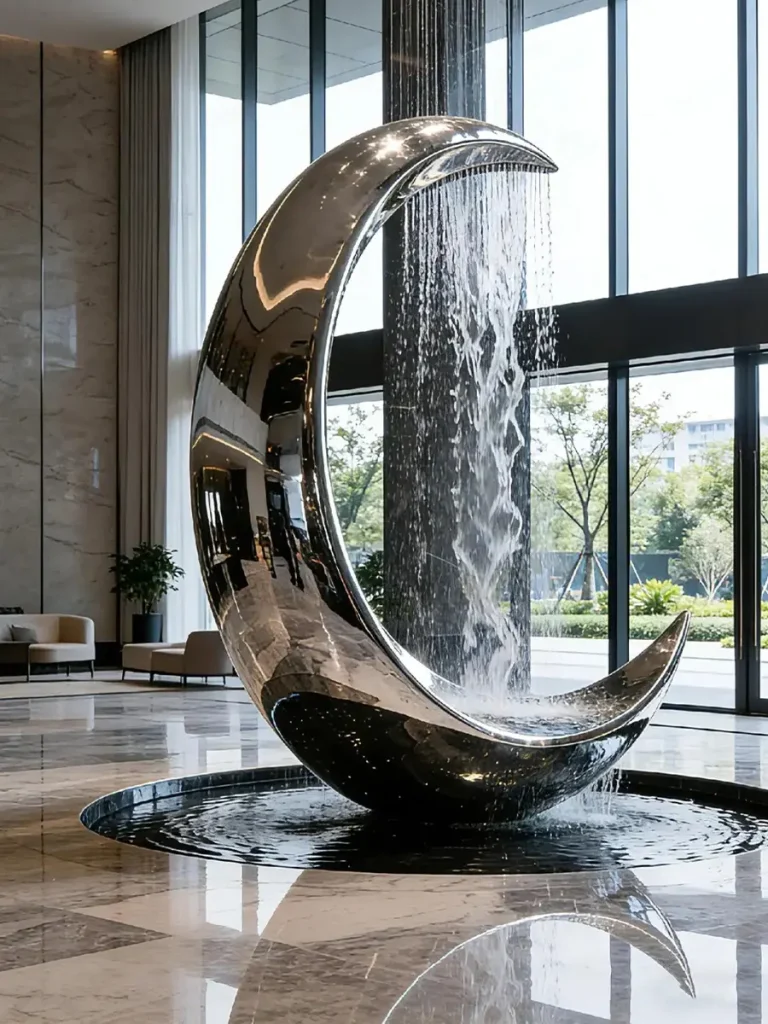

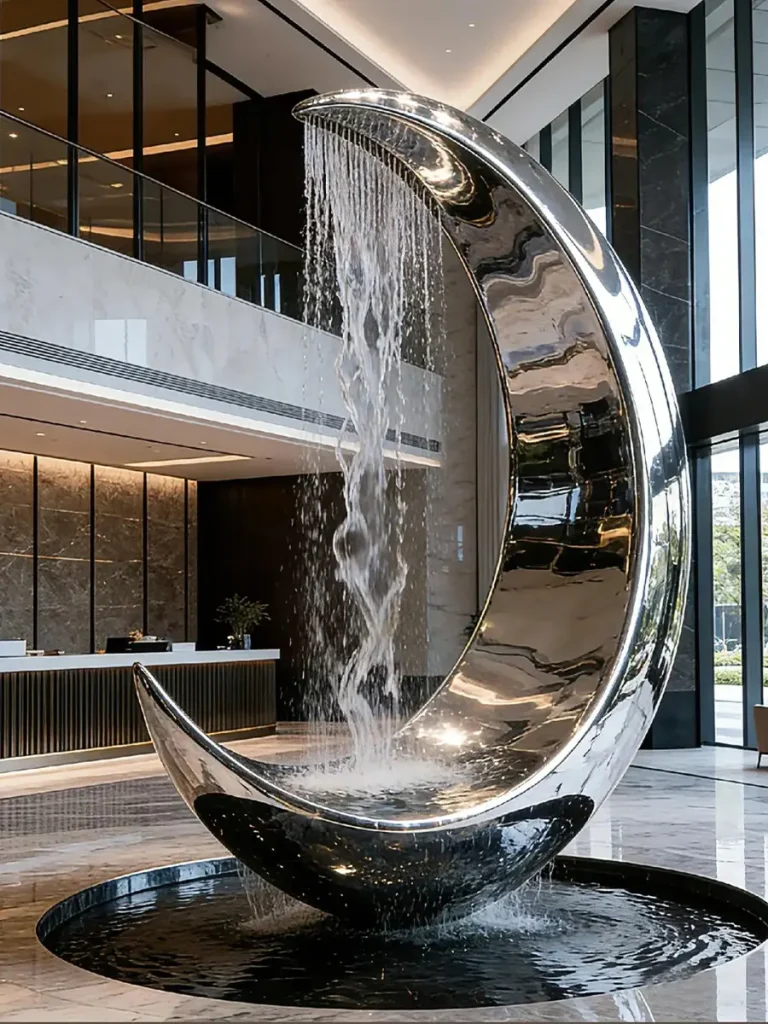
Many designers know the names 304 stainless steel and 316L Marine Grade stainless steel, but fewer understand how dramatically their performance differs.
In dry indoor environments, 304 works fine.
Add water, chlorine, or salt air and things change quickly.
Fountain sculptures are constantly exposed to:
• recirculating water
• chlorine or treatment chemicals
• airborne salt in coastal climates
That combination can trigger pitting corrosion and tea-staining in lower-grade stainless steels. Tiny corrosion points form first. Over time they spread beneath the polished surface.
Once that begins, restoring a mirror finish becomes extremely difficult.
This is why 316L Marine Grade stainless steel is our non-negotiable standard for outdoor water sculptures.
The alloy contains molybdenum, which dramatically increases corrosion resistance in chloride-rich environments.
In practical terms, that means the sculpture can survive:
• chlorinated fountain water
• coastal salt exposure
• humid climates
• urban pollution
Without degradation.
In coastal architectural environments similar to Miami’s oceanfront resorts, sculptures may be installed only a few meters from the shoreline.
In such locations, salt spray and humidity can reach outdoor fountains on a daily basis.
When fabricated using 316L marine-grade stainless steel, the mirror-polished surface can maintain its reflective finish for many years without noticeable degradation.
Material science rarely makes headlines.
But in sculpture fabrication, it quietly determines everything.
Material science rarely makes headlines.
But in sculpture fabrication, it quietly determines everything.
Defining the 8K Mirror Polish Standard
If material choice determines longevity, surface finish determines the visual experience.
The highest architectural standard for reflective sculpture is the 8K mirror polish. Achieving it requires multiple stages of grinding, sanding, and precision polishing until the steel becomes optically reflective.
At that point, the metal behaves almost like liquid glass.
Buildings appear across its curves. Clouds move across its surface. Water flowing across the metal fractures those reflections into constantly shifting light patterns.
But mirror polish alone isn’t enough.


Luxury stainless steel sculpture requires something more difficult:
perfectly invisible welds.
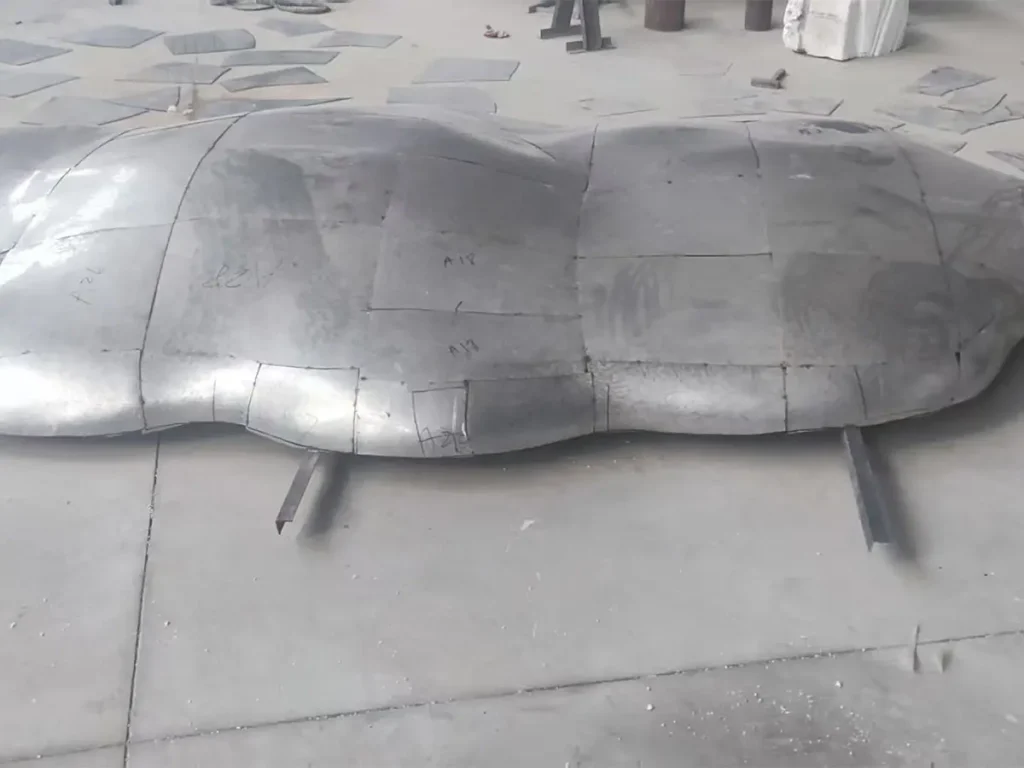
Large sculptures are assembled from many steel plates. If weld seams remain visible—even slightly—the reflection breaks. The illusion collapses.
Master craftsmen therefore perform full-penetration welding followed by meticulous grinding and polishing until the seams disappear entirely.
Done correctly, the sculpture reads as a single continuous surface.
That continuity is what allows a Mirror polished stainless steel sculpture to blur the boundary between object and environment.
Architecture reflects into sculpture.
Water reflects into sky.
And the sculpture itself almost disappears.
Forms Stone Cannot Achieve: The Geometry of Metal Water Features
Stone sculpture is carved.
Metal sculpture is engineered.
That difference unlocks entirely different possibilities.
Because stainless steel has enormous tensile strength, designers can create extremely thin edges—sometimes as fine as 2mm precision lips. These edges allow water to flow evenly across the metal before falling in a perfectly smooth sheet.
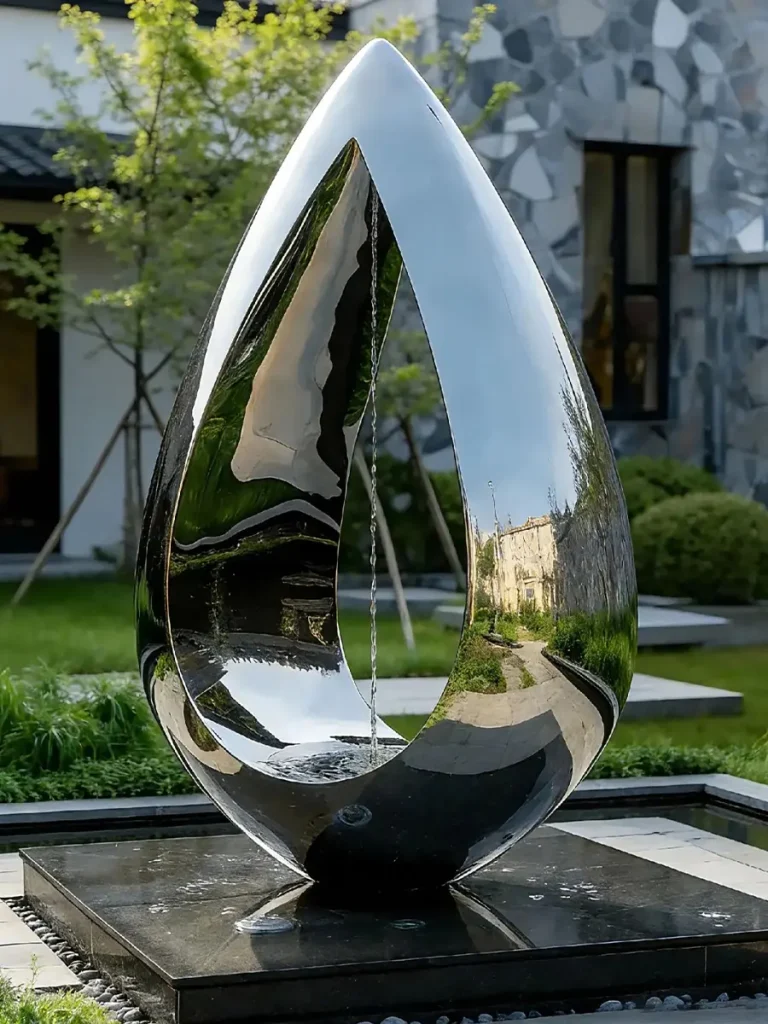
The effect is subtle but mesmerizing.
Water doesn’t splash.
It glides.
This capability has produced several iconic fountain forms in modern landscape architecture.
The Infinity Ring Fountain
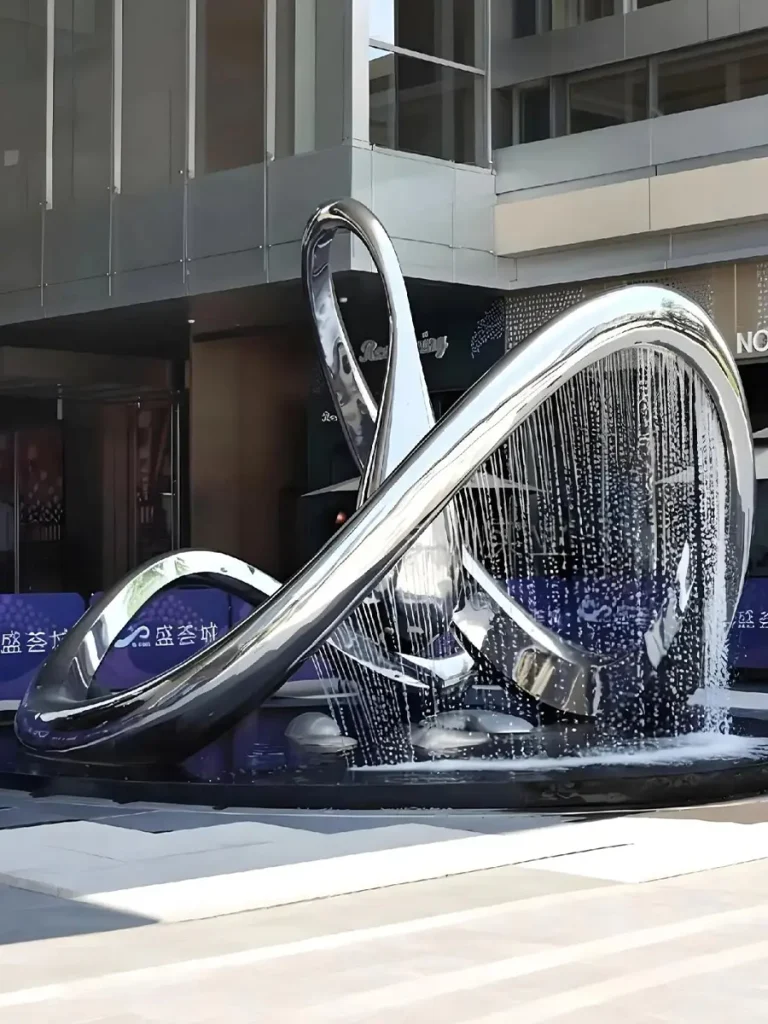
A circular band of stainless steel rises from the water, forming a continuous loop. Water flows along its upper edge before cascading around the entire circumference.
The geometry is simple. The effect is hypnotic.
Reflections move continuously around the ring, making the sculpture feel suspended in motion.
The Water Curtain Fountain
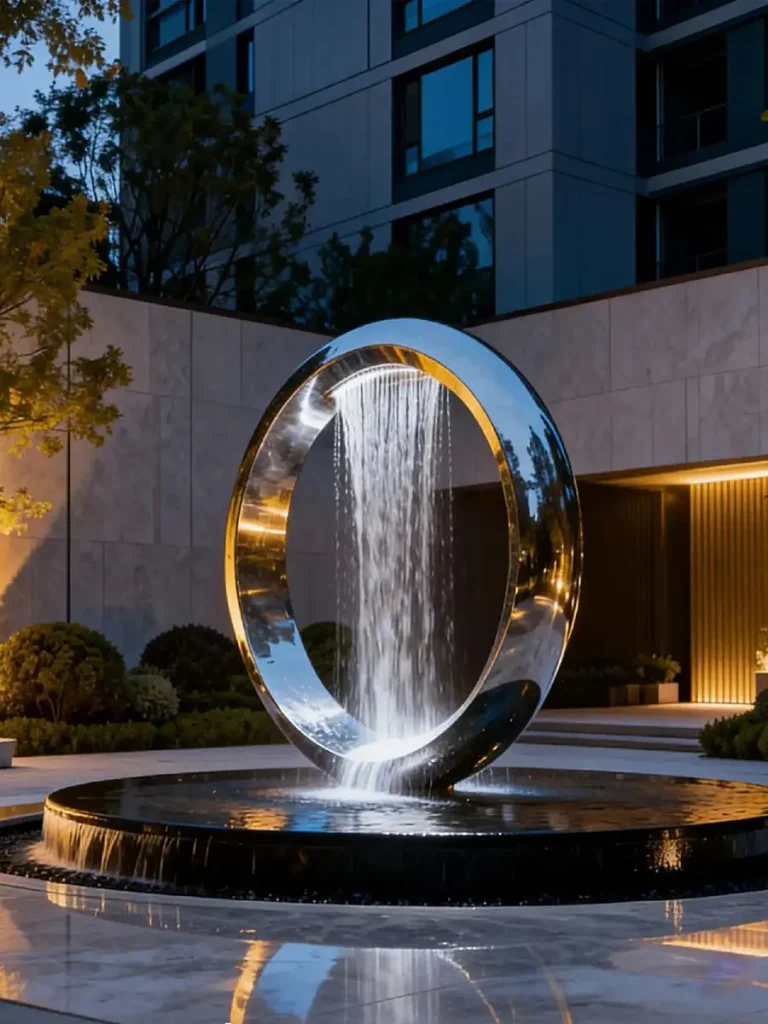
Minimalist architecture often prefers linear forms.
A Water Curtain Fountain uses a razor-thin stainless steel edge to produce a perfectly uniform sheet of falling water—essentially a transparent architectural wall.
These are often installed at hotel entrances or garden corridors where designers want sound and motion without visual mass.
Dynamic Sculpture Systems
Some installations combine fountain sculpture with kinetic stainless steel wind sculptures, allowing wind and water to animate the piece simultaneously.
The sculpture becomes responsive to the environment.
Water flows.
Wind rotates elements.
Reflections shift with the sky.
The artwork never repeats itself.
The Invisible Engineering: Custom Solutions Behind the Sculpture
What visitors see is the reflective surface.
What they never see is the engineering hidden inside.
Every large stainless steel sculpture contains an internal structural skeleton that supports the outer shell and distributes weight to foundation anchors. Inside the cavity are also the plumbing systems that control water flow.
Pump lines.
Pressure regulators.
Drainage channels.
Lighting cables.
All hidden.
During custom metal sculpture fabrication, these systems are integrated so the sculpture appears effortless while functioning like a precision machine.
In large corporate plazas, especially in high-rise cities such as Dubai, wind loads can become a major design consideration.
Open plazas positioned between tall buildings often create urban wind-tunnel effects, where air currents accelerate as they pass through narrow architectural corridors.
For sculptures installed in these environments, structural stability becomes a critical engineering factor.
Donghui Zhang’s engineering team typically designs an internal reinforcement frame capable of absorbing wind loads while allowing the outer stainless steel surface to remain visually light and elegant.
Visitors see a floating ring of steel and water.
Behind that illusion sits structural engineering more commonly associated with bridge construction than sculpture fabrication.
Engineering and Installation: Mounting Heavy Metal Art Safely
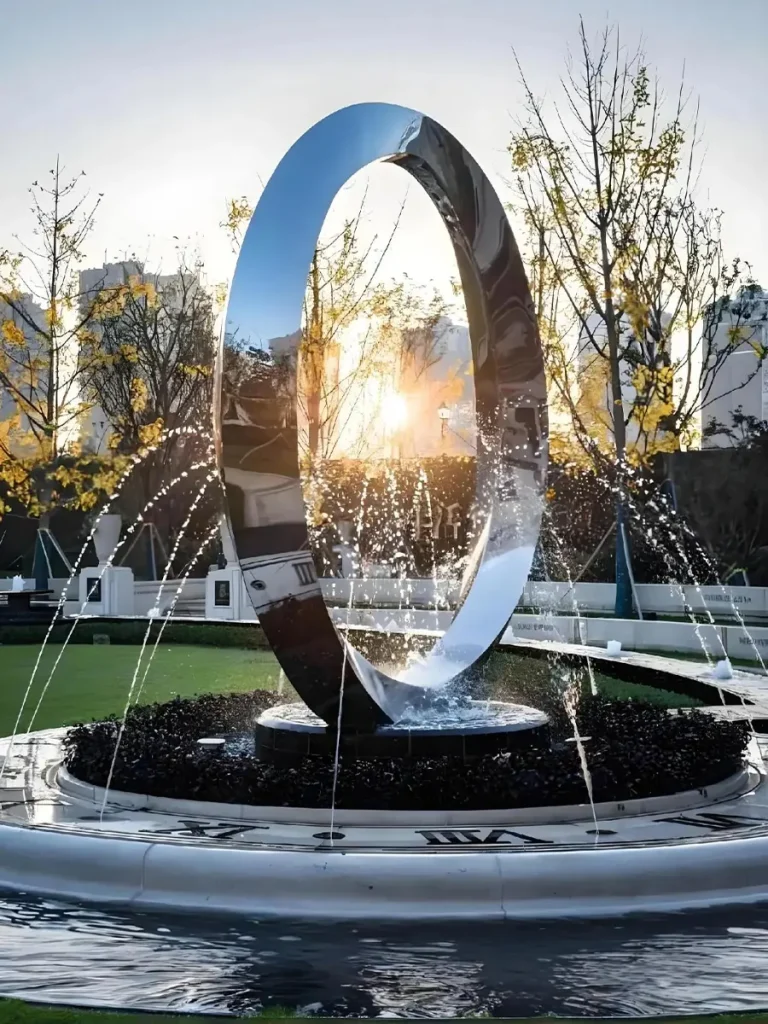
Installing a multi-ton sculpture is never improvisational.
The most reliable approach involves pre-embedded structural anchors placed during concrete construction. The sculpture’s internal frame docks directly to these anchors, transferring weight safely into the building structure.
Wall-mounted installations use another method: stainless steel expansion bolts anchored into reinforced concrete.
Waterproof gaskets are installed between the sculpture base and the wall surface to prevent any water infiltration.
This detail sounds small.
But ignoring it can turn a beautiful fountain into a building-maintenance nightmare.
When installation is engineered properly, the sculpture appears effortless.
Which, ironically, is exactly the goal.
Maintenance & Longevity: Keeping the Sculpture Pristine
A mirror-polished sculpture looks fragile.
In reality, maintenance is surprisingly simple.
Architects often ask how to clean stainless steel sculpture without damaging the finish. The answer is refreshingly boring: mild soap, clean water, and a soft cloth.
That’s it.
Avoid aggressive chemicals and abrasive pads—those will damage the mirror polish.
For long-term protection, many conservators apply microcrystalline wax once or twice per year. It creates an invisible barrier against UV radiation, pollution, and acid rain while preserving the reflective clarity.
A five-minute cleaning routine every few weeks is usually enough to keep the sculpture looking immaculate.
FAQ: Stainless Steel Water Fountain Sculptures
Why must water feature sculptures use 316L Marine Grade stainless steel instead of standard 304?
As we mentioned earlier in the article, coastal environments similar to those found in cities like Miami completely change the material requirements for outdoor sculptures.
In dry environments, 304 stainless steel performs well.
But once you introduce salt air, chlorinated water, or constant humidity, lower-grade steel may eventually develop tea-staining or pitting corrosion.
That is why 316L marine-grade stainless steel has become the baseline specification for water feature sculptures.
It is not a luxury upgrade.
It is simply the correct engineering choice if the sculpture is expected to remain outdoors for decades.
Can stainless steel water sculptures really survive next to swimming pools or the ocean?
Consider coastal environments similar to those found in cities like Miami, where sculptures may be placed only meters from the ocean.
In these conditions, artwork is constantly exposed to salt spray, humid air, and chlorinated pool environments.
When fabricated using 316L marine-grade stainless steel, mirror-polished sculptures can maintain their reflective finish for many years despite these challenges.
Interestingly, coastal environments are often where stainless steel sculptures perform best visually.
The reflections of sky, water, and horizon constantly shift across the polished surface, giving the artwork an almost living quality.
What exactly do you mean by the “Liquid Silver” effect?
It’s a phrase Elena uses with architects during early design meetings.
When an 8K mirror-polished surface interacts with moving water, the reflections stop behaving like normal reflections. The water distorts them into constantly shifting fragments of light.
The sculpture stops looking like metal.
It starts looking like flowing silver.
You see this especially at sunset, when warm light hits the moving water surface. The reflections flicker and ripple across the sculpture in ways that are almost impossible to photograph.
You have to experience it in person.
How are these sculptures actually fabricated?
A lot of people assume they’re cast like bronze statues.
They’re not.
Large stainless steel sculptures are usually built from formed sheets welded over an internal structural frame. This is why they can achieve shapes stone simply cannot — thin edges, floating rings, or extremely large geometric forms.
Because the interior is hollow, the sculpture remains structurally efficient while still appearing monumental.
In many ways, the process is closer to architectural steel fabrication than traditional sculpture.
Will large stainless steel sculptures be too heavy for buildings?
This concern comes up often, especially for rooftop or plaza installations.
In reality, most large pieces are fabricated using techniques similar to Repoussé, where metal sheets are shaped rather than cast solid.
The result is a structure that looks massive but remains surprisingly lightweight relative to its size.
The real engineering challenge isn’t weight — it’s how the load transfers into the building structure, which is why foundation anchoring is planned early in the design process.
Will stainless steel rust outdoors?
Not when the material is genuine 316L stainless steel.
Unlike bronze, which intentionally develops a green patina over time, stainless steel maintains its bright metallic appearance for decades.
Occasional cleaning keeps the surface looking new.
That’s it.
How do you weatherproof metal sculptures in harsh climates?
Material selection is the first step — again, that’s why we insist on 316L stainless steel.
Beyond that, protective treatments like microcrystalline wax and specialized surface finishes help shield the sculpture from UV exposure, airborne pollution, and acid rain.
Most outdoor installations only require minimal maintenance once or twice per year.
Which is surprisingly low for something that becomes the centerpiece of a landscape.
Do you offer custom design services?
Yes — in fact, almost every project we produce is custom.
Elena’s design team typically begins by studying the surrounding architecture and landscape. From there we develop geometric or abstract forms that integrate naturally with the space.
Before fabrication begins, clients receive a detailed 3D rendering showing how the sculpture will interact with the environment, reflections, and water flow.
We also provide Free 316L samples, so architects and developers can evaluate the material and mirror finish firsthand.
Designing sculpture for architecture is a collaborative process — and it always begins with conversation.
The Architecture of Liquid Light
Stainless steel water sculptures sit somewhere between engineering and poetry.
They are structural objects—but they behave like light. They reflect the environment, distort it, animate it.
Used well, they don’t dominate a space.
They transform it.
Our philosophy has always been simple:
Less mass. More reflection. More atmosphere.
Or, as Elena likes to say:
Less is more. Texture is everything.
If you’re planning a water feature for a plaza, resort, or architectural landscape, we’d be happy to explore the possibilities with you.
Request a 3D rendering or Free 316L samples to start the conversation.
And if you’re comparing materials, you may also enjoy our guide:
“Rust vs. Shine: Stainless Steel vs. Bronze Sculptures.”
— Elena Zhang & Donghui Zhang ——Yun Sculpture