Get in touch with Yun-Sculpture company
Rust & Flow: The Ultimate Engineering and Design Guide to Custom Corten Steel Water Features

The most compelling landscapes are built on tension. Not conflict that disrupts, but contrast that completes. In the language of materials, few dialogues are as poetic as that between weathering steel and water—one forged in fire and industry, the other shaped by gravity and time.
A corten steel water feature embodies this duality. It stands as both structure and performance: a material engineered to resist decay, paired with an element that traditionally accelerates it. Yet in this apparent contradiction lies its power. The slow movement of water across a weathered surface produces a living composition—color deepens, textures evolve, reflections shift with light.
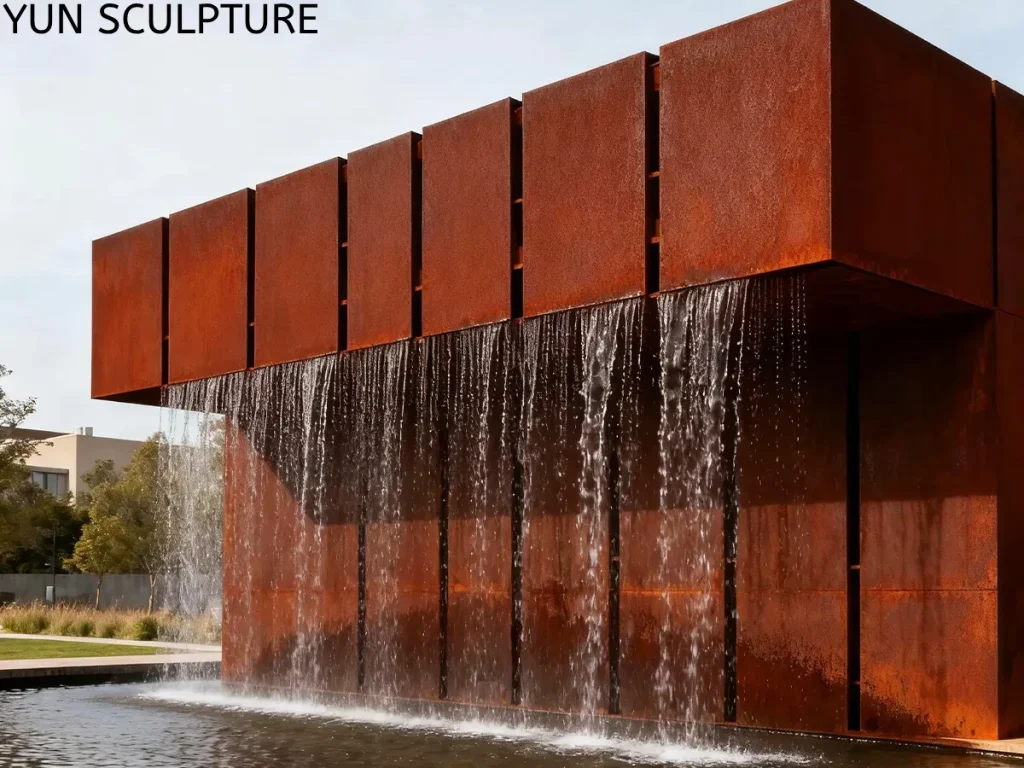
In 2026, modern fountain design is no longer defined by ornament alone. It is defined by material honesty. The industrial aesthetic has moved from urban relic to architectural centerpiece, where steel is not hidden but celebrated. A metal outdoor fountain crafted from corten becomes a visual focal point not because it shines, but because it ages—with intention, with control, and with narrative depth.
Clients no longer ask only how a fountain looks on day one. They ask how it will look in five years, ten years, across seasons of rain and sun. This shift demands more than design sensitivity. It requires metallurgical precision.
The question at the core is deceptively simple: how can flowing water coexist with steel designed to rust?
The answer is not in resisting corrosion, but in engineering it.
What follows is not a surface-level explanation. It is the structural logic behind permanence—how fluid dynamics and chemical stability are balanced to ensure that what appears fragile is, in fact, enduring.
Table of Contents
Table of Contents
The Metallurgical Foundation: Why Flowing Water Won’t Rust Through Corten
From an engineering perspective, corten steel is not a material that avoids corrosion. It is a material that controls it.
The base specification, often aligned with ASTM A588, defines a category of weathering steels distinguished by their alloy composition. Unlike conventional carbon steel, corten incorporates specific alloy elements—Copper (Cu), Chromium (Cr), Nickel (Ni), and Phosphorus (P). These are not decorative additions. They are catalysts.
When exposed to the atmosphere, these elements initiate a controlled oxidation process. Instead of forming a loose, flaky rust layer that continuously sheds and exposes fresh metal, corten develops a dense, adherent film. This is the self-protective patina.
At a microscopic level, the patina acts as a barrier. It reduces the diffusion of oxygen and moisture into the underlying steel. Corrosion does not stop, but it slows dramatically, transitioning from active degradation to a stabilized surface condition.
In the context of a corten steel water feature, this behavior becomes more complex—but not less reliable.
Flowing water introduces mechanical interaction. As water moves across the surface, it can gradually abrade the outermost layer of the patina. In conventional materials, this would accelerate failure. In corten, it activates a regenerative cycle.
This is the principle of self-healing.
When the patina is locally worn or thinned, the newly exposed steel reacts immediately with oxygen and moisture in the environment. The alloy elements once again catalyze oxidation, rebuilding the protective layer. The process repeats continuously, allowing the surface to maintain equilibrium even under dynamic conditions.
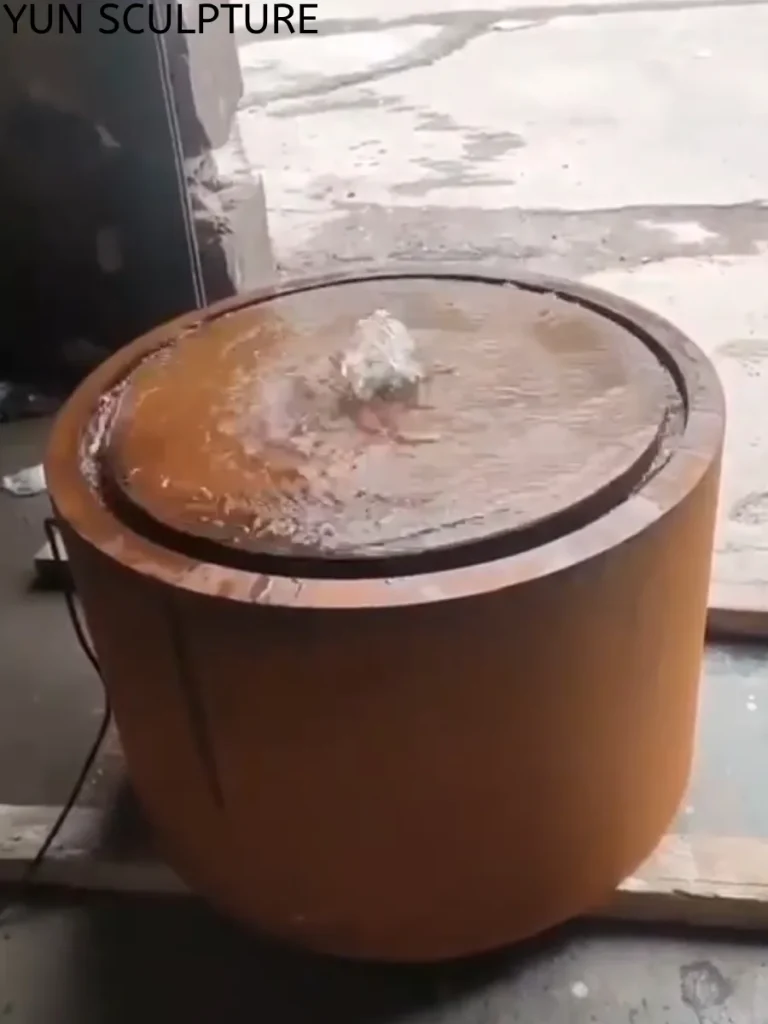
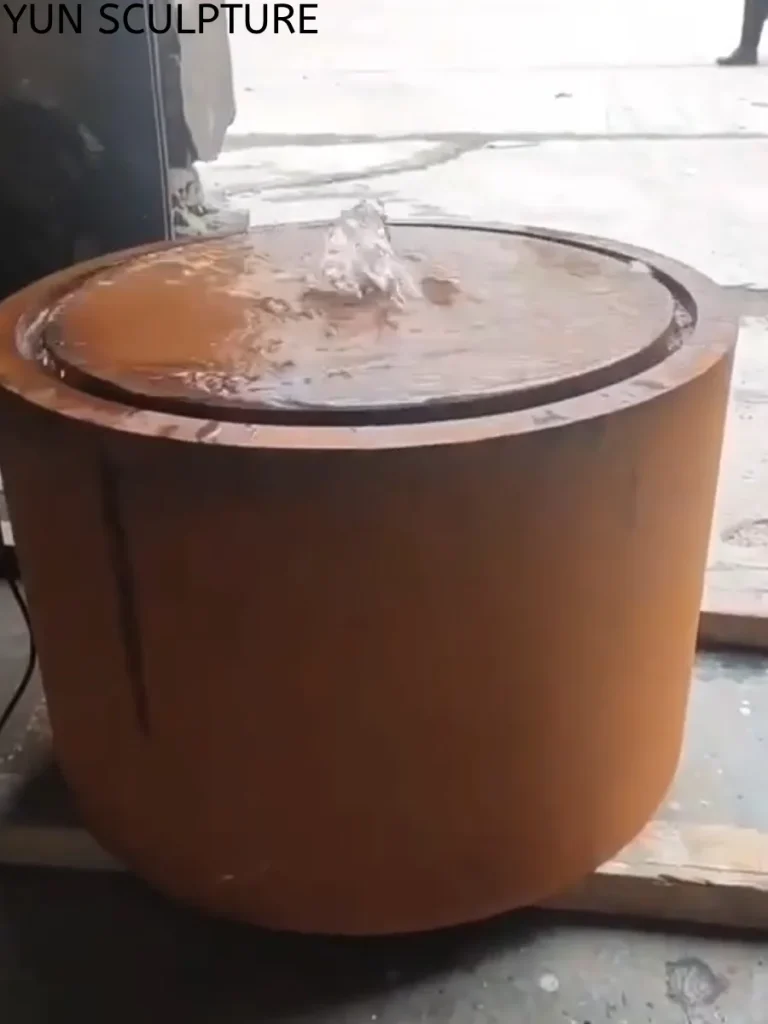
However, this equilibrium depends on one critical environmental rhythm: wet-dry cycles.
The formation and stabilization of the patina occur in three distinct phases. Initially, the steel presents as a clean silver-grey surface. Within weeks of exposure, oxidation produces a vivid orange-red layer—often mistaken for uncontrolled rust. This is a transitional phase. Over time, as cycles of moisture and drying continue, the patina compacts and darkens, stabilizing into a deep chocolate brown with subtle tonal variation.
This final state is not only visually refined. It is structurally protective.
The presence of flowing water, when properly designed, supports this evolution. Thin films, cascading sheets, and intermittent flow patterns allow oxygen to remain in contact with the surface. The steel is alternately wetted and dried, sustaining the chemical reactions required for stability.
The risk emerges when this cycle is interrupted.
Stagnant water, or conditions where steel remains continuously submerged, prevent adequate oxygen exposure. Without oxygen, the patina cannot mature into its dense, protective form. Instead, unstable corrosion products develop—most notably akaganeite, a chloride-rich compound associated with pitting corrosion.
This form of degradation is localized and aggressive. It penetrates rather than protects.
For this reason, the design of any metal outdoor fountain using corten must prioritize movement—not only for aesthetic effect, but for material longevity. Water must flow, surfaces must breathe, and exposure must be intermittent.
The durability of corten is not accidental. It is conditional.
When those conditions are respected, the result is a material that does not weaken in the presence of water, but evolves with it—forming a surface that is both protective and expressive, engineered and alive.
2026 Top Design Typologies for Corten Water Features
The evolution of the corten steel water feature is no longer about form alone. It is about how water behaves across a surface, how sound is shaped in space, and how reflection alters perception. Each typology is a controlled experiment—balancing gravity, material, and atmosphere.
Minimalist Mirrors
- Water table
A water table is the purest expression of restraint. A perfectly leveled corten plane holds a thin film of water, allowing surface tension to create a continuous, unbroken mirror. The sky, surrounding architecture, and light conditions are captured with near-photographic clarity. - Reflective pool
Larger in scale, the reflective pool extends this principle into landscape. The corten perimeter frames the water like a drawing edge, while the still surface dissolves boundaries between built form and environment. The industrial aesthetic becomes unexpectedly quiet—almost meditative.
In both cases, movement is minimal, but never absent. Subtle circulation ensures water clarity while maintaining the critical wet-dry cycles along exposed edges.
Architectural Boundaries
- Rain curtain
The rain curtain transforms water into a vertical veil. Precision-machined weirs distribute water evenly along a linear edge, allowing it to fall in a continuous sheet. The result is both visual and acoustic—a soft, consistent white noise that masks traffic and urban disturbance. - Architectural water wall
A more controlled variant, the architectural water wall directs water along a corten surface rather than free-falling. The texture of the steel interacts with the flow, creating micro-variations in pattern and tone. Light grazes the surface, amplifying depth and movement.
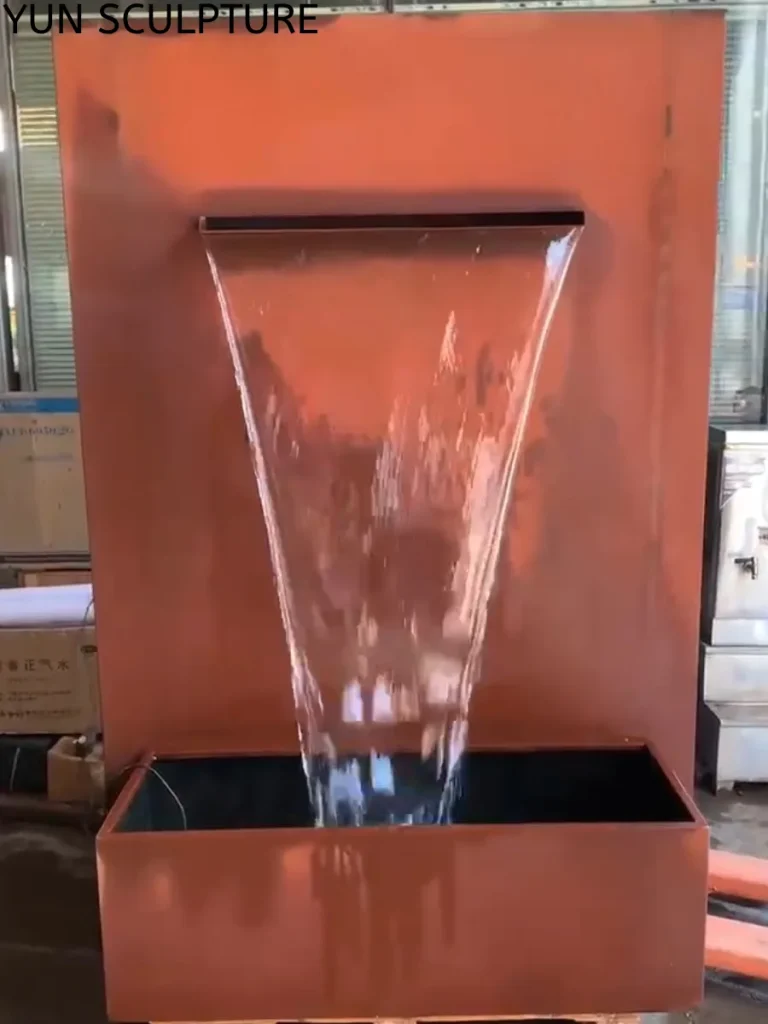
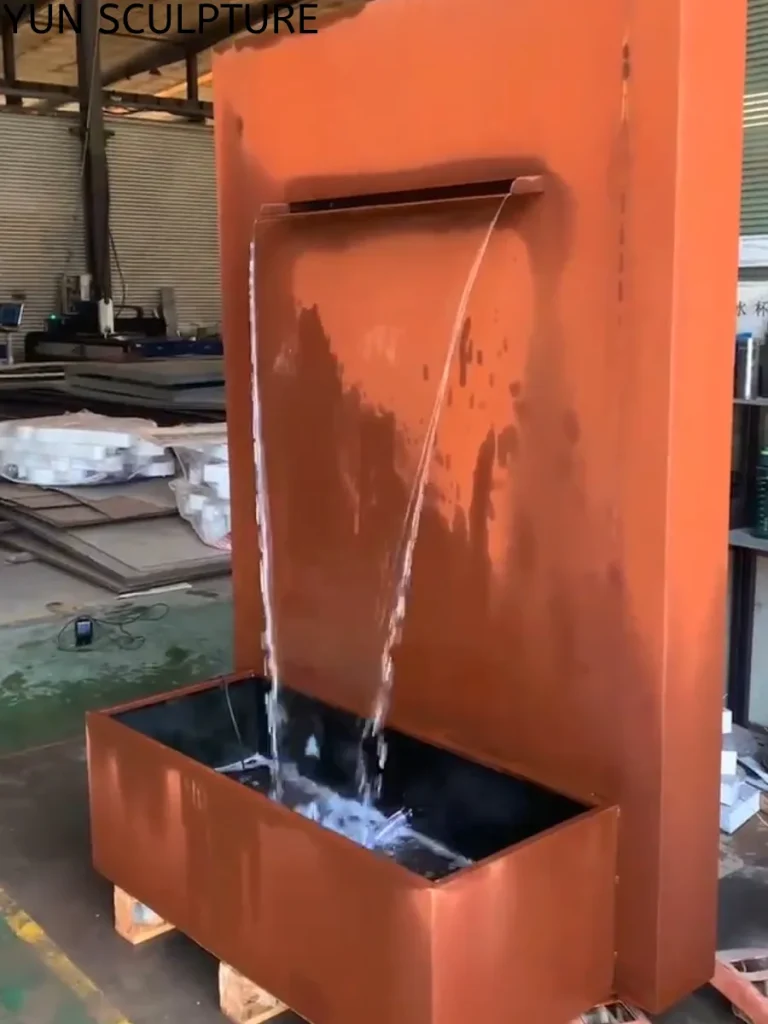
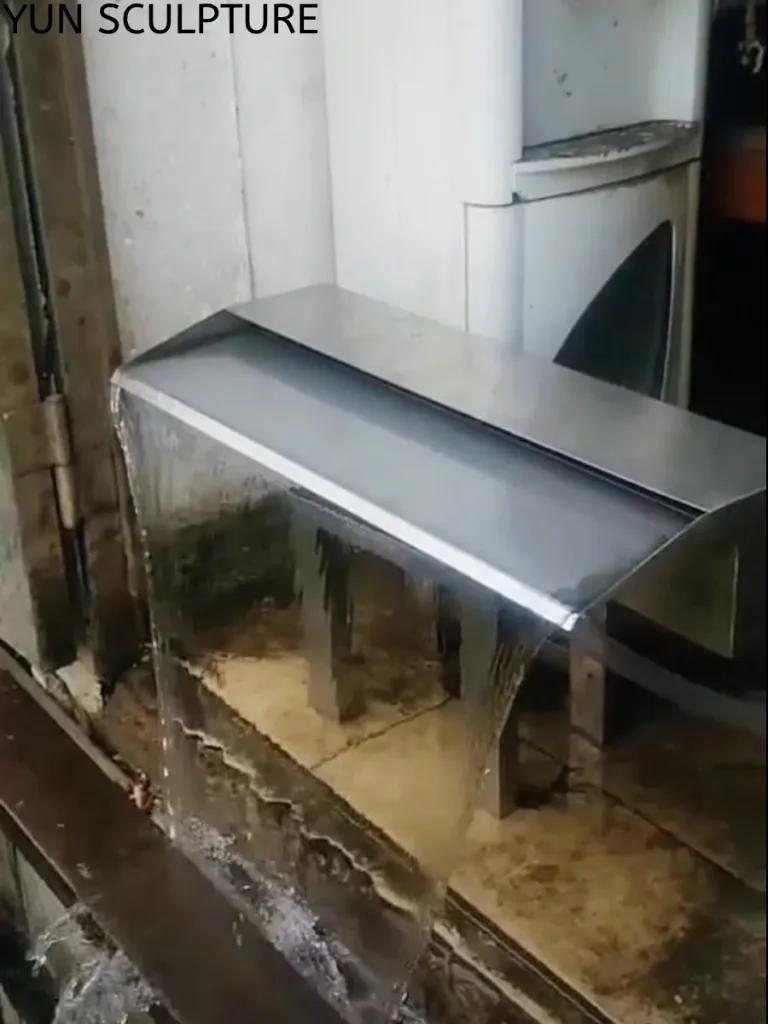
These installations often serve as spatial dividers. They define thresholds without closing them, using water as a permeable boundary.
Spatial Magicians
- Tiered cascading fountain
In constrained urban environments, vertical layering becomes essential. A tiered cascading fountain breaks water into sequential drops, generating rhythm and sound variation. Each level introduces a new acoustic frequency, creating a richer sensory experience within a compact footprint. - Column fountain
The column fountain distills water movement into a vertical axis. Water emerges, rises, and falls within a defined cylindrical or prismatic form. It acts as a sculptural anchor—highly visible, yet spatially efficient.
Both typologies manipulate perception. Through sound and motion, they make small courtyards feel expansive and alive.
Ecological Integration
- Integrated planter-pond
The integrated planter-pond merges landscape and water system into a single organism. Aquatic plants are not decorative additions; they are functional components that assist in filtration and oxygenation.
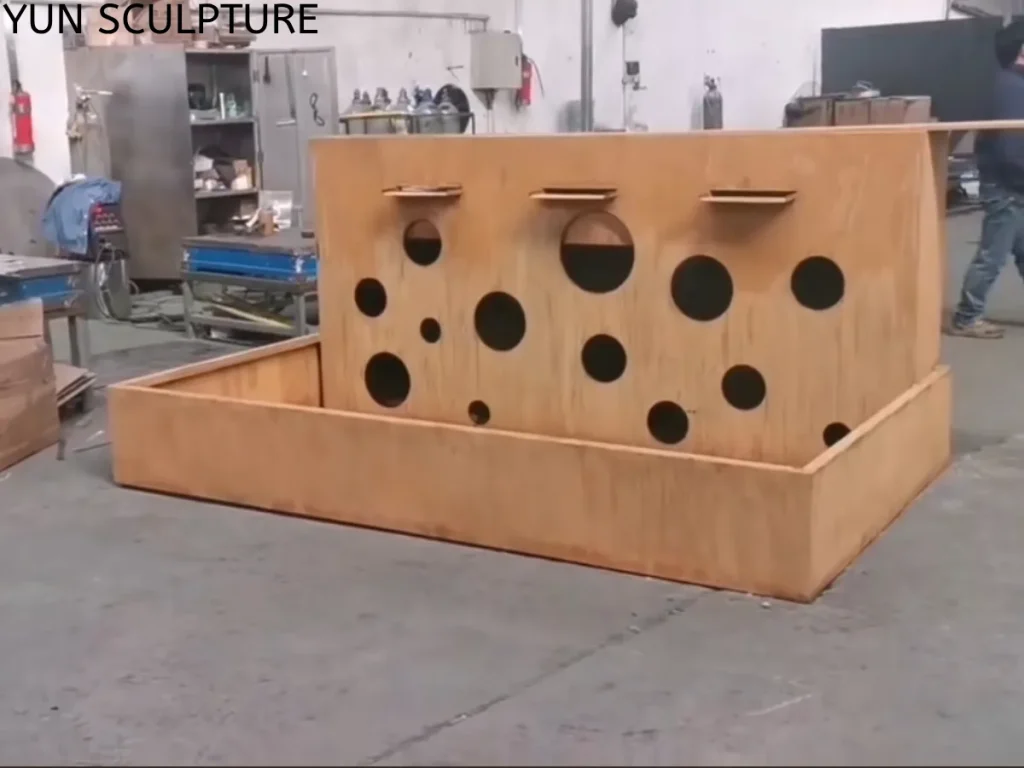

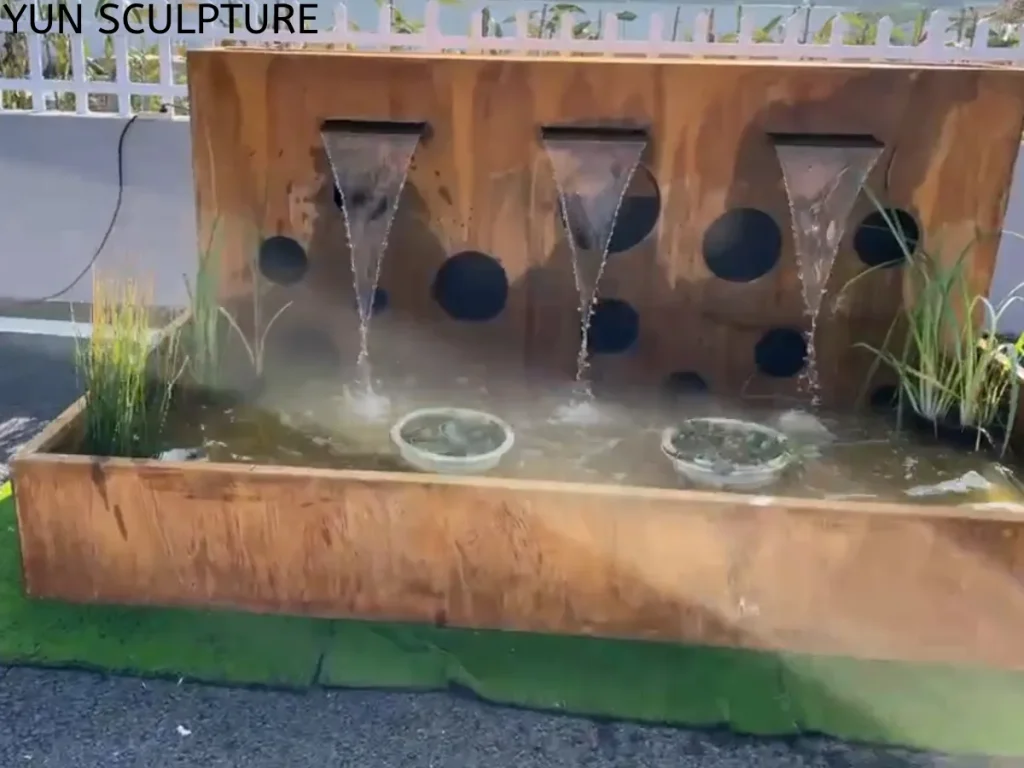
Corten’s industrial character contrasts with the softness of vegetation, creating a layered narrative—engineered structure supporting living systems. When properly detailed, this typology reduces maintenance while enhancing ecological value.
Donghui Zhang’s Hardcore Technical Specifications
Design intent without engineering discipline leads to premature failure. A metal outdoor fountain, particularly in corten, must be dimensioned and controlled with the same rigor as infrastructure.
Thickness is Insurance
Decorative corten panels often operate at 2mm thickness. This standard is insufficient for any water-retaining structure.
Water introduces constant load, thermal variation, and long-term material interaction. For this reason, plate thickness must be treated as structural insurance:
- 4mm: Minimum for small, non-load-intensive elements
- 6mm: Standard for medium-scale basins and vertical features
- 10mm or more: Required for large-format water tables or load-bearing components
Thicker plates do not simply resist deformation. They slow down corrosion kinetics and provide a longer service life under cyclical exposure.
Flow Velocity Control
Water speed is not an aesthetic afterthought. It is a governing parameter in material performance.
For a stable self-protective patina:
- Optimal surface flow velocity should remain below 0.5 m/s
- At this range, water maintains movement without aggressively disturbing the oxide layer
When velocity exceeds 2.0 m/s, a different regime emerges. The mechanical force of water begins to strip the մակropatina layer faster than it can regenerate. This condition is defined as erosion-corrosion.
The result is uneven surfaces, accelerated material loss, and visual inconsistency. Precision in pump selection and flow distribution is therefore essential.
Internal Coatings
In zones of continuous water storage—such as basins or concealed reservoirs—reliance on corten alone is not sufficient.
Applying internal coatings serves two critical functions:
- Polyurea coatings provide a seamless, flexible membrane with high chemical resistance
- Bitumen damp-proof membranes offer cost-effective isolation in less demanding conditions
These layers reduce direct water-steel interaction, limiting iron ion release into the system. This is particularly important in integrated planter-pond designs, where aquatic ecosystems depend on controlled water chemistry.
Structural Reinforcement
Water exerts force quietly, but relentlessly. Hydrostatic pressure increases linearly with depth and acts continuously across surfaces.
For any water table exceeding 1.5 meters on a single side, structural reinforcement is not optional.
Two systems are required:
- Internal structural skeleton
A concealed frame—typically fabricated from steel sections—distributes loads and maintains geometric stability. - Internal bracing (stiffeners)
Welded plates or ribs reinforce flat surfaces, preventing bulging or long-term deformation.
Without these measures, even thick corten plates will gradually deflect under hydrostatic pressure. The visual precision of the design will be lost, and stress concentrations may lead to failure over time.
Engineering, in this context, is not visible. But it defines everything the user ultimately experiences: stillness, alignment, and the quiet confidence of a structure that holds its form against both water and time.
Strategic Solutions for Managing “Rust Runoff”
The beauty of corten lies in its controlled oxidation. But in the early stages of a corten steel water feature, that control has not yet fully stabilized. The result, if unmanaged, is rust runoff—visible as orange staining incidents on adjacent stone, concrete, or paving.
This is not a defect. It is a phase.
The responsibility of design and engineering is to shorten that phase, contain its byproducts, and protect the surrounding environment.
Pre-oxidation
The most effective strategy begins before installation.
Pre-oxidized steel, or factory-controlled pre-oxidation processes, accelerate the formation of the self-protective patina under regulated conditions. Chemical catalysts and controlled wet-dry cycles are applied to stabilize the surface before the piece ever reaches site.

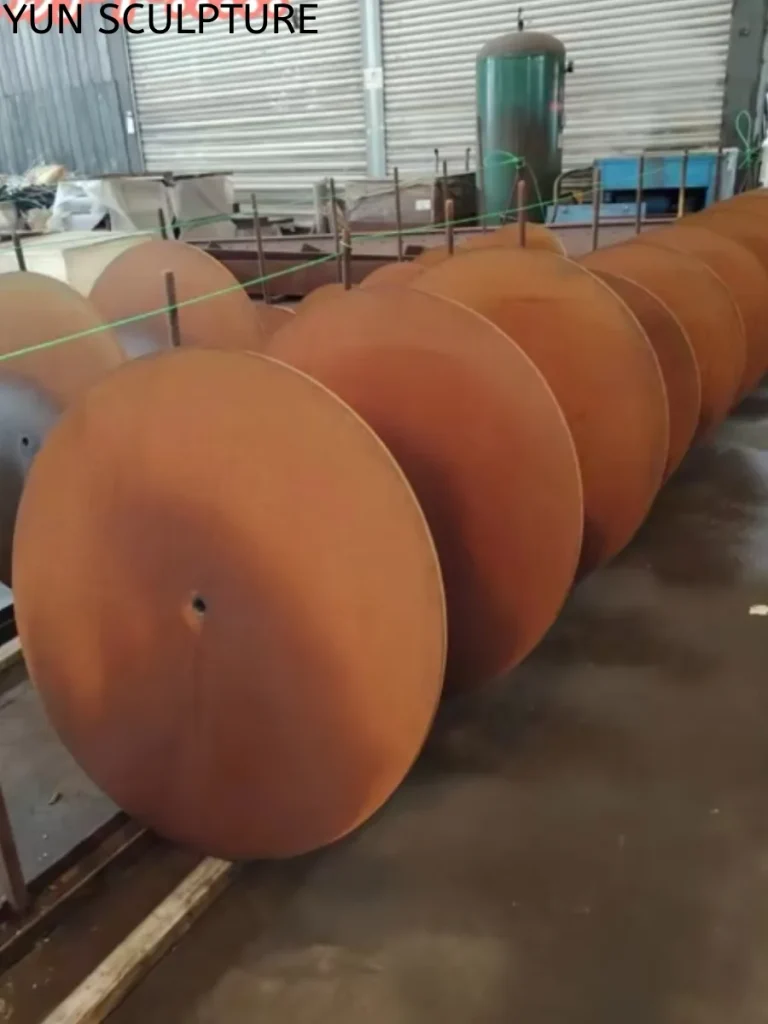
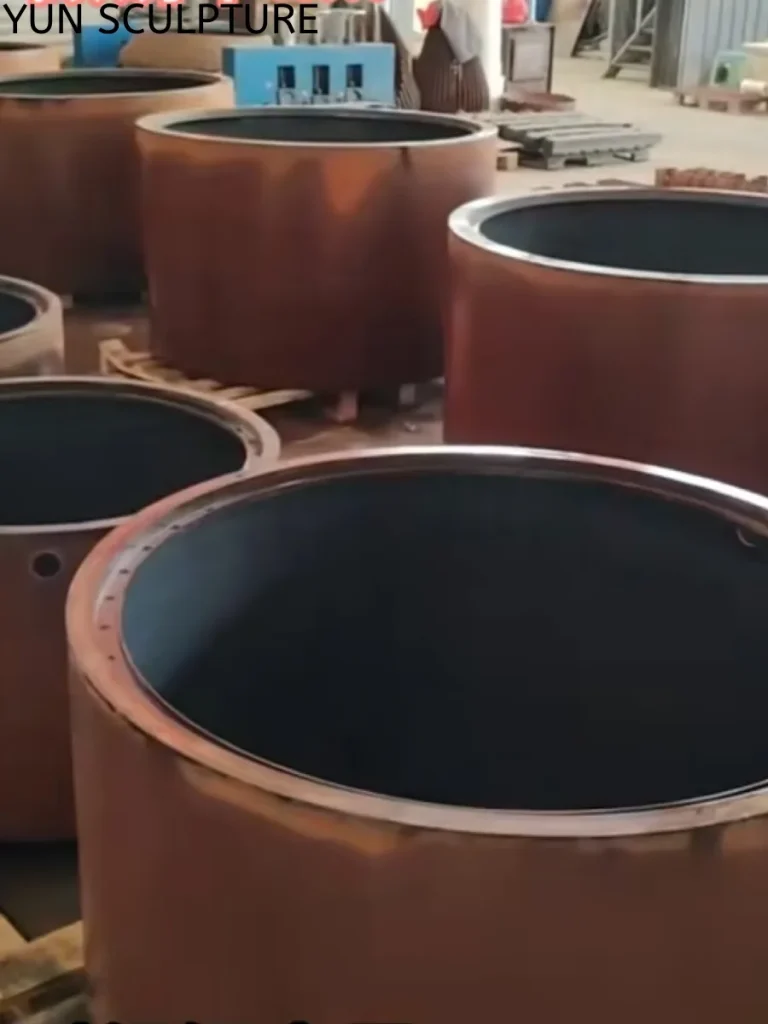
The result is measurable:
- Reduction of rust runoff by up to 90%
- Elimination of unpredictable staining during the critical first months
- Immediate visual maturity, aligning with design intent from day one
Without pre-oxidation, a metal outdoor fountain will inevitably release free iron oxide particles during its early life. With it, that release is largely contained within the factory process.
Physical Barriers
Even with pre-oxidation, intelligent detailing is essential. Water carries particles. Gravity determines where they settle.
Three physical strategies form the first line of defense:
1. Gravel Borders
A perimeter of loose gravel acts as a passive filtration zone. Falling iron oxide particles are captured within the aggregate rather than bonding to finished surfaces. Over time, the gravel itself becomes part of the visual language—subtly echoing the tone of the corten.
2. Drip Edges
Precision-formed drip edges interrupt the path of water as it travels along surfaces. By forcing water to detach cleanly, they prevent capillary action from pulling rust-tinted water across vertical faces. This small geometric detail eliminates a disproportionate amount of staining risk.
3. Pedestal Mounting
Elevating the feature above surrounding paving creates separation between water discharge and finished ground surfaces. It allows airflow beneath the structure, reduces moisture accumulation, and prevents long-term staining halos at the base.
Together, these measures transform runoff from a liability into a controlled, predictable behavior.
Advanced Recirculating Water Treatment and Hydraulics
A corten steel water feature is not a static object. It is a closed-loop system. Water is continuously moving, collecting, filtering, and returning.
Clarity, stability, and longevity depend on how that system is engineered.
Magnetic Filtration
In the early operational phase, even stabilized corten will release microscopic iron particles into the water.
Magnetic filtration introduces a targeted solution.
By integrating a rust catcher equipped with neodymium magnets into the circulation line, ferromagnetic particles are physically extracted from the water before they can accumulate or redeposit. Unlike conventional filters that rely solely on mechanical sieving, this system actively attracts and captures iron oxide at a molecular level.
The effect is immediate:
- Water clarity improves significantly
- Sediment buildup in the recirculation tank is reduced
- Maintenance intervals are extended
For projects where visual purity is critical—particularly reflective pool or water table designs—this system is not optional. It is foundational.
Chemical Turbidity Control
During commissioning, water often appears cloudy. This is not contamination, but suspended particulate matter from initial oxidation.
Turbidity control addresses this condition through flocculation.
Polyacrylamide (PAM) agents bind fine particles into larger clusters, allowing them to settle or be filtered more efficiently. Used correctly, they accelerate the transition from cloudy to clear water without disrupting the patina formation process.

Complementing this, UV clarifiers are introduced to manage biological growth. By disrupting the DNA of algae and microorganisms, they prevent green water conditions without the need for aggressive chemical dosing.
The system remains balanced—chemically stable, visually clean, and materially compatible.
Hydraulic Integrity and System Design
Water systems fail not from complexity, but from oversight.
An effective corten fountain must avoid dead water design—zones where water stagnates, circulation is weak, and oxygen exchange is limited. These areas encourage algae growth, uneven sediment deposition, and unstable corrosion behavior.
Key principles include:
- Continuous circulation across all surfaces
- Proper sizing of the recirculation tank to handle flow volume and sediment load
- Strategic inlet and outlet placement to eliminate stagnant zones
Auto-fill valves play a quiet but essential role. Evaporation is constant, especially in warm climates. Without automatic replenishment, water levels drop, pumps run dry, and system failure follows.
A well-designed hydraulic system is invisible in operation. Its presence is only recognized in the consistency of water movement and clarity.
Installation and Winterization Protocols
A precise design can be undermined by careless installation. At this stage, tolerances become visible, and physics becomes unforgiving.
Leveling
Water reveals error instantly.
In a rain curtain or architectural water wall, a deviation of even 1mm across a weir edge will disrupt the flow. Instead of a continuous sheet, water separates into uneven streams.
This is not adjustable after the fact. It is determined at installation.
Laser leveling, rigid substructures, and verification at multiple stages are required. The visual perfection of a water feature is, in reality, a product of millimeter-level discipline.
Foundation Load
Water carries weight with absolute consistency: 1000 kg per cubic meter.
This must be calculated alongside:
- The mass of the corten structure
- Additional loads from concrete foundations or cladding
- Dynamic forces from moving water
A reflective pool measuring 2m × 2m × 0.3m, for example, holds 1.2 cubic meters of water—equivalent to 1,200 kg, before accounting for the structure itself.
Foundations must be engineered accordingly. Settlement, even minor, will compromise leveling and structural integrity over time.
Winterization and Freeze Protection
In colder climates, water becomes the primary risk factor.
Winterization is not optional. It is a seasonal transition protocol.
Key measures include:
- Complete drainage of all exposed water lines and basins to prevent ice expansion
- Pump removal and indoor storage, protecting mechanical components from freeze damage
- Enhanced drainage detailing, ensuring no residual water is trapped in low points
- Breathable waterproof tarps, shielding the structure while allowing moisture to escape
Freeze protection is not about sealing the object. It is about allowing it to breathe while eliminating the presence of trapped water.
When properly executed, winterization preserves both the mechanical system and the integrity of the patina. The feature reactivates in spring without degradation, continuing its lifecycle as intended.
10 Core Frequently Asked Questions (FAQ)
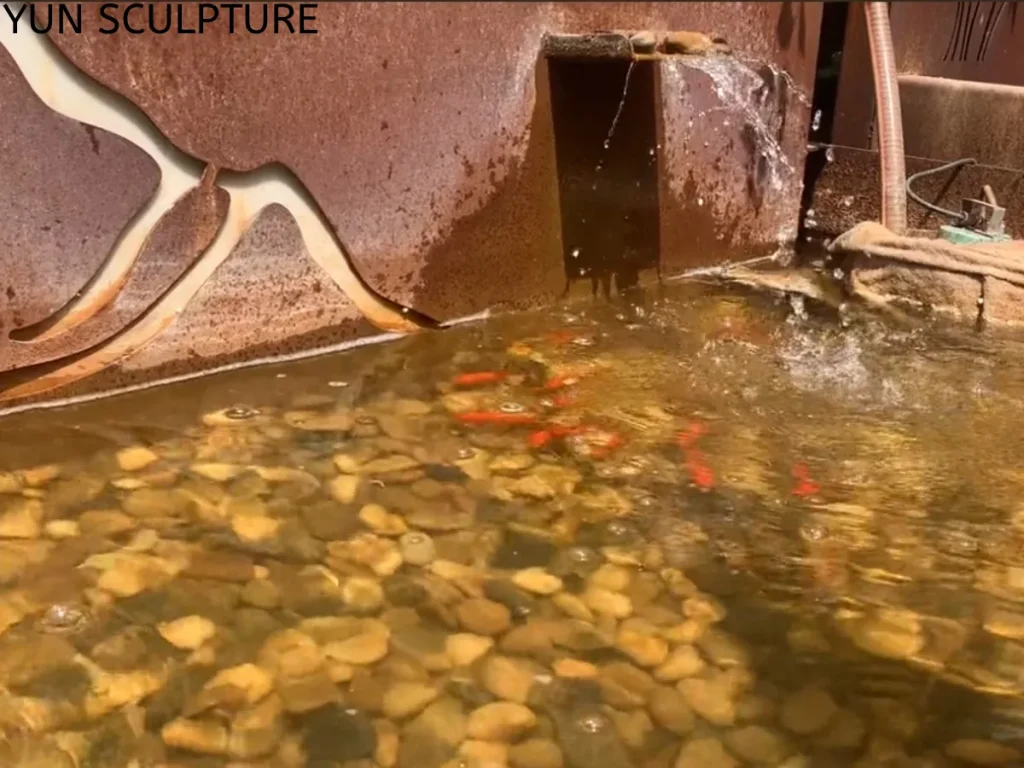
Will the rust runoff from Corten steel kill fish or plants?
Iron oxide itself is not highly toxic. However, in high concentrations, it can stress sensitive fish species and disrupt delicate aquatic systems.
The correct approach is patience. Allow the patina to fully stabilize before introducing fish or plants. Alternatively, apply an internal Polyurea safety coating to isolate the water body from direct steel interaction, ensuring a controlled environment from the beginning.

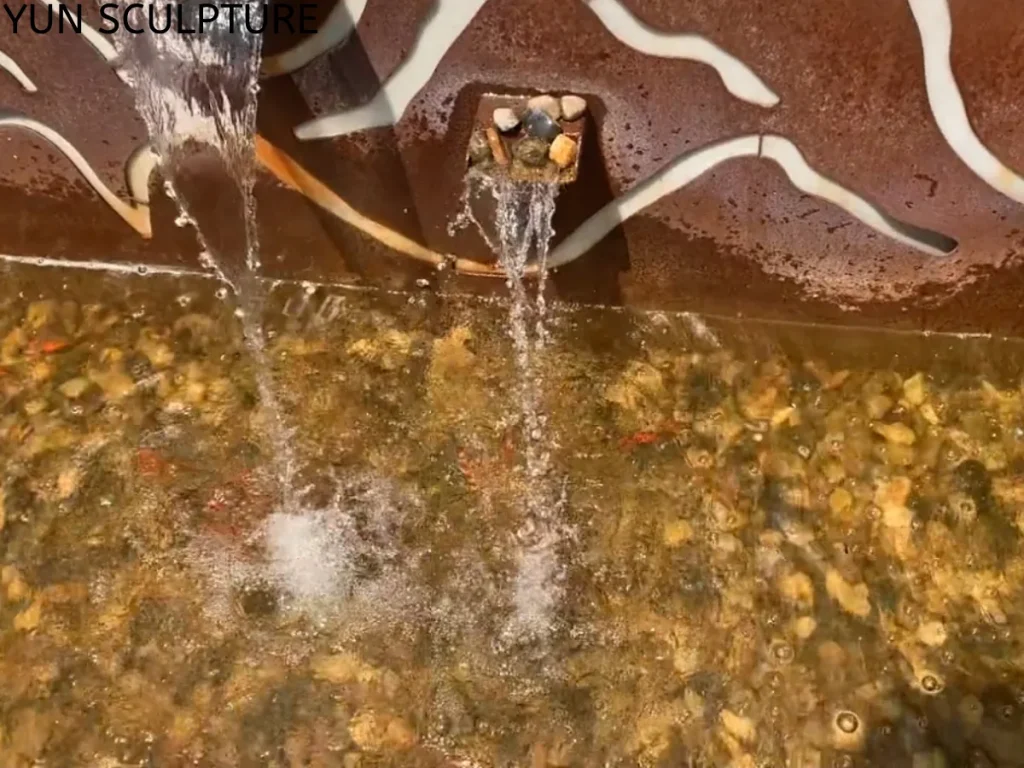
Can I fill my Corten water feature directly with tap water?
Yes—but only if it is properly treated as dechlorinated water.
This is where many failures occur. A water chemistry/chlorine disaster happens when untreated tap water introduces chlorine into the system. Chlorine aggressively attacks the self-protective patina, breaking it down and exposing raw steel. The result is rapid, uneven corrosion and deep pitting.
Always neutralize chlorine before filling or topping up the system. This single step protects both the material and the long-term stability of the feature.
Why is there black, flaky peeling at the bottom of my Corten water bowl?
This condition is a known corrosion form called akaganeite.
It develops when steel is kept in constant submersion without sufficient oxygen—typically in stagnant zones or poorly designed basins. Unlike stable patina, this rust is рых and non-protective, appearing as black, flaky deposits.
The solution is not cosmetic. The system must be drained, cleaned, and redesigned to reintroduce wet-dry cycles and proper circulation. Without oxygen exchange, the steel cannot stabilize.
Does magnetic filtration really clear up rusty water?
Yes, and it is one of the most effective tools available.
Corten steel debris consists largely of ferromagnetic iron oxide particles. High-intensity magnetic filtration systems—using a rust catcher with neodymium magnets—can capture nearly 100% of this material as it circulates.
The result is visibly clearer water, reduced sediment buildup, and a more stable operating system. For high-clarity designs like reflective pools, this is a critical component.
Should I apply a sealing paint to my Corten water feature?
Absolutely not.
Rigid sealing paints suffocate the material. Corten steel must “breathe” to maintain its protective cycle of oxidation and stabilization. When a paint film eventually cracks—as all rigid coatings do—moisture becomes trapped beneath the surface.
This creates accelerated, localized corrosion far more aggressive than natural weathering.
If surface stabilization is required, penetrating oils such as Owatrol oil may be used. These do not form a rigid barrier but instead support the existing patina. The distinction is critical: never apply a sealing paint.
Can water flowing too fast damage the sculpture?
Yes. Flow velocity is a structural variable, not just a visual one.
When water exceeds 2.0 m/s across the steel surface, erosion-corrosion begins to occur. The mechanical force of fast-moving water strips away the protective patina faster than it can regenerate.
This leads to uneven wear, exposed metal, and accelerated degradation.
Flow regulating valves and precise pump calibration are essential. A controlled, moderate flow preserves both the appearance and the lifespan of the feature.
What if my marble paving is already stained by rust?
This is a common issue during early-stage oxidation.
Address how to clean it with professional-grade cleaners containing oxalic acid. These formulations are specifically designed to dissolve iron oxide stains without damaging stone surfaces.
However, cleaning is corrective. Prevention is the true solution. Design strategies such as gravel borders, drip edges, and controlled runoff paths eliminate the conditions that cause staining in the first place.
How does a Corten water feature perform in coastal environments?
Coastal environments introduce a significant challenge: chloride ions.
Salt in the air and water disrupts the formation of a stable patina, leading to a form of chlorine damage that accelerates corrosion. The protective layer becomes less cohesive, and degradation becomes more aggressive.
Mitigation strategies include regular washing of exterior surfaces with fresh water to remove salt deposits. For highly exposed sites, a more robust solution is to use corten-coated 316L stainless steel as the structural base, combining visual authenticity with superior corrosion resistance.
How should I choose the pump power?
Pump selection must align with both aesthetic intent and hydraulic performance.
A practical guideline is:
1500 liters per hour (LPH) for every 10 cm of weir width
This ensures a consistent, unbroken flow across edges such as rain curtains or water walls.
Head height—the vertical distance the pump must lift water—must also be factored in. As height increases, effective flow decreases. Proper sizing ensures that the designed water behavior is achieved in real conditions, not just on paper.
Will winter ice break the Corten steel basin?
It can, if not properly addressed.
Water expands significantly when it freezes, generating internal pressure capable of deforming or cracking rigid structures. This risk is highest in enclosed basins with vertical walls.
Two strategies mitigate this:
Sloped inner walls, which guide expanding ice upward rather than outward
Complete drainage before freezing conditions, eliminating the source of pressure entirely
Winterization is not optional in cold climates. It is a structural safeguard.
Conclusion
A corten steel water feature is not a static installation. It is a living system—one that evolves through time, climate, and use.
Steel oxidizes. Water flows. Between them, a balance is established.
When properly designed, engineered, and maintained, this balance transforms potential conflict into enduring harmony. The raw strength of industrial material does not resist nature—it collaborates with it. The result is a metal outdoor fountain that matures, deepens, and refines its presence year after year.
This is the essence of modern fountain design in its most advanced form: not decoration, but integration. Not surface, but system. Not temporary beauty, but controlled transformation.
– Elena Zhang & Donghui Zhang, Yun Sculpture