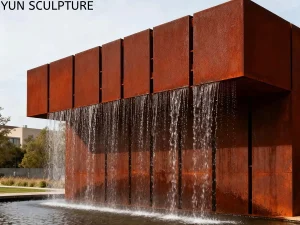
Get in touch with Yun-Sculpture company
The Soul of Industrial Landscapes: The Ultimate Guide to Corten Steel Planters

The contemporary landscape is no longer defined by static perfection. It is shaped by time, climate, and the quiet transformation of materials. In this shift, the industrial aesthetic has re-emerged as a language of honesty—where surfaces are allowed to age, deepen, and record their environment.
In modern garden design, this philosophy finds its most articulate expression in corten steel planters. Also known as weathering steel planters, these forms do not resist change; they collaborate with it. Their surfaces evolve through oxidation, creating a living patina that stabilizes rather than deteriorates.
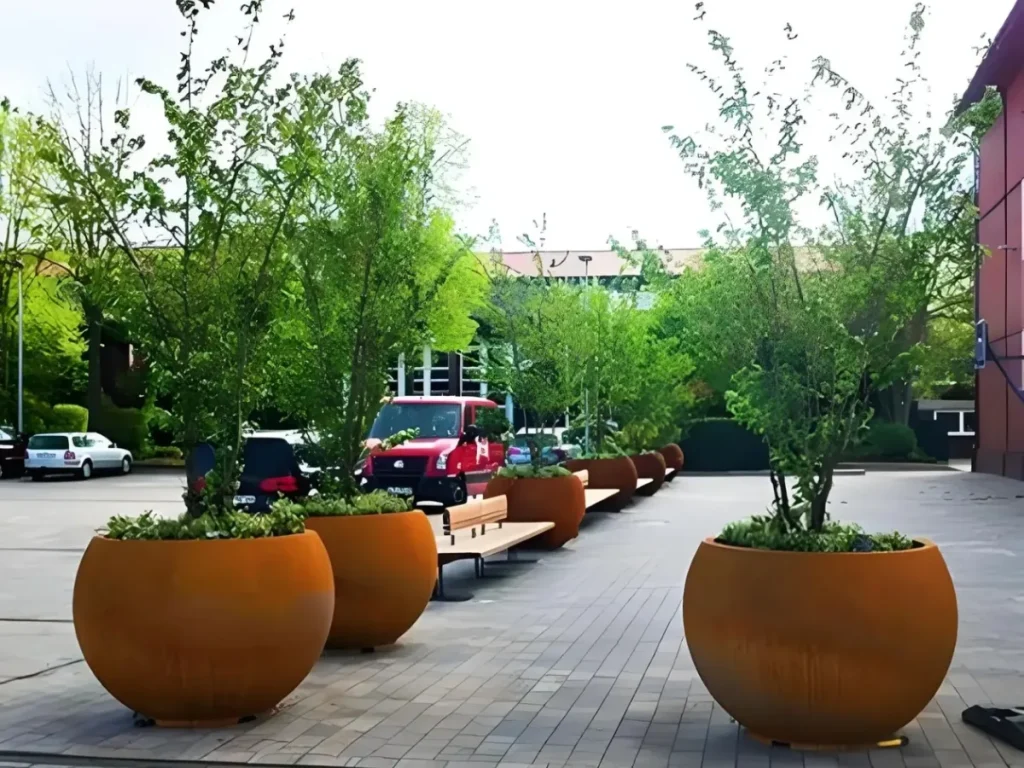
This concept traces back to a pivotal innovation: the 1933 patent by U.S. Steel. The material, later known as “Cor-Ten,” was engineered not to prevent rust, but to control it. That distinction is critical. Unlike conventional materials that demand coatings and constant maintenance, corten steel develops a protective layer that becomes more refined over time.
The result is a planter that feels both industrial and organic. It anchors space with architectural weight while remaining responsive to its surroundings. In plazas, residential courtyards, and large-scale commercial landscapes, corten steel planters act as both container and narrative surface—absorbing light, rain, and air into their identity.
Table of Contents
Table of Contents
The Metallurgical Core: The Chemistry and Self-Protection Logic of Corten
At its core, Cor-Ten is not simply steel that rusts—it is steel that engineers its own protection. The name itself is derived from two defining properties: corrosion resistance and tensile strength. These are not aesthetic qualities; they are structural intentions embedded at the metallurgical level.
Ordinary carbon steel, when exposed to moisture and oxygen, forms a porous rust layer. This layer flakes away, exposing fresh metal beneath, leading to continuous degradation. Over time, the material weakens, loses mass, and ultimately fails.
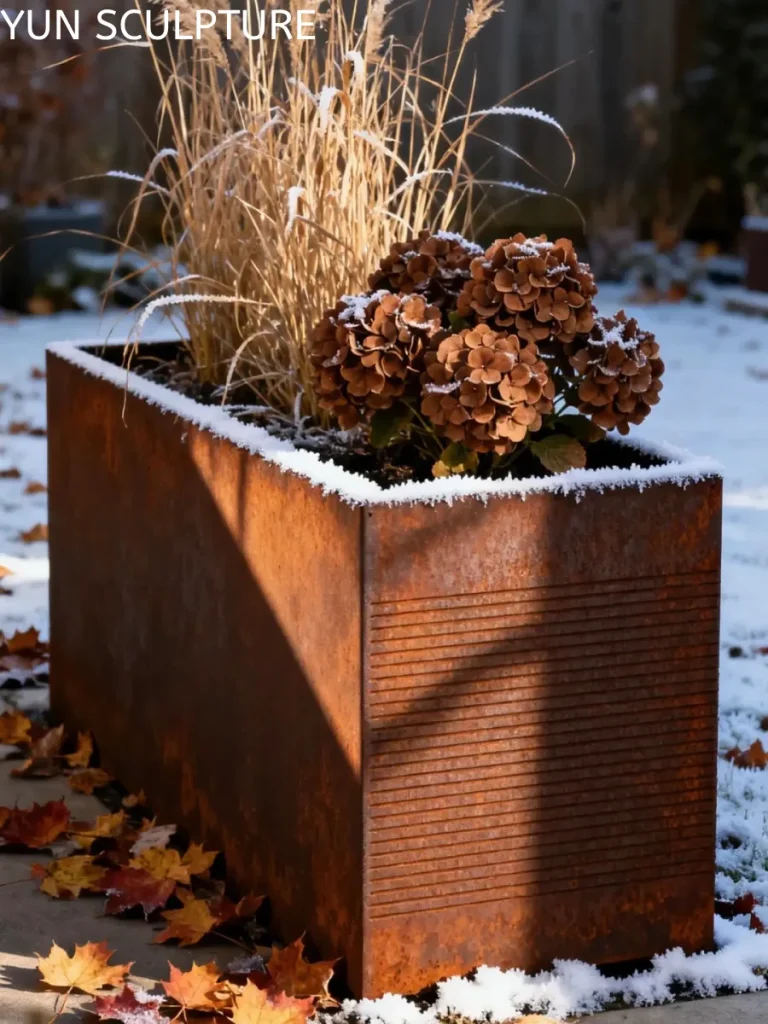
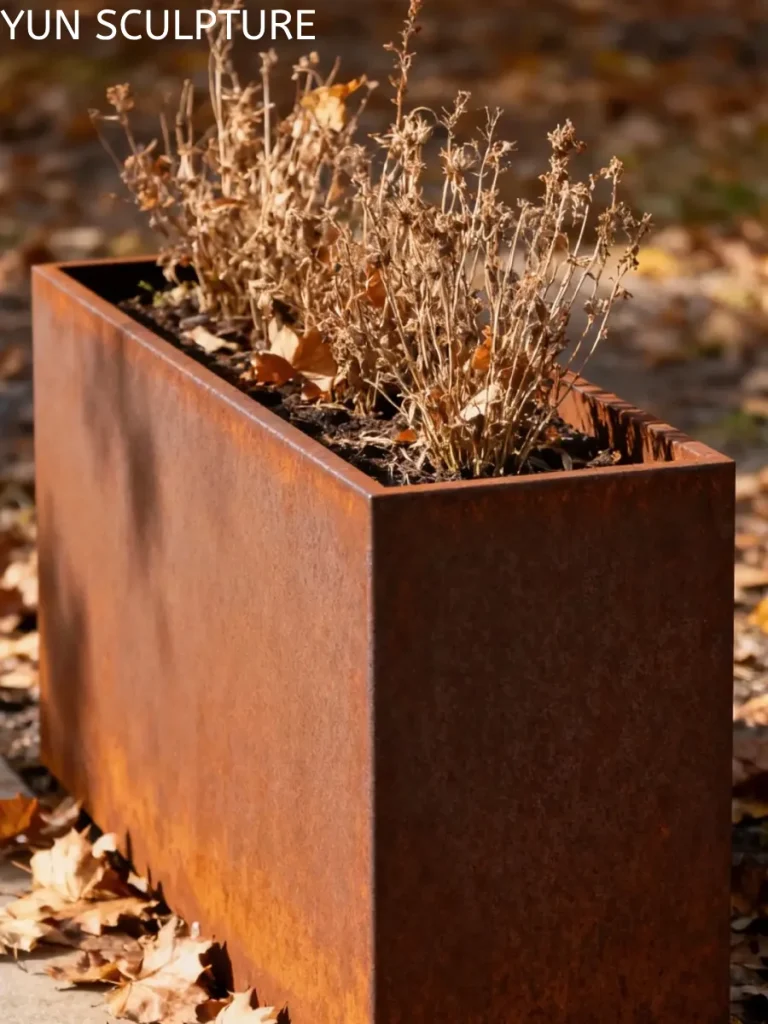

Corten behaves differently. When exposed to the same conditions, it forms a dense, adherent oxide layer. This patina seals the surface, significantly slowing further corrosion. Instead of decay, the material reaches a state of equilibrium. For landscape applications such as corten steel planters, this means longevity without the need for paint or chemical coatings.
From an engineering perspective, this controlled oxidation also preserves tensile strength. The structural integrity remains intact even as the surface evolves. This balance between surface transformation and internal stability is what allows weathering steel planters to function reliably in demanding outdoor environments.
The Alloy Elements
The performance of corten steel is not accidental. It is the result of carefully calibrated alloying elements, each contributing to the material’s long-term behavior:
- Copper (Cu)
Copper plays a critical role in stabilizing the patina. It promotes the formation of a tightly bonded oxide layer, reducing the rate of moisture penetration. - Chromium (Cr)
Chromium increases the density of the oxide film, enhancing resistance against atmospheric pollutants. This is particularly important in urban or coastal environments. - Nickel (Ni)
Nickel improves toughness, especially in low temperatures. It ensures that the steel maintains its mechanical performance under varying climatic conditions. - Phosphorus (P)
Phosphorus contributes to the self-healing characteristics of the patina. When minor վնաս or disruptions occur, the oxide layer can reform and restore its պաշտպան function.
Together, these elements create a material that is both reactive and resilient. The surface evolves, but the structure endures.
Landscape Industry Standards: ASTM A588 vs. A242 vs. A606-4
In professional landscape and architectural applications, selecting the correct grade of weathering steel is essential. Not all corten steel planters are created equal; their performance depends on the specific ASTM standard used.
ASTM A588 is the preferred grade for large-scale applications. With a minimum yield strength of ≥345 MPa, it is suited for structural planters, retaining walls, and installations where load-bearing capacity is critical. Its robustness ensures stability even in expansive or high-traffic environments.
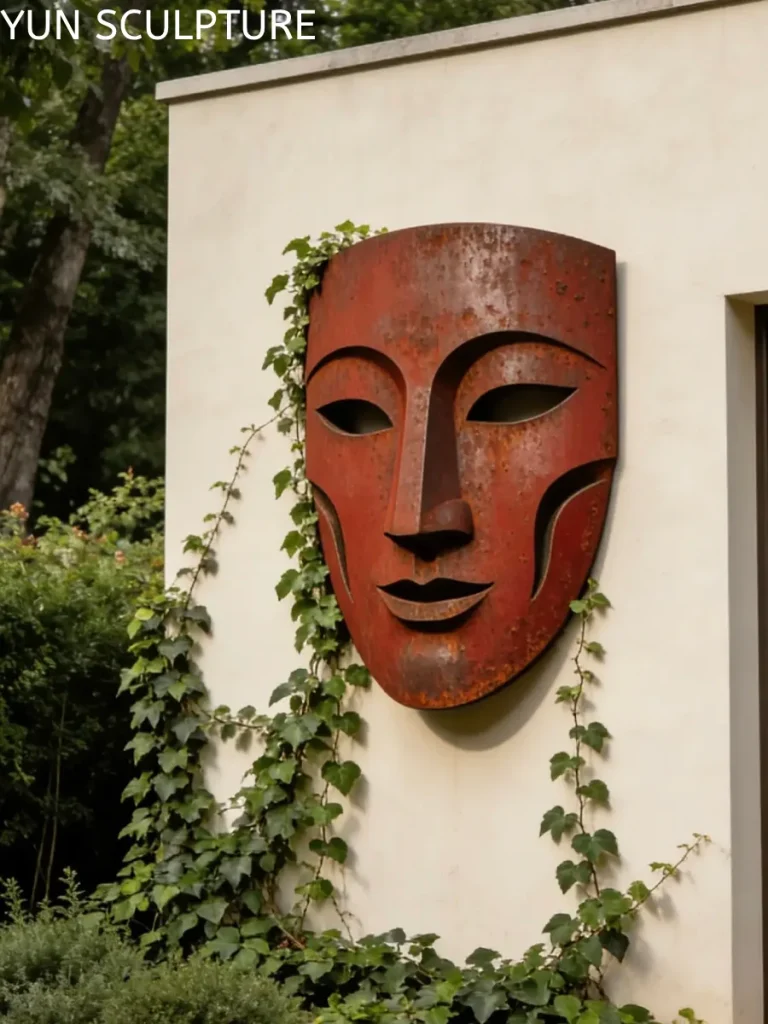
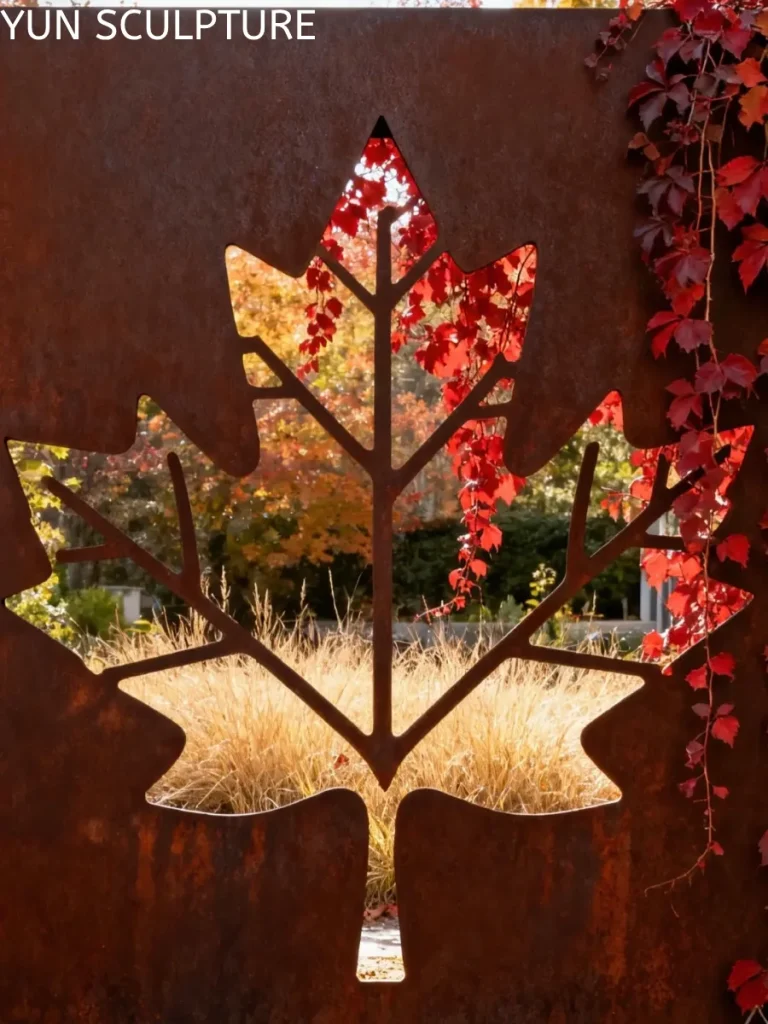
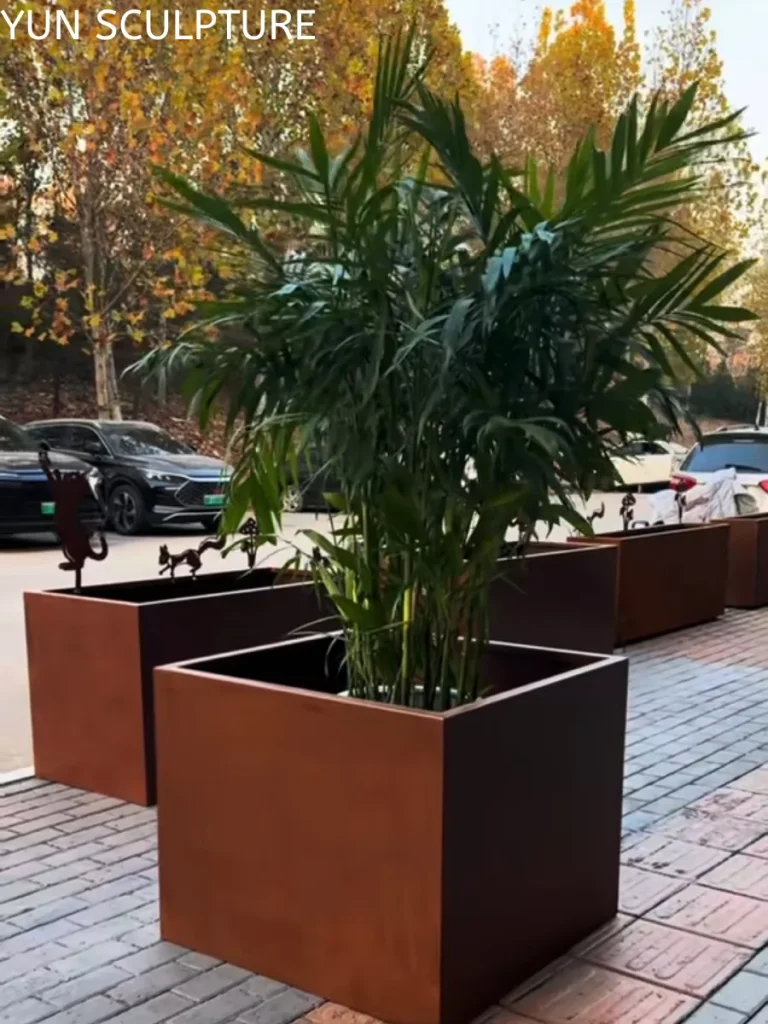
ASTM A242 is commonly used for medium-sized planters and decorative landscape elements. It offers reliable corrosion resistance while allowing for more refined fabrication. This makes it ideal for screens, partitions, and planters that balance structure with visual detail.
ASTM A606-4 is a cold-rolled sheet material designed for precision and curvature. It is frequently used in planters with complex geometries, thin profiles, or intricate bends. Its workability allows designers to achieve fluid, sculptural forms without compromising the essential properties of weathering steel.
Each standard represents a different balance between strength, formability, and application scale. Understanding these distinctions is fundamental to designing corten steel planters that are not only visually compelling, but structurally sound.
The Aesthetics of Oxidation: The Time-Evolution Phases of Corten Patina
Corten steel is not finished in the factory. Its true surface is authored outdoors, through time, climate, and exposure. The visual identity of corten steel planters emerges through patina formation, a process driven by repeated wet-dry cycles that activate and then stabilize the material.
This evolution is not random. It follows a sequence that can be anticipated, designed around, and even celebrated within modern garden design. Understanding these phases allows the designer to align expectation with reality—and to treat time as a design partner.
The Phases
1. Initial Phase (0–6 months)
At installation, the steel presents as a dark, almost bluish-grey surface. With exposure to rain and humidity, oxidation begins rapidly. The color shifts into a vivid, bright orange, often perceived as raw and energetic.
During this stage, rust runoff is inevitable. Water carries iron oxide onto adjacent paving or stone, leaving temporary stains. This is not a defect, but it must be anticipated in detailing—especially in high-end residential or commercial settings.
2. Transformation Phase (6 months–2 years)
As wet-dry cycles continue, the oxide layer begins to consolidate. The surface tone deepens into a richer orange and gradually moves toward red-brown. The visual intensity softens, and the texture becomes more uniform.
This is the moment when corten steel planters start to feel grounded within their environment. The patina tightens, reducing runoff, and the surface takes on a velvety, almost tactile quality. Light interacts differently now—less reflection, more absorption.
3. Mature Phase (2+ years)
The material reaches equilibrium. The color stabilizes into deep brown, often with subtle undertones of purple or charcoal depending on climate. The oxide layer becomes dense and adherent, effectively sealing the steel beneath.
At this stage, corten steel planters achieve their intended permanence. The surface is no longer active in a visible way. Instead, it holds a quiet depth—an architectural finish shaped by time rather than applied by hand.
Coastal Warning
There is one critical exception to this lifecycle. In coastal environments—specifically within approximately 2 kilometers of the shoreline—the presence of airborne salt disrupts the stabilization process.
Under these conditions, the patina does not fully seal. The surface remains active, and corrosion can continue beyond the intended protective phase. From an engineering standpoint, this compromises long-term performance.
In such cases, an alternative material is recommended: 5052-H32 marine-grade aluminum with a fluorocarbon coating. This system provides the necessary resistance to salt-laden air while maintaining a controlled, durable finish.
Integration Strategies in Modern Gardens: Space, Texture, and Light
Corten steel does not exist in isolation. Its success depends on how it shapes space, interacts with surrounding materials, and responds to light. In contemporary landscapes, corten steel planters are not simply containers—they are architectural elements.
Spatial Definition
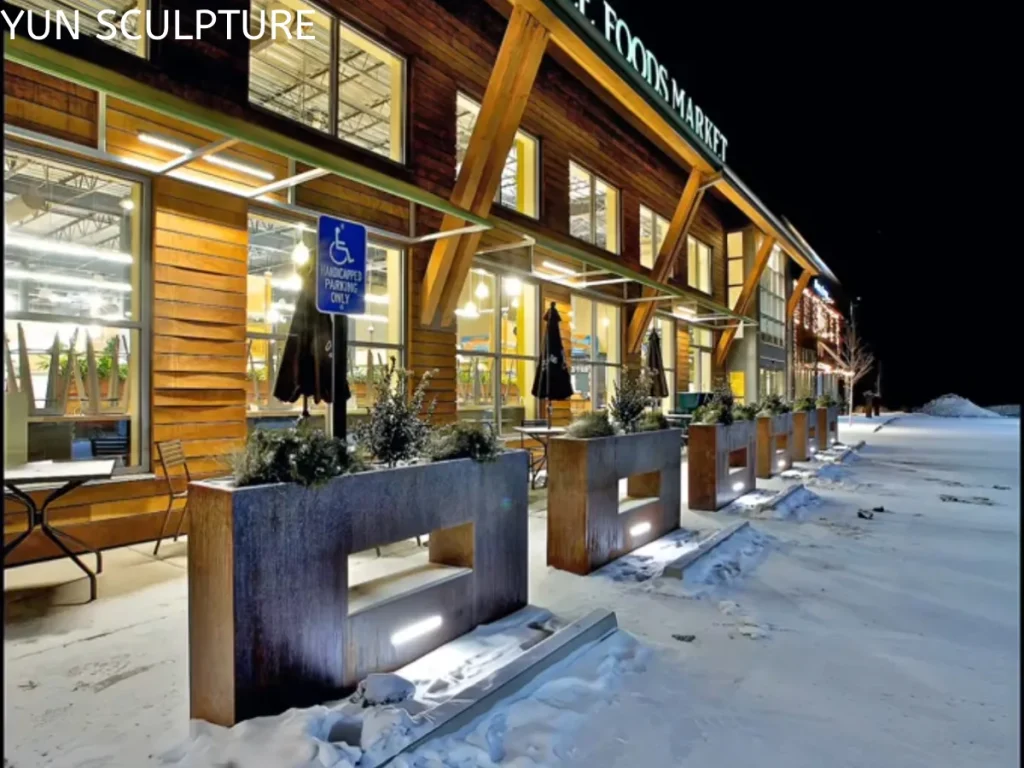
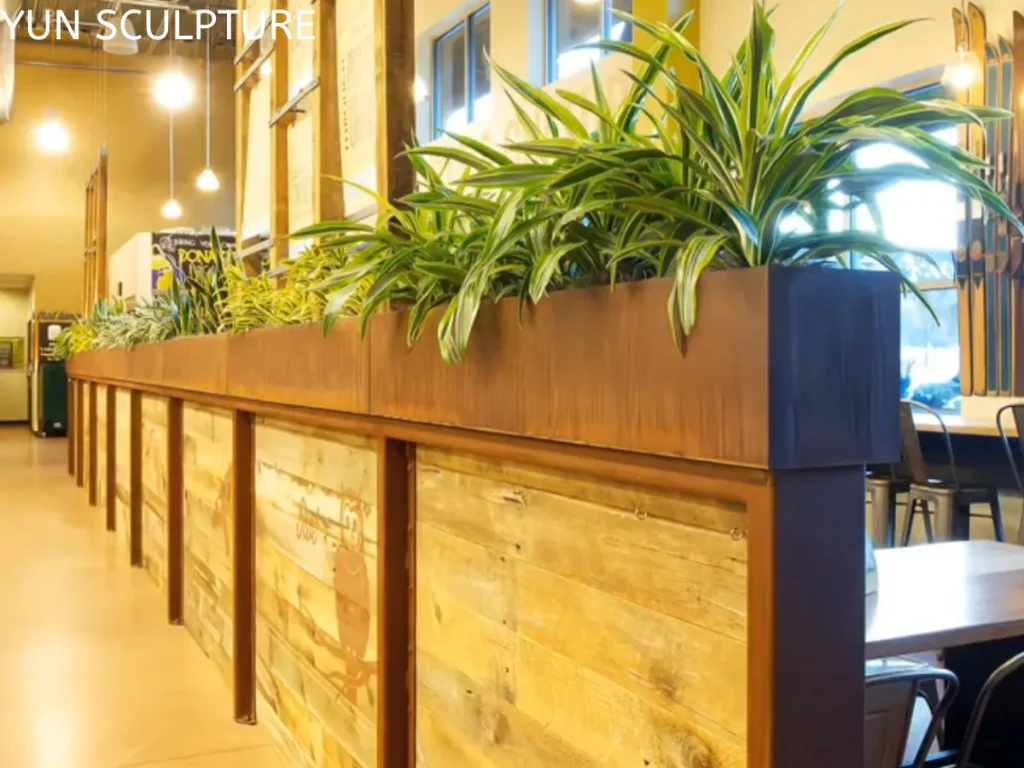
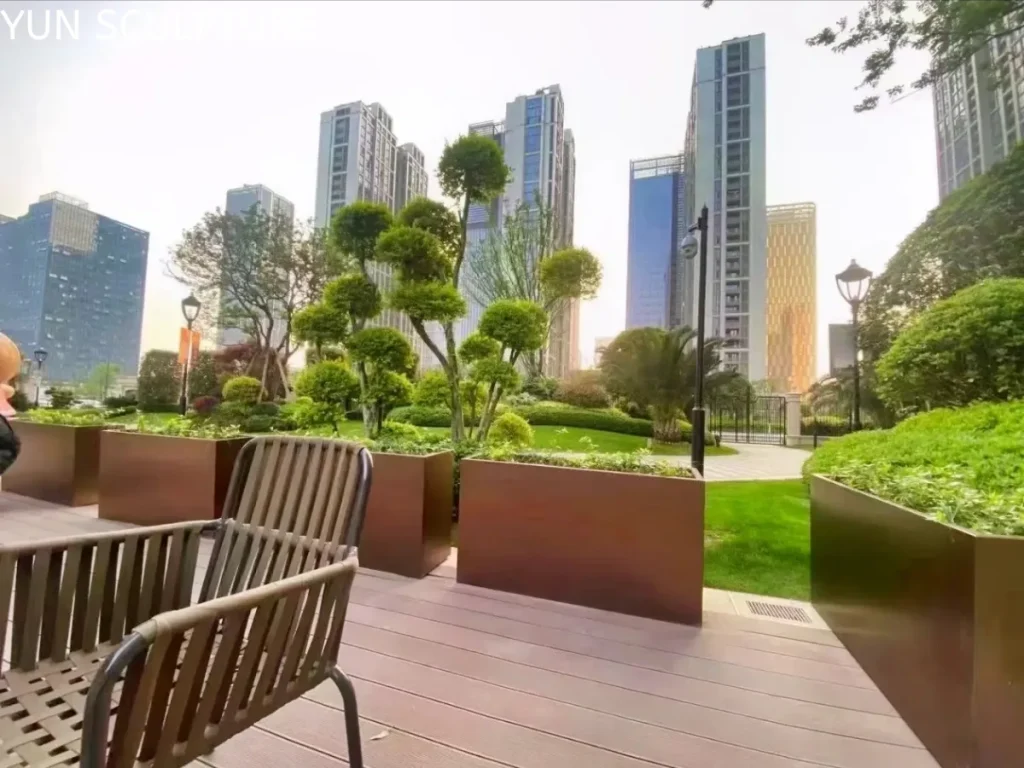
In larger compositions, large corten steel planters and corten steel trough planters function as spatial tools. They define boundaries without the rigidity of built walls. A series of aligned trough planters can frame an outdoor dining area, guide circulation, or create privacy from adjacent spaces.
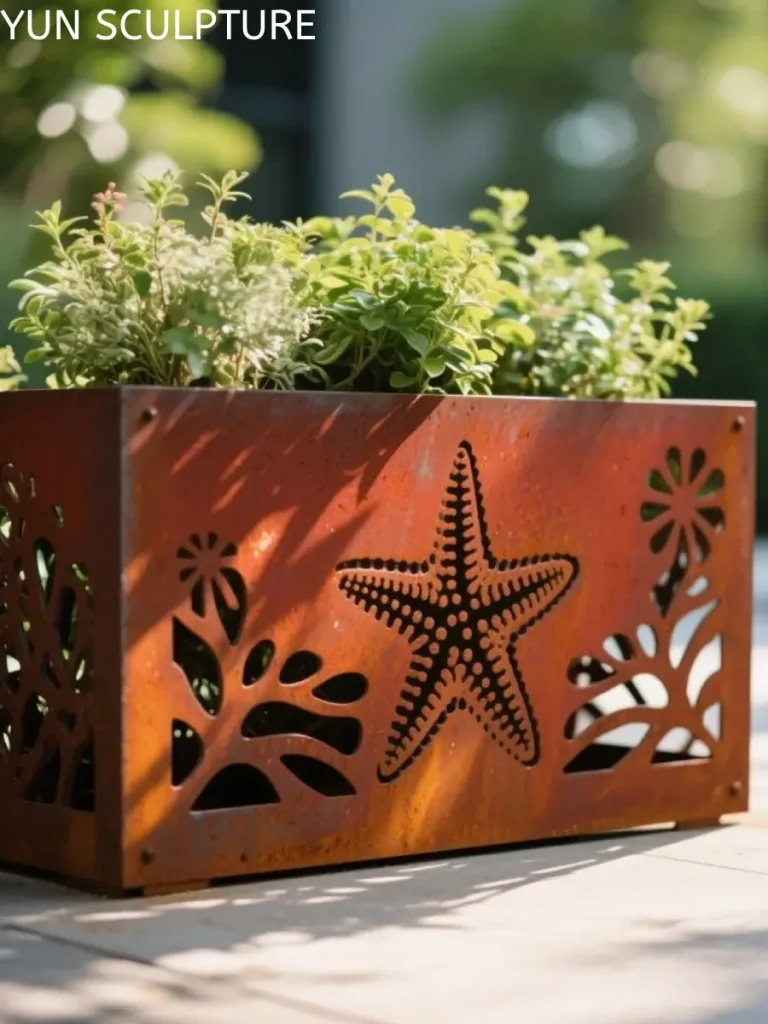
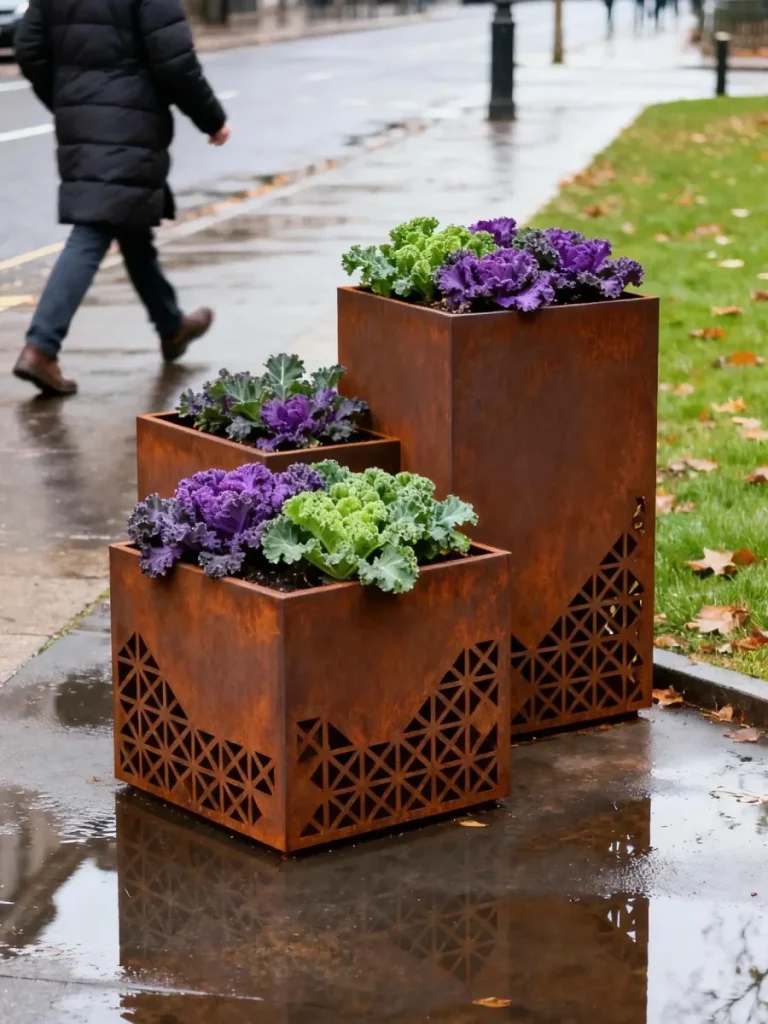

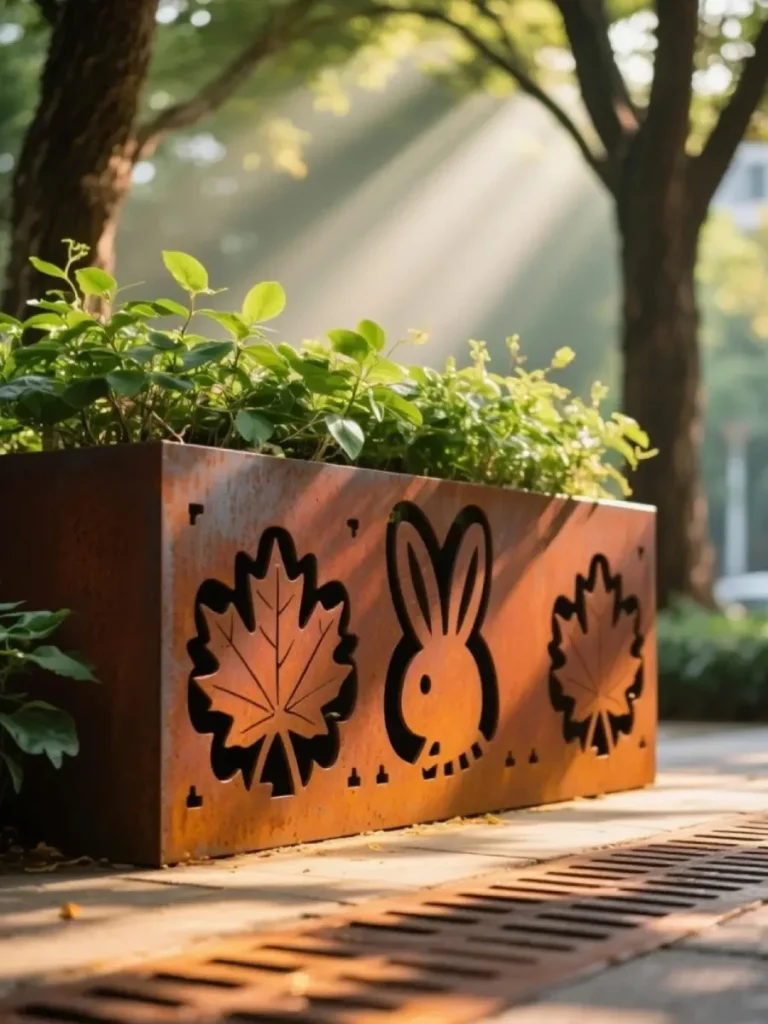
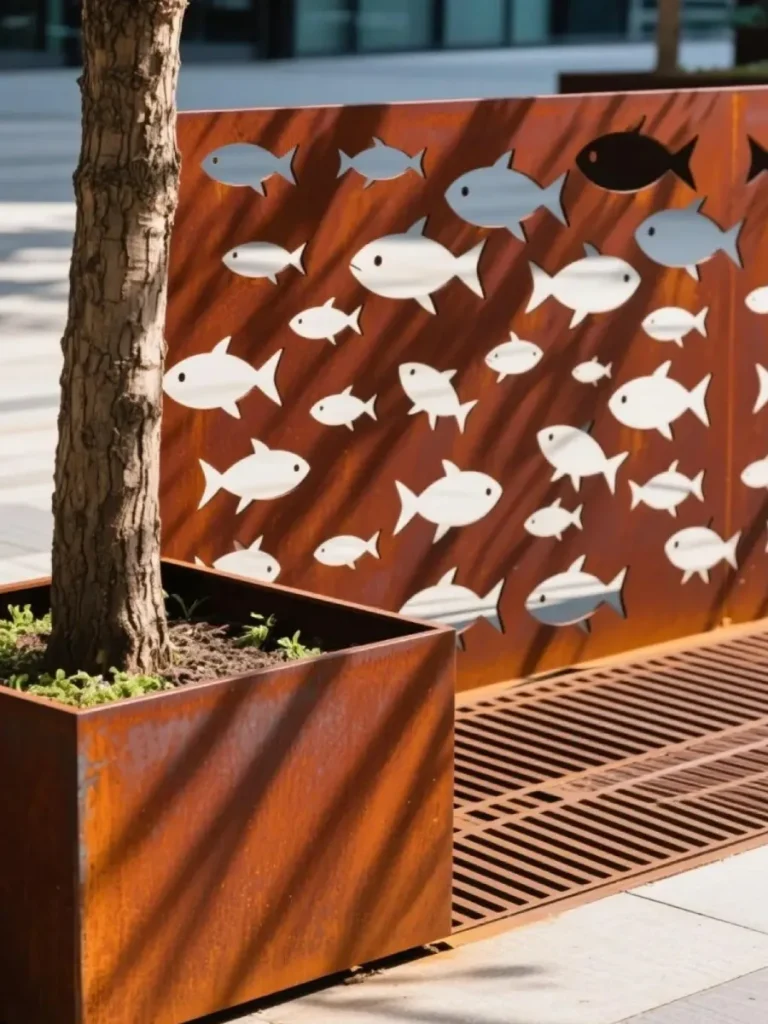

Their mass also provides environmental control. Positioned strategically, they act as wind buffers and acoustic barriers, particularly in open plazas or rooftop gardens. The effect is subtle but measurable—space becomes calmer, more contained.
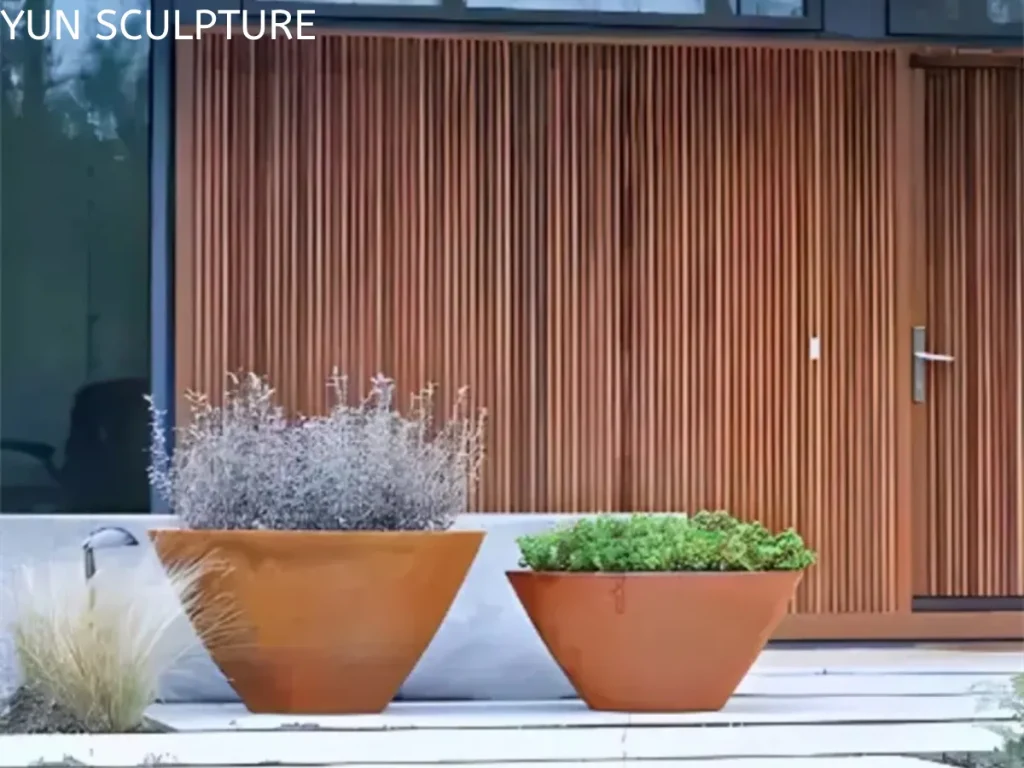
At a more focused scale, form becomes expressive. Round corten steel planters introduce softness, breaking the orthogonality of built environments. Rectangular corten steel planters and square corten steel planters, by contrast, reinforce architectural lines and create rhythm through repetition.
Each geometry carries intention. A single large planter can anchor an entrance. A grid of square forms can organize a courtyard. A linear run of trough planters can extend the visual axis of a space.
Material Dialogue
The strength of corten lies in its ability to mediate between materials. Its warm, oxidized tones soften the severity of concrete and stone, bringing balance to environments that might otherwise feel cold or over-engineered.
When paired with natural wood—particularly cedar—the relationship becomes more nuanced. The reddish undertones of corten echo the organic warmth of timber, creating continuity between built and natural elements.
Planting design amplifies this effect. Silver-leaved species such as Agave and Miscanthus stand in sharp contrast against the darkened patina. Their cool tones appear brighter, almost luminous, when set against the গভened surface of weathering steel.
Light completes the composition. Throughout the day, corten absorbs and releases color differently—glowing in low-angle sunlight, deepening under overcast skies. It is not a static backdrop, but an active participant in the landscape’s visual rhythm.
Haute Couture Engineering: Fulfilling Complex Design Visions
Design intent reaches its limit where material behavior begins. For custom corten steel planters, that threshold is defined by load, geometry, and time. A planter is not an empty object; it becomes a vessel of saturated soil, root mass, and water—each introducing continuous outward pressure.
Once dimensions exceed approximately 1.5 meters in length or diameter, deformation is no longer theoretical. The lateral pressure from soil, especially after irrigation or rainfall, can cause panel bowing if not structurally addressed. Precision engineering is therefore not optional—it is integral to preserving the design line.
From a fabrication standpoint, thickness selection establishes the baseline:
- 3mm corten steel: Suitable for small to medium planters with controlled spans and minimal soil depth.
- 4–5mm thickness: Recommended for standard architectural planters balancing weight and rigidity.
- 6mm corten steel: Required for large-format installations, deep soil beds, or high-load public environments.
Thickness alone, however, does not resolve structural stress. Internal reinforcement systems must be integrated discreetly to maintain the purity of the external form.
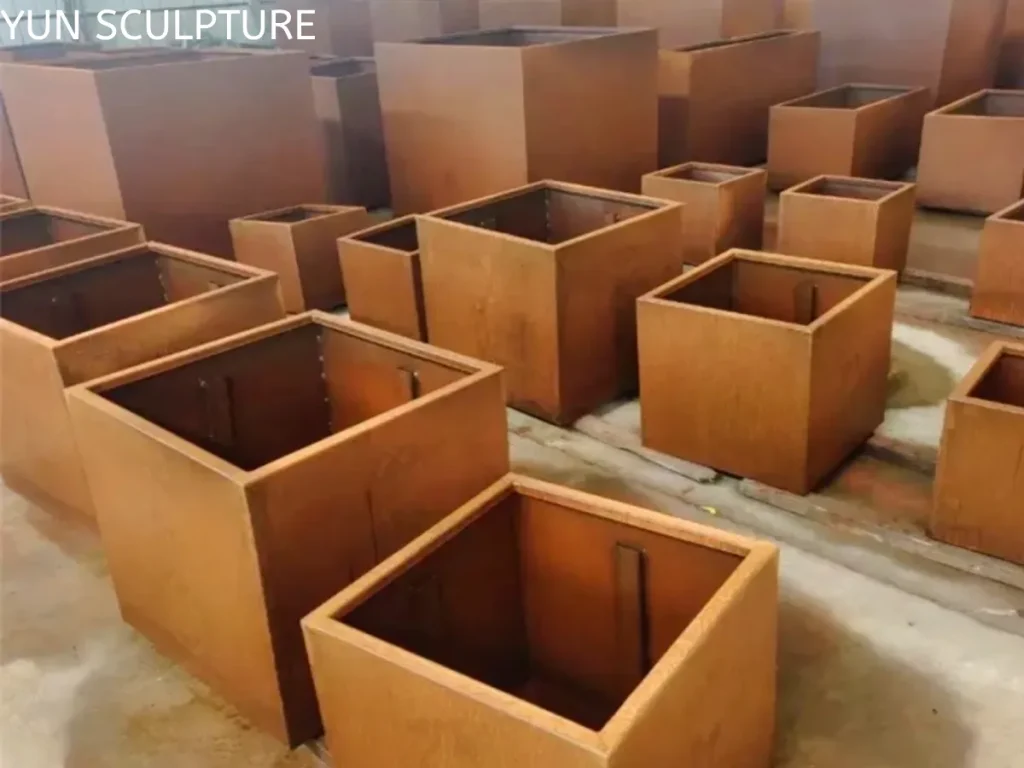
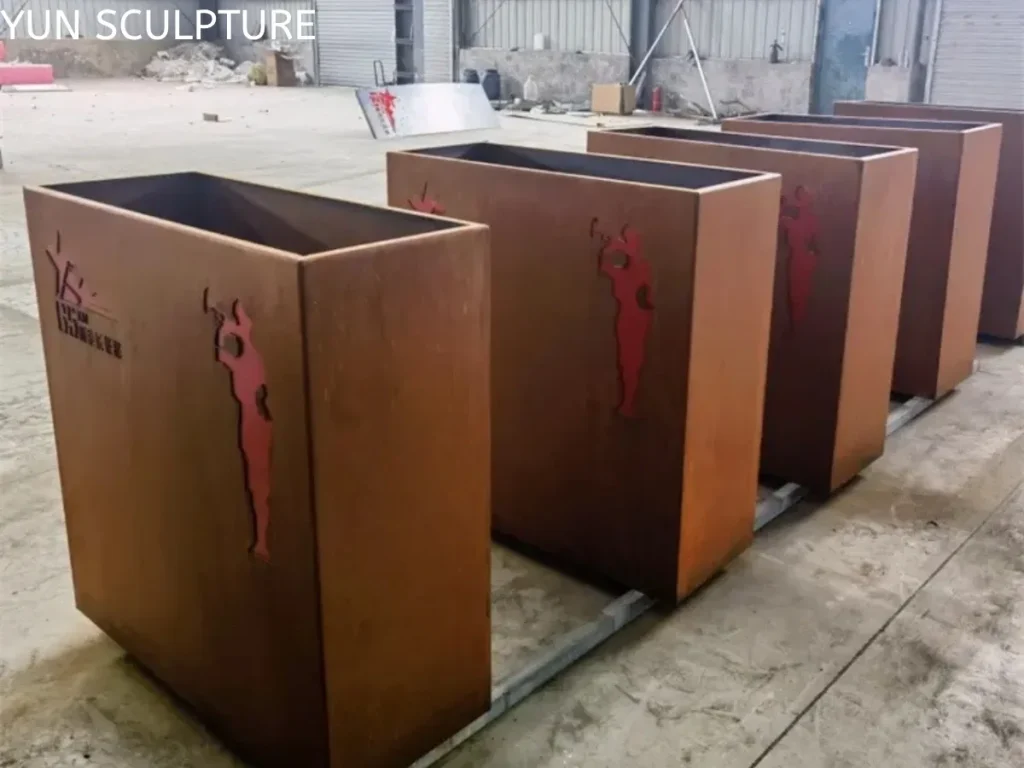


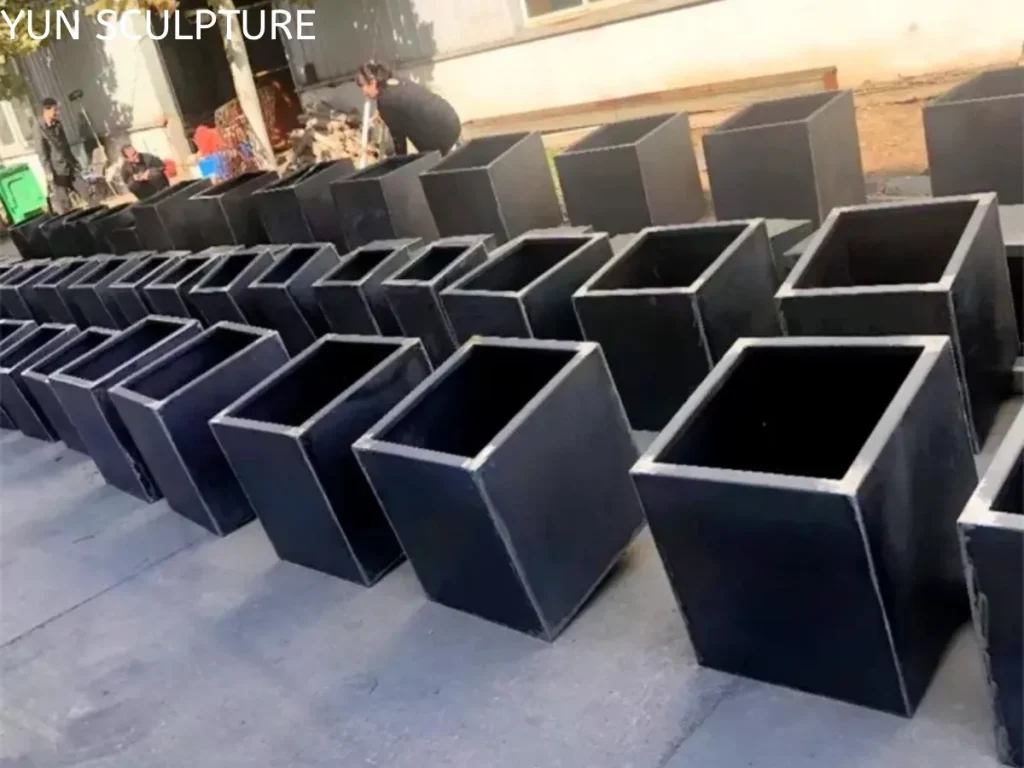
The most reliable approach is the introduction of an internal structural skeleton. This framework, typically fabricated from matching weathering steel profiles, distributes loads across the entire planter body rather than concentrating stress on flat panels.
To further control deformation, internal bracing is deployed:
- Tie rods span opposing walls, counteracting outward pressure.
- Horizontal stiffeners reinforce long elevations.
- Corner gussets stabilize junction points under multidirectional stress.
These elements remain invisible in the final installation, yet they define the planter’s long-term stability.
Welding methodology is equally critical. Standard welds often oxidize at different rates, creating visual inconsistency. For corten applications, full-penetration welds using E7018-W electrodes are specified. This ensures metallurgical compatibility, allowing the weld seams to weather uniformly and disappear into the surrounding patina.
For curved or non-linear geometries, fabrication precision becomes even more demanding. CNC-controlled bending processes are employed to achieve smooth, continuous radii without segmenting the surface. This is essential for round corten steel planters or complex sculptural forms, where any irregularity becomes immediately visible under natural light.
In high-end landscape architecture, customization is not decoration—it is structural choreography. Every dimension, joint, and reinforcement must align with both the visual intent and the physical realities of the material.
Site Installation and Disaster Mitigation Engineering
A completed corten planter is not a lightweight object. Once filled with soil and vegetation, a single unit can exceed 1000 kilograms. At this scale, installation becomes an exercise in structural coordination rather than simple placement.
Load distribution must be verified before delivery. Planters should be positioned directly above load-bearing beams or reinforced slabs. Placing them arbitrarily on paving systems or unsupported decks introduces long-term risk, including settlement or structural fatigue.
For handling and positioning, engineered lifting points are required:
- Lifting lugs are pre-welded to the internal frame.
- These allow safe crane operation without deforming the planter edges.
- After installation, lugs can be removed or concealed depending on the design requirement.
In exposed environments—particularly high-rise terraces or open commercial plazas—wind introduces additional forces. Large corten steel planters, especially when empty or partially filled, can act as sails.
To prevent movement or tipping, mechanical anchoring is recommended:
- Stainless steel expansion bolts secure the planter base to the structural slab.
- Anchoring points are concealed within the base frame.
- Stainless steel is essential to avoid galvanic corrosion with the corten body.
Thermal behavior must also be addressed. As a metal, corten absorbs and retains heat under direct sunlight. Without mitigation, internal soil temperatures can rise to levels that stress plant root systems.
A simple and effective solution is internal insulation:
- Install 20mm XPS insulation boards along the interior walls.
- This creates a thermal buffer between the steel shell and the soil mass.
- It also reduces moisture condensation cycles within the planter.
Drainage design is equally critical, not only for plant health but for material longevity. Conventional flat-bottom drainage traps water and limits oxygen flow.
An elevated drainage system is preferred:
- Planter bases are raised on 10–15mm stand-offs.
- This creates a void beneath the soil layer.
- Water drains freely, while air circulates upward, supporting root respiration and preventing anaerobic conditions.
Engineering at this stage is about prevention. Every detail—load, wind, heat, water—is addressed before it becomes a problem on site.
Managing Rust Runoff: The “Rejection Reaction” Countermeasures
The most common concern with corten steel planters is not structural—it is visual. During the early stages of patina development, rust runoff can stain adjacent materials, particularly light-colored stone, concrete, or tile.
This phenomenon is temporary, but in high-value projects, even short-term staining is unacceptable. It must be managed proactively.
The following countermeasures are standard in professional installations:
- Splash Strips (Gravel Buffers)
A perimeter band of gravel or crushed stone is installed around the planter base.
This sacrificial layer absorbs runoff and prevents direct contact with finished surfaces. - Pre-Oxidation Treatment at the Factory
Planters undergo controlled weathering before delivery.
This stabilizes the initial oxidation phase, significantly reducing on-site runoff. - Hidden Drainage Tubes
Internal drainage systems channel water away from visible edges.
Runoff is directed to controlled discharge points, minimizing staining risk. - Permeable Clear Sealers
In high-touch or sensitive areas, breathable sealers such as Everbrite can be applied.
These coatings allow the steel to continue evolving while limiting surface transfer.
When staining has already occurred, remediation is possible. Oxalic acid solutions can remove iron oxide marks from stone and concrete surfaces. However, application must be tested on a small, inconspicuous area first to avoid unintended discoloration.
Rust runoff is not a flaw. It is a transitional behavior of a material designed to stabilize itself. With proper engineering foresight, it can be fully controlled—allowing corten steel planters to perform as intended, both structurally and visually.
Commercial Value: Life Cycle Cost (LCC) and ROI
From a procurement perspective, corten steel planters are often judged by their initial cost. Compared to treated wood or standard mild steel, the upfront investment is typically 1.5 times higher. This difference, however, reflects material integrity rather than excess.
Over a 30-year lifecycle, the equation shifts completely. Wood requires periodic sealing, repair, and eventual replacement. Painted steel demands ongoing coating maintenance to prevent corrosion. Corten eliminates both cycles.


There is no repainting. No structural replacement. No degradation-driven intervention.
The breakeven point is typically reached at year 15. Beyond this, corten steel planters operate at effectively zero maintenance cost while continuing to perform structurally and visually. For commercial developers, this predictability is critical.
In high-end residential and mixed-use projects, the presence of permanent, architecturally integrated planters contributes directly to perceived value. Industry observations indicate a 5–10% uplift in property valuation when durable, design-led landscape elements are incorporated.
Corten is not an expense. It is a long-term asset embedded in the landscape.
Horticultural Safety: Is Corten Steel Safe for Edible Plants?
The question of whether corten steel planters are safe for growing vegetables is both valid and frequently misunderstood.
The answer is yes—corten steel is safe for growing vegetables.
As the material weathers, it releases trace amounts of iron into the soil. Iron is not a contaminant; it is an essential micronutrient required for plant health. This process mirrors natural soil enrichment rather than introducing risk.


Concerns typically focus on alloying elements such as copper (Cu) and chromium (Cr). In corten steel, these elements are metallurgically bound within the steel matrix. In soil environments with a pH between 6.0 and 7.5, they are further immobilized through chelation by organic matter.
This means they do not dissolve into bioavailable forms that plant roots can absorb.
Equally important, corten steel contains no lead or cadmium. These are the elements associated with genuine toxicity risks, and they are absent from certified weathering steel grades.
For projects requiring extreme organic certification standards, an additional safeguard can be introduced. A food-grade epoxy liner creates a complete barrier between soil and metal, while preserving the external corten aesthetic.
In practical horticultural terms, corten steel planters are both safe and beneficial.
Industry Guide: How to Spot Fake Corten Steel
The global demand for corten steel has led to widespread imitation. Many products marketed as “corten” are, in reality, untreated carbon steel with artificial surface treatments. These substitutes fail structurally and visually within a short period.
Verification is therefore essential.
The following field tests provide immediate indicators:
- Grinding Test
When ground, genuine corten reveals a bright metallic surface that will re-oxidize into a tight, stable patina.
Fake materials often expose a dull surface that quickly forms loose, black-scale rust that flakes away. - Touch Test
Real corten steel feels dense and solid.
Inferior steel tends to shed rust in powdery or scaly layers when handled. - Spark Test
Due to the presence of phosphorus and specific alloying elements, authentic corten produces a distinct spark pattern when cut or ground.
This requires experienced interpretation but remains a reliable metallurgical indicator. - Mill Test Certificates (MTC)
The only definitive verification is documentation.
Always request Mill Test Certificates (MTC) confirming compliance with standards such as ASTM A588, ASTM A242, or ASTM A606-4.
Without MTC documentation, material authenticity cannot be guaranteed.
10 Core Questions Answered (FAQ)
How long do corten steel planters last outdoors?
Corten steel planters have a lifespan of 50+ years. The self-healing patina protects the material from ongoing corrosion. The only exception is within 2 kilometers of the ocean, where salt prevents stabilization.
Will the rust runoff stain my patio tiles? How do I fix it?
Yes. Rust runoff typically occurs during the first 1–2 rainy seasons. Preventative measures include gravel splash strips, pre-oxidation treatment, and sealants. Existing stains can be cleaned using oxalic acid, with prior testing recommended.
Will the metal get too hot in the summer and kill plant roots?
Soil acts as a natural insulator, protecting roots under normal conditions. In extreme heat above 40°C, adding internal XPS insulation is recommended. The planter’s thermal mass helps stabilize temperature fluctuations between day and night.
Can I grow vegetables directly in a corten steel planter?
Yes. Corten steel is safe for growing vegetables. It releases beneficial iron and contains no lead or cadmium.
Can I use corten steel planters indoors?
Yes, with modification. Indoor installations lack the wet-dry cycles needed for natural patina formation. Planters must be pre-oxidized, sealed with a matte clear coat, and fitted with a fully waterproof stainless steel liner.
Does corten steel need to be painted or sealed regularly?
No. Painting interferes with the self-healing patina and will eventually peel. Corten steel is designed to remain uncoated.
Why did my corten planter rust through in less than 3 years?
This is typically due to counterfeit material or insufficient thickness (below 2mm). Authentic corten steel must meet ASTM A588 or ASTM A606 standards to perform correctly.
What are the limitations of using corten steel in coastal villas?
High salt levels in coastal air prevent the formation of a stable patina. In such environments, 5052-H32 marine-grade aluminum with a rust-effect coating is recommended instead.
What should I look out for when customizing a large planter (over 2 meters)?
Ensure the inclusion of internal bracing to prevent deformation and lifting lugs for safe crane installation. These are critical for both structural integrity and installation efficiency.
Is corten steel much more expensive than wood or plastic?
The initial cost is 20–40% higher. However, with a 50-year lifespan and zero maintenance requirements, corten steel reaches cost parity around year 15 and delivers superior long-term value.
Corten steel is not simply a material choice. It is a philosophy of permanence through change. It accepts time, absorbs environment, and transforms both into a stable architectural expression.
In the language of landscape, it provides weight without rigidity, texture without ornament, and longevity without maintenance. This is why corten steel planters have become the defining element of the industrial landscape.
They do not just occupy space—they give it memory.
– Elena Zhang & Donghui Zhang, Yun Sculpture