Get in touch with Yun-Sculpture company
The Eternal Forest: The Ultimate Guide to Custom Stainless Steel Trees & Plant Sculptures

Real trees live in time.
They bloom, they fade, they bend under heat, frost, and wind. In arid climates, they struggle. In coastal regions, salt scars their leaves. Even in the most carefully designed landscape, nature resists permanence.
This is where art begins.
A stainless steel tree and plant sculpture does not replace nature—it reframes it. It captures a single perfect moment of growth and holds it there, untouched by season or decay. The curve of a branch, the tension of a leaf, the quiet geometry of a canopy—these are translated into a form that does not age.
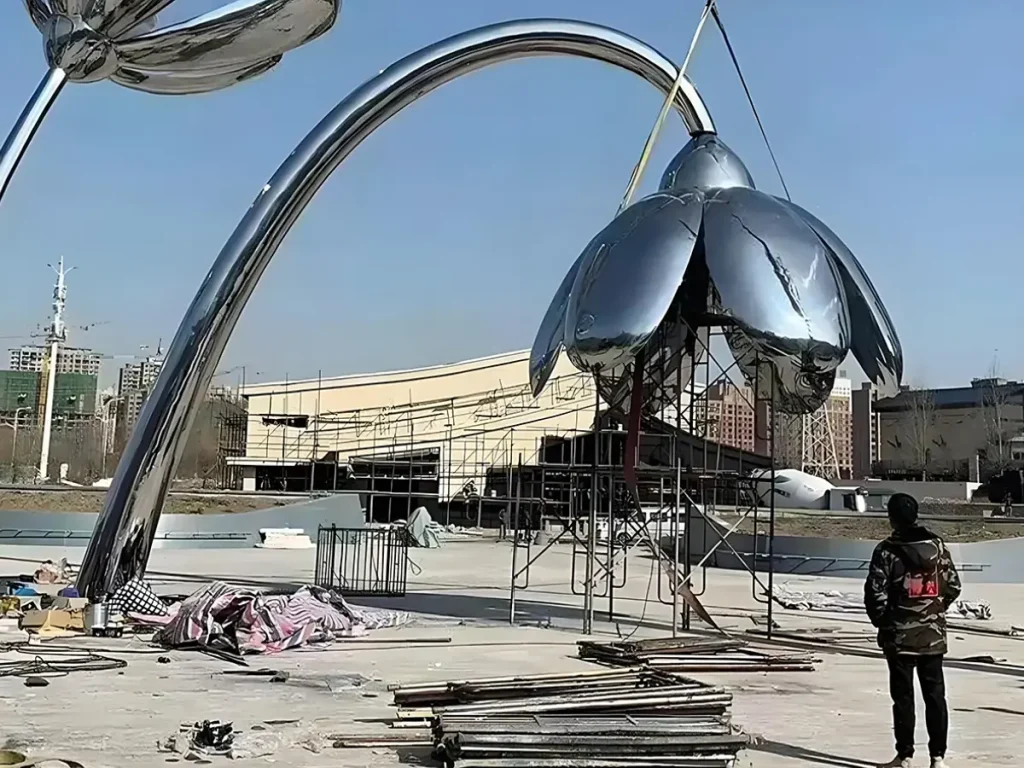
As Elena often tells clients, this is not imitation. It is preservation of essence.
The most transformative quality emerges under light. With an 8K mirror polish, the sculpture dissolves its own boundaries. What you see is not only steel, but sky, water, architecture, and movement layered across its surface.
We call this the “Liquid Silver” effect.
A polished outdoor stainless steel sculpture reflects grass as green currents, clouds as drifting textures, and sunlight as shifting highlights. The sculpture becomes a living lens. It does not stand apart from the environment—it folds the environment into itself.
In a garden, it amplifies space.
In a plaza, it softens architecture.
In a private residence, it becomes a quiet, permanent focal point.
Unlike organic planting, there is no seasonal loss. No thinning canopy. No uneven growth. The form you approve is the form that remains—year after year, decade after decade.
This is how fleeting life becomes eternal art.
Table of Contents
Table of Contents
Material Intelligence: Why 316L is the Non-Negotiable Standard
From Donghui Zhang’s perspective, beauty is only credible when it is structurally and chemically justified.
Tree and plant sculptures are among the most demanding forms in metal fabrication. Unlike solid abstract pieces, they contain hundreds—sometimes thousands—of edges, seams, and micro-surfaces. Each leaf becomes a potential trap for water, airborne salts, and pollutants.
These are not aesthetic details. They are failure points.
Standard 304 stainless steel performs well in controlled environments. But outdoors, especially in coastal cities or polluted urban zones, it reveals its limitations. Moisture settles into leaf junctions. Salt accumulates along edges. Over time, microscopic breakdown begins.
This is why we insist on 316L Marine Grade stainless steel.
The difference lies in chemistry.
316L contains molybdenum, an element that fundamentally changes how the material resists corrosion. It strengthens the passive oxide layer on the steel’s surface, making it significantly more resistant to localized attack.
Without this protection, pitting corrosion begins.

Pitting is subtle at first—tiny pinholes that penetrate beneath the surface. In a mirrored sculpture, even microscopic damage disrupts reflectivity. Light no longer flows cleanly across the surface. The “Liquid Silver” effect breaks.
Another common issue is tea-staining.
This appears as brownish discoloration, especially along edges and weld seams—exactly where leaves taper and water lingers. In complex botanical sculptures, these edges are everywhere. Once tea-staining develops, the sculpture loses its clarity and begins to look aged, even when structurally intact.
316L prevents both.
It does not eliminate maintenance entirely, but it dramatically slows environmental impact. In coastal installations, this is the difference between a sculpture that holds its finish for decades and one that visibly deteriorates within a few years.
For mirror-finished work, this is critical.
An 8K mirror polish is not just a visual choice—it is a performance surface. It depends on absolute smoothness and chemical stability. Any corrosion, no matter how small, interrupts the reflection and diminishes the intended spatial effect.
That is why material selection is not negotiable.
At Yun Sculpture, we design every stainless steel tree and plant sculpture with the assumption that it will face the harshest possible conditions: salt air, acid rain, thermal expansion, and constant exposure.
Because only when the material is correct can the art remain effortless.
And only then can a forest of steel truly feel alive.
Popular Themes: From Desert Minimalism to Blooming Gardens
A landscape is never just decoration. It is spatial language.
When clients choose metal outdoor sculptures, they are not simply selecting objects—they are defining how a space feels, how it flows, and where the eye comes to rest. Living plants grow unpredictably. Metal plants, by contrast, are intentional. They hold proportion, rhythm, and balance exactly as designed.
This is why stainless steel tree sculpture compositions are so powerful. They allow us to “freeze” a landscape concept at its most refined moment. Whether the goal is serenity, drama, or minimalism, each sculptural plant becomes a controlled gesture within the environment.
We typically guide clients into three dominant directions: monumental anchors, delicate floral accents, and desert-inspired minimalism.
Each speaks a different architectural language.
The Anchor: Monumental Tree Sculptures
A metal tree sculpture is not just an object—it is a center of gravity.
In large-scale landscapes, especially commercial plazas or expansive private estates, a large metal tree sculpture establishes hierarchy. It tells the viewer where to look first, and how to understand the surrounding space.
A stainless steel tree sculpture with an 8K mirror finish becomes almost atmospheric. It reflects movement—people walking, clouds shifting—so the sculpture feels alive without physically changing.
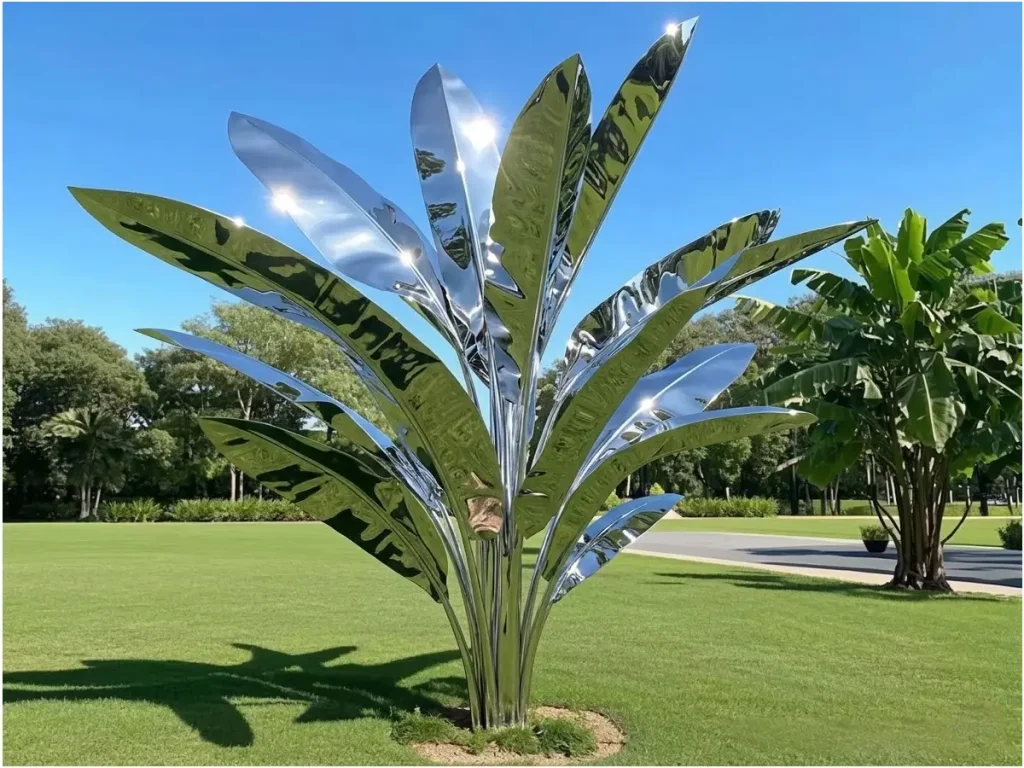
Common applications include:
- Central courtyard installations using outdoor metal tree sculpture forms
- Entry statements with garden art metal tree sculpture compositions
- Sculptural focal points within broader collections of metal outdoor sculptures
- Expressive, abstracted metal tree art sculpture designs that emphasize branch geometry
Certain forms carry strong cultural or climatic associations. A metal palm tree sculpture introduces a relaxed, coastal rhythm, even in inland environments. Its vertical elegance works particularly well in hospitality and resort-style developments.
Wall-mounted variations extend this idea into architecture itself:
- metal tree wall sculpture integrated into façades
- layered metal wall sculpture trees creating depth on flat surfaces
- symbolic large outdoor metal tree of life wall art for civic or spiritual spaces
- minimalist large outdoor metal tree wall art for contemporary homes
In each case, the tree is not background—it is structure. Everything else orbits around it.
Floral & Small Accents: Dandelions and Blooms
If trees define structure, flowers define emotion.
Smaller-scale elements like a stainless steel dandelion sculpture introduce softness into rigid environments. Even in still air, their fine filaments suggest motion. Under natural wind, they tremble subtly, creating a quiet, almost meditative presence.
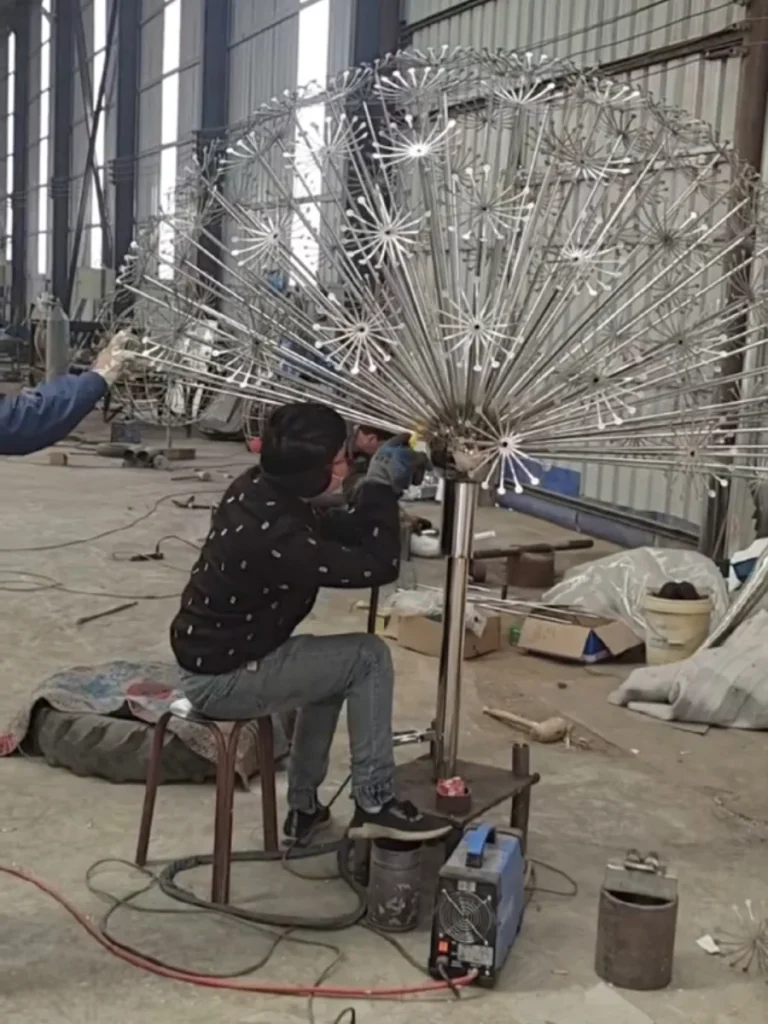
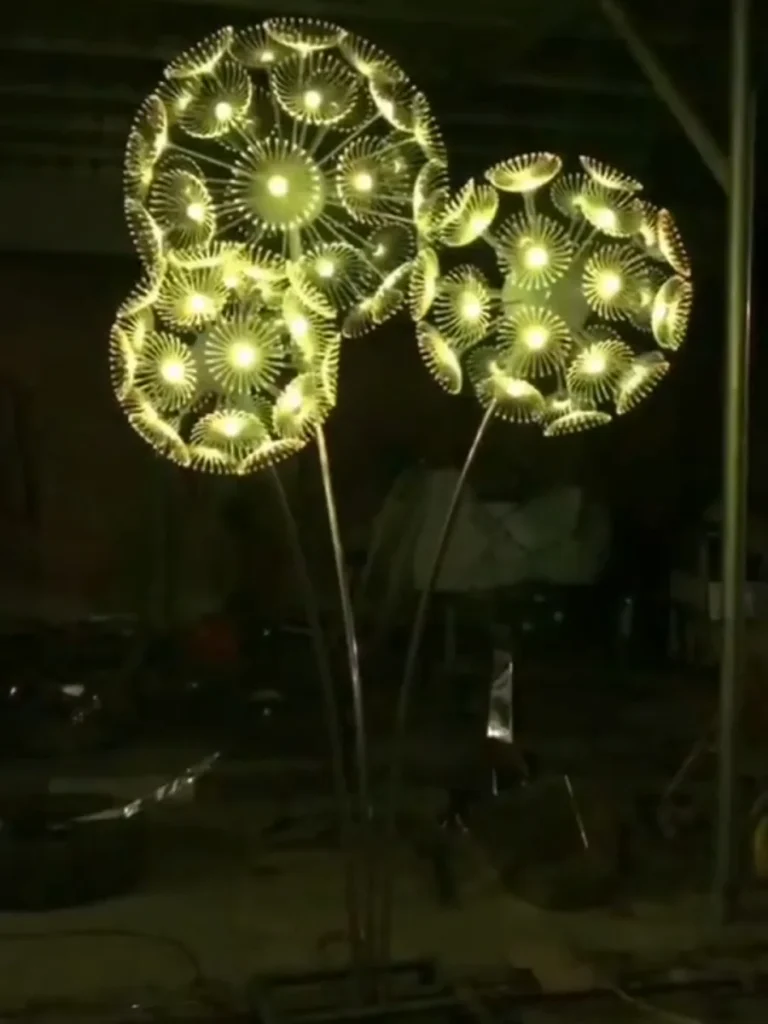
These pieces are often used to humanize large spaces.
Popular floral directions include:
- Sculptural clusters of metal flower sculpture and metal flower sculptures arranged as “frozen gardens”
- Statement pieces like a giant metal flower sculpture rising above low planting
- Recognizable forms such as metal sunflower sculpture, symbolizing warmth and openness
- Refined, romantic accents like metal rose sculpture placed along pathways or entrances
- Elegant, vertical compositions like metal orchid sculpture for modern courtyards
- Cultural motifs such as lotus flower large outdoor metal wall art integrated into water features or walls
Texture also plays a critical role. A single metal leaf sculpture, when scaled and polished, can feel as significant as an entire tree. It captures light differently—more intimate, more tactile.

To complete the illusion of a “living” environment, we often layer in forest-floor details:
- metal mushroom sculpture elements tucked into shaded areas
- decorative accents like metal pine cone sculpture or metal pinecone sculpture placed near seating or pathways
These smaller interventions create narrative. They invite people to approach, pause, and notice.
Desert & Modern Succulents: Low-Maintenance Luxury
In arid regions, or for clients seeking absolute minimal upkeep, desert landscapes have become a defining trend.
Here, the metal cactus sculpture replaces fragile organic planting with permanence. It delivers the same sculptural silhouette without the vulnerability to climate extremes.
We design across a spectrum:
- Single statement cactus sculpture metal pieces for minimalist courtyards
- Grouped metal cactus sculptures forming rhythmic, architectural clusters
- Highly detailed metal agave plant sculpture installations emphasizing radial geometry
- Variations including metal agave sculpture, agave metal sculpture, and metal agave plants sculpture for layered compositions
- Linear, expressive forms like metal ocotillo sculpture that introduce vertical movement without visual heaviness

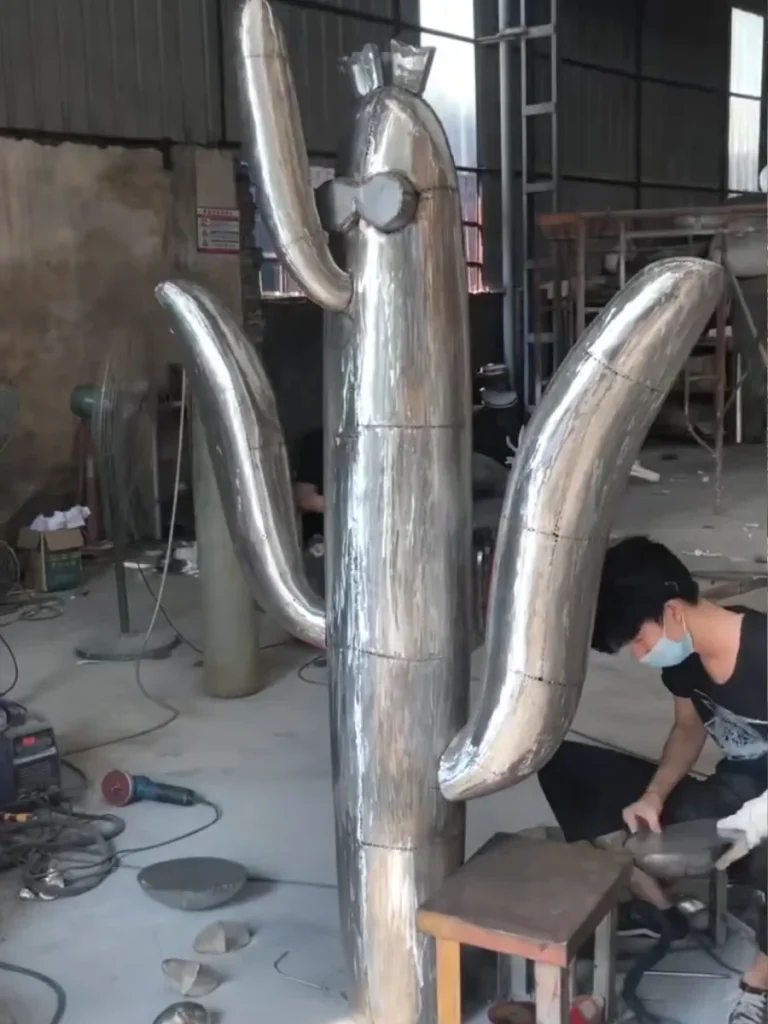
These forms align naturally with modern architecture. Clean lines, controlled repetition, and strong silhouettes create a sense of calm precision.
There is also a psychological shift.
Unlike lush gardens, which suggest growth and change, desert compositions communicate stability. They feel intentional, restrained, and quietly luxurious.
In stainless steel, especially with a mirror or satin finish, these sculptures take on an almost surreal clarity. They do not compete with the environment—they distill it.
And in doing so, they redefine what “low-maintenance” truly means.
Handcrafted Craftsmanship: Giving Cold Metal a Warm Texture
From Donghui Zhang’s standpoint, the greatest misconception about stainless steel sculpture is that it is industrial.
True craftsmanship begins where automation ends.
At Yun Sculpture, we do not rely on molds. Every stainless steel tree is built using the direct metal sculpture technique. This means the material is shaped directly by hand and by eye, responding to the intended form in real time rather than being constrained by a pre-cast system.
Molds create repetition. Trees demand variation.
A natural canopy is never uniform. Leaves twist, bend, and catch light differently. To replicate this, each component must be individually formed. This is where the process becomes both technical and artistic.
The leaves are the most labor-intensive element.
We begin with flat sheets of stainless steel, typically around 2mm thick. Through the traditional Repoussé method, artisans hammer the metal from both sides, gradually raising veins, edges, and subtle undulations.
This is not decoration. It is structure through texture.
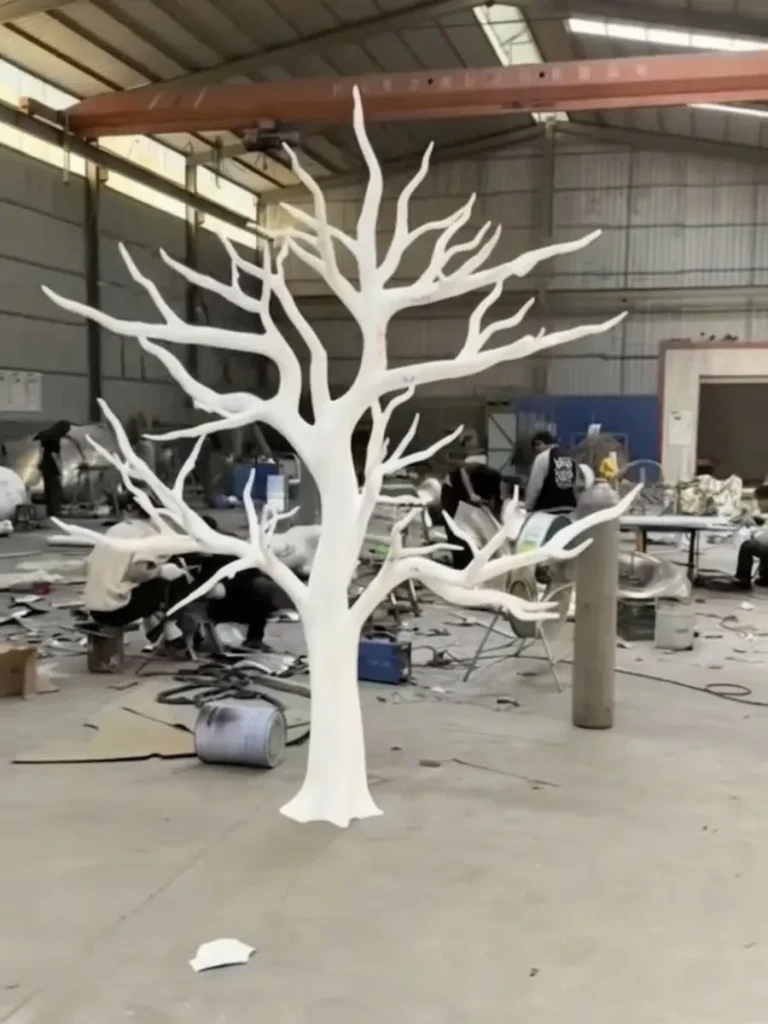
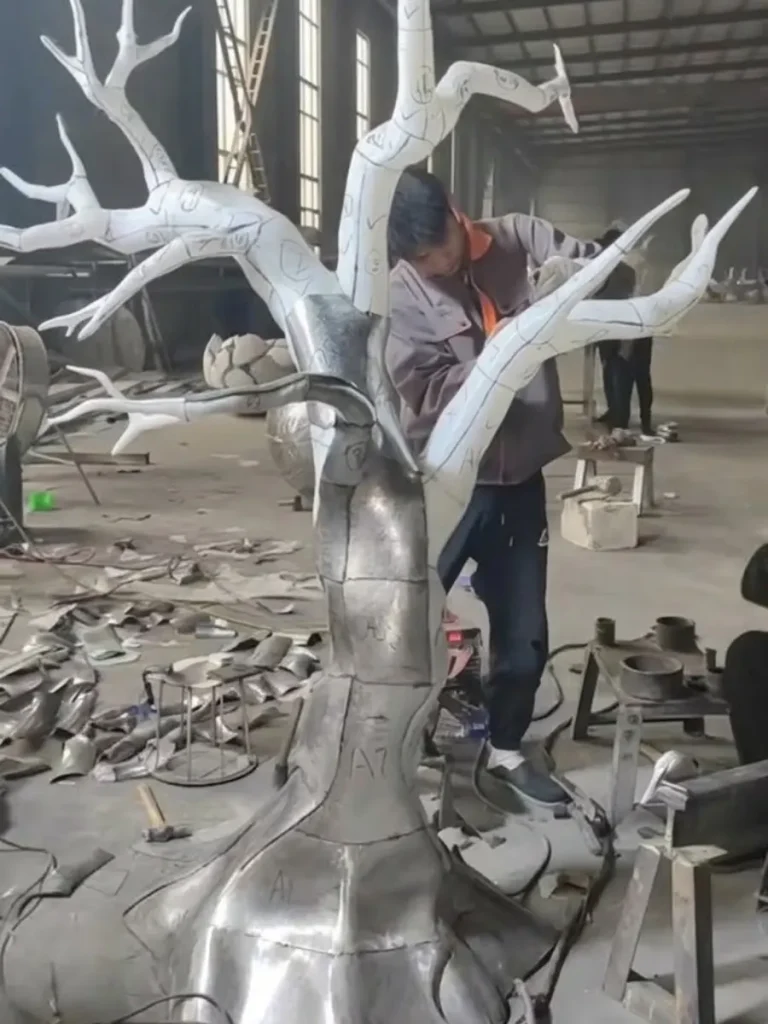
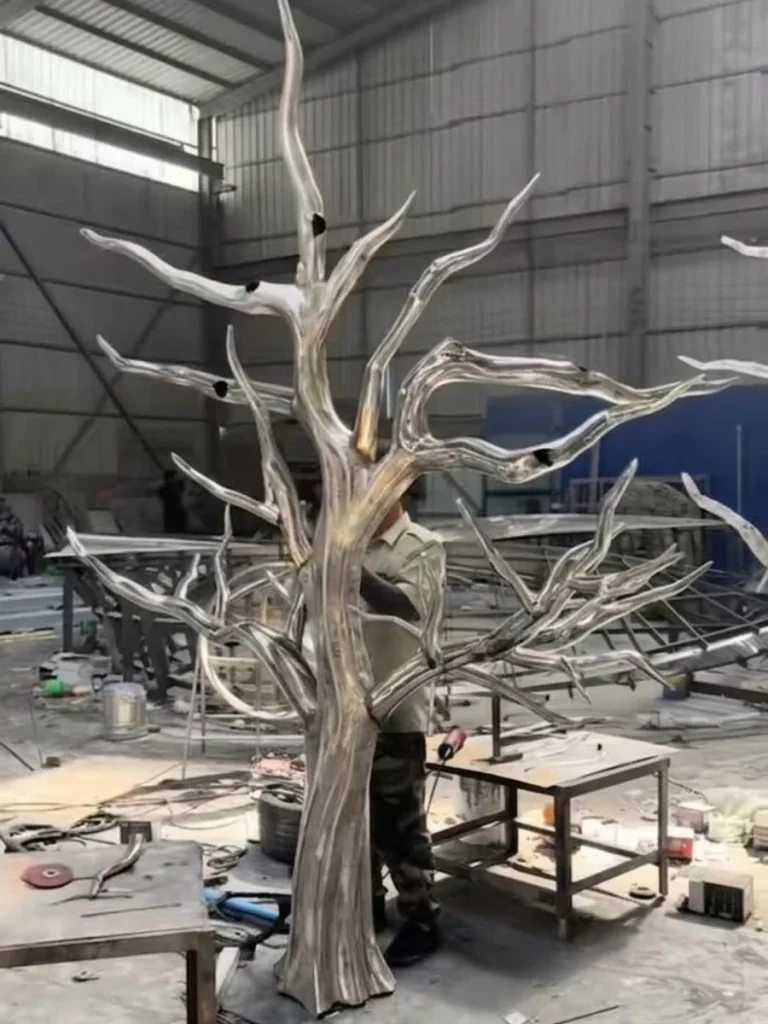
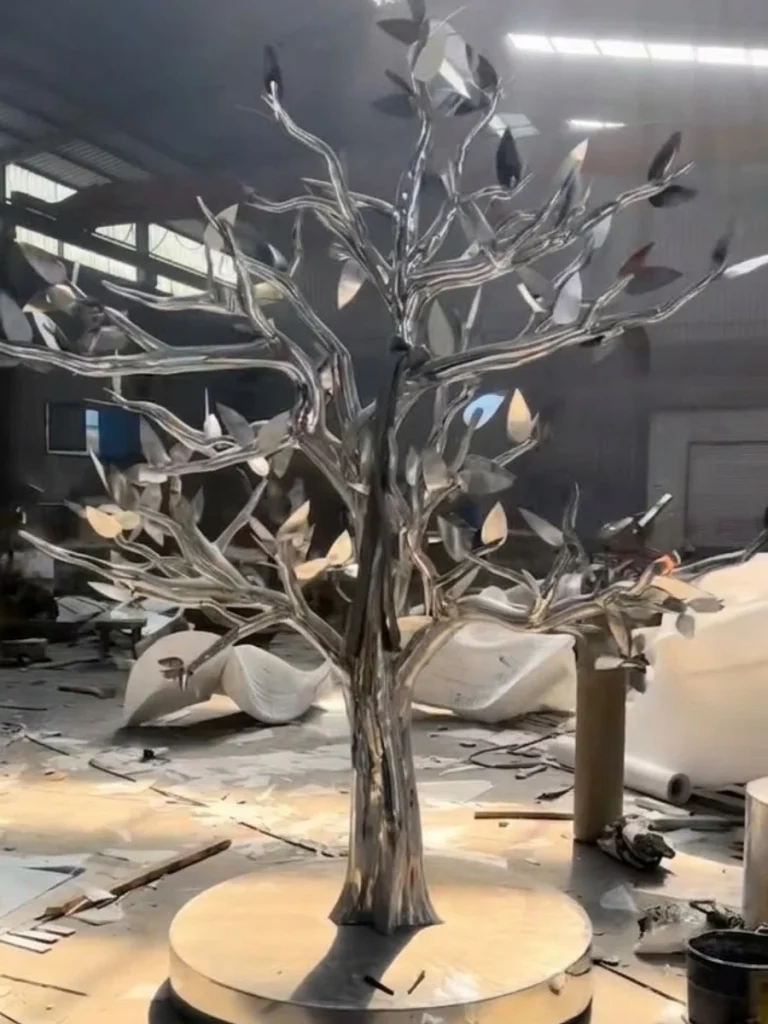
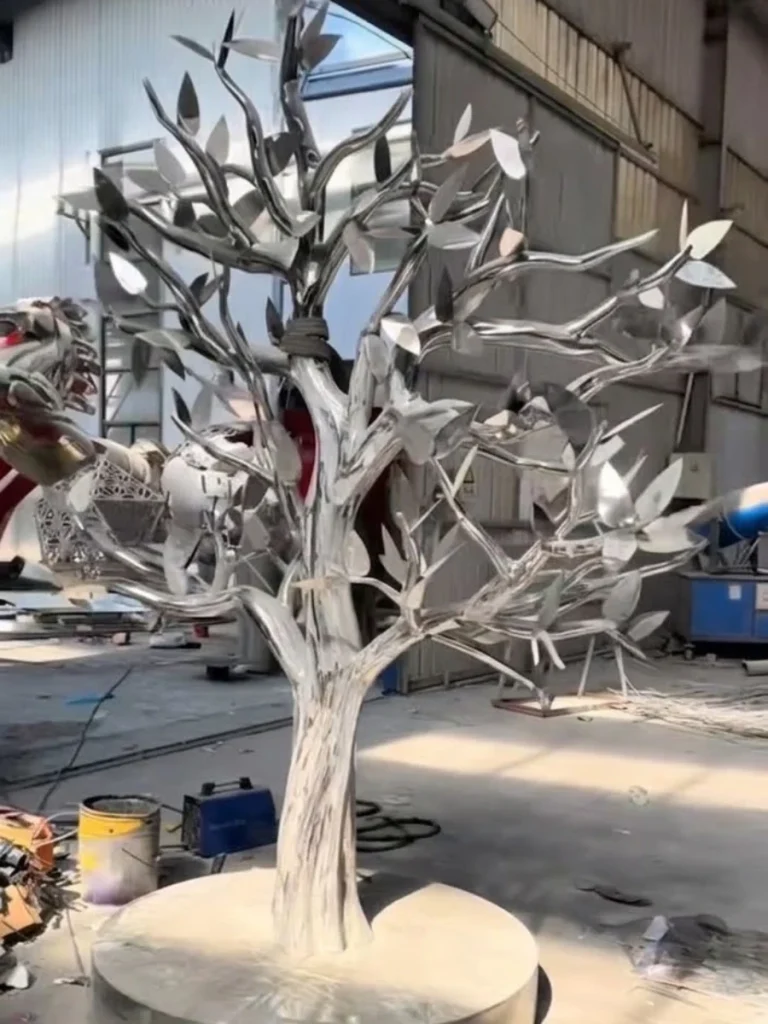
A properly forged leaf gains rigidity from its curvature. It resists deformation while maintaining a thin, elegant profile. More importantly, it interacts with light like a real leaf—breaking reflections into gradients instead of flat glare.
No two leaves are identical.
Across a full metal tree sculpture outdoor installation, there may be hundreds or thousands of these individually shaped elements. This accumulated variation is what gives the final piece its organic credibility.
The trunk and branches follow a different logic.
Rather than casting solid forms, we use hollow forging techniques. Sheets are cut, curved, and welded into continuous volumes. This allows us to achieve depth without weight—a critical engineering advantage.
A solid structure of this scale would be impractical. It would increase transportation cost, foundation requirements, and long-term structural stress. By contrast, a hollow-formed trunk maintains visual mass while significantly reducing load.
This balance is essential.
The sculpture must feel grounded, but it must not behave like a monument of stone. It must respond subtly to environmental forces without compromising stability.
This is where craftsmanship transitions into engineering.
Invisible Engineering: Wind Resistance and Safe Installation
A large metal tree sculpture outdoor is not static.
It exists in an active environment—wind, temperature shifts, and even human interaction all introduce forces that must be anticipated. Among these, wind loads are the most critical.
Unlike a solid sculpture, a tree form is porous.
At first glance, this seems advantageous. Air can pass through. But in reality, each leaf acts as a small sail. When multiplied across hundreds of surfaces, the total pressure becomes significant.
In strong wind conditions, this pressure does not distribute evenly.
Without proper design, stress concentrates at connection points—branches, weld seams, and base joints. This is where failure begins.
To prevent this, every sculpture is built around an internal structural skeleton.
This skeleton is not visible from the outside. It is a carefully engineered framework of reinforced stainless steel that runs through the trunk and extends into the major branches. Its purpose is to collect and redistribute force.
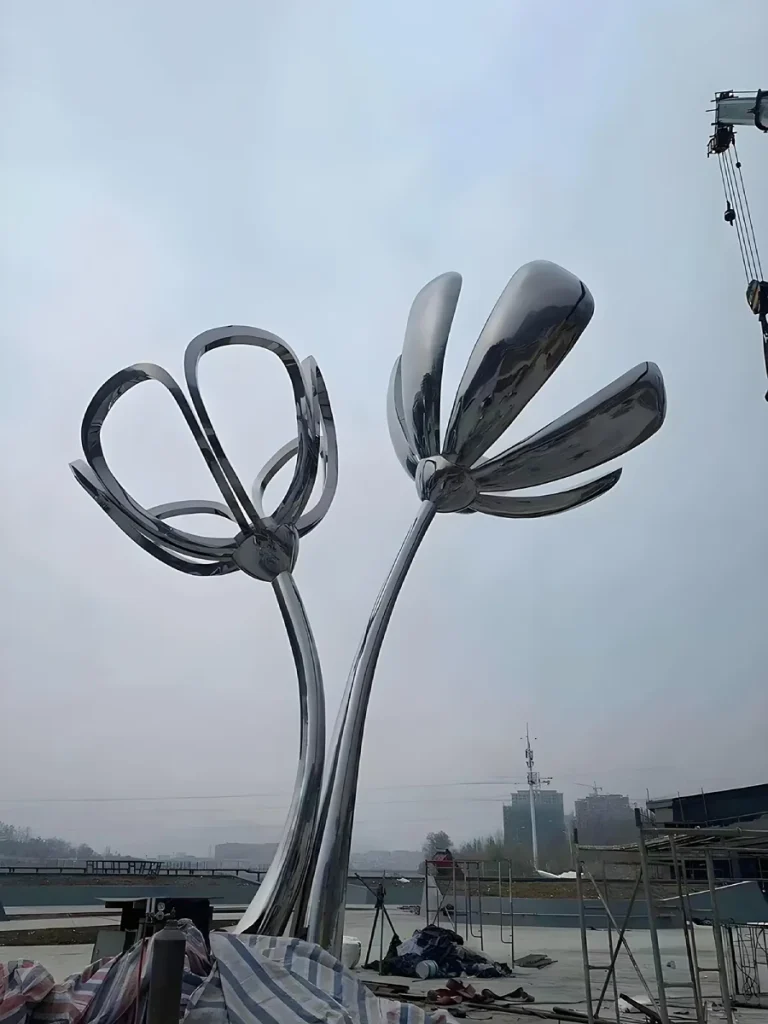
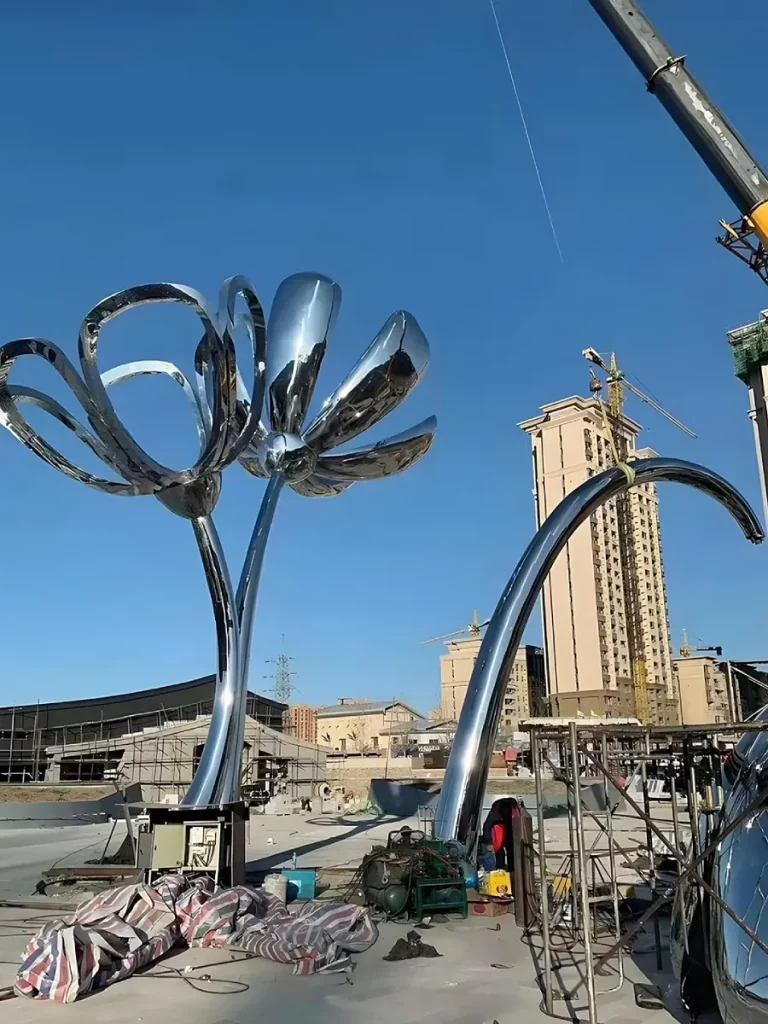
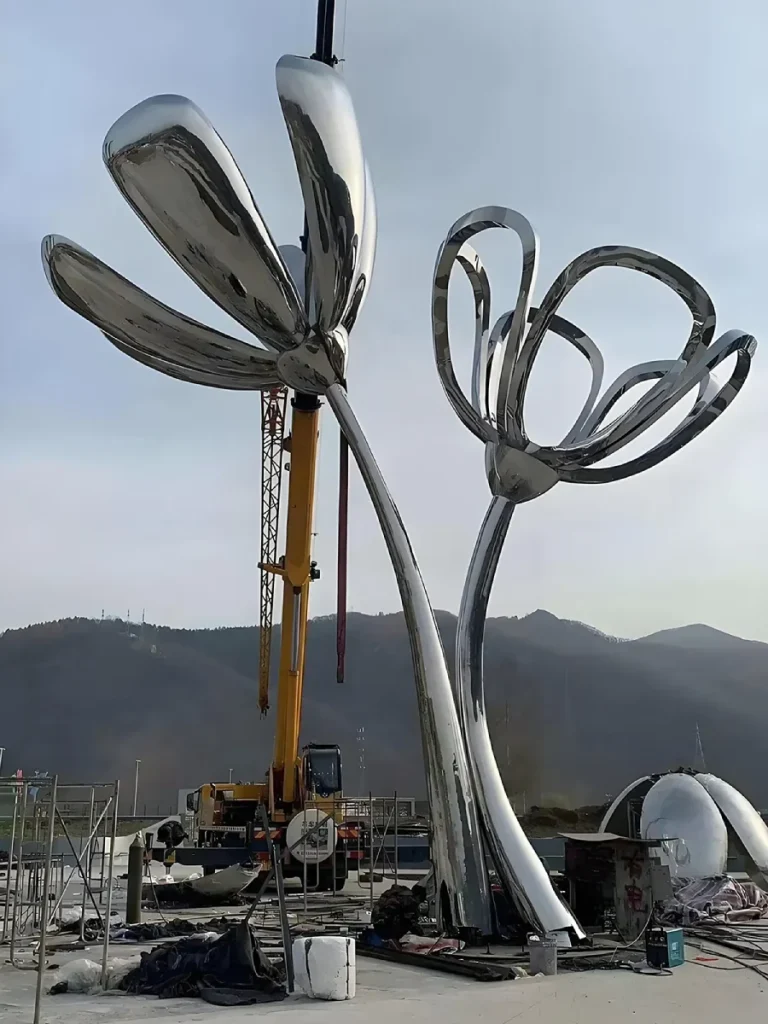
Instead of allowing wind pressure to act on isolated elements, the skeleton channels it downward, transferring loads safely into the foundation.
This creates a unified system.
Leaves, branches, and trunk are no longer independent parts. They behave as one continuous structure, designed to flex within controlled limits while maintaining overall stability.
Installation completes the system.
Even the most precisely fabricated sculpture will fail if it is not anchored correctly. This is why foundation design is treated as part of the sculpture—not an afterthought.
We use stainless steel expansion bolts to secure the base.
These bolts are embedded into a pre-engineered concrete foundation, calculated according to the sculpture’s size, weight, and expected environmental forces. Once installed, they create a mechanical lock between the sculpture and the ground.
This connection must resist uplift, lateral movement, and vibration.
In coastal or high-wind regions, this becomes even more critical. A properly installed system can withstand hurricane-force conditions without shifting or loosening over time.
This is not optional knowledge.
In our guide to buying stainless steel sculptures for modern home exteriors, anchoring and structural design are always emphasized alongside aesthetics. Clients often focus on finish and form, but longevity is determined by what cannot be seen.
Because in the end, a sculpture is only as strong as its hidden structure.
And only when the engineering is invisible can the art appear effortless.
10 Core Questions Answered (FAQ)
How to make a metal tree sculpture?
From Donghui Zhang’s perspective, the question of how to make a metal tree sculpture is really about structure first, beauty second.
We begin with a digital model, then build a primary steel framework that defines proportion and load paths. This answers the core issue of how to give sheet metal sculptures structure—the internal armature carries all forces, while the outer skin remains refined and lightweight.
From there, hundreds or thousands of leaves are hand-forged and individually welded to the branches. For clients asking how to make metal garden sculptures at a professional level, the final stage—mirror polishing or brushing—is what transforms fabrication into art.
Will a stainless steel tree rust outdoors?
No—provided the material is true 316L stainless steel.
Its resistance to moisture, salt, and pollution allows it to perform in harsh outdoor environments without rusting. To maintain a pristine surface over decades, we recommend periodic cleaning and an annual application of microcrystalline wax.
This protective layer enhances corrosion resistance while preserving the clarity of the finish.
How to make a metal flower sculpture?
The process is similar in principle but different in expression.
Petals are shaped from metal sheets with varying curvature, then layered and welded to simulate natural overlap. This creates depth and shadow, which are essential for realism.
In some designs, controlled heat is used to develop subtle patina tones, adding warmth and visual complexity to the surface.
Are slender structures like stainless steel dandelions safe outdoors?
Donghui Zhang approaches these designs with precise calculations.
Although they appear delicate, each stem is engineered using high-strength stainless steel wire. We calculate wind interaction and resonance frequency to ensure the sculpture moves gracefully rather than resisting force rigidly.
The result is controlled flexibility—sway without fatigue, motion without risk.
How heavy is this sculpture? Can it be installed on a roof garden?
Weight is often overestimated.
Because we use hollow forging, these sculptures are significantly lighter than stone or cast metal equivalents. This makes them suitable for elevated environments such as terraces and roof gardens.
For these projects, we provide detailed load analysis and design bases that distribute pressure evenly, protecting the underlying structure.
How to install large outdoor metal plants?
Installation is an extension of engineering, not a separate step.
We anchor the sculpture to a prepared concrete foundation using embedded components or stainless steel expansion bolts. Waterproof gaskets are added to protect connection points from moisture intrusion.
This system ensures long-term stability against wind, vibration, and environmental stress.
How to clean complex leaf details?
Maintenance is straightforward when done consistently.
Use mild soapy water and a soft brush to reach into crevices and along leaf edges. This removes dust, salt, and airborne residue before buildup occurs.
For mirror-polished surfaces, a microfiber cloth restores reflectivity without scratching, preserving the “Liquid Silver” effect.
Can you make desert plants like agave or cactus?
Elena often notes that desert forms are among the most sculptural in nature.
Yes, we specialize in metal agave and cactus designs. Through hand-forging, we replicate the sharp geometry and dense, fleshy character of these plants with remarkable precision.
The result is a composition that feels both minimal and powerful—perfect for modern landscapes.
How long is the production cycle?
Time depends on complexity.
Medium-scale projects typically require 4–8 weeks from fabrication to finishing. Large installations, especially those with thousands of individually crafted leaves, may extend beyond 10 weeks.
This timeframe reflects the handcrafted nature of the work rather than industrial production speed.
Do you provide 3D rendering previews?
Yes, and this step is essential.
Before fabrication begins, we create a detailed 3D rendering that places the sculpture within your actual environment. This allows you to evaluate scale, proportion, and reflection behavior under different lighting conditions.
It ensures that what you imagine is exactly what will be built.
A stainless steel tree is not simply a sculpture.
It is a moment of nature, refined and held in permanence. It does not fade with the seasons or depend on climate to survive. It reflects the world around it, evolving visually while remaining physically unchanged.
For architects, it is a spatial tool.
For homeowners, it is a lasting presence.
For us, it is the intersection of art and engineering, resolved with precision.
– Elena Zhang & Donghui Zhang, Yun Sculpture