Get in touch with Yun-Sculpture company
Eternal Rhythm: The Engineering and Aesthetics of Custom Stainless Steel Kinetic Wind Sculptures

Landscapes often fall into stillness. Lawns settle into flat color, architecture holds its lines, and even water—when absent—leaves space feeling paused. A kinetic wind sculpture interrupts that silence. It introduces motion that cannot be predicted, only experienced.
As Elena, I see these works not as objects, but as instruments. A wind sculpture kinetic does not impose movement; it reveals it. Air, usually invisible, becomes legible. The passing breeze traces arcs, accelerations, and pauses, transforming atmosphere into choreography.

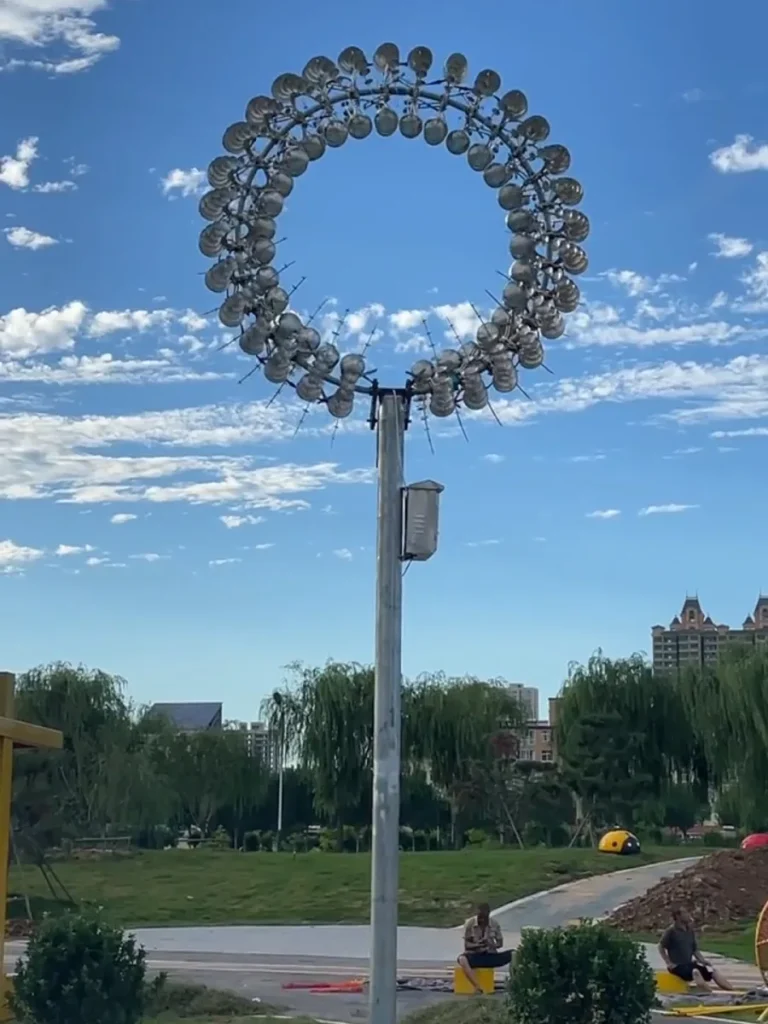

This is where the idea of Time-evolving art becomes essential. Unlike static sculpture, which offers a fixed composition, kinetic works are never complete. They unfold continuously. Morning light produces one expression, afternoon winds another, and twilight reflections something entirely new.
The experience is deeply spatial. Movement draws the eye outward, then inward. It connects sculpture to its surroundings—trees, sky, architecture—binding them into a single visual system. The result is a subtle but powerful Visualization of wind, where environment and artwork exist in dialogue rather than isolation.
From an engineering standpoint, as Zhang would emphasize, this fluidity is not accidental. It is controlled freedom. Bearings, balance, and structural tolerances are calibrated so that even the lightest wind can activate the form, while stronger gusts remain within safe mechanical limits. The sculpture appears effortless, yet every degree of motion is designed.
What emerges is a rare equilibrium. Art that feels alive, yet remains precise. Movement that feels natural, yet is engineered with discipline. This duality is what elevates kinetic wind sculptures beyond decoration—they become living elements within architectural space.
Table of Contents
Table of Contents
The Dynamic “Liquid Silver” Effect
The defining visual phenomenon of a kinetic stainless steel wind sculpture is what we describe as the Liquid Silver effect. Stainless steel, when mirror-polished to a high degree, ceases to behave like a solid surface. It becomes a field of reflection.
In a static state, this reflection is already compelling. Sky, clouds, greenery, and built forms are mirrored with clarity. But the moment the sculpture begins to rotate, the surface transforms. Reflections stretch, fragment, and recombine.
As Elena, I often describe this as watching light dissolve and reform in real time. A passing cloud becomes a streak. A tree canopy fractures into shimmering layers. The sculpture does not merely reflect its environment—it reinterprets it.
This is where the stainless steel kinetic wind sculpture distinguishes itself from other materials. Bronze absorbs light. Stone diffuses it. Stainless steel captures and releases it dynamically. The movement converts reflection into motion, and motion into emotion.
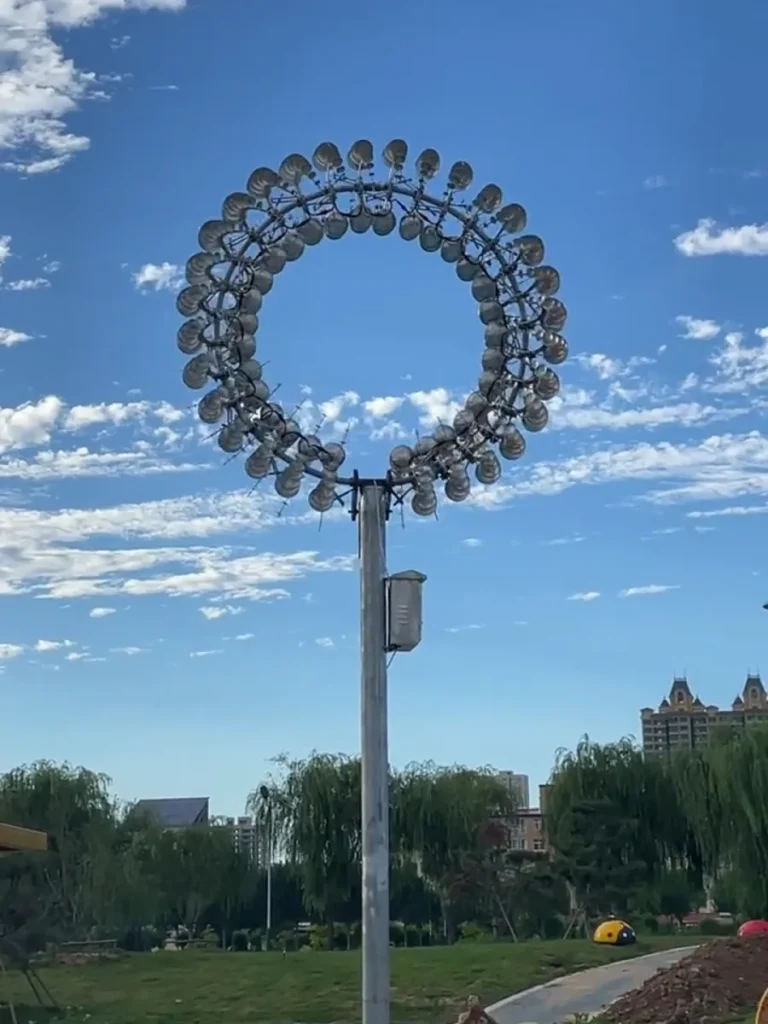

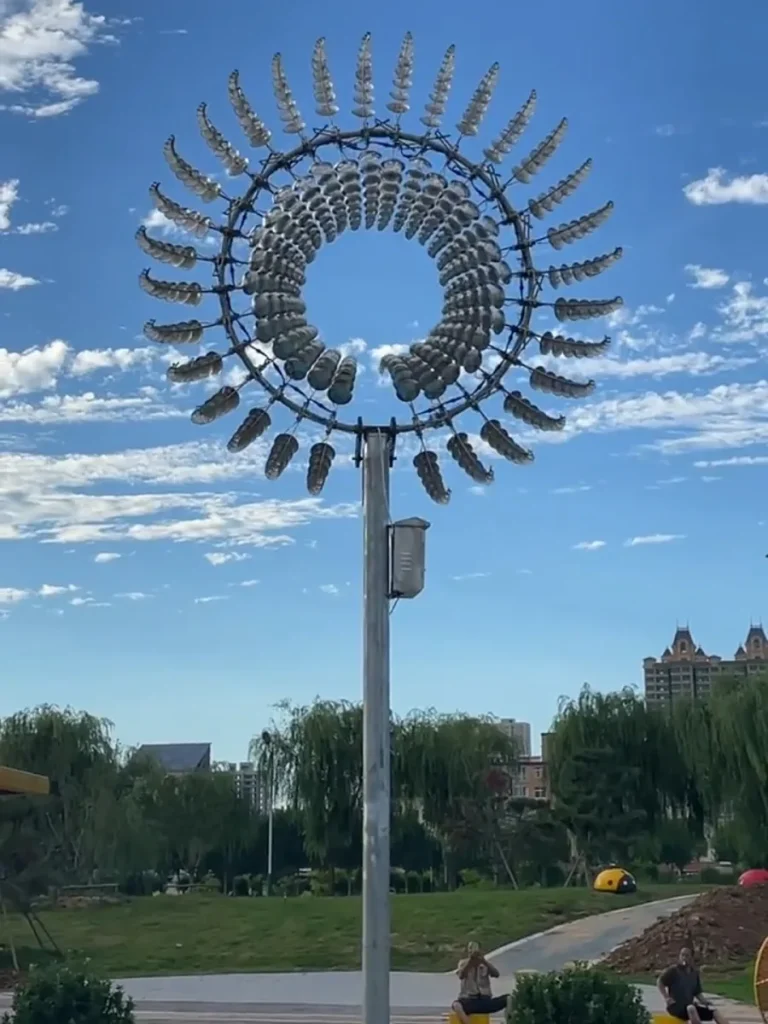
The viewer’s perception shifts continuously. From one angle, the sculpture appears almost invisible, blending seamlessly with the sky. From another, it flashes with intensity, catching sunlight and dispersing it in radiant pulses. This variability creates a sense of discovery that never fades.
Donghui Zhang’s perspective adds another layer to this effect. The geometry of each blade or element is carefully calculated to optimize how light travels across the surface during rotation. Curvature, spacing, and axis alignment determine how reflections stretch or compress.
Too flat, and the effect becomes dull. Too complex, and it turns chaotic. Precision lies in achieving controlled distortion—where the reflections feel fluid, but never disordered.
The result is a surface that behaves almost like water, yet retains the crispness of metal. It is solid, but appears liquid. Stable, yet constantly changing.
This is the essence of the Liquid Silver effect: a fusion of material science and visual poetry, where light, motion, and form converge into a single, mesmerizing experience.
The Material Battle: Why 316L is the Foundation of Kinetic Art
From Donghui Zhang’s perspective, every successful kinetic sculpture begins at the molecular level. Movement demands stability, and stability begins with material. For this reason, 316L Marine Grade stainless steel is not a preference—it is a requirement.
Kinetic systems rely on exact equilibrium. A deviation of even a few grams can shift rotational behavior. When oxidation or corrosion occurs, that balance is compromised. What begins as a visual imperfection quickly becomes a mechanical flaw.
The advantage of 316L lies in its chemistry. Its composition includes Molybdenum, an عنصر that significantly enhances resistance to chloride corrosion. This is critical in outdoor environments, especially in coastal or humid regions where airborne salts penetrate surfaces at a microscopic level.
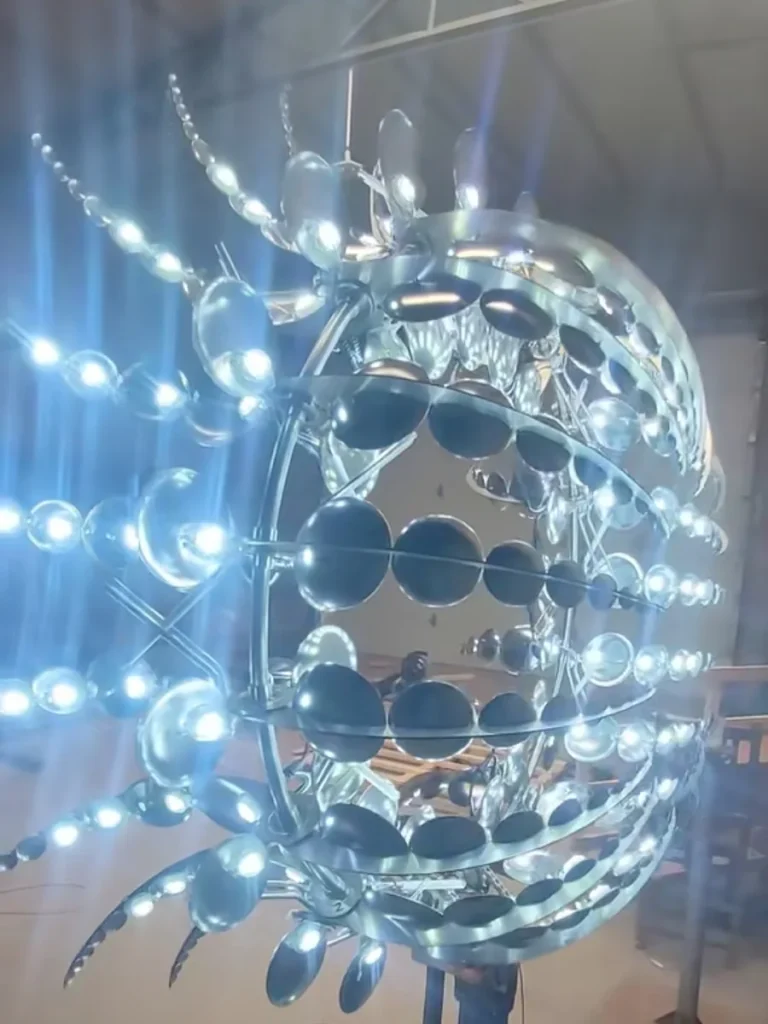

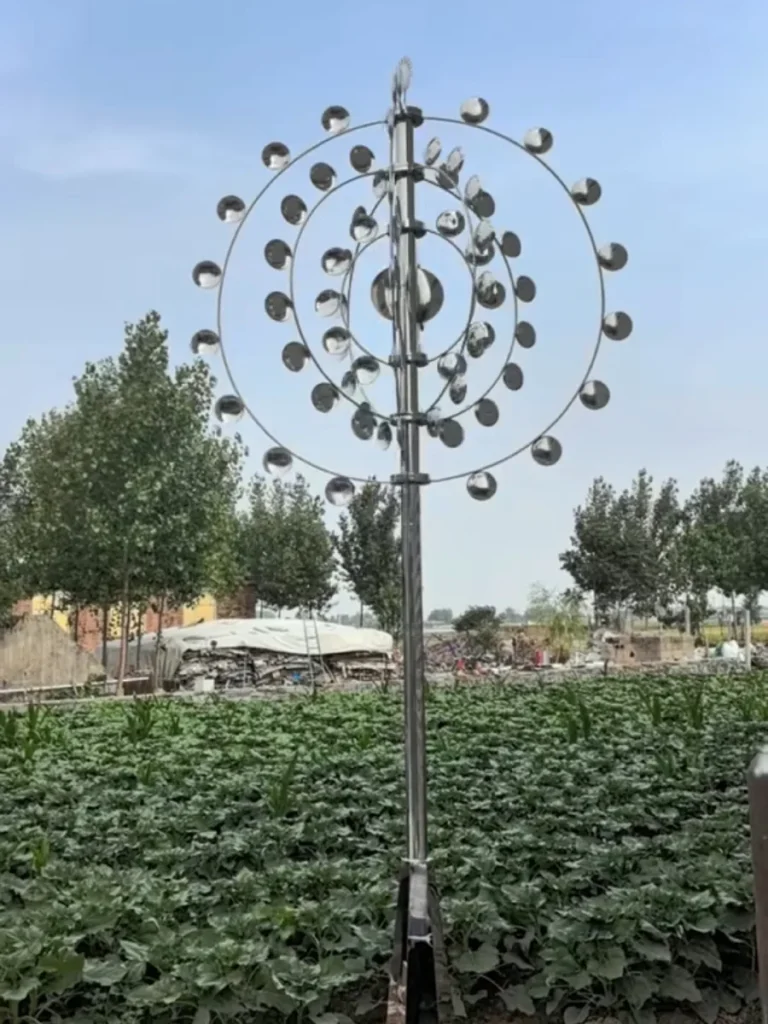
The most vulnerable zones in a kinetic system are not the visible surfaces, but the hidden interfaces—particularly near the bearings for kinetic wind sculptures. These are tight, sensitive areas where moisture can settle. Without proper resistance, micro-pitting begins, gradually expanding into structural weakness.
316L prevents this at the source. Its enhanced corrosion resistance protects not only the exterior finish, but also the internal integrity of the sculpture. This ensures that rotational systems remain stable over time, preserving both motion quality and safety.
Contrast this with copper or bronze. These materials develop patina, which is often appreciated visually. However, that transformation is not purely cosmetic. Oxidation alters surface density and, over time, subtly affects weight distribution.
For static sculpture, this evolution can be acceptable, even desirable. For kinetic systems, it introduces unpredictability. Balance shifts. Rotational resistance increases. Motion becomes inconsistent.
This is why we return to a simple principle: durability is not separate from performance. In kinetic art, the material is part of the mechanism. Without stability at the molecular level, there can be no precision in motion.
The Engineering Soul: Bearings, Balance, and Physics
The Mechanics
A common question we encounter is straightforward: how these metal sculptures move with the wind without motors or visible force. The answer is neither magic nor mystery. It is controlled physics.
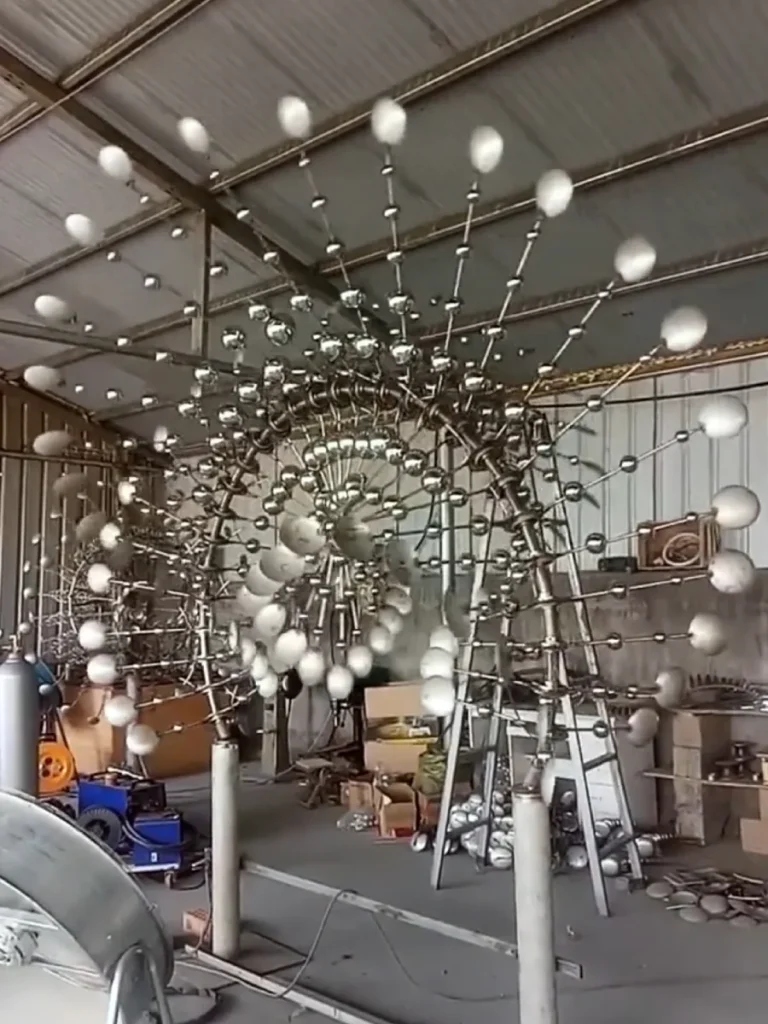
Wind provides energy, but the sculpture determines how that energy is received. Surface geometry captures airflow. Curved elements redirect it. The axis translates that force into rotation.
At the core of every design is a guiding philosophy: Structure first beauty second. Visual elegance is achieved only after mechanical integrity is secured. A sculpture that looks dynamic but resists movement has failed its purpose.
To achieve fluid motion, resistance must be minimized while stability is maximized. This balance defines the entire engineering process.
Precision & Balance
The internal system of a kinetic sculpture is deliberately concealed, yet it is the most critical component. It is here that motion is refined from force into grace.
Key engineering elements include:
- Sealed Precision Bearings
High-grade, weather-protected bearings reduce friction to near-zero levels. These Precision Bearings allow rotation to begin with minimal wind input and continue smoothly without interruption. - Optimized Bearing Placement
Bearings are positioned to align perfectly with the rotational axis, preventing wobble and ensuring consistent motion over time. - Internal Counterweight Systems
Carefully calibrated weights establish exact Physical balance. Each moving element is tuned so that mass is evenly distributed around the محور. - Low-Resistance Axis Design
The محور itself is engineered to تحمل load while minimizing drag, allowing even large-scale components to feel weightless in motion. - Wind Capture Geometry
Blade curvature and spacing are designed to interact with airflow progressively, avoiding sudden or erratic movement.


When these elements work in harmony, a remarkable transformation occurs. Heavy stainless steel forms begin to respond to the faintest breeze. Motion becomes continuous, yet never repetitive.
Each rotation is influenced by subtle environmental shifts—wind speed, direction, surrounding structures. The sculpture does not repeat itself because the conditions driving it are never identical.
This is the essence of kinetic engineering. Not forcing movement, but enabling it. Not controlling nature, but collaborating with it.
In the end, what the viewer experiences as effortless motion is the result of rigorous calculation. Physics, when respected, becomes invisible. And in that invisibility, the sculpture feels alive.
Invisible Engineering: Wind Resistance and Safe Installation
From Donghui Zhang’s perspective, what appears light and effortless above ground is supported by a disciplined system below it. Every piece within our range of large kinetic wind sculptures for sale is built around a reinforced Internal structural skeleton. This hidden framework carries the حقیقی forces generated during rotation.
As the sculpture moves, centrifugal force continuously redistributes stress across its محور and اتصال points. At the same time, sudden Wind loads—especially during storms—introduce unpredictable ضغط from multiple directions. The skeleton absorbs, redirects, and stabilizes these forces without transferring strain to the visible outer surfaces.
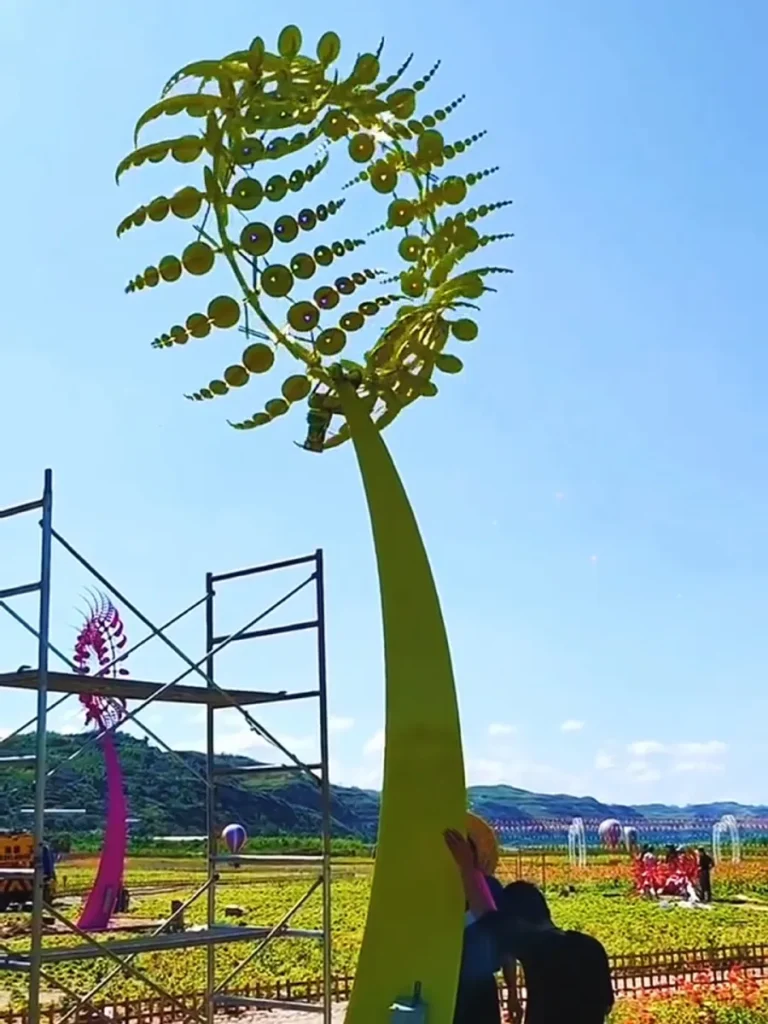
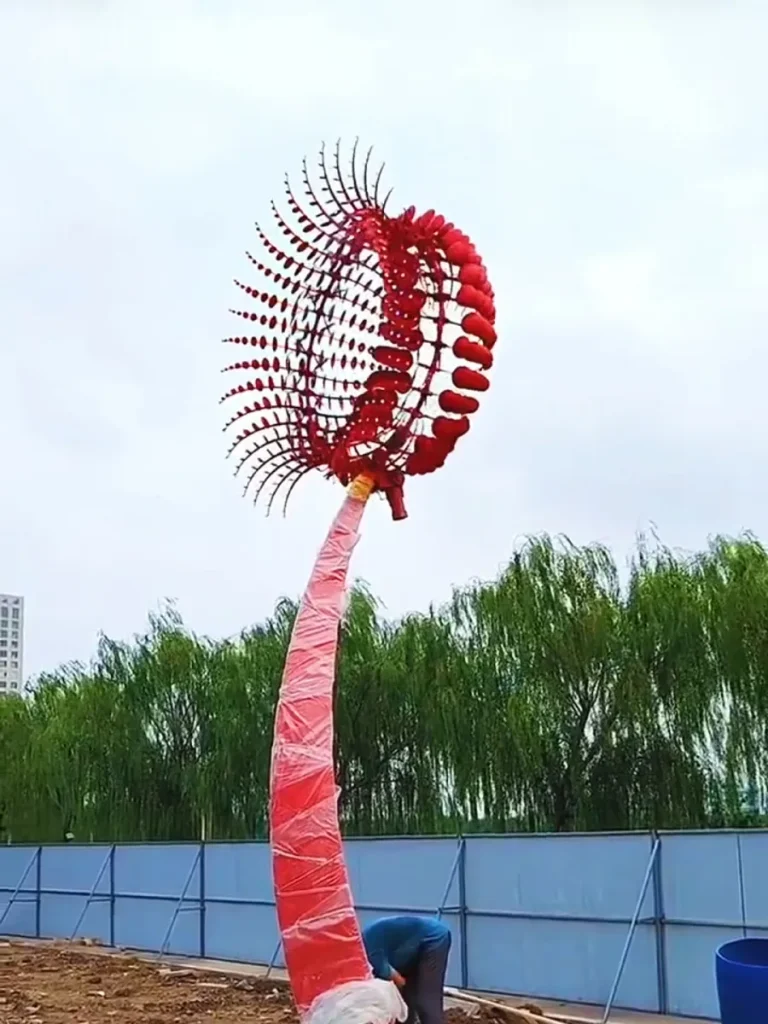
This separation between structure and skin is intentional. The polished exterior delivers the visual experience, while the internal system ensures long-term durability. It allows complex forms to appear delicate, even though they are engineered with the logic of infrastructure.
Installation completes this system. A kinetic sculpture is not simply placed; it is integrated into the site. For clients looking to buy kinetic wind sculpture pieces or evaluating different kinetic wind sculptures for sale, anchoring is one of the most critical factors.
We use Stainless steel expansion bolts to secure the rotating base to a pre-poured concrete foundation. These bolts expand within the concrete under torque, creating a powerful mechanical lock. The connection resists uplift, lateral movement, and vibration.
Foundation depth and dimensions are calculated based on sculpture height, weight, and local wind conditions. In open landscapes or coastal zones, this becomes even more precise. The result is a system where the sculpture moves freely above, while remaining absolutely stable below.
Safety is not an added feature. It is the starting point of the design.
7 Core Questions Answered (FAQ)
Will they fly away in strong winds?
From Donghui Zhang’s engineering standpoint, this concern is understandable but unfounded. Each sculpture is designed against extreme Wind loads, far beyond normal environmental conditions.
The internal skeleton works together with deep concrete foundations and high-strength anchoring systems. Even in severe weather, the structure remains grounded, while the الحركة itself is controlled and within safe limits.
Will the bearings rust and stop spinning?
This is where material science and sealing technology converge. We use fully enclosed, marine-grade bearing systems designed specifically for outdoor kinetic applications.
Protected by the 316L stainless steel outer structure, these components resist moisture, dust, and corrosion. The result is long-term reliability—decades of smooth, consistent rotation without degradation.
How to make a kinetic wind sculpture?
The process begins in the digital realm. Advanced 3D modeling allows us to calculate weight distribution, rotational dynamics, and stress points before fabrication begins.
From there, precision laser cutting defines each component. Welding follows, executed to maintain structural continuity without visible seams. The final and most critical stage is balancing—each rotating element is adjusted until motion becomes effortless and stable.
Can you customize a stainless steel mandala kinetic sculpture?
As Elena, I can say this is one of the most requested directions in contemporary landscape art. The mandala form carries both geometric clarity and symbolic depth.
We use high-precision cutting to create layered patterns that respond dramatically to rotation. As the sculpture spins, the geometry generates shifting optical illusions—expanding, contracting, and dissolving in rhythm with the wind.
Why must kinetic sculptures use 316L instead of 304 stainless steel?
From Donghui Zhang’s perspective, the distinction is not theoretical—it is mechanical. Kinetic sculptures depend on near-frictionless movement, where even microscopic resistance can disrupt rotation.
304 stainless steel performs well indoors, but outdoors it is vulnerable to subtle pitting corrosion. These tiny surface failures introduce unevenness, increasing friction and gradually disturbing the sculpture’s balance.
316L eliminates this risk. Its enhanced corrosion resistance protects both visible surfaces and critical اتصال points, ensuring that motion remains smooth and consistent over time. In kinetic systems, this stability is not optional—it is fundamental.
Can I see how it moves before production begins?
As Elena, I believe movement should be understood before it is built. A kinetic sculpture is not defined by its shape alone, but by how it behaves within space.
We provide a dynamic 3D rendering preview that simulates rotation, light reflection, and environmental interaction. This allows you to see how the sculpture will respond to wind patterns, sunlight, and surrounding architecture in your specific setting.
It transforms decision-making into a visual experience. You are not selecting an object—you are witnessing its future presence in your landscape.
How do I maintain the mirror finish and the bearings?
Maintenance is intentionally minimal, but precision care preserves the full visual and mechanical performance. The mirror-polished surface can be cleaned with mild soap and water to remove dust or environmental residue.
To maintain its depth and clarity, we recommend applying Microcrystalline wax once per year. This creates a protective layer that enhances reflectivity while shielding the surface from contaminants.
The bearing system, by contrast, is designed for longevity without intervention. Fully sealed units protect against moisture and debris. In extreme climates, we provide specific lubrication guidelines, but under normal conditions, the rotation remains effortless without maintenance.
A kinetic wind sculpture stands at the intersection of art and physics. It is not only seen—it is experienced through time, light, and movement. Each rotation captures a fleeting moment, then releases it, creating a rhythm that never repeats.
From Elena’s perspective, this is what elevates the work beyond decoration. It becomes a living presence within the landscape, continuously redefining space. From Donghui Zhang’s perspective, this beauty exists only because of disciplined engineering—balance, material integrity, and structural precision working in silence.
Together, these principles form a complete system. Art gives the sculpture its voice. Engineering ensures it can speak forever.
For those considering how to make a kinetic wind sculpture, the answer is not found in a single step, but in the integration of vision and physics. Every curve, every bearing, every reflection must align toward one goal: motion that feels inevitable.
If you are envisioning a custom piece, we invite you to begin with a 3D rendering preview tailored to your project. It is the first step in transforming an idea into a time-evolving work of art.
– Elena Zhang & Donghui Zhang, Yun Sculpture